Dr. Jayesh Patidar
www.drjayeshpatidar.blogspot.com
04/10/2015 1
PERFORMANCE –
2 Elements
 MOTIVATION
 ABILITY
the ability to get individuals to do
what you want them to do, when and
how you want it done
MOTIVATION
04/10/2015 www.drjayeshpatidar.blogspot.com 3
FIND THE RIGHT REWARDS
IN ORDER TO MOTIVATE
OTHERS!
Personal
Economic
Creative
MOTIVATION
 Understanding how others work.
 Some internal or external force to
move human beings to continuous
high levels of productivity.
 Have an effect on outcomes such
as performance, turnover, and
absenteeism
COMPREHENSIVE
APPRAISAL SYSTEM
Determine ability required
Match ability of job and employee
Improve employee’s abilities
(staff development)
Enhance employee’s motivation (reward
system)
04/10/2015 www.drjayeshpatidar.blogspot.com 6
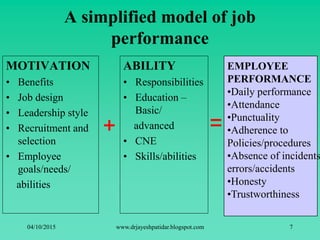
A simplified model of job
performance
MOTIVATION
• Benefits
• Job design
• Leadership style
• Recruitment and
selection
• Employee
goals/needs/
abilities
ABILITY
• Responsibilities
• Education –
Basic/
advanced
• CNE
• Skills/abilities
EMPLOYEE
PERFORMANCE
•Daily performance
•Attendance
•Punctuality
•Adherence to
Policies/procedures
•Absence of incidents
errors/accidents
•Honesty
•Trustworthiness
04/10/2015 www.drjayeshpatidar.blogspot.com 7
PERFORMANCE APPRAISAL
Systematic, standardized evaluation
of an employee by the supervisor,
aimed at judging the value of the
employee’s work contribution,
quality of work, and potential for
advancement
PERFORMANCE APPRAISAL
Definition
• The process of interaction, written
documentation, formal interview and follow
up that occurs between managers and their
employees in order to give feedback, make
decisions and cover fair employment
practice law
- Eleanor J Sullivan
04/10/2015 www.drjayeshpatidar.blogspot.com 9
PERFORMANCE APPRAISAL
Definition
• Is a periodic formal evaluation of how
well the nurse has performed her duties
during a specified period
- Ann Mariner
04/10/2015 www.drjayeshpatidar.blogspot.com 10
GOAL OF PERFORMANCE
APPRAISAL?
 To improve performance
 Letting employee “know where they
stand”
 Giving performance feedback - strongest
nonfinancial reward!
Purposes
 Determine job competence
 Enhance staff development
 Discover employee’s aspirations
 Recognize accomplishments
 Improve communications
 Aid in manager’s coaching and counseling
 Determine training and developmental needs
 Make inventories of talents
 Select for advancement of salary
 Identify unsatisfactory employees04/10/2015 www.drjayeshpatidar.blogspot.com 12
Is your appraisal system
nondiscriminatory?
Be in writing and carried out at least once in a year
Share with employee
Opportunity to respond in writing
Appeal the results
Opportunity for observation
Maintenance of Anecdotal reports/critical incidents
Training of evaluators
Focus on employee behavior and results rather on
personal traits or characteristics
04/10/2015 www.drjayeshpatidar.blogspot.com 13
Evaluation Philosophy
 ABSOLUTE JUDGEMENT:
Based on reasonable and acceptable
standards set by the organization
 COMPARATIVE JUDGEMENT:
Employees are compared with each other
04/10/2015 www.drjayeshpatidar.blogspot.com 14
Errors in evaluation
▲ Halo error
▲ Horns error
▲ Contrast error
▲ Leniency error
▲ Recency error
04/10/2015 www.drjayeshpatidar.blogspot.com 15
Guidelines for Performance Criteria
Realistic
Measurable and verifiable
Practical
Relevant
Non Discriminating
Stable
Time bound
Written
04/10/2015 www.drjayeshpatidar.blogspot.com 16
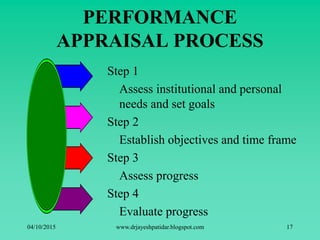
PERFORMANCE
APPRAISAL PROCESS
Step 1
Assess institutional and personal
needs and set goals
Step 2
Establish objectives and time frame
Step 3
Assess progress
Step 4
Evaluate progress
04/10/2015 www.drjayeshpatidar.blogspot.com 17
Performance Appraisal
Mechanisms
• Personal
• Peer
• Managerial evaluation
– Evaluative
• Making decisions/rewards (past performance)
– Judgmental or developmental
• Role as counselor, areas of improvement
• Identifying resources available
04/10/2015 www.drjayeshpatidar.blogspot.com 18
FORMAL AND INFORMAL
PROCESS
• Informal - day-to-day
– Coaching - approach to developing people
– Ongoing, face-to-face collaboration
• Formal
– Written documentation
– Formal appraisal interview with follow-up
• Work is measured against some standard for the
purposes of determining the level of quality of
job performance
04/10/2015 www.drjayeshpatidar.blogspot.com 19
PERFORMANCE
MEASUREMENT TOOLS
Anecdotal Notes
Checklists
Rating Scale
Numerical
Graphic
Descriptive
Frequency rating scale
04/10/2015 www.drjayeshpatidar.blogspot.com 20
PERFORMANCE
MEASUREMENT TOOLS
 Behaviorally Anchored Rating Scales
(BARS)/
 Behavioral expectation scales (BES)
 Behavioral Observation scales (BOS)
 Ranking
- Paired comparison : N(N-1)/2
 Management by objectives
04/10/2015 www.drjayeshpatidar.blogspot.com 21
Management by Objectives
 Review the mission and group objectives
 List major job responsibilities
 Determine expected levels of
accomplishment
 Meet manager to establish priorities
 Develop plans for the accomplishment of the
objectives
 Annual review – comparison of actual results
with expected levels of accomplishment
04/10/2015 www.drjayeshpatidar.blogspot.com 22
Advantages of MBO - staff
 Works on participative management
 Based on characteristics of a specific person and
job
 Control and emphasis over future
 Awareness of the standards of judgment, goals,
priorities and deadlines
 Understanding about progress
 Stimulates higher individual performance / morale
04/10/2015 www.drjayeshpatidar.blogspot.com 23
Advantages of MBO - manager
Reservoir of personnel data and performance
information
Basis for promotion/ compensation
Relationship with staff as coach
Directs work activities towards organization
goals
Facilitates planning
Objective appraisal criteria
Reduces role conflict
04/10/2015 www.drjayeshpatidar.blogspot.com 24
Limitations of MBO
Difficult of implement
Needs teaching and reinforcement
Manager responsible for assessing results and not activities
directed towards results
Some nurses do not want to be involved in setting goals
Only lip service
Stresses on results but not on methods to achieve them
Frustration when higher goals are set
Neglects qualitative factors
No comparative data for promotion/ salary increase
04/10/2015 www.drjayeshpatidar.blogspot.com 25
Key concept:
Clients, peers and superiors are
always evaluating a nurse’s
performance!
04/10/2015 www.drjayeshpatidar.blogspot.com 26
Who is a peer?
• A peer is a person of the same
profession, grade or setting.
04/10/2015 www.drjayeshpatidar.blogspot.com 27
Peer review
• A process whereby a group of practicing
registered nurses evaluate the quality of
another RN’s professional performance
Ann Mariner
• A process by which other employees assess
and judge the performance of professional
peers against predetermined standards
- Eleanor J Sullivan
04/10/2015 www.drjayeshpatidar.blogspot.com 28
• An organised effort where people critically
appraise, systematically assess, monitor,
make judgements, determine their
strengths and weakness and review the
quality of their practice, to provide
evidence to use as the basis of
recommendations by obtaining the opinion
of their peers.
• Offers staff an opportunity to both give
and receive support, and to network across
the site involved.
04/10/2015 www.drjayeshpatidar.blogspot.com 29
Peer evaluation process
Review of employee’s self evaluation form
Reference letters, committee work, special projects,
additional education, contributions to nursing
Performance evaluation by manager
Review of past performance, care plans and charting
Assessments, observation of the nurse
Interviews with her patients
Summary of findings
Presentation of findings and recommendations to the
nurse
04/10/2015 www.drjayeshpatidar.blogspot.com 30
Advantages & Limitations
Advantages:
 Accountability and responsibility for
nursing performance.
Limitations:
 Threatening and time consuming
 Risk of rating candidates too high or too
low
04/10/2015 www.drjayeshpatidar.blogspot.com 31
Appraisal interview
Tell and sell
Tell and listen
Problem solving
Goal setting
04/10/2015 www.drjayeshpatidar.blogspot.com 32
Appraisal interview style
Purposes of evaluation
Manager’s philosophy of management
Institutional guidelines
04/10/2015 www.drjayeshpatidar.blogspot.com 33
Key behaviors for an
appraisal interview
Put the employee at ease
Atmosphere creation
Clearly state the purpose of the interview
Go through the ratings one by one with the
employee
Draw out the employee’s reactions to the ratings
Decide on specific ways in which performance
areas can be strengthened
Set a follow up date
Express confidence in the employee.04/10/2015 www.drjayeshpatidar.blogspot.com 34
PERFORMANCE
APPRAISAL OUTCOMES
improve performance
improve communication
reinforce positive behavior
method to communicate/correct
provide basis for regards/basis for
motivation
provide basis for termination if necessary
identify learning needs and develop
personnel04/10/2015 www.drjayeshpatidar.blogspot.com 35
Thank You
04/10/2015 www.drjayeshpatidar.blogspot.com 36

Performance appraisal

  • 1.
  • 2.
    PERFORMANCE – 2 Elements MOTIVATION  ABILITY
  • 3.
    the ability toget individuals to do what you want them to do, when and how you want it done MOTIVATION 04/10/2015 www.drjayeshpatidar.blogspot.com 3
  • 4.
    FIND THE RIGHTREWARDS IN ORDER TO MOTIVATE OTHERS! Personal Economic Creative
  • 5.
    MOTIVATION  Understanding howothers work.  Some internal or external force to move human beings to continuous high levels of productivity.  Have an effect on outcomes such as performance, turnover, and absenteeism
  • 6.
    COMPREHENSIVE APPRAISAL SYSTEM Determine abilityrequired Match ability of job and employee Improve employee’s abilities (staff development) Enhance employee’s motivation (reward system) 04/10/2015 www.drjayeshpatidar.blogspot.com 6
  • 7.
    A simplified modelof job performance MOTIVATION • Benefits • Job design • Leadership style • Recruitment and selection • Employee goals/needs/ abilities ABILITY • Responsibilities • Education – Basic/ advanced • CNE • Skills/abilities EMPLOYEE PERFORMANCE •Daily performance •Attendance •Punctuality •Adherence to Policies/procedures •Absence of incidents errors/accidents •Honesty •Trustworthiness 04/10/2015 www.drjayeshpatidar.blogspot.com 7
  • 8.
    PERFORMANCE APPRAISAL Systematic, standardizedevaluation of an employee by the supervisor, aimed at judging the value of the employee’s work contribution, quality of work, and potential for advancement
  • 9.
    PERFORMANCE APPRAISAL Definition • Theprocess of interaction, written documentation, formal interview and follow up that occurs between managers and their employees in order to give feedback, make decisions and cover fair employment practice law - Eleanor J Sullivan 04/10/2015 www.drjayeshpatidar.blogspot.com 9
  • 10.
    PERFORMANCE APPRAISAL Definition • Isa periodic formal evaluation of how well the nurse has performed her duties during a specified period - Ann Mariner 04/10/2015 www.drjayeshpatidar.blogspot.com 10
  • 11.
    GOAL OF PERFORMANCE APPRAISAL? To improve performance  Letting employee “know where they stand”  Giving performance feedback - strongest nonfinancial reward!
  • 12.
    Purposes  Determine jobcompetence  Enhance staff development  Discover employee’s aspirations  Recognize accomplishments  Improve communications  Aid in manager’s coaching and counseling  Determine training and developmental needs  Make inventories of talents  Select for advancement of salary  Identify unsatisfactory employees04/10/2015 www.drjayeshpatidar.blogspot.com 12
  • 13.
    Is your appraisalsystem nondiscriminatory? Be in writing and carried out at least once in a year Share with employee Opportunity to respond in writing Appeal the results Opportunity for observation Maintenance of Anecdotal reports/critical incidents Training of evaluators Focus on employee behavior and results rather on personal traits or characteristics 04/10/2015 www.drjayeshpatidar.blogspot.com 13
  • 14.
    Evaluation Philosophy  ABSOLUTEJUDGEMENT: Based on reasonable and acceptable standards set by the organization  COMPARATIVE JUDGEMENT: Employees are compared with each other 04/10/2015 www.drjayeshpatidar.blogspot.com 14
  • 15.
    Errors in evaluation ▲Halo error ▲ Horns error ▲ Contrast error ▲ Leniency error ▲ Recency error 04/10/2015 www.drjayeshpatidar.blogspot.com 15
  • 16.
    Guidelines for PerformanceCriteria Realistic Measurable and verifiable Practical Relevant Non Discriminating Stable Time bound Written 04/10/2015 www.drjayeshpatidar.blogspot.com 16
  • 17.
    PERFORMANCE APPRAISAL PROCESS Step 1 Assessinstitutional and personal needs and set goals Step 2 Establish objectives and time frame Step 3 Assess progress Step 4 Evaluate progress 04/10/2015 www.drjayeshpatidar.blogspot.com 17
  • 18.
    Performance Appraisal Mechanisms • Personal •Peer • Managerial evaluation – Evaluative • Making decisions/rewards (past performance) – Judgmental or developmental • Role as counselor, areas of improvement • Identifying resources available 04/10/2015 www.drjayeshpatidar.blogspot.com 18
  • 19.
    FORMAL AND INFORMAL PROCESS •Informal - day-to-day – Coaching - approach to developing people – Ongoing, face-to-face collaboration • Formal – Written documentation – Formal appraisal interview with follow-up • Work is measured against some standard for the purposes of determining the level of quality of job performance 04/10/2015 www.drjayeshpatidar.blogspot.com 19
  • 20.
    PERFORMANCE MEASUREMENT TOOLS Anecdotal Notes Checklists RatingScale Numerical Graphic Descriptive Frequency rating scale 04/10/2015 www.drjayeshpatidar.blogspot.com 20
  • 21.
    PERFORMANCE MEASUREMENT TOOLS  BehaviorallyAnchored Rating Scales (BARS)/  Behavioral expectation scales (BES)  Behavioral Observation scales (BOS)  Ranking - Paired comparison : N(N-1)/2  Management by objectives 04/10/2015 www.drjayeshpatidar.blogspot.com 21
  • 22.
    Management by Objectives Review the mission and group objectives  List major job responsibilities  Determine expected levels of accomplishment  Meet manager to establish priorities  Develop plans for the accomplishment of the objectives  Annual review – comparison of actual results with expected levels of accomplishment 04/10/2015 www.drjayeshpatidar.blogspot.com 22
  • 23.
    Advantages of MBO- staff  Works on participative management  Based on characteristics of a specific person and job  Control and emphasis over future  Awareness of the standards of judgment, goals, priorities and deadlines  Understanding about progress  Stimulates higher individual performance / morale 04/10/2015 www.drjayeshpatidar.blogspot.com 23
  • 24.
    Advantages of MBO- manager Reservoir of personnel data and performance information Basis for promotion/ compensation Relationship with staff as coach Directs work activities towards organization goals Facilitates planning Objective appraisal criteria Reduces role conflict 04/10/2015 www.drjayeshpatidar.blogspot.com 24
  • 25.
    Limitations of MBO Difficultof implement Needs teaching and reinforcement Manager responsible for assessing results and not activities directed towards results Some nurses do not want to be involved in setting goals Only lip service Stresses on results but not on methods to achieve them Frustration when higher goals are set Neglects qualitative factors No comparative data for promotion/ salary increase 04/10/2015 www.drjayeshpatidar.blogspot.com 25
  • 26.
    Key concept: Clients, peersand superiors are always evaluating a nurse’s performance! 04/10/2015 www.drjayeshpatidar.blogspot.com 26
  • 27.
    Who is apeer? • A peer is a person of the same profession, grade or setting. 04/10/2015 www.drjayeshpatidar.blogspot.com 27
  • 28.
    Peer review • Aprocess whereby a group of practicing registered nurses evaluate the quality of another RN’s professional performance Ann Mariner • A process by which other employees assess and judge the performance of professional peers against predetermined standards - Eleanor J Sullivan 04/10/2015 www.drjayeshpatidar.blogspot.com 28
  • 29.
    • An organisedeffort where people critically appraise, systematically assess, monitor, make judgements, determine their strengths and weakness and review the quality of their practice, to provide evidence to use as the basis of recommendations by obtaining the opinion of their peers. • Offers staff an opportunity to both give and receive support, and to network across the site involved. 04/10/2015 www.drjayeshpatidar.blogspot.com 29
  • 30.
    Peer evaluation process Reviewof employee’s self evaluation form Reference letters, committee work, special projects, additional education, contributions to nursing Performance evaluation by manager Review of past performance, care plans and charting Assessments, observation of the nurse Interviews with her patients Summary of findings Presentation of findings and recommendations to the nurse 04/10/2015 www.drjayeshpatidar.blogspot.com 30
  • 31.
    Advantages & Limitations Advantages: Accountability and responsibility for nursing performance. Limitations:  Threatening and time consuming  Risk of rating candidates too high or too low 04/10/2015 www.drjayeshpatidar.blogspot.com 31
  • 32.
    Appraisal interview Tell andsell Tell and listen Problem solving Goal setting 04/10/2015 www.drjayeshpatidar.blogspot.com 32
  • 33.
    Appraisal interview style Purposesof evaluation Manager’s philosophy of management Institutional guidelines 04/10/2015 www.drjayeshpatidar.blogspot.com 33
  • 34.
    Key behaviors foran appraisal interview Put the employee at ease Atmosphere creation Clearly state the purpose of the interview Go through the ratings one by one with the employee Draw out the employee’s reactions to the ratings Decide on specific ways in which performance areas can be strengthened Set a follow up date Express confidence in the employee.04/10/2015 www.drjayeshpatidar.blogspot.com 34
  • 35.
    PERFORMANCE APPRAISAL OUTCOMES improve performance improvecommunication reinforce positive behavior method to communicate/correct provide basis for regards/basis for motivation provide basis for termination if necessary identify learning needs and develop personnel04/10/2015 www.drjayeshpatidar.blogspot.com 35
  • 36.