SEMINAR ON STAFF
DEVELOPMENT PROGRAMME
PRESENTED BY:
C.SUDHAKAR.
M.Sc., (N)-II YEAR
GCON,CUDDALORE
INTRODUCTION:
Staff development is the process directed towards the
personal and professional growth of nurses and other
personnel while they are employed by a health care
agency.
Staff development refers to all training and education
provided by an employee to improve the occupational
and personal knowledge, skill, attitude of vested
employees.
DEFINITION:
Staff development is a process to assist
employees in attaining skills and knowledge
and gain levels of competence and to grow
through orientation, in-service education and
continuing education and other programs.
-Medical Dictionary
OBJECTIVES OF STAFF
DEVELOPMENT
 To improve staff performance and skill in providing
quality care.
 To update the knowledge related the current trends.
 To encourage the staff members to conduct evidence-
based research activities on current technological
advancements.
 To upgrade the knowledge regarding therapeutics and
diagnostics technologies.
OBJECTIVES OF STAFF
DEVELOPMENT CONT…
 To create friendly working atmosphere that
motivates the staff to work well, ensuring the sense
of security.
 To provide adequate reinforcement for their good
work.
 To reduce the workload and burden on single staff
by providing equal distribution of work schedules,
thereby reducing staff turnover and absenteeism
GOALS OF STAFF DEVELOPMENT:
•To assist each employee to improve performance
in his or her present position and to acquire
personal and professional abilities that
maximizes the possibility of career advancement.
IMPORTANCE AND NEED OF
STAFF DEVELOPMENT:
To update knowledge, skill and practices with the
advancement in the medical field.
To cope up with rapid societal changes and
improvements in health sciences.
To fill the demand and interest of the public in health
promotion.
To fill the gap due to increased specialization and
research among nursing personnel.
IMPORTANCE AND NEED OF
STAFF DEVELOPMENT: CONT…
To have a challenge in growing unionization and
legislative control of nursing.
To help nurses to be aware of unfamiliar practice
roles and rules.
To emphasize quality rather than quantity.
PRINCIPLES
OF
STAFF
DEVELOPMENT
PRINCIPLES OF STAFF
DEVELOPMENT:
1. Activities must base of needs and interest of
employees and organization.
2. Learning is combination of theory and experience.
3. Learning is internal, personal and emotional process.
4. Learning involves changes in behaviour.
PRINCIPLES OF STAFF
DEVELOPMENT: CONT…
5. Learner should be encouraged to contribute in
learning process.
6. Problem solving approach is well suited.
7. Positive reward is effective.
8. Teaching – learning should be based on
educational psychology.
PHILOSOPHY OF STAFF
DEVELOPMENT:
The department of Continuing Education is an essential part
of the nursing division and adopts the philosophy of the
division.
1. The primary goal of a health care agency is the
achievement of a high quality of health care for the people
who use the agency’s service.
PHILOSOPHY OF STAFF
DEVELOPMENT: (Cont)
2. It focus in the development of all employees for the
enhancement of nursing care given to its patients.
3. Educational activities should be designed and
implemented to promote a high standard of safe,
effective nursing practice.
STAFF DEVELOPMENT MODELS:
A.1. The RPTIM Model
A.2. Iowa professional development model
3. Staff development model for Goal Achievement
THE RPTIM MODEL
RPTIM MODEL
•R – READINESS.
•P – PLANNING
•T – TIMING.
•I – IMPLEMENTATION.
•M - MAINTENANCE
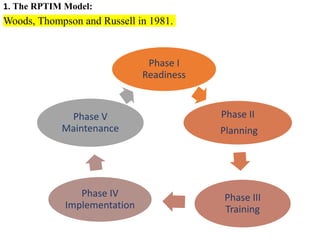
1. The RPTIM Model:
Woods, Thompson and Russell in 1981.
Phase I
Readiness
Phase II
Planning
Phase III
Training
Phase IV
Implementation
Phase V
Maintenance
2. Iowa professional development model:
3. Staff development model for Goal Achievement of
the Health Care Agency, the Nurse and the Nursing
Profession:
• This model has three main components:
Education
Experience
Socio – economics
STAFF DEVELOPMENT
METHODS
STAFF DEVELOPMENT METHODS:
On – the – job methods
•Example – job rotation
Off-the-job methods
•Example – seminars
FACTORS INFLUENCING STAFF
DEVELOPMENT PROGRAMME
a. Administrative philosophy, policies and practices of
health care agency.
b. Policies, practices and standards of nursing and
other health professionals.
c. Human and material resources within the health
care agency and community.
d. Physical facilities within a health care agency and
community.
e. Financial resources within a health care agency and
community.
FUNCTIONS OF STAFF DEVLOPMENT
PERSONNEL:
 Determination of the administrative structure of the staff
development programme.
 Determination and establishment of organizational
methods, policies and procedures for a staff development
programme.
 Determination and establishment of line of communication
for the utilization of facilities and resources personnel for
the staff development programme.
 Determination of organizational and individual staff
development needs and priority.
FUNCTIONS OF STAFF DEVLOPMENT
PERSONNEL:
 Development of measurable short and long term
objectives for staff development programmes.
 Promotion, development, implementation and
evaluation of programmes to meet these objectives.
 Planning, co-ordination and utilization of community
resources to assist in meeting these objectives.
 Provision of a consultative service and a resource for
information relative to staff development.
OTHER ACTIVITIES OF STAFF
DEVELOPMENT:
 Make rounds with a physicians
 Attend medical round in a teaching centre
 Visit another hospital to observe their method of patient
care
 Attend professional meetings, conferences etc and
present papers
 Read articles of special interest and report them to staff
BENEFITS OF STAFF DEVELOPMENT:
• For the employees:
Leads to improved professional practice
Aids in updating knowledge and skills at all levels of
organization
Keep the nurses abreast of the latest trends and
developments in techniques
Equips the nurses with knowledge of current research
and developments
Helps the nurses to learn new and to maintain old
competencies
•For the organizations/employer:
Keeps the nursing staff enthusiastic in their learning
Develop interest and job satisfaction amongst the staff
Develops the sense of responsibilities for being
competent and knowledgeable
Creates an appropriate environment and sound
decisions as well as using effective problem-solving
techniques
•For the organizations/employer:
•(CONT)
Helps the nurse to adjust to change
Aids in developing leadership skills, motivation and
better attitudes
Aids in encouraging and achieving self development and
self-confidence
Makes the organization a better place to worker
ROLE OF ADMINISTRATOR
IN
STAFF DEVELOPMENT
PROGRAMME
ROLE OF ADMINISTRATOR IN
STAFF DEVELOPMENT
PROGRAMME:
 As an orienteer
 As a teacher
 As a resource person
 As a counsellor
 As a role model and evaluator
PROGRAMMES FOR STAFF DEVELOPMENT:
1.1. Induction training
1.2. Job orientation programme.
1.3. In-service education
1.4. Continuing education
1.5. Training for special function
SUMMARY
THEORY APPLICATION:
Theory of Scientific Management – Frederick Taylor
JOURNAL REFERENCE
Ghenghes, P., & Abdelmageed, S., (2018). A study on the effects of staff
development on teachers satisfaction and perceptions on change in teaching
performance. Journal of education and practice. 9(16).
Abstract
Staff development is vital to the success of any academic institution as it
ensures that staff maintains and enhances their skills and knowledge that can
be used to improve quality and performance in their job role. Therefore,
assessing the satisfaction of staff towards staff development activities is
becoming increasingly important to its success. This paper aims to focus on the
reasons why academic staff attends staff development workshops/sessions, to
determine their satisfaction levels towards staff development and whether
participation in such activities enhances their perceptions of their teaching
practices and how effective they are as a teacher.
Data was gathered through a questionnaire survey. The results indicated that the
two main reasons for attending staff development are to ‘gain knowledge and
skills’ and for ‘personal development’. However, the two external factors that
constrained them from attending all the workshops/sessions were ‘time conflict’
and ‘administrative workload’. A significant positive relationship between
satisfaction with staff development and enhancing staff’s effectiveness as a
teacher, teaching practices and applying the knowledge and techniques acquired
in their lectures and classes was also found.
• Keywords: staff development, satisfaction, perceptions, performance, higher
education
STAFF DEVELOPMENT  programme in nursing Management

STAFF DEVELOPMENT programme in nursing Management

  • 2.
    SEMINAR ON STAFF DEVELOPMENTPROGRAMME PRESENTED BY: C.SUDHAKAR. M.Sc., (N)-II YEAR GCON,CUDDALORE
  • 4.
    INTRODUCTION: Staff development isthe process directed towards the personal and professional growth of nurses and other personnel while they are employed by a health care agency. Staff development refers to all training and education provided by an employee to improve the occupational and personal knowledge, skill, attitude of vested employees.
  • 5.
    DEFINITION: Staff development isa process to assist employees in attaining skills and knowledge and gain levels of competence and to grow through orientation, in-service education and continuing education and other programs. -Medical Dictionary
  • 6.
    OBJECTIVES OF STAFF DEVELOPMENT To improve staff performance and skill in providing quality care.  To update the knowledge related the current trends.  To encourage the staff members to conduct evidence- based research activities on current technological advancements.  To upgrade the knowledge regarding therapeutics and diagnostics technologies.
  • 7.
    OBJECTIVES OF STAFF DEVELOPMENTCONT…  To create friendly working atmosphere that motivates the staff to work well, ensuring the sense of security.  To provide adequate reinforcement for their good work.  To reduce the workload and burden on single staff by providing equal distribution of work schedules, thereby reducing staff turnover and absenteeism
  • 8.
    GOALS OF STAFFDEVELOPMENT: •To assist each employee to improve performance in his or her present position and to acquire personal and professional abilities that maximizes the possibility of career advancement.
  • 9.
    IMPORTANCE AND NEEDOF STAFF DEVELOPMENT: To update knowledge, skill and practices with the advancement in the medical field. To cope up with rapid societal changes and improvements in health sciences. To fill the demand and interest of the public in health promotion. To fill the gap due to increased specialization and research among nursing personnel.
  • 10.
    IMPORTANCE AND NEEDOF STAFF DEVELOPMENT: CONT… To have a challenge in growing unionization and legislative control of nursing. To help nurses to be aware of unfamiliar practice roles and rules. To emphasize quality rather than quantity.
  • 11.
  • 12.
    PRINCIPLES OF STAFF DEVELOPMENT: 1.Activities must base of needs and interest of employees and organization. 2. Learning is combination of theory and experience. 3. Learning is internal, personal and emotional process. 4. Learning involves changes in behaviour.
  • 13.
    PRINCIPLES OF STAFF DEVELOPMENT:CONT… 5. Learner should be encouraged to contribute in learning process. 6. Problem solving approach is well suited. 7. Positive reward is effective. 8. Teaching – learning should be based on educational psychology.
  • 14.
    PHILOSOPHY OF STAFF DEVELOPMENT: Thedepartment of Continuing Education is an essential part of the nursing division and adopts the philosophy of the division. 1. The primary goal of a health care agency is the achievement of a high quality of health care for the people who use the agency’s service.
  • 15.
    PHILOSOPHY OF STAFF DEVELOPMENT:(Cont) 2. It focus in the development of all employees for the enhancement of nursing care given to its patients. 3. Educational activities should be designed and implemented to promote a high standard of safe, effective nursing practice.
  • 16.
    STAFF DEVELOPMENT MODELS: A.1.The RPTIM Model A.2. Iowa professional development model 3. Staff development model for Goal Achievement
  • 17.
  • 18.
    RPTIM MODEL •R –READINESS. •P – PLANNING •T – TIMING. •I – IMPLEMENTATION. •M - MAINTENANCE
  • 19.
    1. The RPTIMModel: Woods, Thompson and Russell in 1981. Phase I Readiness Phase II Planning Phase III Training Phase IV Implementation Phase V Maintenance
  • 20.
    2. Iowa professionaldevelopment model:
  • 21.
    3. Staff developmentmodel for Goal Achievement of the Health Care Agency, the Nurse and the Nursing Profession: • This model has three main components: Education Experience Socio – economics
  • 22.
  • 23.
    STAFF DEVELOPMENT METHODS: On– the – job methods •Example – job rotation Off-the-job methods •Example – seminars
  • 24.
    FACTORS INFLUENCING STAFF DEVELOPMENTPROGRAMME a. Administrative philosophy, policies and practices of health care agency. b. Policies, practices and standards of nursing and other health professionals. c. Human and material resources within the health care agency and community. d. Physical facilities within a health care agency and community. e. Financial resources within a health care agency and community.
  • 25.
    FUNCTIONS OF STAFFDEVLOPMENT PERSONNEL:  Determination of the administrative structure of the staff development programme.  Determination and establishment of organizational methods, policies and procedures for a staff development programme.  Determination and establishment of line of communication for the utilization of facilities and resources personnel for the staff development programme.  Determination of organizational and individual staff development needs and priority.
  • 26.
    FUNCTIONS OF STAFFDEVLOPMENT PERSONNEL:  Development of measurable short and long term objectives for staff development programmes.  Promotion, development, implementation and evaluation of programmes to meet these objectives.  Planning, co-ordination and utilization of community resources to assist in meeting these objectives.  Provision of a consultative service and a resource for information relative to staff development.
  • 27.
    OTHER ACTIVITIES OFSTAFF DEVELOPMENT:  Make rounds with a physicians  Attend medical round in a teaching centre  Visit another hospital to observe their method of patient care  Attend professional meetings, conferences etc and present papers  Read articles of special interest and report them to staff
  • 28.
    BENEFITS OF STAFFDEVELOPMENT: • For the employees: Leads to improved professional practice Aids in updating knowledge and skills at all levels of organization Keep the nurses abreast of the latest trends and developments in techniques Equips the nurses with knowledge of current research and developments Helps the nurses to learn new and to maintain old competencies
  • 29.
    •For the organizations/employer: Keepsthe nursing staff enthusiastic in their learning Develop interest and job satisfaction amongst the staff Develops the sense of responsibilities for being competent and knowledgeable Creates an appropriate environment and sound decisions as well as using effective problem-solving techniques
  • 30.
    •For the organizations/employer: •(CONT) Helpsthe nurse to adjust to change Aids in developing leadership skills, motivation and better attitudes Aids in encouraging and achieving self development and self-confidence Makes the organization a better place to worker
  • 31.
    ROLE OF ADMINISTRATOR IN STAFFDEVELOPMENT PROGRAMME
  • 32.
    ROLE OF ADMINISTRATORIN STAFF DEVELOPMENT PROGRAMME:  As an orienteer  As a teacher  As a resource person  As a counsellor  As a role model and evaluator
  • 33.
    PROGRAMMES FOR STAFFDEVELOPMENT: 1.1. Induction training 1.2. Job orientation programme. 1.3. In-service education 1.4. Continuing education 1.5. Training for special function
  • 69.
  • 70.
    THEORY APPLICATION: Theory ofScientific Management – Frederick Taylor
  • 71.
    JOURNAL REFERENCE Ghenghes, P.,& Abdelmageed, S., (2018). A study on the effects of staff development on teachers satisfaction and perceptions on change in teaching performance. Journal of education and practice. 9(16). Abstract Staff development is vital to the success of any academic institution as it ensures that staff maintains and enhances their skills and knowledge that can be used to improve quality and performance in their job role. Therefore, assessing the satisfaction of staff towards staff development activities is becoming increasingly important to its success. This paper aims to focus on the reasons why academic staff attends staff development workshops/sessions, to determine their satisfaction levels towards staff development and whether participation in such activities enhances their perceptions of their teaching practices and how effective they are as a teacher.
  • 72.
    Data was gatheredthrough a questionnaire survey. The results indicated that the two main reasons for attending staff development are to ‘gain knowledge and skills’ and for ‘personal development’. However, the two external factors that constrained them from attending all the workshops/sessions were ‘time conflict’ and ‘administrative workload’. A significant positive relationship between satisfaction with staff development and enhancing staff’s effectiveness as a teacher, teaching practices and applying the knowledge and techniques acquired in their lectures and classes was also found. • Keywords: staff development, satisfaction, perceptions, performance, higher education