Continuing Education in Nursing
Mr.Vinayak Gunjal
MVP’S INE NASHIK
History of Continuing Education in Nursing
“Let us never consider ourselves as finished nurses…..
We must be learning all our lives”
-Florence Nightingale
The idea of continuing education in nursing is as old as
organized nursing, but the concept of lifelong learning for the
practitioner has developed slowly. The history of continuing
education in nursing has shown that educational institutions
generally have been slow to accept responsibility for assisting
the practitioner who wishes to add to her nursing knowledge
and skill
Need
Rapid technological advances related to knowledge explosion
have greatly altered the practice of nursing
The gap between scientific knowledge and its application
grows wider each year as a result of multiple influences
Elimination of certain illnesses, particularly the communicable
diseases
New drugs to cure some illnesses and alter the course of
many
Need
Surgeries are being performed successfully in areas that
would not have been attempted 10-20 years ago
Organ transplants are no more a novelty
Complex and intricate machinery can extend lives
All these advances require more highly skilled nursing care in
a great variety of settings
Continuing education is an accepted way of life
Need for Continuing Education in Nursing
Phenomena of change
Altered Professional Roles
Effective and wise leadership and competent
practitioners.
To fulfill needs of nurse practitioners.
Nurses and Continuing Education
Are Nurses exception?
In fact we lagged behind.
Certain exceptional nurses have
always been self- directed
learners.
Once a Nurse, always a Nurse?
“some continuation training in service for nurses
would promote the well-being of the nation”.
Major reason for continuing education in nursing: the
improvement in professional practice.
Life-long learning in nursing relates not only to
professional practice but also to the development of the
person as an individual and as a responsible citizen.
Charles Judd AJN (1928)
Definitions
“Continuing education is any extension of opportunities
for reading, study and training to young persons and
adults following their completion of or withdrawal from
full-time school and college programs”
Purposes of Continuing Education in Nursing
To meets the needs of population.
Development of nurses will occur by updating their knowledge
and prepare them for specialization.
For Carrere development.
Professional roles are altered as society changes and new
knowledge and technologies emerge.
Nurses with research aptitude and p[reparation are needed.
To Acquire specialize skills of personnel and meet technological
adjuncts.
Purposes of Continuing Education in Nursing
Increased in demand of specialized nursing care.
Need for additional preparation for the position are already
holding or to prepare themselves for other positions.
Nursing functions requires high degree of skills, knowledge,
competence and educational preparation.
It provides opportunity for educational growth compatible with
the realities of the work situation.
Elements of Continuing Education
A Learner is a person as a nurse and a citizen.
CE covers a three aspects of life long learning:
1. Diversity is a part of learning process and
contributes to development of individual.
2. Learner in the life plays many different role
e.g. friends, adults and from every aspect of
life there are some CE.
3. It aims at self directed learning.
Elements of Continuing Education
A Teacher/ Nurse Educator:
1. To help the students to how
to learn, how to approach
situation with an open,
inquiring attitude.
2. Educator must be aware of
source of knowledge
Elements of Continuing Education
A Teacher/ Nurse Educator:
1. Creative teaching is
essential.
2. Teacher should act as a role
model.
3. To show interest and
concern for every member
of class.
4. To play many roles such as
guide, motivator and
evaluator.
Principles of Continuing Education
Provision for school and nursing faculty environment.
Adequate staffing is essential.
Well qualified staff with sufficient talents and numbers to
implement planned programmers.
Responsibilities of the Director of CNE are:
1. Determination of learning needs of the nurse population.
2. Development and implementation of the programme to meet
these needs
3. Evaluation of results.
Adult Education
The terms Continuing Education
and Adult Education are often
used interchangeably.
Continuing Nursing Education
“Educational activities primarily designed to keep
registered nurses abreast of their particular field of
interest and do not lead to any formal advanced
standing in the profession”
Nursing Thesaurus of the International Nursing Index
In-service Education
“Planned instructional or training
program provided by an employing
agency in the employment setting and
is designed to increase competence in
a specific area”
In-service Education is one aspect
of continuing education, but the
terms are not interchangeable
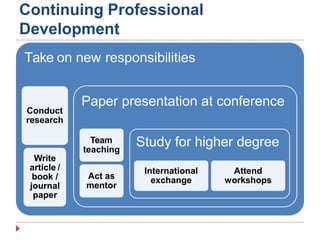
Continuing Professional
Development
Conduct
research
Write
article /
book /
journal
paper
Take on new responsibilities
Paper presentation at conference
Team
teaching
Act as
mentor
Study for higher degree
International
exchange
Attend
workshops
Types
Orientation to introduce new recruits to the basic
aspects of the job so that they can perform their job
effectively
Continuing education for the improvement of
knowledge, skills and attitudes
Management skills and leadership training
Staff development program is directed toward
expanding to the fullest all the potentials of an
individual
Individual Interest Promotion Programs
Future Oriented Programs to prepare learners for
the future activities
The Planning Formula
What is to
be done?
Why is it
necessary
How is it to
be done?
Where is it
to be done?
When is it
to be done?
Who should
do the job?
Stages
Analysis
Design
Development
Implementation
Evaluation
Analysis
Analyze needs
Goals
Priorities
Resources
Constraints and
Alternate delivery systems
Determine scope and sequence of training program
(by task and job analysis)
Design
Emphasizes what will be
taught
Determine training approach
Develop learning objectives
Performance measures
Training program
specifications
Development
Emphasizes on how the content will be taught
Develop curriculum guide
Lesson plan
Supportive teaching aids
Revise material
Implementation
Implement training plan
Conduct training
Formative evaluation
Document training results
Evaluation
Conduct summative evaluation
Analyze collected information
Initiate corrective action
Benefits of Continuing Nursing
Education
New /
Improved
• Knowledge and Skills
• Attitudinal Change
Institution
• Better Performance
• Quality Patient Care
Personal
• Increased Job Satisfaction
• High Motivation
Content Areas
• Nursing Process
• Intravenous Therapy
• Communication
• Ethics
General
Programs
• Maternity
• Pediatrics
• Surgical
• Orthopedics
Hospital
Specific
Programs
• CVP Care
• Neonatal CPR
• Ventilator
• Dialysis
Area
Specific
Programs
Learning
Learning continues through out life and is called
“lifelong learning”
From “womb” to “tomb”
Learning makes life easier, fuller longer and more
enjoyable
Learning has practical purpose
In-service Educator
Public Relations
Educational
Preparation with
emphasis on Adult
Education
The Continuing
Educator as a
Continuing Learner
Clinical Knowledge
and Skill
Working withAdults
Broad Knowledge
Base
Concern for People
Determination
Self-confidence
Zest for life
Innate curiosity
Love for adventure
Desire to search
the unknown
Flexibility
Creativity
Resourcefulness
Continuing Education.pdf

Continuing Education.pdf

  • 1.
    Continuing Education inNursing Mr.Vinayak Gunjal MVP’S INE NASHIK
  • 2.
    History of ContinuingEducation in Nursing “Let us never consider ourselves as finished nurses….. We must be learning all our lives” -Florence Nightingale The idea of continuing education in nursing is as old as organized nursing, but the concept of lifelong learning for the practitioner has developed slowly. The history of continuing education in nursing has shown that educational institutions generally have been slow to accept responsibility for assisting the practitioner who wishes to add to her nursing knowledge and skill
  • 3.
    Need Rapid technological advancesrelated to knowledge explosion have greatly altered the practice of nursing The gap between scientific knowledge and its application grows wider each year as a result of multiple influences Elimination of certain illnesses, particularly the communicable diseases New drugs to cure some illnesses and alter the course of many
  • 4.
    Need Surgeries are beingperformed successfully in areas that would not have been attempted 10-20 years ago Organ transplants are no more a novelty Complex and intricate machinery can extend lives All these advances require more highly skilled nursing care in a great variety of settings Continuing education is an accepted way of life
  • 5.
    Need for ContinuingEducation in Nursing Phenomena of change Altered Professional Roles Effective and wise leadership and competent practitioners. To fulfill needs of nurse practitioners.
  • 6.
    Nurses and ContinuingEducation Are Nurses exception? In fact we lagged behind. Certain exceptional nurses have always been self- directed learners.
  • 7.
    Once a Nurse,always a Nurse? “some continuation training in service for nurses would promote the well-being of the nation”. Major reason for continuing education in nursing: the improvement in professional practice. Life-long learning in nursing relates not only to professional practice but also to the development of the person as an individual and as a responsible citizen. Charles Judd AJN (1928)
  • 8.
    Definitions “Continuing education isany extension of opportunities for reading, study and training to young persons and adults following their completion of or withdrawal from full-time school and college programs”
  • 9.
    Purposes of ContinuingEducation in Nursing To meets the needs of population. Development of nurses will occur by updating their knowledge and prepare them for specialization. For Carrere development. Professional roles are altered as society changes and new knowledge and technologies emerge. Nurses with research aptitude and p[reparation are needed. To Acquire specialize skills of personnel and meet technological adjuncts.
  • 10.
    Purposes of ContinuingEducation in Nursing Increased in demand of specialized nursing care. Need for additional preparation for the position are already holding or to prepare themselves for other positions. Nursing functions requires high degree of skills, knowledge, competence and educational preparation. It provides opportunity for educational growth compatible with the realities of the work situation.
  • 11.
    Elements of ContinuingEducation A Learner is a person as a nurse and a citizen. CE covers a three aspects of life long learning: 1. Diversity is a part of learning process and contributes to development of individual. 2. Learner in the life plays many different role e.g. friends, adults and from every aspect of life there are some CE. 3. It aims at self directed learning.
  • 12.
    Elements of ContinuingEducation A Teacher/ Nurse Educator: 1. To help the students to how to learn, how to approach situation with an open, inquiring attitude. 2. Educator must be aware of source of knowledge
  • 13.
    Elements of ContinuingEducation A Teacher/ Nurse Educator: 1. Creative teaching is essential. 2. Teacher should act as a role model. 3. To show interest and concern for every member of class. 4. To play many roles such as guide, motivator and evaluator.
  • 14.
    Principles of ContinuingEducation Provision for school and nursing faculty environment. Adequate staffing is essential. Well qualified staff with sufficient talents and numbers to implement planned programmers. Responsibilities of the Director of CNE are: 1. Determination of learning needs of the nurse population. 2. Development and implementation of the programme to meet these needs 3. Evaluation of results.
  • 15.
    Adult Education The termsContinuing Education and Adult Education are often used interchangeably.
  • 16.
    Continuing Nursing Education “Educationalactivities primarily designed to keep registered nurses abreast of their particular field of interest and do not lead to any formal advanced standing in the profession” Nursing Thesaurus of the International Nursing Index
  • 17.
    In-service Education “Planned instructionalor training program provided by an employing agency in the employment setting and is designed to increase competence in a specific area” In-service Education is one aspect of continuing education, but the terms are not interchangeable
  • 18.
    Continuing Professional Development Conduct research Write article / book/ journal paper Take on new responsibilities Paper presentation at conference Team teaching Act as mentor Study for higher degree International exchange Attend workshops
  • 19.
    Types Orientation to introducenew recruits to the basic aspects of the job so that they can perform their job effectively Continuing education for the improvement of knowledge, skills and attitudes Management skills and leadership training Staff development program is directed toward expanding to the fullest all the potentials of an individual Individual Interest Promotion Programs Future Oriented Programs to prepare learners for the future activities
  • 20.
    The Planning Formula Whatis to be done? Why is it necessary How is it to be done? Where is it to be done? When is it to be done? Who should do the job?
  • 21.
  • 22.
    Analysis Analyze needs Goals Priorities Resources Constraints and Alternatedelivery systems Determine scope and sequence of training program (by task and job analysis)
  • 23.
    Design Emphasizes what willbe taught Determine training approach Develop learning objectives Performance measures Training program specifications
  • 24.
    Development Emphasizes on howthe content will be taught Develop curriculum guide Lesson plan Supportive teaching aids Revise material
  • 25.
    Implementation Implement training plan Conducttraining Formative evaluation Document training results
  • 26.
    Evaluation Conduct summative evaluation Analyzecollected information Initiate corrective action
  • 27.
    Benefits of ContinuingNursing Education New / Improved • Knowledge and Skills • Attitudinal Change Institution • Better Performance • Quality Patient Care Personal • Increased Job Satisfaction • High Motivation
  • 28.
    Content Areas • NursingProcess • Intravenous Therapy • Communication • Ethics General Programs • Maternity • Pediatrics • Surgical • Orthopedics Hospital Specific Programs • CVP Care • Neonatal CPR • Ventilator • Dialysis Area Specific Programs
  • 29.
    Learning Learning continues throughout life and is called “lifelong learning” From “womb” to “tomb” Learning makes life easier, fuller longer and more enjoyable Learning has practical purpose
  • 30.
    In-service Educator Public Relations Educational Preparationwith emphasis on Adult Education The Continuing Educator as a Continuing Learner Clinical Knowledge and Skill Working withAdults Broad Knowledge Base Concern for People Determination Self-confidence Zest for life Innate curiosity Love for adventure Desire to search the unknown Flexibility Creativity Resourcefulness