CONTINUING EDUCATION
IN NURSING
By;
Mr. MANULAL. V.S
FACULTY
CACEE, University of Kerala,
Thiruvananthapuram.
CONTINUING EDUCATION
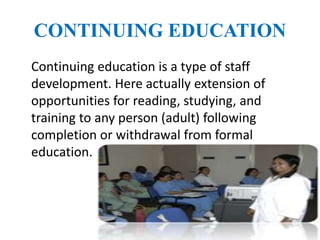
Continuing education is a type of staff
development. Here actually extension of
opportunities for reading, studying, and
training to any person (adult) following
completion or withdrawal from formal
education.
CONTINUING EDUCATION…
Definition.
• Continuing education has been defined as
the training that an individual undertakes
after the end of basic professional education
to improve competence as a practitioner and
not with a view to gain a new diploma or
license .
CONTINUING EDUCATION
It consists of planned learning experiences
designed to promote the development of
knowledge, skills and attitude for the
enhancement of professional practice .
OUTCOMES OF CONTINUING EDUCATION
- Bridges the gap between knowledge and demand
of service, research and practice; educational
ideals and reality of clinical setting.
- It balances between employee’s capabilities and
job demand .
CONTINUING EDUCATION
Continuing education is different from in-service
education, because continuing education co-
ordinates attendance at approved programs locally
as well as in the state . Continuing professional
education is always after the basic professional
education .
PLANNING FOR CONTINUING
EDUCATION
Planning formula
• What is to be done ?
• Why it is necessary?
• How it is to be done ?
• Where is to be done ?
• When is it to be done?
• Who should do the job ?
PLANNING FOR CONTINUING
EDUCATION
STEPS
1. Establishing goals compatible with the purpose or mission of
the organization.
2. Deciding upon specific objectives consistent with these goals
.
3. Determining the course of action required to meet the
specific objectives.
4. Assessing the available resources for establishing the
program. People and financial resources are of particular
significance .
5. Establishing a workable budget, appropriate for the program.
6. Evaluating the results at stated intervals.
7. Reassessing the goals ad updating the plan periodically.
PURPOSES OF CONTINUING
EDUCATION
• For improved professional practice.
• Aid in updating knowledge and skills at all
levels of the organization .
• Cope with latest trends and developments in
our Nursing field .
• Equip with knowledge of current research and
developments.
• To learn new knowledge and maintain old
competencies.
PURPOSES OF CONTINUING
EDUCATION ……. Cont…….
• Develops interest and job satisfaction among
the staff.
• Create supportive environment with
opportunities for growth and communication.
• Adjust to change.
• For developing better leadership skills ,
motivation and better attitude .
• For achieving self-development and self
confidence .
PRODERS OF CONTINUING
EDUCATION
• Universities and professional educational
institutions.
• Professional organizations .
• Employers.
• Independent providers.
• Health care institutions such as hospitals etc.
ROLE OF NURSE ADMINISTRATORS
IN CONTINUING EDUCATION
• Mutual co-ordination and assistance , unity of
effort is maintained.
• Must have proper recording and reporting
system.
• Must become involved in creating new
solutions for problems both old and new.
• They must justify and initiate changes needed
for the improvement of nursing care.
ROLE OF NURSE ADMINISTRATORS
IN CONTINUING EDUCATION…
Cont…
• Nurses who with no help shape their own destiny
must be aware of the forces at work, which will
affect their future roles.
• Ensure that there are adequate resources for staff
development.
• Assumes responsibility for quality of continuing
education program.

Continuing education in nursing

  • 1.
    CONTINUING EDUCATION IN NURSING By; Mr.MANULAL. V.S FACULTY CACEE, University of Kerala, Thiruvananthapuram.
  • 2.
    CONTINUING EDUCATION Continuing educationis a type of staff development. Here actually extension of opportunities for reading, studying, and training to any person (adult) following completion or withdrawal from formal education.
  • 3.
    CONTINUING EDUCATION… Definition. • Continuingeducation has been defined as the training that an individual undertakes after the end of basic professional education to improve competence as a practitioner and not with a view to gain a new diploma or license .
  • 4.
    CONTINUING EDUCATION It consistsof planned learning experiences designed to promote the development of knowledge, skills and attitude for the enhancement of professional practice . OUTCOMES OF CONTINUING EDUCATION - Bridges the gap between knowledge and demand of service, research and practice; educational ideals and reality of clinical setting. - It balances between employee’s capabilities and job demand .
  • 5.
    CONTINUING EDUCATION Continuing educationis different from in-service education, because continuing education co- ordinates attendance at approved programs locally as well as in the state . Continuing professional education is always after the basic professional education .
  • 6.
    PLANNING FOR CONTINUING EDUCATION Planningformula • What is to be done ? • Why it is necessary? • How it is to be done ? • Where is to be done ? • When is it to be done? • Who should do the job ?
  • 7.
    PLANNING FOR CONTINUING EDUCATION STEPS 1.Establishing goals compatible with the purpose or mission of the organization. 2. Deciding upon specific objectives consistent with these goals . 3. Determining the course of action required to meet the specific objectives. 4. Assessing the available resources for establishing the program. People and financial resources are of particular significance . 5. Establishing a workable budget, appropriate for the program. 6. Evaluating the results at stated intervals. 7. Reassessing the goals ad updating the plan periodically.
  • 8.
    PURPOSES OF CONTINUING EDUCATION •For improved professional practice. • Aid in updating knowledge and skills at all levels of the organization . • Cope with latest trends and developments in our Nursing field . • Equip with knowledge of current research and developments. • To learn new knowledge and maintain old competencies.
  • 9.
    PURPOSES OF CONTINUING EDUCATION……. Cont……. • Develops interest and job satisfaction among the staff. • Create supportive environment with opportunities for growth and communication. • Adjust to change. • For developing better leadership skills , motivation and better attitude . • For achieving self-development and self confidence .
  • 10.
    PRODERS OF CONTINUING EDUCATION •Universities and professional educational institutions. • Professional organizations . • Employers. • Independent providers. • Health care institutions such as hospitals etc.
  • 11.
    ROLE OF NURSEADMINISTRATORS IN CONTINUING EDUCATION • Mutual co-ordination and assistance , unity of effort is maintained. • Must have proper recording and reporting system. • Must become involved in creating new solutions for problems both old and new. • They must justify and initiate changes needed for the improvement of nursing care.
  • 12.
    ROLE OF NURSEADMINISTRATORS IN CONTINUING EDUCATION… Cont… • Nurses who with no help shape their own destiny must be aware of the forces at work, which will affect their future roles. • Ensure that there are adequate resources for staff development. • Assumes responsibility for quality of continuing education program.