PRESENTATION
ON
CONTINUING NURSING
EDUCATION
INTRODUCTION
Staff development is the process
directed towards the personal and
professional growth of nurses and other
personnel while they are in a health care
agency. Staff development programs
includes
1.inservice education
2.continuing education
3.adult learning
CONTINUING EDUCATION
• “Continuing education is all the learning
activities that occurs after an individual
has completed his basic education”
-cooper
• “That education which builds on previous
knowledge”
-Shannon
NEEDS
• Keep up to date with new concepts and
developments in health fields
• To increase their basis knowledge ,skills
and develop positive attitude’
• Develop an ability to analyse problems
and to work with others
• Meet challenges of changes in technology
• Maintain standards of health care at
acceptable levels
CONT..
• Help in setting standards of performance
• Help in career development
• Motivate staff for better patient care
• Meet new needs of the community
• Help in career development
TYPES
• Mandatory continuing education
• Voluntary continuing education
• Formal education
• Informal education
FUNCTIONS
• To meet the health needs and public
expectation.
• To develop the practicing abilities of the
nurses.
• Recruitment function.
• Recognizes gaps in their knowledge.
• To improve the communication between
the participants, faculty, community and
health sector.
CONT
• To test the participants ability to do
formal academic study.
• To ensure the quality of education.
• To grant budget for orientation studies.
• To maintain academic standards.
• To meet educational requirements
PRINCIPLES
• Provision for school and nursing faculty involvement in
planning and teaching the continuing nursing education
courses tends to maintain high educational standards for the
program.
• A moderate staff is essential to planning, implementing and
evaluating a program which is based on learning needs and
which has an impact on the quality of nursing care provided.
• Responsibility of the educator of continuing education are:
• Determination of learning of the nurse population.
• Development and implementation of a program to meet the
needs.
CONT..
• Evaluation of results.
• Staff services are resumed with sufficient talents and
numbers to implement the planned program.
• An advisory committee has to be appointed which includes,
faculty members from a variety of areas of nursing practice,
director of the hospital, representatives from health
department or voluntary agencies.
• Continuing nursing education program may be decentralized
or centralized.
• Financial support I by either university grants or self
supporting.
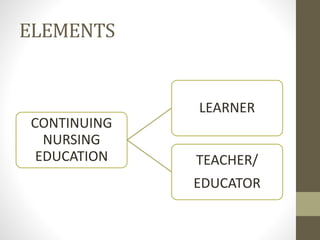
ELEMENTS
CONTINUING
NURSING
EDUCATION
LEARNER
TEACHER/
EDUCATOR
PROCESS
• Establishing goals with purpose
• Establishing goals and purposes
• Determining needs and practices
• Assess the available resources for establishing the program
• Plan the budget appropriate for the program
• Conducting CNE
• Evaluation of CNE
NURSES ROLE
NURSES ROLE
Presentation on continuing education

Presentation on continuing education

  • 1.
  • 2.
    INTRODUCTION Staff development isthe process directed towards the personal and professional growth of nurses and other personnel while they are in a health care agency. Staff development programs includes 1.inservice education 2.continuing education 3.adult learning
  • 3.
    CONTINUING EDUCATION • “Continuingeducation is all the learning activities that occurs after an individual has completed his basic education” -cooper • “That education which builds on previous knowledge” -Shannon
  • 4.
    NEEDS • Keep upto date with new concepts and developments in health fields • To increase their basis knowledge ,skills and develop positive attitude’ • Develop an ability to analyse problems and to work with others • Meet challenges of changes in technology • Maintain standards of health care at acceptable levels
  • 5.
    CONT.. • Help insetting standards of performance • Help in career development • Motivate staff for better patient care • Meet new needs of the community • Help in career development
  • 6.
    TYPES • Mandatory continuingeducation • Voluntary continuing education • Formal education • Informal education
  • 7.
    FUNCTIONS • To meetthe health needs and public expectation. • To develop the practicing abilities of the nurses. • Recruitment function. • Recognizes gaps in their knowledge. • To improve the communication between the participants, faculty, community and health sector.
  • 8.
    CONT • To testthe participants ability to do formal academic study. • To ensure the quality of education. • To grant budget for orientation studies. • To maintain academic standards. • To meet educational requirements
  • 9.
    PRINCIPLES • Provision forschool and nursing faculty involvement in planning and teaching the continuing nursing education courses tends to maintain high educational standards for the program. • A moderate staff is essential to planning, implementing and evaluating a program which is based on learning needs and which has an impact on the quality of nursing care provided. • Responsibility of the educator of continuing education are: • Determination of learning of the nurse population. • Development and implementation of a program to meet the needs.
  • 10.
    CONT.. • Evaluation ofresults. • Staff services are resumed with sufficient talents and numbers to implement the planned program. • An advisory committee has to be appointed which includes, faculty members from a variety of areas of nursing practice, director of the hospital, representatives from health department or voluntary agencies. • Continuing nursing education program may be decentralized or centralized. • Financial support I by either university grants or self supporting.
  • 11.
  • 12.
    PROCESS • Establishing goalswith purpose • Establishing goals and purposes • Determining needs and practices • Assess the available resources for establishing the program • Plan the budget appropriate for the program • Conducting CNE • Evaluation of CNE
  • 13.