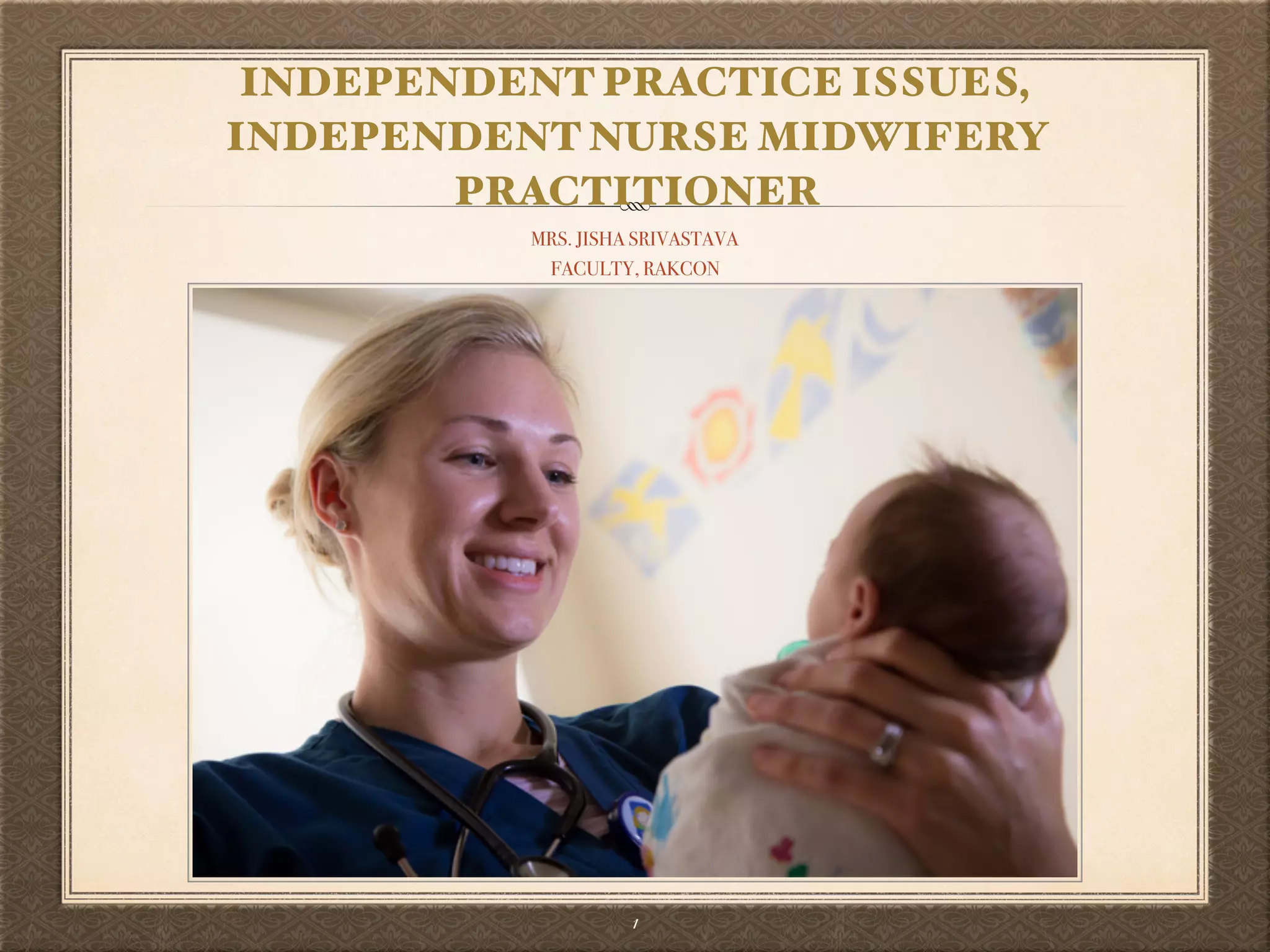
INDEPENDENT PRACTICE ISSUES,
INDEPENDENT NURSE MIDWIFERY
PRACTITIONER

1
MRS. JISHA SRIVASTAVA
FACULTY, RAKCON
OBJECTIVES

2
At the end of the class students will be able to :
Describe independent nurse Practitioner.
Describe the philosophy and historical development of
independent nurse Practitioner .
Explain the basic requirements of independent nurse
midwifery practitioner.
List down the role of independent nurse midwifery
practitioner.
Explain the issues in independent nurse practice.
Explain the need for establishment of a continuing
nursing education system.
DEFINITION OF INDEPENDENT
NURSE PRACTITIONER
American Academy of Nurse Practitioners: “An
Independent Nurse Practitioner is referred as
advanced practice nurse has a master’s degree in
nursing in the specialized area of her/his interest
and licensed to practice in her/his state.”

3
The International Council of Nurses defines
INP: “A registered nurse who has acquired the
expert knowledge base, complex decision-
making skills and clinical competencies for
expanded practice.”

4
DEFINITION OF INDEPENDENT
NURSE PRACTITIONER
DEFINITION OF INDEPENDENT
NURSE PRACTITIONER
“An independent Nurse Practitioner(INP) is a
registered nurse who has completed specific
advanced nursing education (generally a master’s
degree) and training in the diagnosis and
management of common as well as complex
medical conditions to provide a broad range of
health care services.”

5
PHILOSOPHY OF INP
The core philosophy of INP is to provide individual care to
patients of all ages. Its care focuses on patient’s conditions as well
as the effects of illness on the lives of the patients and their
families.
INPs make prevention, wellness and patient education priorities.
This means fewer prescriptions and less expensive treatment.
Informing patients of their health care and encouraging them to
participate in decisions central to the care
In addition to care, INPs conduct research and are often active in
patient advocacy activities.

6
STANDARDS REQUIRED FOR
PRACTICE OF MIDWIFERY
Midwifery care is provided by qualified practitioner, who is
registered
Midwifery care occurs in a safe environment with in context of
family, community and system of health care.
Midwifery care supports individual rights and self determination
with in boundaries of safety.
Midwifery care comprises of knowledge, skills and judgment that
foster the delivery of safe, satisfying and culturally competent
care.

7
STANDARDS REQUIRED FOR
PRACTICE OF MIDWIFERY
Midwifery care is based upon knowledge, skills and
judgment which are reflected in written practice guidelines.
Midwifery care is evaluated according to an established
program. For quality management that include a plan to
identify and resolves problem.
Midwifery practices may be extended beyond the set
competences to incorporate new procedures, that improves
care for women and their family.

8
HISTORICAL DEVELOPMENT
OF INP
Nurse practitioners have provided a healthy
partnership with their patients for more than 40
years.
The nurse practitioner role had its inception in the
mid-1960s in response to a shortage of physicians.

9
HISTORICAL DEVELOPMENT
OF INP
The first INP Program was developed as a
master’s degree curriculum at the University of
Colorado’s School of Nursing in 1965, founded by
Loretta C. Ford, a nursing faculty member and Dr.
Henry K. Silver, a paediatrician.

10
HISTORICAL DEVELOPMENT
OF INP
The first programs were in paediatrics and they
soon spread to many other health care specialties.
During 1970-1971 Federal Legislation
recommended Certificate Programme for nurses to
deliver primary health care.
Gradually certificate programme shifted to
master’s degree

11
HISTORICAL DEVELOPMENT
OF INP
In response to health care reform in 1990s 3 INPs
programmes were developed to meet the demand
of primary care services.
By 1994, 248 programme centres were developed
for INP in US.

12
HISTORICAL DEVELOPMENT
OF INP
In 1995, 49000 nurses were employed as INPs.
American Academy of Nurse Practitioner in 1993
developed standard and guidelines for practice of
INPs which are still followed.

13
HISTORICAL DEVELOPMENT
OF INP
Today 200 universities and colleges are offering
INP programme all over the world.
70,000 nurses are working as INP in US.

14
KEY PRACTICES
A nurse needs to clearly identify that he/she is
providing nursing services, the extent of those
nursing services and under what conditions he/
she will refer clients to other health care
professionals.

15
KEY PRACTICES
Must maintain the high standards of nursing and
uphold the public trust that has been bestowed on
the nursing profession.

16
KEY ISSUES TO CONSIDER PROFESSIONAL ISSUES
Conflict of interest
Endorsement
Advertising
Fees
Informed consent
Documentation
Confidentiality
Other issues
Liability protection
Networking
Business or legal council

18
KEY ISSUES TO CONSIDER
PROFESSIONAL ISSUES
Primary obligation is providing professional care
to his/her clients .
In a position of trust and cannot use their position
to influence their clients for financial gain of non
financial benefit.

19
1. CONFLICT OF INTEREST
Avoid selling products or services to clients they
are treating.
Avoid conflict of interest situations in their
practice, particularly when it comes to the
endorsement and advertising of products .

20
1. CONFLICT OF INTEREST
Endorsing or promoting a product or services is
closely linked to conflict of interest .
Endorsement occurs when a nurse uses her
credentials to lend credibility to a commercial
product line or service.

21
2. ENDORSEMENT
The endorsement of a product or service without
providing information about other options could
mislead the public and compromise trust.
For example, a nurse in independent practice who
provides foot care services should not sell any
foot care products for her clients.

22
2. ENDORSEMENT
Advertising may take various forms, such as
business cards listing in telephone directories,
announcements in newspapers and periodicals,
and promotional materials
It can include information such as a description of
services and nursing credentials, practice
experience, fee, address and phone number

23
3.ADVERTISING
According to Nursing Act 1991
Submitting an account or change for services that
the member knows is false or misleading
Failing to fulfil the terms of an agreement for
professional services

24
4. FEES
Changing a fee that is excessive in relation to the
service for which is charged .
Offering or giving a reduction for prompt
payment of an account.
Before setting fees , a nurse should research the
fees of other nurses who have similar qualification
and experience and who provide comparable
services

25
4. FEES
Nurse in independent practice are expected to
obtain informed consent before performing
any treatment .
Treatment is de
fi
ned as anything that is
performed for a therapeutic, preventive,
palliative, diagnostic, cosmetic or other health
related purposes, and includes a course or plan
of treatment

26
5. INFORMED CONSENT
Health records are the means by which
information about the client is communicated the
health care team and how continuity of care is
maintained .
They also demonstrate the nurses accountability
and answer questions about the type of care
provided

27
6.DOCUMENTATION
7. CONFIDENTIALITY SYSTEM
Nurse in independent practice requires to
maintain the confidentiality of the client
information and cannot communicate the
information to another person unless the client or
client’s representative gives consent or it is
required by law

28
8. OTHER ISSUES
Business or legal council: nurses may want to seek legal
advise before starting an independent nursing practice.
Liability of protection: the college recommends that
nurses in independent practice purchase liability
protection to enable public redress if any problems
occurs
Networking: entrepreneurial support groups for self
employed nurses offer assistance with peer feedback, idea
and issue sharing, planning for vacation and sickness etc.

29
The Indian Nursing Council (INC), the parent
body of the nursing councils in the country, has
rolled out an initiative, which is in the early
implementation stage, and has been forwarded for
approval to the Union Health ministry.
DEVELOPMENT OF INDEPENDENT NURSE
PRACTITIONER (INDEPENDENT NURSE
MIDWIFERY PRACTITIONER) IN INDIA

30
Independent nurse practitioners trained in
midwifery has been introduced to bring down the
high Maternal Mortality Rate (MMR) and Infant
Mortality Rate (IMR) in rural areas.
The National Population policy 2000 includes
reduction of maternal and infant mortality as one
of the socio-demographic goals to be achieved by
2010.
DEVELOPMENT OF INDEPENDENT NURSE
PRACTITIONER (INDEPENDENT NURSE
MIDWIFERY PRACTITIONER) IN INDIA

31
Skilled care during childbirth is important
because millions of women and newborns
develop serious and hard to predict complications
during or immediately after delivery.
Skilled health professions such as doctors or
nurses who have midwifery skills can recognize
these complications and either treat them or refer
women to health centers or hospitals immediately
if more skilled care is needed.
DEVELOPMENT OF INDEPENDENT NURSE
PRACTITIONER (INDEPENDENT NURSE
MIDWIFERY PRACTITIONER) IN INDIA

32
To ease the impact of the shortage of gynaecologists in
community health centres, INC performed a pilot study
for the ‘Independent Nurse Practitioner Project’ in West
Bengal at SSKM Hospital’s female medical and surgical
wards.
The project provides an 18 months training in midwifery,
besides an additional training in emergency obstetric care
to candidates who have completed their BSc in nursing
and have two to three years of clinical experience in ob-
gyn wards to take care of ANMS in rural sector.
DEVELOPMENT OF INDEPENDENT NURSE
PRACTITIONER (INDEPENDENT NURSE
MIDWIFERY PRACTITIONER) IN INDIA

33
These nurses are called independent nurse
practitioners as they are trained to prescribe
medicines following approved protocols and take
decisions independently in absence of
gynaecologists.
2 of the 4 trainees have been assigned to a CHC
to manage obstetric cases.
DEVELOPMENT OF INDEPENDENT NURSE
PRACTITIONER (INDEPENDENT NURSE
MIDWIFERY PRACTITIONER) IN INDIA

34
The results of the pilot study has been submitted
to health ministry and the government of India is
currently examining the proposal to extend this
project all over India. INC is finalising a
curriculum with senior obstetrics and
gynaecologists for the training of independent
nurse practitioner module.
DEVELOPMENT OF INDEPENDENT NURSE
PRACTITIONER (INDEPENDENT NURSE
MIDWIFERY PRACTITIONER) IN INDIA

35
Explains T Dileep Kumar, president, INC, “In
rural areas, though a community health centre
should be manned by physician, surgeon,
paediatrician and gynaecologist, the community
health centre is usually found facing a shortage of
gynaecologists.
DEVELOPMENT OF INDEPENDENT NURSE
PRACTITIONER (INDEPENDENT NURSE
MIDWIFERY PRACTITIONER) IN INDIA

36
It’s in such a scenario, that the role of
independent nurse practitioner gains importance,
here, Auxiliary midwives are trained. Independent
nurse practitioners should be regarded as a part of
solution for improving quality, access and cost of
care and continuing education.”
DEVELOPMENT OF INDEPENDENT NURSE
PRACTITIONER (INDEPENDENT NURSE
MIDWIFERY PRACTITIONER) IN INDIA

37
BASIC REQUIREMENTS OF INDEPENDENT
NURSE MIDWIFERY PRACTITIONER
Basic nursing education
Registered nurse
Advance Nursing Certification (Master Degree
in Obstetrics and gynaecology nursing)
Collaboration with any hospital/agencies for
referral and reimbursement

38
AREAS OF PRACTICE
Community Clinics and Health Centres
Nurse managed centres
Private practices (either by themselves or together with a physician),
Hospitals
Nursing homes
Birthing centers
Women’s Health Clinics
Home health care agencies/Home Nursing
Schools or colleges based health clinics
They often provide care to underserved populations in rural areas or
inner-city settings.

39
ROLE OF INDEPENDENT NURSE MIDWIFERY
PRACTITIONER
She is prepared to practice in an expanded role to provide
primary care to women, related to reproductive health,
conduct annual gynecological exams, provide education
regarding family planning, and provide menopausal care.
She acts independently and/or in collaboration with other
health care professionals to deliver health care services.
She conducts comprehensive health assessments aimed at
health promotion and disease prevention.
She is capable of solo practice with clinically competent skills
and are legally approved to provide a defined set of services
without assistance or supervision of another professional.

40
ROLE OF INDEPENDENT NURSE MIDWIFERY
PRACTITIONER
Midwifery practitioners are specialists in low-risk pregnancy,
childbirth, and postpartum. They generally strive to help women to
have a healthy pregnancy and natural birth experience. They are
trained to recognize and deal with deviations from the normal.
Midwifery nurse practitioners are uniquely qualified to resolve
unmet needs in primary health care by serving as an individual’s
point of first contact with the health care system. Their focus of care is
on health surveillance (promotion and maintenance of wellness), but
it also provides for management of complications in order to maintain
continuity.

41
ROLE OF INDEPENDENT NURSE MIDWIFERY
PRACTITIONER
Midwifery practitioners refer women to general practitioners or
obstetricians when a pregnant woman requires care beyond their’
area of expertise. They are trained to handle certain more difficult
deliveries, including breech births, twin births and births where the
baby is in a posterior position, using non-invasive techniques.
Nurse-midwives work together with OBS/GYN doctors. They
either consult with or refer to other health care providers in cases
that are outside of their experience (for example, high-risk
pregnancies and pregnant women who also have a chronic disease).

42
ROLE OF INDEPENDENT NURSE MIDWIFERY
PRACTITIONER
Many studies over the past 20 – 30 years have shown
that nurse-midwives can manage most perinatal
(including prenatal, delivery, and postpartum) care, and
most of the family planning and gynecological needs of
women of all ages.
Nurse-midwifery practitioners have improved primary
health care services for women in rural and inner-city
areas.

43
SCENARIO OF INDEPENDENT
MIDWIFERY PRACTICE IN USA
It is the position of the American College of Nurse-Midwives
(ACNM) that midwifery practice is the independent management
of women’s health care, focusing particularly on common
primary care issues, family planning and gynecologic needs of
women, pregnancy, childbirth, the postpartum period and care of
the newborn. The practice occurs within a health care system
that provides for consultation, collaborative management or
referral as indicated by the health status of the client.

44
SCENARIO OF INDEPENDENT
MIDWIFERY PRACTICE IN USA
Independent practice is not defined by the place of
employment, the employee-employer relationship,
requirements for physician co-signature, or the method
of reimbursement for services. Nor should independent
be interpreted to mean alone, as there are clinical
situations when any prudent practitioner would seek
the assistance of another qualified practitioner.
Collaboration is the process whereby health care
professionals jointly manage care.

45
SCENARIO OF MIDWIFERY IN
UNITED KINGDOM
The organisation is committed to improving
maternity provision for all women in the UK and
is working with other support, service and
professional groups, including the Government,
to achieve that objective. Independent Midwives
UK also provides professional advice and mutual
support for independent midwives.

46
SCENARIO OF MIDWIFERY IN
UNITED KINGDOM
The former Independent Midwives Assosiation
has recently become Independent Midwives UK,
an Industrial and Provident Society. The new
organisation is a Social Enterprise and with
Government support, Independent Midwives UK
is working towards making Independent
Midwifery available to all women who are
entitled to NHS maternity care.

47
SCENARIO OF MIDWIFERY IN
UNITED KINGDOM
Independent Midwives are fully qualified midwives who
have chosen to work outside the NHS in a self employed
capacity. Independent midwives fully support the principals
of the NHS and are currently working to ensure that all
women can access ‘gold standard’ of care in the future. The
role of the midwife encompasses the care of women and
babies during pregnancy, birth and the early weeks of
motherhood.

48
SCENARIO OF MIDWIFERY IN
UNITED KINGDOM
The organisation is committed to improving maternity
provision for all women in the UK and is working with other
support, service and professional groups, including the
Government, to achieve that objective. Independent Midwives
UK also provides professional advice and mutual support for
independent midwives.
The former Independent Midwives Assosiation has recently
become Independent Midwives UK, an Industrial and Provident
Society. The new organisation is a Social Enterprise and with
Government support, Independent Midwives UK is working
towards making Independent Midwifery available to all women
who are entitled to NHS maternity care.

49
Qualification and regulation of midwives
All practising midwives must adhere to the
Midwives’ Rules which are enshrined in the 1902
Midwives Act of Parliament and subsequent
amendments.

50
SCENARIO OF MIDWIFERY IN
UNITED KINGDOM
Role in emergency
As the experts in childbirth, midwives are trained to
recognise any early warning signs that things may not be
progressing normally and to take appropriate action.
If the unexpected should happen, all midwives are
trained in emergency resuscitation of both mothers and
babies .
Independent Midwives carry all the necessary
emergency drugs and equipment and these are checked
on a yearly basis by a supervisor of midwives.

51
SCENARIO OF MIDWIFERY IN
UNITED KINGDOM
Emergency equipments
All midwives are trained in emergency resuscitation.
Independent Midwives also carry emergency drugs in
case a woman is bleeding heavily. They update ourselves
on a yearly basis in emergency neonatal resuscitation
and many of them have attended emergency skills
workshops tailored for independent midwives attending
homebirths.
It is a requirement that the equipments are checked on a
yearly basis by a supervisor of midwives.

52
SCENARIO OF MIDWIFERY IN
UNITED KINGDOM
Charges for services
Rates may vary in different areas of the UK;
currently a complete package of care will cost
you between £2000 and £4500 (approx).

53
SCENARIO OF MIDWIFERY IN
UNITED KINGDOM
Midwives in Private Practice (MIPP)
Midwives choosing to work privately, rather than
being employed by hospitals and other
institutions, do so because it allows them to be
flexible about the care they provide.
The private practitioner midwife is able to
provide continuity of care to the families who
have chosen to use her services.
SCENARIO OF MIDWIFERY IN
AUSTRALIA

54
Some midwives in private practice choose to
work in specific areas. For example, some may
offer postnatal care, or advice with difficult
breastfeeding problems (Lactation Consultants)
or Maternal and Child Health (M&CHN). In
addition, some midwives are skilled and have
qualifications in complementary areas such as
acupuncture, counselling, naturopathy,
chiropractic, massage or homeopathy.
SCENARIO OF MIDWIFERY IN
AUSTRALIA

55
Pre-pregnancy advice
Advice about birth options
Childbirth education classes
Sibling preparation classes
Continuous midwifery care during pregnancy
Preparation for and attendance at births in an appropriate environment of the parents’ choice
Postnatal care following birth at home, birth centre or hospital
Separate postnatal care for women who want private midwifery care for this period only or who
are discharged home early from hospital
Lactation consultancy
Acupuncture and Chiropractic
Referral to and advice about other health professionals such as medical and natural health
practitioners, eg obstetricians, paediatricians, GPs, chiropractors, osteopaths, naturopaths,
homeopaths
Some midwives have a special interest and expertise in supporting women in special areas such as
vaginal birth after caesarean section (VBAC), breech births, water births and postnatal depression.

56
SCENARIO OF MIDWIFERY IN
AUSTRALIA
ISSUES IN INDEPENDENT NURSE PRACTICE
•≈
The nurses could not document that they hold a patient’s
medications based on ‘nursing judgment’. Such an instance
might be when a patient had hypotension from pain
medication and thus the morning anti-hypertensive is held.
Instead, they need an order from a physician to hold such
medication. Further, something like ‘Tylenol’ on a patient’s
medication record ordered for fever could not be administered
by the nurse for a headache if the patient requested it because
that would be ‘practicing medicine without a license’.

57
ISSUES IN INDEPENDENT NURSE PRACTICE
•≈
A nurse cannot order a social services consult, refer a patient for
diabetes education, etc., etc., without an order from the supervising
physician. Although they were trained to recognize these things, they
carried an independent license, sat for an examination to obtain that
license, and had years of education. Perhaps nurses really could not
do any of these things without a supervising physician to tell them?
Physicians, are critical components of the health care team there is
no doubt, but why send a nurse to school and give him/her an
independent license, scope of practice, and make them answerable to
a board of nursing but then limit their usefulness.

58
1. CURRICULUM FOR INDEPENDENT
NURSE PRACTITIONER DEVELOPMENT
•≈
Although the level of education is higher, the
focus has remained the same: Nurse practitioner
programs emphasize primary care, preventive
medicine and patient education.
However, physicians offer a different service to
patients. With five years of medical education
and three years of residency training, their depth
of understanding of complex medical problems
cannot be equaled by lesser-trained
professionals.”

59
2.PRESCRIPTIVE AUTHORITY
•≈
Nurse practitioners have the authority to
prescribe and can write prescriptions
(including ones for controlled substances)
without any physician involvement. However,
some believe that there should be collaborative
prescribing agreement between nurse
practitioners and physicians.

60
3. PUBLIC VIEW OF NURSING
•≈
Many articles in nursing as early as 1928, speak to the
concerns about nurses. “Nice girls, don’t do nursing!”. “If
you have a strong back and weak mind, be a nurse” The
public’s images of nurses has not essentially changed
since nursing’s inception. In public opinion, nurses are
identified as a means for decreasing the cost of health
care. She is considered as “a highly trained professional
who is providing an alternative to the expensive primary
care physician”. They wonder that can she do anything
that a primary care physician can do.” They are reluctant
to recognize nurse practitioners as primary care providers.

61
4.AREAS OF PRACTICE
•≈
“Nonphysician providers have historically
thrived in settings where physicians were
unavailable — places they were unable or
unwilling to go,” “It remains to be seen if
independent nurse practitioners will be
economically viable in areas of physician
oversupply.”

62
5.QUALITY OF CARE
•≈
Many studies show that patients have a high
or very high level of satisfaction with NP
Services. Regarding measurement of
diagnosis, treatment, and patient outcomes,
several studies indicate that the quality of care
provided by NPs is equal to that of physicians.

63
5.COST EFFECTIVE CARE
•≈
Nurse practitioners provide a cost effective care.
One study compared the costs of care for two
primary care problems and found that the cost of
care given by NPs was 20% less than the cost of care
given by physicians. At the same time, some argue
that, without ready access to supervising physicians,
nurse practitioners are likely to order more tests and
consultations and be quicker to admit patients to the
hospital, thereby driving up health care costs.

64
5.INSUFFICIENT EVIDENCE-BASED
PRACTICE AND NURSING RESEARCH
•≈
There is a need of promotion of evidence-based
practice and nursing research so that with a
sound knowledge base, the nurses will be able
to function more independently.Establishment
of policies on the use of evidence in practice is
required. Nurses with a Master’s degree should
be encouraged to provide evidence, read
nursing research and use evidence to improve
or change nursing practices.

65
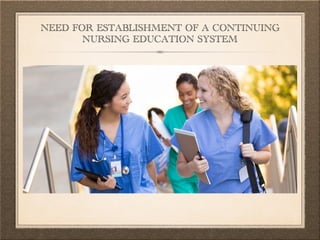
NEED FOR ESTABLISHMENT OF A CONTINUING
NURSING EDUCATION SYSTEM
1.CONTINUING NURSING
EDUCATION SYSTEM
•≈
Continuing education is an informal study or
activity to gain knowledge and learn about new
technology.
Lifelong education is essential for self development,
knowledge building and learning.
Stimulates nurses to keep up with new knowledge
and technology, to increase their skills and
competency, and to be able to contribute to the
health care team.

67
1.CONTINUING NURSING
EDUCATION SYSTEM
•≈
Continuing nursing education programmes should
be strengthened or new units should be established.
The appointment of responsible persons for
continuing education activity is needed.
Continuing education programmes should get
approval from the INC so that nurses can develop
increased competency to work independently.

68
ASSESSMENT OF EYE:
•≈
A quality assurance system comprises vision, mission,
objectives, strategic and operational plans, nursing service
activity, nursing manpower management, roles and
responsibilities, nursing standards, nursing indicators,
nursing research, nursing administration and management,
resource allocation and financial support.
The objective of this system will be to ensure quality care
and nursing outcomes as expected by clients (less
suffering, shorter duration of hospital stay, and reduction
of health care costs, infection, complications and
mortality).

69
2. NEED TO ESTABLISH A QUALITY
ASSURANCE SYSTEM FOR THE NURSING
SERVICE
ASSESSMENT OF EYE:
•≈
Successful development and implementation of the system
depends on the commitment of nursing leaders, hospital
administrators, mutual goal-setting, participation of all
personnel in the process, continuous quality improvement and
good communication.
The role of the INC in regulating nursing practice should be
strengthened by amending the Nursing Act to include
maintaining of registration of qualified nurses, renewal of
licence, and setting up a nursing service and nursing education
accrediting system.
If possible, a hospital QA system should have nursing as an
integral part and involves nurses in the team.

70
2. NEED TO ESTABLISH A QUALITY
ASSURANCE SYSTEM FOR THE NURSING
SERVICE
3. LACK OF INVOLVEMENT OF NURSES IN HEALTH
AND NURSING POLICY FORMULATION AND PLANNING
•≈
Nurses need to know how the healthcare system is
structured and how it operates, because it has a
significant impact on nursing practice and determines
who has access to services and what type of services
are available.
Knowing the structure of healthcare system will
ensure a reasonable standard of care for all citizens.

71
3. LACK OF INVOLVEMENT OF NURSES
IN HEALTH AND NURSING POLICY
•≈
There is inadequate number of nurse and
midwife leaders at the national and state levels
for nursing practice, research, education,
management, planning and policy development.
Although the nurse is a member of the health
team, she/he is never asked to represent the
profession in planning and policy formulation for
nursing services, education, etc.

72
3. LACK OF INVOLVEMENT OF NURSES IN HEALTH
AND NURSING POLICY FORMULATION AND PLANNING
4. STRENGTHENING NURSING
PROGRAMMES
•≈
Education is a key factor for human resource
development. With good education, people can learn
and earn money.
Education programmes should be reviewed
intensively and revised.
The INC has set standards and syllabus for all
nursing programmes.
Educators should coordinate closely with the nursing
staff in hospitals to achieve education that is relevant to
the needs of the service.

73
4. STRENGTHENING NURSING
PROGRAMMES
•≈
The Master of Science programme in nursing should
focus on advanced nursing practice. The quality of
education depends on the quality of the educators.
The teacher for the B.Sc. programme in nursing should
be at least a Master's degree holder and have teaching
experience as prescribed by the INC.
The teacher at the graduate level should do research
and publish at least one article every 2 years.
The teaching learning activity should emphasise
participatory learning and cultivation of lifelong
education.

74
5. INSUFFICIENT EVIDENCE BASED
PRACTICE AND NURSING RESEARCH
•≈
Nurse educators should develop a short-course
training on evidence-based research or to supervise
research activity.
Resources such as journals and books can be shared.
Joint research between nurse educators and clinical
staff should be encouraged to strengthen the capacity
of both groups and improve education and practice.
The INC can be a part of nursing research
development.

75
5. INSUFFICIENT EVIDENCE BASED
PRACTICE AND NURSING RESEARCH:
•≈
The INC should set nursing research priorities in
collaboration with nursing and non-nursing
organizations to provide research funds and promote
nursing activities for policy formulation.
Establishment of a nursing research information
system is encouraged to monitor research work,
areas of research and researchers.
Dissemination of nursing research and models for
best practices should be established.

76
RESEARCH
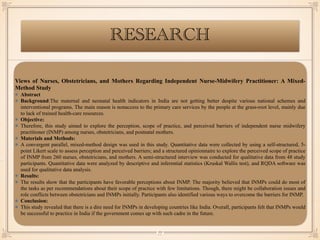
Views of Nurses, Obstetricians, and Mothers Regarding Independent Nurse-Midwifery Practitioner: A Mixed-
Method Study
Abstract
Background:The maternal and neonatal health indicators in India are not getting better despite various national schemes and
interventional programs. The main reason is nonaccess to the primary care services by the people at the grass-root level, mainly due
to lack of trained health-care resources.
Objective:
Therefore, this study aimed to explore the perception, scope of practice, and perceived barriers of independent nurse midwifery
practitioner (INMP) among nurses, obstetricians, and postnatal mothers.
Materials and Methods:
A convergent parallel, mixed-method design was used in this study. Quantitative data were collected by using a self-structured, 5-
point Likert scale to assess perception and perceived barriers; and a structured opinionnaire to explore the perceived scope of practice
of INMP from 260 nurses, obstetricians, and mothers. A semi-structured interview was conducted for qualitative data from 48 study
participants. Quantitative data were analyzed by descriptive and inferential statistics (Kruskal Wallis test), and RQDA software was
used for qualitative data analysis.
Results:
The results show that the participants have favorable perceptions about INMP. The majority believed that INMPs could do most of
the tasks as per recommendations about their scope of practice with few limitations. Though, there might be collaboration issues and
role conflicts between obstetricians and INMPs initially. Participants also identified various ways to overcome the barriers for INMP.
Conclusion:
This study revealed that there is a dire need for INMPs in developing countries like India. Overall, participants felt that INMPs would
be successful to practice in India if the government comes up with such cadre in the future.

77
BIBLIOGRAPHY
Dr. Vijay kumar Gauttam, A Comprehensive Textbook of Advanced
practices in Nursing, ed:2019, kumar Publishing House, Page 667-76
Humphries, JL and Green, E (2000). Nurse Prescribers: Infrastructures
Required to Support their Rale Newhouse, RP, Stanik-Hutt, J and White,
KM, et al. Advanced Practice Nurse Outcomes 1990-2008.
A Systematic Review, Nursing Economics 2011; 29: 1-22.
Sargen, M, Hooker, RS and Cooper, RA. Gaps in the Supply of
Physicians, Advance Practice Nurses andPhysician Assistants, J Am
Coll Surg. 2011; 212: 991-999.Nursing Standard, 14: 35-39.
www.ukessays.com/essays/nursing/independent-practice-issues-and-
independent-midwifery-nursing-essay,.pho
INDEPENDENT PRACTICE ISSUES.pdf

INDEPENDENT PRACTICE ISSUES.pdf

  • 1.
    INDEPENDENT PRACTICE ISSUES, INDEPENDENTNURSE MIDWIFERY PRACTITIONER  1 MRS. JISHA SRIVASTAVA FACULTY, RAKCON
  • 2.
    OBJECTIVES  2 At the endof the class students will be able to : Describe independent nurse Practitioner. Describe the philosophy and historical development of independent nurse Practitioner . Explain the basic requirements of independent nurse midwifery practitioner. List down the role of independent nurse midwifery practitioner. Explain the issues in independent nurse practice. Explain the need for establishment of a continuing nursing education system.
  • 3.
    DEFINITION OF INDEPENDENT NURSEPRACTITIONER American Academy of Nurse Practitioners: “An Independent Nurse Practitioner is referred as advanced practice nurse has a master’s degree in nursing in the specialized area of her/his interest and licensed to practice in her/his state.”  3
  • 4.
    The International Councilof Nurses defines INP: “A registered nurse who has acquired the expert knowledge base, complex decision- making skills and clinical competencies for expanded practice.”  4 DEFINITION OF INDEPENDENT NURSE PRACTITIONER
  • 5.
    DEFINITION OF INDEPENDENT NURSEPRACTITIONER “An independent Nurse Practitioner(INP) is a registered nurse who has completed specific advanced nursing education (generally a master’s degree) and training in the diagnosis and management of common as well as complex medical conditions to provide a broad range of health care services.”  5
  • 6.
    PHILOSOPHY OF INP Thecore philosophy of INP is to provide individual care to patients of all ages. Its care focuses on patient’s conditions as well as the effects of illness on the lives of the patients and their families. INPs make prevention, wellness and patient education priorities. This means fewer prescriptions and less expensive treatment. Informing patients of their health care and encouraging them to participate in decisions central to the care In addition to care, INPs conduct research and are often active in patient advocacy activities.  6
  • 7.
    STANDARDS REQUIRED FOR PRACTICEOF MIDWIFERY Midwifery care is provided by qualified practitioner, who is registered Midwifery care occurs in a safe environment with in context of family, community and system of health care. Midwifery care supports individual rights and self determination with in boundaries of safety. Midwifery care comprises of knowledge, skills and judgment that foster the delivery of safe, satisfying and culturally competent care.  7
  • 8.
    STANDARDS REQUIRED FOR PRACTICEOF MIDWIFERY Midwifery care is based upon knowledge, skills and judgment which are reflected in written practice guidelines. Midwifery care is evaluated according to an established program. For quality management that include a plan to identify and resolves problem. Midwifery practices may be extended beyond the set competences to incorporate new procedures, that improves care for women and their family.  8
  • 9.
    HISTORICAL DEVELOPMENT OF INP Nursepractitioners have provided a healthy partnership with their patients for more than 40 years. The nurse practitioner role had its inception in the mid-1960s in response to a shortage of physicians.  9
  • 10.
    HISTORICAL DEVELOPMENT OF INP Thefirst INP Program was developed as a master’s degree curriculum at the University of Colorado’s School of Nursing in 1965, founded by Loretta C. Ford, a nursing faculty member and Dr. Henry K. Silver, a paediatrician.  10
  • 11.
    HISTORICAL DEVELOPMENT OF INP Thefirst programs were in paediatrics and they soon spread to many other health care specialties. During 1970-1971 Federal Legislation recommended Certificate Programme for nurses to deliver primary health care. Gradually certificate programme shifted to master’s degree  11
  • 12.
    HISTORICAL DEVELOPMENT OF INP Inresponse to health care reform in 1990s 3 INPs programmes were developed to meet the demand of primary care services. By 1994, 248 programme centres were developed for INP in US.  12
  • 13.
    HISTORICAL DEVELOPMENT OF INP In1995, 49000 nurses were employed as INPs. American Academy of Nurse Practitioner in 1993 developed standard and guidelines for practice of INPs which are still followed.  13
  • 14.
    HISTORICAL DEVELOPMENT OF INP Today200 universities and colleges are offering INP programme all over the world. 70,000 nurses are working as INP in US.  14
  • 15.
    KEY PRACTICES A nurseneeds to clearly identify that he/she is providing nursing services, the extent of those nursing services and under what conditions he/ she will refer clients to other health care professionals.  15
  • 16.
    KEY PRACTICES Must maintainthe high standards of nursing and uphold the public trust that has been bestowed on the nursing profession.  16
  • 17.
    KEY ISSUES TOCONSIDER PROFESSIONAL ISSUES
  • 18.
    Conflict of interest Endorsement Advertising Fees Informedconsent Documentation Confidentiality Other issues Liability protection Networking Business or legal council  18 KEY ISSUES TO CONSIDER PROFESSIONAL ISSUES
  • 19.
    Primary obligation isproviding professional care to his/her clients . In a position of trust and cannot use their position to influence their clients for financial gain of non financial benefit.  19 1. CONFLICT OF INTEREST
  • 20.
    Avoid selling productsor services to clients they are treating. Avoid conflict of interest situations in their practice, particularly when it comes to the endorsement and advertising of products .  20 1. CONFLICT OF INTEREST
  • 21.
    Endorsing or promotinga product or services is closely linked to conflict of interest . Endorsement occurs when a nurse uses her credentials to lend credibility to a commercial product line or service.  21 2. ENDORSEMENT
  • 22.
    The endorsement ofa product or service without providing information about other options could mislead the public and compromise trust. For example, a nurse in independent practice who provides foot care services should not sell any foot care products for her clients.  22 2. ENDORSEMENT
  • 23.
    Advertising may takevarious forms, such as business cards listing in telephone directories, announcements in newspapers and periodicals, and promotional materials It can include information such as a description of services and nursing credentials, practice experience, fee, address and phone number  23 3.ADVERTISING
  • 24.
    According to NursingAct 1991 Submitting an account or change for services that the member knows is false or misleading Failing to fulfil the terms of an agreement for professional services  24 4. FEES
  • 25.
    Changing a feethat is excessive in relation to the service for which is charged . Offering or giving a reduction for prompt payment of an account. Before setting fees , a nurse should research the fees of other nurses who have similar qualification and experience and who provide comparable services  25 4. FEES
  • 26.
    Nurse in independentpractice are expected to obtain informed consent before performing any treatment . Treatment is de fi ned as anything that is performed for a therapeutic, preventive, palliative, diagnostic, cosmetic or other health related purposes, and includes a course or plan of treatment  26 5. INFORMED CONSENT
  • 27.
    Health records arethe means by which information about the client is communicated the health care team and how continuity of care is maintained . They also demonstrate the nurses accountability and answer questions about the type of care provided  27 6.DOCUMENTATION
  • 28.
    7. CONFIDENTIALITY SYSTEM Nursein independent practice requires to maintain the confidentiality of the client information and cannot communicate the information to another person unless the client or client’s representative gives consent or it is required by law  28
  • 29.
    8. OTHER ISSUES Businessor legal council: nurses may want to seek legal advise before starting an independent nursing practice. Liability of protection: the college recommends that nurses in independent practice purchase liability protection to enable public redress if any problems occurs Networking: entrepreneurial support groups for self employed nurses offer assistance with peer feedback, idea and issue sharing, planning for vacation and sickness etc.  29
  • 30.
    The Indian NursingCouncil (INC), the parent body of the nursing councils in the country, has rolled out an initiative, which is in the early implementation stage, and has been forwarded for approval to the Union Health ministry. DEVELOPMENT OF INDEPENDENT NURSE PRACTITIONER (INDEPENDENT NURSE MIDWIFERY PRACTITIONER) IN INDIA  30
  • 31.
    Independent nurse practitionerstrained in midwifery has been introduced to bring down the high Maternal Mortality Rate (MMR) and Infant Mortality Rate (IMR) in rural areas. The National Population policy 2000 includes reduction of maternal and infant mortality as one of the socio-demographic goals to be achieved by 2010. DEVELOPMENT OF INDEPENDENT NURSE PRACTITIONER (INDEPENDENT NURSE MIDWIFERY PRACTITIONER) IN INDIA  31
  • 32.
    Skilled care duringchildbirth is important because millions of women and newborns develop serious and hard to predict complications during or immediately after delivery. Skilled health professions such as doctors or nurses who have midwifery skills can recognize these complications and either treat them or refer women to health centers or hospitals immediately if more skilled care is needed. DEVELOPMENT OF INDEPENDENT NURSE PRACTITIONER (INDEPENDENT NURSE MIDWIFERY PRACTITIONER) IN INDIA  32
  • 33.
    To ease theimpact of the shortage of gynaecologists in community health centres, INC performed a pilot study for the ‘Independent Nurse Practitioner Project’ in West Bengal at SSKM Hospital’s female medical and surgical wards. The project provides an 18 months training in midwifery, besides an additional training in emergency obstetric care to candidates who have completed their BSc in nursing and have two to three years of clinical experience in ob- gyn wards to take care of ANMS in rural sector. DEVELOPMENT OF INDEPENDENT NURSE PRACTITIONER (INDEPENDENT NURSE MIDWIFERY PRACTITIONER) IN INDIA  33
  • 34.
    These nurses arecalled independent nurse practitioners as they are trained to prescribe medicines following approved protocols and take decisions independently in absence of gynaecologists. 2 of the 4 trainees have been assigned to a CHC to manage obstetric cases. DEVELOPMENT OF INDEPENDENT NURSE PRACTITIONER (INDEPENDENT NURSE MIDWIFERY PRACTITIONER) IN INDIA  34
  • 35.
    The results ofthe pilot study has been submitted to health ministry and the government of India is currently examining the proposal to extend this project all over India. INC is finalising a curriculum with senior obstetrics and gynaecologists for the training of independent nurse practitioner module. DEVELOPMENT OF INDEPENDENT NURSE PRACTITIONER (INDEPENDENT NURSE MIDWIFERY PRACTITIONER) IN INDIA  35
  • 36.
    Explains T DileepKumar, president, INC, “In rural areas, though a community health centre should be manned by physician, surgeon, paediatrician and gynaecologist, the community health centre is usually found facing a shortage of gynaecologists. DEVELOPMENT OF INDEPENDENT NURSE PRACTITIONER (INDEPENDENT NURSE MIDWIFERY PRACTITIONER) IN INDIA  36
  • 37.
    It’s in sucha scenario, that the role of independent nurse practitioner gains importance, here, Auxiliary midwives are trained. Independent nurse practitioners should be regarded as a part of solution for improving quality, access and cost of care and continuing education.” DEVELOPMENT OF INDEPENDENT NURSE PRACTITIONER (INDEPENDENT NURSE MIDWIFERY PRACTITIONER) IN INDIA  37
  • 38.
    BASIC REQUIREMENTS OFINDEPENDENT NURSE MIDWIFERY PRACTITIONER Basic nursing education Registered nurse Advance Nursing Certification (Master Degree in Obstetrics and gynaecology nursing) Collaboration with any hospital/agencies for referral and reimbursement  38
  • 39.
    AREAS OF PRACTICE CommunityClinics and Health Centres Nurse managed centres Private practices (either by themselves or together with a physician), Hospitals Nursing homes Birthing centers Women’s Health Clinics Home health care agencies/Home Nursing Schools or colleges based health clinics They often provide care to underserved populations in rural areas or inner-city settings.  39
  • 40.
    ROLE OF INDEPENDENTNURSE MIDWIFERY PRACTITIONER She is prepared to practice in an expanded role to provide primary care to women, related to reproductive health, conduct annual gynecological exams, provide education regarding family planning, and provide menopausal care. She acts independently and/or in collaboration with other health care professionals to deliver health care services. She conducts comprehensive health assessments aimed at health promotion and disease prevention. She is capable of solo practice with clinically competent skills and are legally approved to provide a defined set of services without assistance or supervision of another professional.  40
  • 41.
    ROLE OF INDEPENDENTNURSE MIDWIFERY PRACTITIONER Midwifery practitioners are specialists in low-risk pregnancy, childbirth, and postpartum. They generally strive to help women to have a healthy pregnancy and natural birth experience. They are trained to recognize and deal with deviations from the normal. Midwifery nurse practitioners are uniquely qualified to resolve unmet needs in primary health care by serving as an individual’s point of first contact with the health care system. Their focus of care is on health surveillance (promotion and maintenance of wellness), but it also provides for management of complications in order to maintain continuity.  41
  • 42.
    ROLE OF INDEPENDENTNURSE MIDWIFERY PRACTITIONER Midwifery practitioners refer women to general practitioners or obstetricians when a pregnant woman requires care beyond their’ area of expertise. They are trained to handle certain more difficult deliveries, including breech births, twin births and births where the baby is in a posterior position, using non-invasive techniques. Nurse-midwives work together with OBS/GYN doctors. They either consult with or refer to other health care providers in cases that are outside of their experience (for example, high-risk pregnancies and pregnant women who also have a chronic disease).  42
  • 43.
    ROLE OF INDEPENDENTNURSE MIDWIFERY PRACTITIONER Many studies over the past 20 – 30 years have shown that nurse-midwives can manage most perinatal (including prenatal, delivery, and postpartum) care, and most of the family planning and gynecological needs of women of all ages. Nurse-midwifery practitioners have improved primary health care services for women in rural and inner-city areas.  43
  • 44.
    SCENARIO OF INDEPENDENT MIDWIFERYPRACTICE IN USA It is the position of the American College of Nurse-Midwives (ACNM) that midwifery practice is the independent management of women’s health care, focusing particularly on common primary care issues, family planning and gynecologic needs of women, pregnancy, childbirth, the postpartum period and care of the newborn. The practice occurs within a health care system that provides for consultation, collaborative management or referral as indicated by the health status of the client.  44
  • 45.
    SCENARIO OF INDEPENDENT MIDWIFERYPRACTICE IN USA Independent practice is not defined by the place of employment, the employee-employer relationship, requirements for physician co-signature, or the method of reimbursement for services. Nor should independent be interpreted to mean alone, as there are clinical situations when any prudent practitioner would seek the assistance of another qualified practitioner. Collaboration is the process whereby health care professionals jointly manage care.  45
  • 46.
    SCENARIO OF MIDWIFERYIN UNITED KINGDOM The organisation is committed to improving maternity provision for all women in the UK and is working with other support, service and professional groups, including the Government, to achieve that objective. Independent Midwives UK also provides professional advice and mutual support for independent midwives.  46
  • 47.
    SCENARIO OF MIDWIFERYIN UNITED KINGDOM The former Independent Midwives Assosiation has recently become Independent Midwives UK, an Industrial and Provident Society. The new organisation is a Social Enterprise and with Government support, Independent Midwives UK is working towards making Independent Midwifery available to all women who are entitled to NHS maternity care.  47
  • 48.
    SCENARIO OF MIDWIFERYIN UNITED KINGDOM Independent Midwives are fully qualified midwives who have chosen to work outside the NHS in a self employed capacity. Independent midwives fully support the principals of the NHS and are currently working to ensure that all women can access ‘gold standard’ of care in the future. The role of the midwife encompasses the care of women and babies during pregnancy, birth and the early weeks of motherhood.  48
  • 49.
    SCENARIO OF MIDWIFERYIN UNITED KINGDOM The organisation is committed to improving maternity provision for all women in the UK and is working with other support, service and professional groups, including the Government, to achieve that objective. Independent Midwives UK also provides professional advice and mutual support for independent midwives. The former Independent Midwives Assosiation has recently become Independent Midwives UK, an Industrial and Provident Society. The new organisation is a Social Enterprise and with Government support, Independent Midwives UK is working towards making Independent Midwifery available to all women who are entitled to NHS maternity care.  49
  • 50.
    Qualification and regulationof midwives All practising midwives must adhere to the Midwives’ Rules which are enshrined in the 1902 Midwives Act of Parliament and subsequent amendments.  50 SCENARIO OF MIDWIFERY IN UNITED KINGDOM
  • 51.
    Role in emergency Asthe experts in childbirth, midwives are trained to recognise any early warning signs that things may not be progressing normally and to take appropriate action. If the unexpected should happen, all midwives are trained in emergency resuscitation of both mothers and babies . Independent Midwives carry all the necessary emergency drugs and equipment and these are checked on a yearly basis by a supervisor of midwives.  51 SCENARIO OF MIDWIFERY IN UNITED KINGDOM
  • 52.
    Emergency equipments All midwivesare trained in emergency resuscitation. Independent Midwives also carry emergency drugs in case a woman is bleeding heavily. They update ourselves on a yearly basis in emergency neonatal resuscitation and many of them have attended emergency skills workshops tailored for independent midwives attending homebirths. It is a requirement that the equipments are checked on a yearly basis by a supervisor of midwives.  52 SCENARIO OF MIDWIFERY IN UNITED KINGDOM
  • 53.
    Charges for services Ratesmay vary in different areas of the UK; currently a complete package of care will cost you between £2000 and £4500 (approx).  53 SCENARIO OF MIDWIFERY IN UNITED KINGDOM
  • 54.
    Midwives in PrivatePractice (MIPP) Midwives choosing to work privately, rather than being employed by hospitals and other institutions, do so because it allows them to be flexible about the care they provide. The private practitioner midwife is able to provide continuity of care to the families who have chosen to use her services. SCENARIO OF MIDWIFERY IN AUSTRALIA  54
  • 55.
    Some midwives inprivate practice choose to work in specific areas. For example, some may offer postnatal care, or advice with difficult breastfeeding problems (Lactation Consultants) or Maternal and Child Health (M&CHN). In addition, some midwives are skilled and have qualifications in complementary areas such as acupuncture, counselling, naturopathy, chiropractic, massage or homeopathy. SCENARIO OF MIDWIFERY IN AUSTRALIA  55
  • 56.
    Pre-pregnancy advice Advice aboutbirth options Childbirth education classes Sibling preparation classes Continuous midwifery care during pregnancy Preparation for and attendance at births in an appropriate environment of the parents’ choice Postnatal care following birth at home, birth centre or hospital Separate postnatal care for women who want private midwifery care for this period only or who are discharged home early from hospital Lactation consultancy Acupuncture and Chiropractic Referral to and advice about other health professionals such as medical and natural health practitioners, eg obstetricians, paediatricians, GPs, chiropractors, osteopaths, naturopaths, homeopaths Some midwives have a special interest and expertise in supporting women in special areas such as vaginal birth after caesarean section (VBAC), breech births, water births and postnatal depression.  56 SCENARIO OF MIDWIFERY IN AUSTRALIA
  • 57.
    ISSUES IN INDEPENDENTNURSE PRACTICE •≈ The nurses could not document that they hold a patient’s medications based on ‘nursing judgment’. Such an instance might be when a patient had hypotension from pain medication and thus the morning anti-hypertensive is held. Instead, they need an order from a physician to hold such medication. Further, something like ‘Tylenol’ on a patient’s medication record ordered for fever could not be administered by the nurse for a headache if the patient requested it because that would be ‘practicing medicine without a license’.  57
  • 58.
    ISSUES IN INDEPENDENTNURSE PRACTICE •≈ A nurse cannot order a social services consult, refer a patient for diabetes education, etc., etc., without an order from the supervising physician. Although they were trained to recognize these things, they carried an independent license, sat for an examination to obtain that license, and had years of education. Perhaps nurses really could not do any of these things without a supervising physician to tell them? Physicians, are critical components of the health care team there is no doubt, but why send a nurse to school and give him/her an independent license, scope of practice, and make them answerable to a board of nursing but then limit their usefulness.  58
  • 59.
    1. CURRICULUM FORINDEPENDENT NURSE PRACTITIONER DEVELOPMENT •≈ Although the level of education is higher, the focus has remained the same: Nurse practitioner programs emphasize primary care, preventive medicine and patient education. However, physicians offer a different service to patients. With five years of medical education and three years of residency training, their depth of understanding of complex medical problems cannot be equaled by lesser-trained professionals.”  59
  • 60.
    2.PRESCRIPTIVE AUTHORITY •≈ Nurse practitionershave the authority to prescribe and can write prescriptions (including ones for controlled substances) without any physician involvement. However, some believe that there should be collaborative prescribing agreement between nurse practitioners and physicians.  60
  • 61.
    3. PUBLIC VIEWOF NURSING •≈ Many articles in nursing as early as 1928, speak to the concerns about nurses. “Nice girls, don’t do nursing!”. “If you have a strong back and weak mind, be a nurse” The public’s images of nurses has not essentially changed since nursing’s inception. In public opinion, nurses are identified as a means for decreasing the cost of health care. She is considered as “a highly trained professional who is providing an alternative to the expensive primary care physician”. They wonder that can she do anything that a primary care physician can do.” They are reluctant to recognize nurse practitioners as primary care providers.  61
  • 62.
    4.AREAS OF PRACTICE •≈ “Nonphysicianproviders have historically thrived in settings where physicians were unavailable — places they were unable or unwilling to go,” “It remains to be seen if independent nurse practitioners will be economically viable in areas of physician oversupply.”  62
  • 63.
    5.QUALITY OF CARE •≈ Manystudies show that patients have a high or very high level of satisfaction with NP Services. Regarding measurement of diagnosis, treatment, and patient outcomes, several studies indicate that the quality of care provided by NPs is equal to that of physicians.  63
  • 64.
    5.COST EFFECTIVE CARE •≈ Nursepractitioners provide a cost effective care. One study compared the costs of care for two primary care problems and found that the cost of care given by NPs was 20% less than the cost of care given by physicians. At the same time, some argue that, without ready access to supervising physicians, nurse practitioners are likely to order more tests and consultations and be quicker to admit patients to the hospital, thereby driving up health care costs.  64
  • 65.
    5.INSUFFICIENT EVIDENCE-BASED PRACTICE ANDNURSING RESEARCH •≈ There is a need of promotion of evidence-based practice and nursing research so that with a sound knowledge base, the nurses will be able to function more independently.Establishment of policies on the use of evidence in practice is required. Nurses with a Master’s degree should be encouraged to provide evidence, read nursing research and use evidence to improve or change nursing practices.  65
  • 66.
    NEED FOR ESTABLISHMENTOF A CONTINUING NURSING EDUCATION SYSTEM
  • 67.
    1.CONTINUING NURSING EDUCATION SYSTEM •≈ Continuingeducation is an informal study or activity to gain knowledge and learn about new technology. Lifelong education is essential for self development, knowledge building and learning. Stimulates nurses to keep up with new knowledge and technology, to increase their skills and competency, and to be able to contribute to the health care team.  67
  • 68.
    1.CONTINUING NURSING EDUCATION SYSTEM •≈ Continuingnursing education programmes should be strengthened or new units should be established. The appointment of responsible persons for continuing education activity is needed. Continuing education programmes should get approval from the INC so that nurses can develop increased competency to work independently.  68
  • 69.
    ASSESSMENT OF EYE: •≈ Aquality assurance system comprises vision, mission, objectives, strategic and operational plans, nursing service activity, nursing manpower management, roles and responsibilities, nursing standards, nursing indicators, nursing research, nursing administration and management, resource allocation and financial support. The objective of this system will be to ensure quality care and nursing outcomes as expected by clients (less suffering, shorter duration of hospital stay, and reduction of health care costs, infection, complications and mortality).  69 2. NEED TO ESTABLISH A QUALITY ASSURANCE SYSTEM FOR THE NURSING SERVICE
  • 70.
    ASSESSMENT OF EYE: •≈ Successfuldevelopment and implementation of the system depends on the commitment of nursing leaders, hospital administrators, mutual goal-setting, participation of all personnel in the process, continuous quality improvement and good communication. The role of the INC in regulating nursing practice should be strengthened by amending the Nursing Act to include maintaining of registration of qualified nurses, renewal of licence, and setting up a nursing service and nursing education accrediting system. If possible, a hospital QA system should have nursing as an integral part and involves nurses in the team.  70 2. NEED TO ESTABLISH A QUALITY ASSURANCE SYSTEM FOR THE NURSING SERVICE
  • 71.
    3. LACK OFINVOLVEMENT OF NURSES IN HEALTH AND NURSING POLICY FORMULATION AND PLANNING •≈ Nurses need to know how the healthcare system is structured and how it operates, because it has a significant impact on nursing practice and determines who has access to services and what type of services are available. Knowing the structure of healthcare system will ensure a reasonable standard of care for all citizens.  71
  • 72.
    3. LACK OFINVOLVEMENT OF NURSES IN HEALTH AND NURSING POLICY •≈ There is inadequate number of nurse and midwife leaders at the national and state levels for nursing practice, research, education, management, planning and policy development. Although the nurse is a member of the health team, she/he is never asked to represent the profession in planning and policy formulation for nursing services, education, etc.  72 3. LACK OF INVOLVEMENT OF NURSES IN HEALTH AND NURSING POLICY FORMULATION AND PLANNING
  • 73.
    4. STRENGTHENING NURSING PROGRAMMES •≈ Educationis a key factor for human resource development. With good education, people can learn and earn money. Education programmes should be reviewed intensively and revised. The INC has set standards and syllabus for all nursing programmes. Educators should coordinate closely with the nursing staff in hospitals to achieve education that is relevant to the needs of the service.  73
  • 74.
    4. STRENGTHENING NURSING PROGRAMMES •≈ TheMaster of Science programme in nursing should focus on advanced nursing practice. The quality of education depends on the quality of the educators. The teacher for the B.Sc. programme in nursing should be at least a Master's degree holder and have teaching experience as prescribed by the INC. The teacher at the graduate level should do research and publish at least one article every 2 years. The teaching learning activity should emphasise participatory learning and cultivation of lifelong education.  74
  • 75.
    5. INSUFFICIENT EVIDENCEBASED PRACTICE AND NURSING RESEARCH •≈ Nurse educators should develop a short-course training on evidence-based research or to supervise research activity. Resources such as journals and books can be shared. Joint research between nurse educators and clinical staff should be encouraged to strengthen the capacity of both groups and improve education and practice. The INC can be a part of nursing research development.  75
  • 76.
    5. INSUFFICIENT EVIDENCEBASED PRACTICE AND NURSING RESEARCH: •≈ The INC should set nursing research priorities in collaboration with nursing and non-nursing organizations to provide research funds and promote nursing activities for policy formulation. Establishment of a nursing research information system is encouraged to monitor research work, areas of research and researchers. Dissemination of nursing research and models for best practices should be established.  76
  • 77.
    RESEARCH Views of Nurses,Obstetricians, and Mothers Regarding Independent Nurse-Midwifery Practitioner: A Mixed- Method Study Abstract Background:The maternal and neonatal health indicators in India are not getting better despite various national schemes and interventional programs. The main reason is nonaccess to the primary care services by the people at the grass-root level, mainly due to lack of trained health-care resources. Objective: Therefore, this study aimed to explore the perception, scope of practice, and perceived barriers of independent nurse midwifery practitioner (INMP) among nurses, obstetricians, and postnatal mothers. Materials and Methods: A convergent parallel, mixed-method design was used in this study. Quantitative data were collected by using a self-structured, 5- point Likert scale to assess perception and perceived barriers; and a structured opinionnaire to explore the perceived scope of practice of INMP from 260 nurses, obstetricians, and mothers. A semi-structured interview was conducted for qualitative data from 48 study participants. Quantitative data were analyzed by descriptive and inferential statistics (Kruskal Wallis test), and RQDA software was used for qualitative data analysis. Results: The results show that the participants have favorable perceptions about INMP. The majority believed that INMPs could do most of the tasks as per recommendations about their scope of practice with few limitations. Though, there might be collaboration issues and role conflicts between obstetricians and INMPs initially. Participants also identified various ways to overcome the barriers for INMP. Conclusion: This study revealed that there is a dire need for INMPs in developing countries like India. Overall, participants felt that INMPs would be successful to practice in India if the government comes up with such cadre in the future.  77
  • 78.
    BIBLIOGRAPHY Dr. Vijay kumarGauttam, A Comprehensive Textbook of Advanced practices in Nursing, ed:2019, kumar Publishing House, Page 667-76 Humphries, JL and Green, E (2000). Nurse Prescribers: Infrastructures Required to Support their Rale Newhouse, RP, Stanik-Hutt, J and White, KM, et al. Advanced Practice Nurse Outcomes 1990-2008. A Systematic Review, Nursing Economics 2011; 29: 1-22. Sargen, M, Hooker, RS and Cooper, RA. Gaps in the Supply of Physicians, Advance Practice Nurses andPhysician Assistants, J Am Coll Surg. 2011; 212: 991-999.Nursing Standard, 14: 35-39. www.ukessays.com/essays/nursing/independent-practice-issues-and- independent-midwifery-nursing-essay,.pho