Professor Ian Macdonald Victoria University
Advance organiser Basic assumptions about learning Summary of principles for a good learning environment A simple model of “formal” learning Chunking Concepts Questions Scripts Society’s changing learning needs Workplace embedded learning Creating a learning organisation
Basic assumptions about learning Learners  construct  a unique meaning,  filtered  by, and  building  on  existing understanding .  Learning is an  individual experience , but is primarily a  social activity .  It is what learners  THINK  and  DO  that matters most – and that is a  decision of the learner .
Good   learning environments: Are not be seen by the learner as ‘fixing’ a  knowledge deficit  in the learner, but are seen as an opportunity to continue to develop and improve on current knowledge . Are  long term and incremental , not a hurdle to be jumped to achieve a qualification.  Are on a need-to-know basis, where  new knowledge has immediate utility .  Foster learning primarily by  social interaction with peers  – with knowledge construction guided and  validated by a trusted expert .  Are as  closely situated  in the required context for use of the knowledge as possible, to limit the need to translate theory into practice.
Good learning environments  cont. Engage the learner in  active construction of meaning  to solve a real problem in a  social context .  Encourage risk taking  and experimentation, with assessment that does not focus on mistakes, but  rewards learning .  Give ample opportunity for  reflection on practice , and  in practice . Give  immediate constructive feedback  to any attempts to change.  Provide a  constant sense of progress  and self-efficacy.
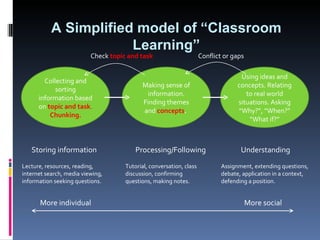
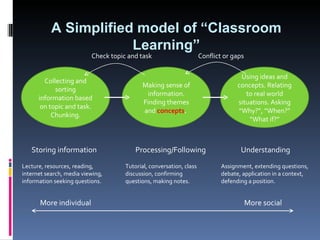
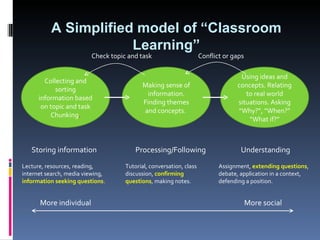
Collecting and sorting information based on  topic and task . Chunking. Making sense of information. Finding themes and  concepts .   Using ideas and concepts. Relating to real world situations. Asking “ Why?”, “When?” “What if?” Storing information Processing/Following Understanding More social  More individual Check  topic and task Conflict or gaps Lecture, resources, reading, internet search, media viewing, information seeking questions. Tutorial, conversation, class discussion, confirming questions, making notes. Assignment, extending questions, debate, application in a context, defending a position.  A Simplified model of “Classroom Learning”
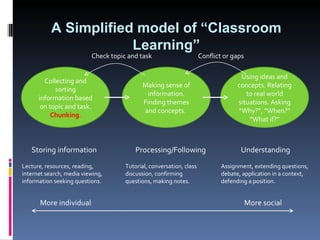
Collecting and sorting information based on topic and task. Chunking . Making sense of information. Finding themes and  concepts.  Using ideas and concepts. Relating to real world situations. Asking “ Why?”, “When?” “What if?” Storing information Processing/Following Understanding More social  More individual Check topic and task Conflict or gaps Lecture, resources, reading, internet search, media viewing, information seeking questions. Tutorial, conversation, class discussion, confirming questions, making notes. Assignment, extending questions, debate, application in a context, defending a position.  A Simplified model of “Classroom Learning”
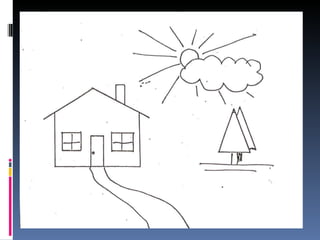
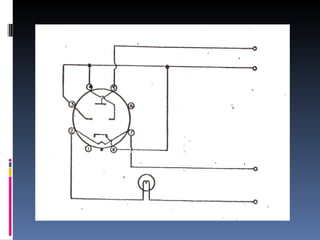
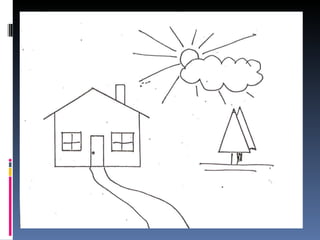
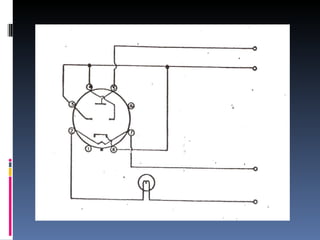
10 seconds to view – then draw
 
Chunking exercise Draw as much detail as possible of picture.
 
Chunking exercise Draw as much detail as possible of picture. Now correct your work.
 
 
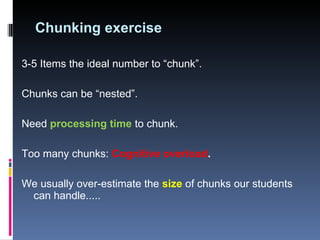
Chunking exercise 3-5 Items the ideal number to “chunk”.  Chunks can be “nested”.  Need  processing time  to chunk.  Too many chunks:  Cognitive overload .  We usually over-estimate the  size  of chunks our students can handle.....
Collecting and sorting information based on topic and task. Chunking. Making sense of information. Finding themes and  concepts .  Using ideas and concepts. Relating to real world situations. Asking “ Why?”, “When?” “What if?” Storing information Processing/Following Understanding More social  More individual Check topic and task Conflict or gaps Lecture, resources, reading, internet search, media viewing, information seeking questions. Tutorial, conversation, class discussion, confirming questions, making notes. Assignment, extending questions, debate, application in a context, defending a position.  A Simplified model of “Classroom Learning”
Concepts Generalisable principles that can be applied to many different situations.  Teachers typically spend much more time teaching PROCEDURES.
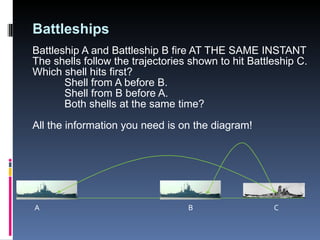
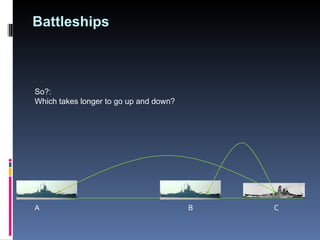
Battleships Battleship A and Battleship B fire AT THE SAME INSTANT The shells follow the trajectories shown to hit Battleship C. Which shell hits first?  Shell from A before B. Shell from B before A. Both shells at the same time? All the information you need is on the diagram! A B C
Battleships The  concept  you needed to know: Horizontal and Vertical motion are INDEPENDENT .
Battleships A B C So?: Which takes longer to go up and down?
Collecting and sorting information based on topic and task Chunking . Making sense of information. Finding themes and  concepts.   Using ideas and concepts. Relating to real world situations. Asking “ Why?”, “When?” “What if?” Storing information Processing/Following Understanding More social  More individual Check topic and task Conflict or gaps Lecture, resources, reading, internet search, media viewing,  information seeking questions . Tutorial, conversation, class discussion,  confirming questions , making notes. Assignment,  extending questions , debate, application in a context, defending a position.  A Simplified model of “Classroom Learning”
Questions Information Seeking :   What shape is it? [First stage of learning] Who uses this? Confirming:  Am I right if I said...? [Second stage of learning] Is this an example of...? Extending:  When does this not apply? [Third stage of learning] What if....?
Scripts Patterns of behaviour to automate our lives.  Scripts are learned.  Scripts powerfully effect learning. Displacement activities.  Scripts for coping when overload sets in.
In passing... The more you know about learning, the easier it is to make informed decisions about how you do it.
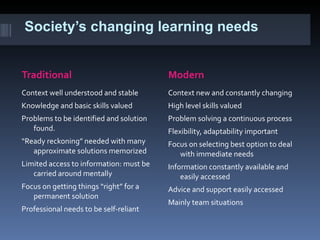
Society’s changing learning needs Traditional Modern Context well understood and stable Knowledge and basic skills valued Problems to be identified and solution found.  “ Ready reckoning” needed with many approximate solutions memorized Limited access to information: must be carried around mentally Focus on getting things “right” for a permanent solution Professional needs to be self-reliant Context new and constantly changing High level skills valued  Problem solving a continuous process Flexibility, adaptability important Focus on selecting best option to deal with immediate needs Information constantly available and easily accessed Advice and support easily accessed Mainly team situations
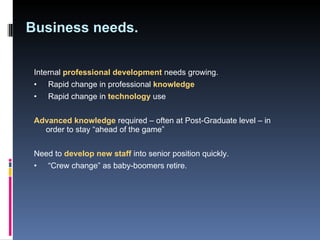
Business needs. Internal  professional development  needs growing.  •   Rapid change in professional  knowledge •   Rapid change in  technology  use Advanced knowledge   required – often at Post-Graduate level – in order to stay “ahead of the game”  Need to  develop new staff   into senior position quickly. •  “ Crew change” as baby-boomers retire.
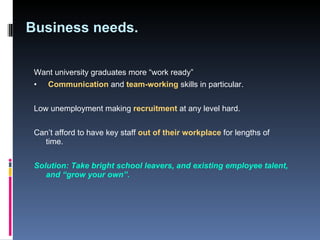
Business needs. Want university graduates more “work ready” •   Communication  and  team-working  skills in particular. Low unemployment making  recruitment  at any level hard.  Can’t afford to have key staff  out of their workplace  for lengths of time.  Solution: Take bright school leavers, and existing employee talent, and “grow your own”.
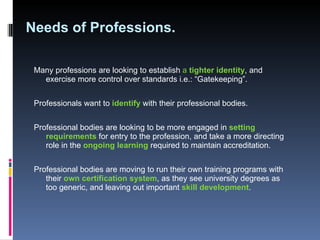
Needs of Professions.  Many professions are looking to establish  a  tighter identity , and exercise more control over standards i.e.: “Gatekeeping”.  Professionals want to  identify  with their professional bodies. Professional bodies are looking to be more engaged in  setting requirements  for entry to the profession, and take a more directing role in the  ongoing learning   required to maintain accreditation.  Professional bodies are moving to run their own training programs with their  own certification system , as they see university degrees as too generic, and leaving out important  skill development .
Student needs. Many potential students are in  mid-career , wanting to advance or change their careers, but working  full time jobs   with other commitments.  Want qualifications that are valued and  recognised nationally and internationally .  Highly connected   socially, often through intensive use of technology.  Time poor . Study has to fit around busy lives.  Reluctant to take  on  large debts   for “entry” degrees.  Want a good learning experience – each is a  demanding and well informed consumer of education .
Workplace-Embedded Learning.  Study in the workplace  using the workplace as classroom .  Blended learning   approach, with web-based materials and communication modes in flexible timeframes.  Authentic learning/situated learning . Teaching interaction primarily by Subject Matter Experts (SME’s), with educational expertise in the “back room”. Materials “tuned” to context.  Emphasis in building  overlapping learning communities .  Start with practice and  extract theory   frameworks.  Skill development  integrated .
Why is Blended Learning so effective?  Emphasis in building  overlapping learning communities : Workplace  – connection with colleagues in current workplace, for immediate use of knowledge and feedback.  Learning cohort   – connection with the other students studying similar work, building networks across businesses. Professional  – connection with experienced professionals as mentors/SME’s. A future resource.  Academic  – connection with resources, literature and theory frameworks that allow for prediction and modelling.  Creates a  learning organisation , not just a more learned person.
How to facilitate Learning Communities Communication,   Communication,  Communication.  Structured  learning system – linked to job competencies, performance evaluations, and promotions.  Access to  resources  – particularly human ones. Hurdles/assessments to complete to  measure progress  – with  validation from an expert. Accreditation  for progress made in a portable and generally recognised form.
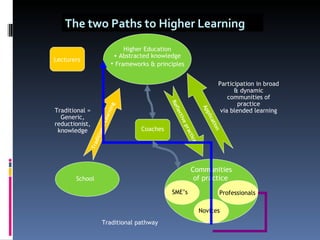
The two Paths to Higher Learning  Higher Education Abstracted knowledge Frameworks & principles   School   Communities of practice   Professionals   SME’s   Novices   Traditional Learning   Traditional = Generic, reductionist, knowledge Application Reflective practice   Traditional pathway Participation in broad & dynamic communities of practice via blended learning Lecturers Coaches
A Parting thought... Learn  in a career  not  for a career.
Contacts Professor Ian Macdonald,  Director, Centre for Innovation in Learning and Teaching (CILT) Victoria University, Melbourne.  [email_address] Ph: 0413 455 393

How people learn

  • 1.
    Professor Ian MacdonaldVictoria University
  • 2.
    Advance organiser Basicassumptions about learning Summary of principles for a good learning environment A simple model of “formal” learning Chunking Concepts Questions Scripts Society’s changing learning needs Workplace embedded learning Creating a learning organisation
  • 3.
    Basic assumptions aboutlearning Learners construct a unique meaning, filtered by, and building on existing understanding . Learning is an individual experience , but is primarily a social activity . It is what learners THINK and DO that matters most – and that is a decision of the learner .
  • 4.
    Good learning environments: Are not be seen by the learner as ‘fixing’ a knowledge deficit in the learner, but are seen as an opportunity to continue to develop and improve on current knowledge . Are long term and incremental , not a hurdle to be jumped to achieve a qualification. Are on a need-to-know basis, where new knowledge has immediate utility . Foster learning primarily by social interaction with peers – with knowledge construction guided and validated by a trusted expert . Are as closely situated in the required context for use of the knowledge as possible, to limit the need to translate theory into practice.
  • 5.
    Good learning environments cont. Engage the learner in active construction of meaning to solve a real problem in a social context . Encourage risk taking and experimentation, with assessment that does not focus on mistakes, but rewards learning . Give ample opportunity for reflection on practice , and in practice . Give immediate constructive feedback to any attempts to change. Provide a constant sense of progress and self-efficacy.
  • 6.
    Collecting and sortinginformation based on topic and task . Chunking. Making sense of information. Finding themes and concepts . Using ideas and concepts. Relating to real world situations. Asking “ Why?”, “When?” “What if?” Storing information Processing/Following Understanding More social More individual Check topic and task Conflict or gaps Lecture, resources, reading, internet search, media viewing, information seeking questions. Tutorial, conversation, class discussion, confirming questions, making notes. Assignment, extending questions, debate, application in a context, defending a position. A Simplified model of “Classroom Learning”
  • 7.
    Collecting and sortinginformation based on topic and task. Chunking . Making sense of information. Finding themes and concepts. Using ideas and concepts. Relating to real world situations. Asking “ Why?”, “When?” “What if?” Storing information Processing/Following Understanding More social More individual Check topic and task Conflict or gaps Lecture, resources, reading, internet search, media viewing, information seeking questions. Tutorial, conversation, class discussion, confirming questions, making notes. Assignment, extending questions, debate, application in a context, defending a position. A Simplified model of “Classroom Learning”
  • 8.
    10 seconds toview – then draw
  • 9.
  • 10.
    Chunking exercise Drawas much detail as possible of picture.
  • 11.
  • 12.
    Chunking exercise Drawas much detail as possible of picture. Now correct your work.
  • 13.
  • 14.
  • 15.
    Chunking exercise 3-5Items the ideal number to “chunk”. Chunks can be “nested”. Need processing time to chunk. Too many chunks: Cognitive overload . We usually over-estimate the size of chunks our students can handle.....
  • 16.
    Collecting and sortinginformation based on topic and task. Chunking. Making sense of information. Finding themes and concepts . Using ideas and concepts. Relating to real world situations. Asking “ Why?”, “When?” “What if?” Storing information Processing/Following Understanding More social More individual Check topic and task Conflict or gaps Lecture, resources, reading, internet search, media viewing, information seeking questions. Tutorial, conversation, class discussion, confirming questions, making notes. Assignment, extending questions, debate, application in a context, defending a position. A Simplified model of “Classroom Learning”
  • 17.
    Concepts Generalisable principlesthat can be applied to many different situations. Teachers typically spend much more time teaching PROCEDURES.
  • 18.
    Battleships Battleship Aand Battleship B fire AT THE SAME INSTANT The shells follow the trajectories shown to hit Battleship C. Which shell hits first? Shell from A before B. Shell from B before A. Both shells at the same time? All the information you need is on the diagram! A B C
  • 19.
    Battleships The concept you needed to know: Horizontal and Vertical motion are INDEPENDENT .
  • 20.
    Battleships A BC So?: Which takes longer to go up and down?
  • 21.
    Collecting and sortinginformation based on topic and task Chunking . Making sense of information. Finding themes and concepts. Using ideas and concepts. Relating to real world situations. Asking “ Why?”, “When?” “What if?” Storing information Processing/Following Understanding More social More individual Check topic and task Conflict or gaps Lecture, resources, reading, internet search, media viewing, information seeking questions . Tutorial, conversation, class discussion, confirming questions , making notes. Assignment, extending questions , debate, application in a context, defending a position. A Simplified model of “Classroom Learning”
  • 22.
    Questions Information Seeking: What shape is it? [First stage of learning] Who uses this? Confirming: Am I right if I said...? [Second stage of learning] Is this an example of...? Extending: When does this not apply? [Third stage of learning] What if....?
  • 23.
    Scripts Patterns ofbehaviour to automate our lives. Scripts are learned. Scripts powerfully effect learning. Displacement activities. Scripts for coping when overload sets in.
  • 24.
    In passing... Themore you know about learning, the easier it is to make informed decisions about how you do it.
  • 25.
    Society’s changing learningneeds Traditional Modern Context well understood and stable Knowledge and basic skills valued Problems to be identified and solution found. “ Ready reckoning” needed with many approximate solutions memorized Limited access to information: must be carried around mentally Focus on getting things “right” for a permanent solution Professional needs to be self-reliant Context new and constantly changing High level skills valued Problem solving a continuous process Flexibility, adaptability important Focus on selecting best option to deal with immediate needs Information constantly available and easily accessed Advice and support easily accessed Mainly team situations
  • 26.
    Business needs. Internal professional development needs growing. • Rapid change in professional knowledge • Rapid change in technology use Advanced knowledge required – often at Post-Graduate level – in order to stay “ahead of the game” Need to develop new staff into senior position quickly. • “ Crew change” as baby-boomers retire.
  • 27.
    Business needs. Wantuniversity graduates more “work ready” • Communication and team-working skills in particular. Low unemployment making recruitment at any level hard. Can’t afford to have key staff out of their workplace for lengths of time. Solution: Take bright school leavers, and existing employee talent, and “grow your own”.
  • 28.
    Needs of Professions. Many professions are looking to establish a tighter identity , and exercise more control over standards i.e.: “Gatekeeping”. Professionals want to identify with their professional bodies. Professional bodies are looking to be more engaged in setting requirements for entry to the profession, and take a more directing role in the ongoing learning required to maintain accreditation. Professional bodies are moving to run their own training programs with their own certification system , as they see university degrees as too generic, and leaving out important skill development .
  • 29.
    Student needs. Manypotential students are in mid-career , wanting to advance or change their careers, but working full time jobs with other commitments. Want qualifications that are valued and recognised nationally and internationally . Highly connected socially, often through intensive use of technology. Time poor . Study has to fit around busy lives. Reluctant to take on large debts for “entry” degrees. Want a good learning experience – each is a demanding and well informed consumer of education .
  • 30.
    Workplace-Embedded Learning. Study in the workplace using the workplace as classroom . Blended learning approach, with web-based materials and communication modes in flexible timeframes. Authentic learning/situated learning . Teaching interaction primarily by Subject Matter Experts (SME’s), with educational expertise in the “back room”. Materials “tuned” to context. Emphasis in building overlapping learning communities . Start with practice and extract theory frameworks. Skill development integrated .
  • 31.
    Why is BlendedLearning so effective? Emphasis in building overlapping learning communities : Workplace – connection with colleagues in current workplace, for immediate use of knowledge and feedback. Learning cohort – connection with the other students studying similar work, building networks across businesses. Professional – connection with experienced professionals as mentors/SME’s. A future resource. Academic – connection with resources, literature and theory frameworks that allow for prediction and modelling. Creates a learning organisation , not just a more learned person.
  • 32.
    How to facilitateLearning Communities Communication, Communication, Communication. Structured learning system – linked to job competencies, performance evaluations, and promotions. Access to resources – particularly human ones. Hurdles/assessments to complete to measure progress – with validation from an expert. Accreditation for progress made in a portable and generally recognised form.
  • 33.
    The two Pathsto Higher Learning Higher Education Abstracted knowledge Frameworks & principles School Communities of practice Professionals SME’s Novices Traditional Learning Traditional = Generic, reductionist, knowledge Application Reflective practice Traditional pathway Participation in broad & dynamic communities of practice via blended learning Lecturers Coaches
  • 34.
    A Parting thought...Learn in a career not for a career.
  • 35.
    Contacts Professor IanMacdonald, Director, Centre for Innovation in Learning and Teaching (CILT) Victoria University, Melbourne. [email_address] Ph: 0413 455 393

Editor's Notes

  • #34 In traditional HE role of educators is that of lecturers isolated from their professional practice base and generally focused on teaching abstracted knowledges (first) In WPHE educators are coaches and mentors linked to their professional communities and promote ‘deeper’ participation in communities of practice through higher order knowledges and reflective practice Being embedded in a socio-cultural view of learning, WPHE recognises the dialectic relation that exists between individual learners and the community they are entering. From this perspective, learning, rather then being about passively absorbing and processing information, is about mutual transformation; changing the way newcomers (and academics) participate in these socially situated settings, and actively facilitating that change; and in the process also transforming their community of practice. (Wenger, 1998; Eijkman, 2004) Characteristics of WPHE Strengthens and expands the learning- workplace connection and further extends the notion of ‘authentic learning’ of which PBL is a prime example. WPHE takes authentic and PBL to its logical conclusion where it is “ managed so that reflection that lies at the heart of learning can lead to the transfer of understanding and the transforming of future tasks” (Connor, 2005:i). It enables new and/or better social relationships and networks for both students and academics – both have bridged that knowledge divide between the extended frameworks and principles of HE and the real world of professional communities of practice. WPHE provides opportunities for all participants to work with and learn from an extended range of others meet others and in extended environments that more easily enable reflection in and on practice (Schon) a different forum and context. It is this environment characterised by a density and richness of relationships that is decisive for growing the capacity for developing, processing, and reflecting on ideas and practices. In HE knowledge construction focuses on theory while in work-based learning the emphasis is on action. In higher education the purpose of learning is much broader and often abstracted from the real world of work (Laurillard, 2002). There is a dualistic positioning of second-order abstract knowledge in higher education and a focus on first-order experiential knowledge in work-based learning. In HE, learning is about the acquisition of decontextualised, abstracted, second order knowledges in which theory, separated from practice features prominently, and which, in the end, is wedded to a cognitivist, individuated psychological worldview (Habermas, 1973; Laurillard, 2002; (Eijkman 2004). This dominant paradigm of academic learning is highlighted by Diana Laurillard’s (2002) highly popular work. While she sees situated learning as having some value, “situated cognition is not enough”, “academic knowledge is importantly different from experiential knowledge, and this distinction becomes unavoidable” (Laurillard, 2002:16,52). The implication is that WPHE need to meet five conditions; immediate and emergent forms of engagement; involvement in authentic learning activities; appropriate scaffolding; emergent participation with other, and preferably local, members of their new community of practice; and participation in the critical reproduction of the culture of their new community of practice (Eijkman 2004).