Dr. Jagannath K. Dange
Assistant Professor,
Dept. of P G Studies and Research in Education
KUVEMPU UNIVERSITY
SHANKARAGHATTA – 577451, INDIA
E-Mail: jkdange@gmail.com
Computer-Assisted Instruction:
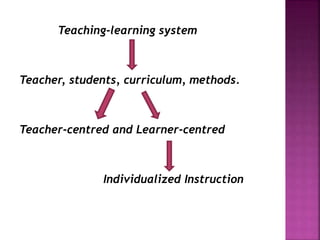
Teaching-learning system
Teacher, students, curriculum, methods.
Teacher-centred and Learner-centred
Individualized Instruction
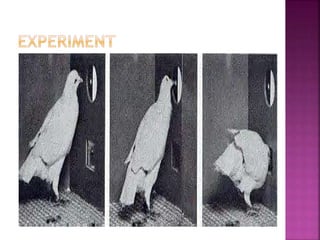
Based upon extensive laboratory studies with rats
and pigeons, operant conditioning by skinner
suggested that
A learning task could be analyzed into small-
and hence easily achievable-pieces of
behavior, each of which would be promptly
rewarded when performed correctly.
This leads to the development of
Programmed learning
Principle of small steps
Principle of active responding
Principle of immediate reinforcement
Principle of self-pacing
Principle of student evaluation
In case of human learners the material to be taught
is ‘programmed’ by breaking down into small sections
or frames that are presented to the learner one at a
time.
At the end of each frame there is a simple test of the
preceding material, which has to be completed
correctly before the learner can go on to the next
frame.
Since the information is given in small chunks, Once
the learner has given the correct response, the
correct answer is provided, often with short
congratulatory expression (That’s right!, Very good!,
keep it up!, Go ahead!)This is intended to constitute
both feedback and reward for the student.
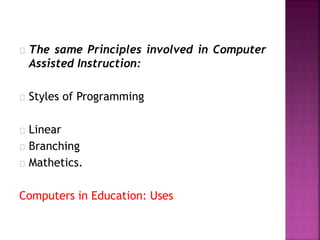
The same Principles involved in Computer
Assisted Instruction:
Styles of Programming
Linear
Branching
Mathetics.
Computers in Education: Uses
Later Sydney L Pressy incorporated all
principles of individualized instruction in
presenting content through Hardware (Drum
tutors) and called teaching machines.
In 1965 Lawrence Stalrow adopted system of
programmed instruction (Individualized
instruction) into the computers and developed a
system of ‘Computer Assisted Instruction’ this
brought out a revolution in the field of
education.
The Computer Assisted Instruction has been
used on experimental basis for tutorials in
arithmetic and reading for elementary
school children by Patrick Suppes of
Stanford University in 1966 and in fact he is
considered to be the father of Computer
Assisted Instruction.
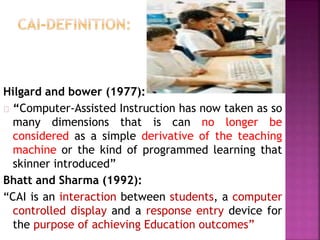
Hilgard and bower (1977):
“Computer-Assisted Instruction has now taken as so
many dimensions that is can no longer be
considered as a simple derivative of the teaching
machine or the kind of programmed learning that
skinner introduced”
Bhatt and Sharma (1992):
“CAI is an interaction between students, a computer
controlled display and a response entry device for
the purpose of achieving Education outcomes”
Two-way interaction of a learner and computer
Computer Assisted Instruction as an instructional
technique: computer much actually instruct the
student, and the computer contains a stored
instructional program designed to inform guide
and test the student until a prescribed level of
proficiency is reached.
Individually paced on and individualized
instruction,
Problem solving
Drill and practice
Inquiry
Simulation and games.
Tutorial instruction,
Demonstration.
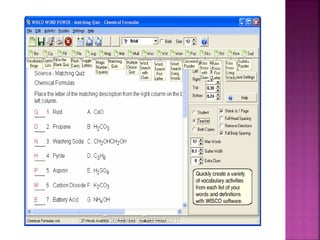
Drill and Practice instructional programs simply
assist the student in remembering and utilizing
information that the teacher has already
presented, reinforcing previous learning
through repetition. It is most important to
improving knowledge level.
Tutorials are designed to introduce unfamiliar
subject matter. The format of a computer
tutorial often emulates a dialogue between the
computer and the student, i.e. information is
presented, questions are asked of the student
and on the basis of the response given, a
decision is made to move on to new material
or review what has already been presented.
Instructional Games present course content in
a competitive and entertaining manner, in an
effort to maintain a high level of student
interest. Though most frequently used to
reinforce factual knowledge at the lower levels
of the taxonomy, it is quite possible to create
instructional games that demand application
skills from all levels.
Teaches students about the federal budget system and how
to manage future debt.
Simulations require the student to apply
acquired knowledge to a novel situation. As
a result, the student must analyze a
presented scenario, make decisions based
on the information given and determine a
course of action. The simulated environment
must change based on the course of action
taken, presenting a significant challenge to
the programmer. Successful performance
relies on skills up to Bloom’s level of
analysis.
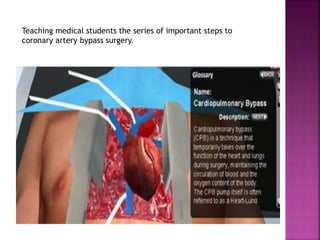
Teaching medical students the series of important steps to
coronary artery bypass surgery.
Problem-solving requires the student to use
high level cognitive abilities in the process of
considering the problem at hand, analyzing the
problem situation and its various solutions,
predicting respective outcomes, determining
which specific plan to attempt, and enacting
the appropriate action(s).
The student would be forced to identify
relationships and evaluate all aspects of the
chosen set of course materials.
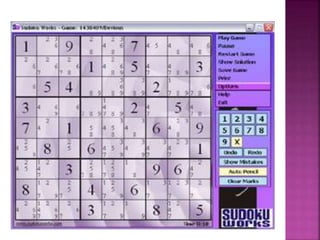
Ex; SUDOKU
Discovery-environment; the student is given
a high level of freedom in determining the
specific information presented during each
session, as well as the order of
presentation”.
Basically, Computer Assisted Instruction system is
described in terms of ‘hardware’ (the machine),
‘software’ (the programme), and communication
links (the devices which allow learners to use
the hardware and software) and also curriculum
(teaching material stored in a computer).
The first assumption is that the Computer-
Assisted Instruction can be arranged for 4000
students simultaneously. It can cope with the
problem of quality and quantity in education.
In Computer Assisted Instruction, more flexible
kind of branching is possible because the
computer can make complex branching
decisions based on the student’s performance.
promptly evaluate the learner’s performance
and use the data in designing the best strategy
for the learner in future.
presentation of variety of subject materials. It
can be used in all types of teaching-learning
programmes.
lesson material represented in words, pictures
and experiments to be presented to the
students.
Students say they like working with computer
Are infinitely patient
Never get tired
Never get frustrated or angry
Allow students to work privately
Are fun and entertaining
Never forget to correct or praise
Individualize learning
Are self paced
Computer assisted instruction provides
differentiated lesson for varied levels of learning
including with disabilities and gifted students
Students are able to work at their own pace while
receiving instant feedback which enables them to
self correct before moving on to the next skill
The programs are interactive and students can
work individually or in groups
Student also gain valuable computer skill which
will continue to benefit them through out life
Teachers are better able to track their students’ strength and
weaknesses though CAI.
Computer programs can enhance the lesson and allow teacher
to pick different level of a programs.
When students are learning and active involved with learning
teacher will have less behavior problems in the classroom.
CAI benefits teacher by allowing them to work with small
group of children on a particular skill while the other students
in the class are working on their computer program.
The nature of the program allows the students to work
independently.
Minimizing distraction to the teacher while s/he works with
the other students.
The instruction of CAI in classroom proves quite
expensive.
Computer as an electronic device may invite
significant hazards to children.
Students can become bored and restless, if
computer programs are over used.
The emotional touch warmth and sympathy
are not possible in CAI
Thank you
ALL THE VERY BEST…

Computer Assisted Instruction

  • 1.
    Dr. Jagannath K.Dange Assistant Professor, Dept. of P G Studies and Research in Education KUVEMPU UNIVERSITY SHANKARAGHATTA – 577451, INDIA E-Mail: jkdange@gmail.com Computer-Assisted Instruction:
  • 2.
    Teaching-learning system Teacher, students,curriculum, methods. Teacher-centred and Learner-centred Individualized Instruction
  • 3.
    Based upon extensivelaboratory studies with rats and pigeons, operant conditioning by skinner suggested that
  • 7.
    A learning taskcould be analyzed into small- and hence easily achievable-pieces of behavior, each of which would be promptly rewarded when performed correctly. This leads to the development of Programmed learning
  • 8.
    Principle of smallsteps Principle of active responding Principle of immediate reinforcement Principle of self-pacing Principle of student evaluation
  • 9.
    In case ofhuman learners the material to be taught is ‘programmed’ by breaking down into small sections or frames that are presented to the learner one at a time. At the end of each frame there is a simple test of the preceding material, which has to be completed correctly before the learner can go on to the next frame. Since the information is given in small chunks, Once the learner has given the correct response, the correct answer is provided, often with short congratulatory expression (That’s right!, Very good!, keep it up!, Go ahead!)This is intended to constitute both feedback and reward for the student.
  • 10.
    The same Principlesinvolved in Computer Assisted Instruction: Styles of Programming Linear Branching Mathetics. Computers in Education: Uses
  • 11.
    Later Sydney LPressy incorporated all principles of individualized instruction in presenting content through Hardware (Drum tutors) and called teaching machines. In 1965 Lawrence Stalrow adopted system of programmed instruction (Individualized instruction) into the computers and developed a system of ‘Computer Assisted Instruction’ this brought out a revolution in the field of education.
  • 12.
    The Computer AssistedInstruction has been used on experimental basis for tutorials in arithmetic and reading for elementary school children by Patrick Suppes of Stanford University in 1966 and in fact he is considered to be the father of Computer Assisted Instruction.
  • 13.
    Hilgard and bower(1977): “Computer-Assisted Instruction has now taken as so many dimensions that is can no longer be considered as a simple derivative of the teaching machine or the kind of programmed learning that skinner introduced” Bhatt and Sharma (1992): “CAI is an interaction between students, a computer controlled display and a response entry device for the purpose of achieving Education outcomes”
  • 14.
    Two-way interaction ofa learner and computer Computer Assisted Instruction as an instructional technique: computer much actually instruct the student, and the computer contains a stored instructional program designed to inform guide and test the student until a prescribed level of proficiency is reached. Individually paced on and individualized instruction,
  • 15.
    Problem solving Drill andpractice Inquiry Simulation and games. Tutorial instruction, Demonstration.
  • 16.
    Drill and Practiceinstructional programs simply assist the student in remembering and utilizing information that the teacher has already presented, reinforcing previous learning through repetition. It is most important to improving knowledge level. Tutorials are designed to introduce unfamiliar subject matter. The format of a computer tutorial often emulates a dialogue between the computer and the student, i.e. information is presented, questions are asked of the student and on the basis of the response given, a decision is made to move on to new material or review what has already been presented.
  • 17.
    Instructional Games presentcourse content in a competitive and entertaining manner, in an effort to maintain a high level of student interest. Though most frequently used to reinforce factual knowledge at the lower levels of the taxonomy, it is quite possible to create instructional games that demand application skills from all levels.
  • 18.
    Teaches students aboutthe federal budget system and how to manage future debt.
  • 19.
    Simulations require thestudent to apply acquired knowledge to a novel situation. As a result, the student must analyze a presented scenario, make decisions based on the information given and determine a course of action. The simulated environment must change based on the course of action taken, presenting a significant challenge to the programmer. Successful performance relies on skills up to Bloom’s level of analysis.
  • 20.
    Teaching medical studentsthe series of important steps to coronary artery bypass surgery.
  • 21.
    Problem-solving requires thestudent to use high level cognitive abilities in the process of considering the problem at hand, analyzing the problem situation and its various solutions, predicting respective outcomes, determining which specific plan to attempt, and enacting the appropriate action(s). The student would be forced to identify relationships and evaluate all aspects of the chosen set of course materials. Ex; SUDOKU
  • 25.
    Discovery-environment; the studentis given a high level of freedom in determining the specific information presented during each session, as well as the order of presentation”.
  • 26.
    Basically, Computer AssistedInstruction system is described in terms of ‘hardware’ (the machine), ‘software’ (the programme), and communication links (the devices which allow learners to use the hardware and software) and also curriculum (teaching material stored in a computer). The first assumption is that the Computer- Assisted Instruction can be arranged for 4000 students simultaneously. It can cope with the problem of quality and quantity in education.
  • 27.
    In Computer AssistedInstruction, more flexible kind of branching is possible because the computer can make complex branching decisions based on the student’s performance. promptly evaluate the learner’s performance and use the data in designing the best strategy for the learner in future. presentation of variety of subject materials. It can be used in all types of teaching-learning programmes. lesson material represented in words, pictures and experiments to be presented to the students.
  • 28.
    Students say theylike working with computer Are infinitely patient Never get tired Never get frustrated or angry Allow students to work privately Are fun and entertaining Never forget to correct or praise Individualize learning Are self paced
  • 29.
    Computer assisted instructionprovides differentiated lesson for varied levels of learning including with disabilities and gifted students Students are able to work at their own pace while receiving instant feedback which enables them to self correct before moving on to the next skill The programs are interactive and students can work individually or in groups Student also gain valuable computer skill which will continue to benefit them through out life
  • 30.
    Teachers are betterable to track their students’ strength and weaknesses though CAI. Computer programs can enhance the lesson and allow teacher to pick different level of a programs. When students are learning and active involved with learning teacher will have less behavior problems in the classroom. CAI benefits teacher by allowing them to work with small group of children on a particular skill while the other students in the class are working on their computer program. The nature of the program allows the students to work independently. Minimizing distraction to the teacher while s/he works with the other students.
  • 31.
    The instruction ofCAI in classroom proves quite expensive. Computer as an electronic device may invite significant hazards to children. Students can become bored and restless, if computer programs are over used. The emotional touch warmth and sympathy are not possible in CAI
  • 32.
    Thank you ALL THEVERY BEST…