

BY
M.VIJAYALAKSHMI
ACHIEVEMENT TESTS
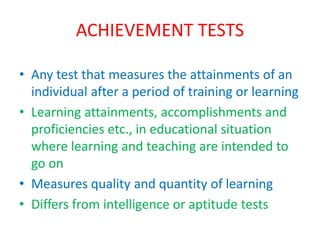
• Any test that measures the attainments of an
individual after a period of training or learning
• Learning attainments, accomplishments and
proficiencies etc., in educational situation
where learning and teaching are intended to
go on
• Measures quality and quantity of learning
• Differs from intelligence or aptitude tests
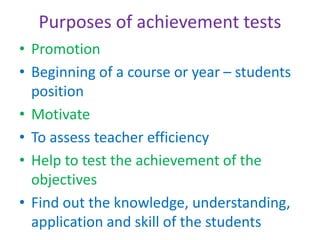
Purposes of achievement tests
• Promotion
• Beginning of a course or year – students
position
• Motivate
• To assess teacher efficiency
• Help to test the achievement of the
objectives
• Find out the knowledge, understanding,
application and skill of the students
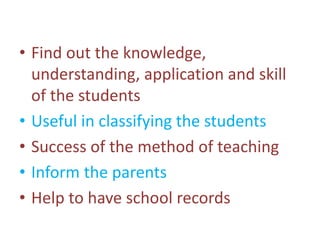
• Find out the knowledge,
understanding, application and skill
of the students
• Useful in classifying the students
• Success of the method of teaching
• Inform the parents
• Help to have school records
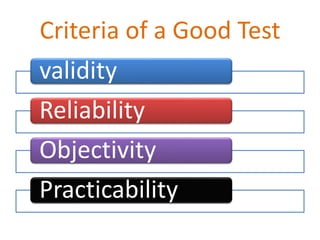
Criteria of a Good Test
validity
Reliability
Objectivity
Practicability
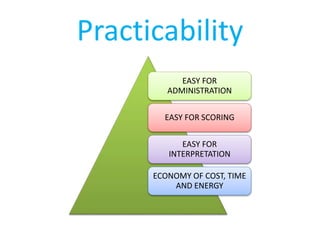
Practicability
EASY FOR
ADMINISTRATION
EASY FOR SCORING
EASY FOR
INTERPRETATION
ECONOMY OF COST, TIME
AND ENERGY
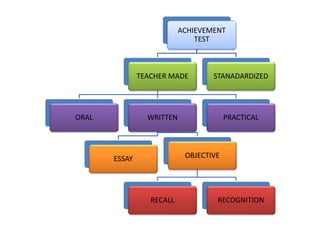
ACHIEVEMENT
TEST
TEACHER MADE
ORAL WRITTEN
ESSAY OBJECTIVE
RECALL RECOGNITION
PRACTICAL
STANADARDIZED
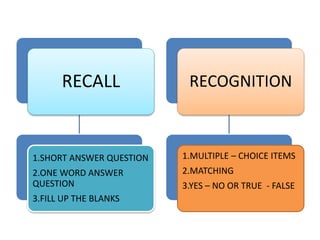
RECALL
1.SHORT ANSWER QUESTION
2.ONE WORD ANSWER
QUESTION
3.FILL UP THE BLANKS
RECOGNITION
1.MULTIPLE – CHOICE ITEMS
2.MATCHING
3.YES – NO OR TRUE - FALSE
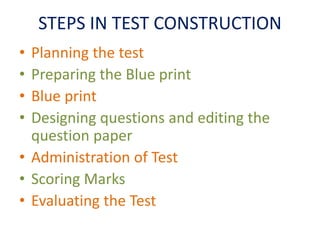
STEPS IN TEST CONSTRUCTION
• Planning the test
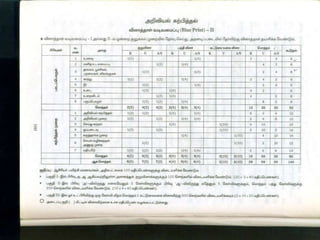
• Preparing the Blue print
• Blue print
• Designing questions and editing the
question paper
• Administration of Test
• Scoring Marks
• Evaluating the Test
Planning the test
•Objectives – marks
•Content – marks
•Types of question – marks
•Choices for essay and short
answers
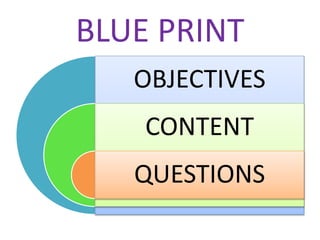
BLUE PRINT
OBJECTIVES
CONTENT
QUESTIONS
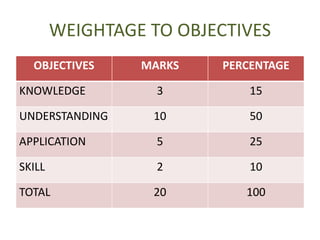
WEIGHTAGE TO OBJECTIVES
OBJECTIVES MARKS PERCENTAGE
KNOWLEDGE 3 15
UNDERSTANDING 10 50
APPLICATION 5 25
SKILL 2 10
TOTAL 20 100
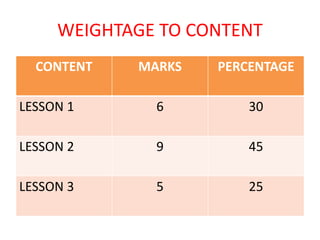
WEIGHTAGE TO CONTENT
CONTENT MARKS PERCENTAGE
LESSON 1 6 30
LESSON 2 9 45
LESSON 3 5 25
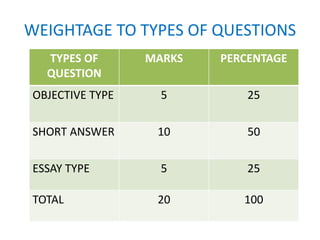
WEIGHTAGE TO TYPES OF QUESTIONS
TYPES OF
QUESTION
MARKS PERCENTAGE
OBJECTIVE TYPE 5 25
SHORT ANSWER 10 50
ESSAY TYPE 5 25
TOTAL 20 100
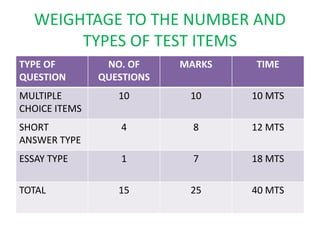
WEIGHTAGE TO THE NUMBER AND
TYPES OF TEST ITEMS
TYPE OF
QUESTION
NO. OF
QUESTIONS
MARKS TIME
MULTIPLE
CHOICE ITEMS
10 10 10 MTS
SHORT
ANSWER TYPE
4 8 12 MTS
ESSAY TYPE 1 7 18 MTS
TOTAL 15 25 40 MTS
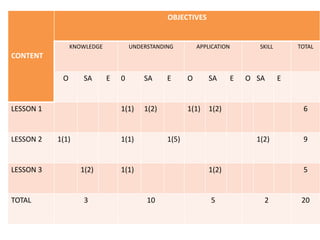
CONTENT
OBJECTIVES
KNOWLEDGE UNDERSTANDING APPLICATION SKILL TOTAL
O SA E 0 SA E O SA E O SA E
LESSON 1 1(1) 1(2) 1(1) 1(2) 6
LESSON 2 1(1) 1(1) 1(5) 1(2) 9
LESSON 3 1(2) 1(1) 1(2) 5
TOTAL 3 10 5 2 20
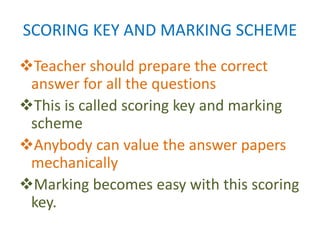
SCORING KEY AND MARKING SCHEME
Teacher should prepare the correct
answer for all the questions
This is called scoring key and marking
scheme
Anybody can value the answer papers
mechanically
Marking becomes easy with this scoring
key.
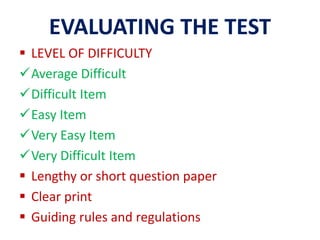
EVALUATING THE TEST
 LEVEL OF DIFFICULTY
Average Difficult
Difficult Item
Easy Item
Very Easy Item
Very Difficult Item
 Lengthy or short question paper
 Clear print
 Guiding rules and regulations
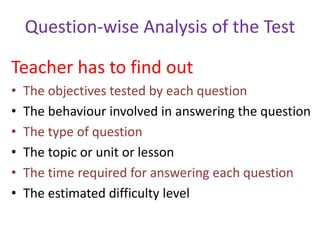
Question-wise Analysis of the Test
Teacher has to find out
• The objectives tested by each question
• The behaviour involved in answering the question
• The type of question
• The topic or unit or lesson
• The time required for answering each question
• The estimated difficulty level
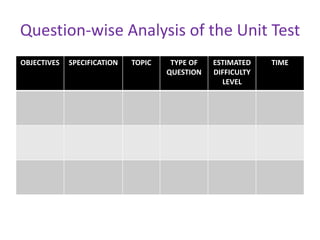
Question-wise Analysis of the Unit Test
OBJECTIVES SPECIFICATION TOPIC TYPE OF
QUESTION
ESTIMATED
DIFFICULTY
LEVEL
TIME
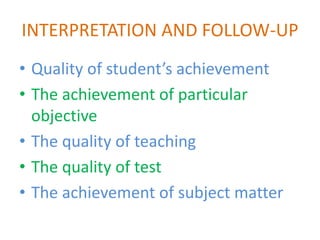
INTERPRETATION AND FOLLOW-UP
• Quality of student’s achievement
• The achievement of particular
objective
• The quality of teaching
• The quality of test
• The achievement of subject matter
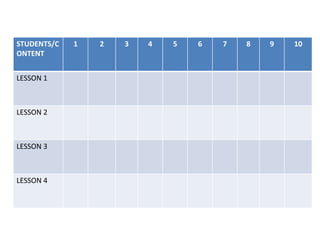
STUDENTS/C
ONTENT
1 2 3 4 5 6 7 8 9 10
LESSON 1
LESSON 2
LESSON 3
LESSON 4
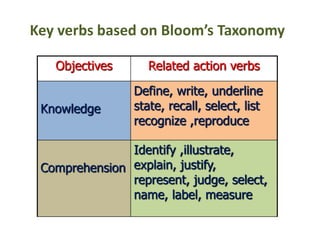
Objectives Related action verbs
Knowledge
Define, write, underline
state, recall, select, list
recognize ,reproduce
Comprehension
Identify ,illustrate,
explain, justify,
represent, judge, select,
name, label, measure
Key verbs based on Bloom’s Taxonomy
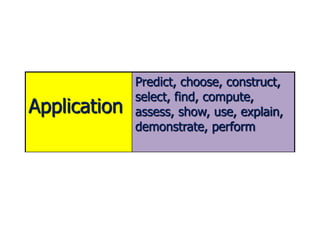
Application
Predict, choose, construct,
select, find, compute,
assess, show, use, explain,
demonstrate, perform
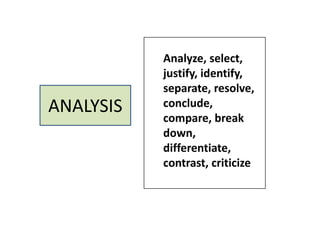
Analyze, select,
justify, identify,
separate, resolve,
conclude,
compare, break
down,
differentiate,
contrast, criticize
ANALYSIS
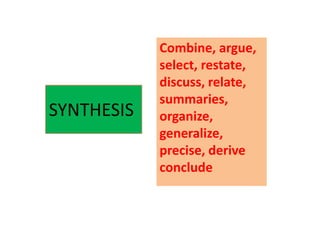
Combine, argue,
select, restate,
discuss, relate,
summaries,
organize,
generalize,
precise, derive
conclude
SYNTHESIS
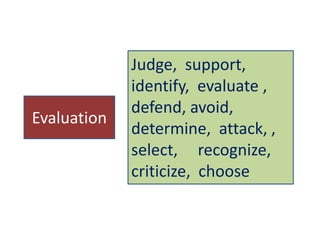
Judge, support,
identify, evaluate ,
defend, avoid,
determine, attack, ,
select, recognize,
criticize, choose
Evaluation
Credit to the Sources
Sources are taken from
INTERNET

Blue print

  • 1.
  • 2.
    ACHIEVEMENT TESTS • Anytest that measures the attainments of an individual after a period of training or learning • Learning attainments, accomplishments and proficiencies etc., in educational situation where learning and teaching are intended to go on • Measures quality and quantity of learning • Differs from intelligence or aptitude tests
  • 3.
    Purposes of achievementtests • Promotion • Beginning of a course or year – students position • Motivate • To assess teacher efficiency • Help to test the achievement of the objectives • Find out the knowledge, understanding, application and skill of the students
  • 4.
    • Find outthe knowledge, understanding, application and skill of the students • Useful in classifying the students • Success of the method of teaching • Inform the parents • Help to have school records
  • 5.
    Criteria of aGood Test validity Reliability Objectivity Practicability
  • 6.
    Practicability EASY FOR ADMINISTRATION EASY FORSCORING EASY FOR INTERPRETATION ECONOMY OF COST, TIME AND ENERGY
  • 7.
    ACHIEVEMENT TEST TEACHER MADE ORAL WRITTEN ESSAYOBJECTIVE RECALL RECOGNITION PRACTICAL STANADARDIZED
  • 8.
    RECALL 1.SHORT ANSWER QUESTION 2.ONEWORD ANSWER QUESTION 3.FILL UP THE BLANKS RECOGNITION 1.MULTIPLE – CHOICE ITEMS 2.MATCHING 3.YES – NO OR TRUE - FALSE
  • 9.
    STEPS IN TESTCONSTRUCTION • Planning the test • Preparing the Blue print • Blue print • Designing questions and editing the question paper • Administration of Test • Scoring Marks • Evaluating the Test
  • 10.
    Planning the test •Objectives– marks •Content – marks •Types of question – marks •Choices for essay and short answers
  • 11.
  • 12.
    WEIGHTAGE TO OBJECTIVES OBJECTIVESMARKS PERCENTAGE KNOWLEDGE 3 15 UNDERSTANDING 10 50 APPLICATION 5 25 SKILL 2 10 TOTAL 20 100
  • 13.
    WEIGHTAGE TO CONTENT CONTENTMARKS PERCENTAGE LESSON 1 6 30 LESSON 2 9 45 LESSON 3 5 25
  • 14.
    WEIGHTAGE TO TYPESOF QUESTIONS TYPES OF QUESTION MARKS PERCENTAGE OBJECTIVE TYPE 5 25 SHORT ANSWER 10 50 ESSAY TYPE 5 25 TOTAL 20 100
  • 15.
    WEIGHTAGE TO THENUMBER AND TYPES OF TEST ITEMS TYPE OF QUESTION NO. OF QUESTIONS MARKS TIME MULTIPLE CHOICE ITEMS 10 10 10 MTS SHORT ANSWER TYPE 4 8 12 MTS ESSAY TYPE 1 7 18 MTS TOTAL 15 25 40 MTS
  • 16.
    CONTENT OBJECTIVES KNOWLEDGE UNDERSTANDING APPLICATIONSKILL TOTAL O SA E 0 SA E O SA E O SA E LESSON 1 1(1) 1(2) 1(1) 1(2) 6 LESSON 2 1(1) 1(1) 1(5) 1(2) 9 LESSON 3 1(2) 1(1) 1(2) 5 TOTAL 3 10 5 2 20
  • 17.
    SCORING KEY ANDMARKING SCHEME Teacher should prepare the correct answer for all the questions This is called scoring key and marking scheme Anybody can value the answer papers mechanically Marking becomes easy with this scoring key.
  • 18.
    EVALUATING THE TEST LEVEL OF DIFFICULTY Average Difficult Difficult Item Easy Item Very Easy Item Very Difficult Item  Lengthy or short question paper  Clear print  Guiding rules and regulations
  • 19.
    Question-wise Analysis ofthe Test Teacher has to find out • The objectives tested by each question • The behaviour involved in answering the question • The type of question • The topic or unit or lesson • The time required for answering each question • The estimated difficulty level
  • 20.
    Question-wise Analysis ofthe Unit Test OBJECTIVES SPECIFICATION TOPIC TYPE OF QUESTION ESTIMATED DIFFICULTY LEVEL TIME
  • 21.
    INTERPRETATION AND FOLLOW-UP •Quality of student’s achievement • The achievement of particular objective • The quality of teaching • The quality of test • The achievement of subject matter
  • 22.
    STUDENTS/C ONTENT 1 2 34 5 6 7 8 9 10 LESSON 1 LESSON 2 LESSON 3 LESSON 4
  • 27.
    Objectives Related actionverbs Knowledge Define, write, underline state, recall, select, list recognize ,reproduce Comprehension Identify ,illustrate, explain, justify, represent, judge, select, name, label, measure Key verbs based on Bloom’s Taxonomy
  • 28.
    Application Predict, choose, construct, select,find, compute, assess, show, use, explain, demonstrate, perform
  • 29.
    Analyze, select, justify, identify, separate,resolve, conclude, compare, break down, differentiate, contrast, criticize ANALYSIS
  • 30.
    Combine, argue, select, restate, discuss,relate, summaries, organize, generalize, precise, derive conclude SYNTHESIS
  • 31.
    Judge, support, identify, evaluate, defend, avoid, determine, attack, , select, recognize, criticize, choose Evaluation
  • 32.
    Credit to theSources Sources are taken from INTERNET