GRACIOUS COLLEGE OF NURSING ABHANPUE
RAIPUR
ADMINISTRATION SCORING
AND
REPORTING
REPORTING
PRESENTED BY
OM VERMA
ASSISTANT PROFESSOR
ADMINISTRATION SCORING
AND
AND
REPORTING
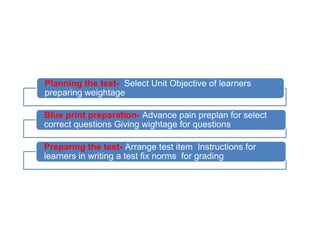
Planning the test- Select Unit Objective of learners
preparing weightage
Blue print preparation- Advance pain preplan for select
correct questions Giving wightage for questions
Preparing the test- Arrange test item Instructions for
learners in writing a test fix norms for grading
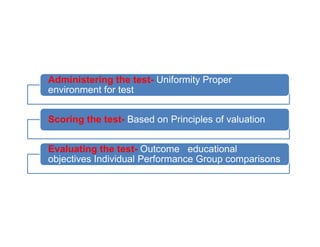
Administering the test- Uniformity Proper
environment for test
Scoring the test- Based on Principles of valuation
Evaluating the test- Outcome educational
objectives Individual Performance Group comparisons
1. PLANNING THE TEST
Unit plan has to be developed, teachers
careful analysis of the content and his
plan for promoting pupils learning.
Promotes objective based learning.
Brings the relationship between the
content, objectives, methodology,
economies the plan.
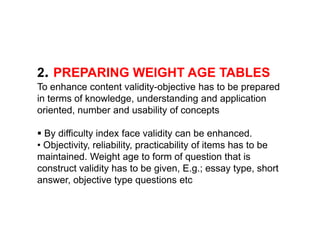
2. PREPARING WEIGHT AGE TABLES
To enhance content validity-objective has to be prepared
in terms of knowledge, understanding and application
oriented, number and usability of concepts
 By difficulty index face validity can be enhanced.
• Objectivity, reliability, practicability of items has to be
maintained. Weight age to form of question that is
construct validity has to be given, E.g.; essay type, short
answer, objective type questions etc
BLUE PRINT
It is a three dimensional chart which has a
provision for Giving weight age for objectives
content and form of cuestions. It depicts the true
nature and purpose of It describes the feasibility of
items, guides to correct questions, helps the
students to advance plan for development of
study/learning experiences.
PREPARING THE TEST
The teacher has to prepare the test in
accordance with the blue print. Arrange the
test item in ascending order of difficulty.
Prepare instructions for the student in writing
principles of valuation, fix norms for grading.
ADMINISTERING THE TEST
It pays a vital role in enhancing the reliability of the test
scores. Test should be administered in a congenial
environment strictly as per the instructions planned and
assure uniformity of conclusions to all the people tested.
SCORING THE TEST
The principles of valuation should be followed in
scoring the test. It enhances the objectivity and
reliability of the test.
EVALUATING THE TEST
Learning activities are the methods,
techniques which the class teacher employs to
help pupils to learn the content and realize the
objectives. The mean of determining the extent
to which the learning activities have been
effective are termed as evaluation procedure
or testing.
The test scores must be evaluated in relation
to the objectives and learning experiences
planned so that these components may be
modified. To evaluate the individual
performance and progress his scores must be
compared with peer group scores and his
previous scores. It helps to uplift the total
pedagogic programme.
The process of evaluation
1. Identifying and defining general objectives
2. Identifying and defining specific objectives.
3. Selecting teaching points. Through teaching
points objectives can be realized
4. Planning suitable learning objectives The
teachers: has to coordinate the objectives, teaching
points and learning activities.
5. Evaluating The teacher observes and measures
the challenges in the behaviour of his pupils through
testing.
6. Using the rests as feedback The results will act as
a feedback the teacher observes the results and
plan appropriate learning activity for achieving the
objectives.
SCORING, GRADING
VERSUS MARKS
VERSUS MARKS
Scoring, grading versus marks
When the performance of the learners is assessed, the
teachers need to tell the persons concerned with the
learner's performance-how good or bad the performance of
the learner is. There are several methods to assess the
evaluation of the students performance, one such method is
the Grading system of evaluation.
Definition - Grading is a means for reporting the result of
evaluation.
Methods of Grading Analytical method:
 In analytical method the ideal answer to a question is
specified in advance, although it need not be in the am the
ideal or model answer is broken down into specific points.
 The students sure are based upon the number of points
contained in his answer.
In addition, component parts such as "effectiveness of
expulsion“
. Logical organization and support statements are specifies
and assigned points or values. In essence,
 it is a checklist that can be used quite objectively. ( Correct
fair )
Advantages
a)It can yield very reliable scores. To produce real
scores
b)The preparation of detailed answer may bring to
the teachers. Attention such errors as faculty
wording extreme difficulty, complexity of the
questions and unrealistic ( real ) time limits.
c)The subdivision of the model answer can make it
easier to discuss with the students the marks
awarded to them.
Limitations
a) It is very laborious and time consuming.
b) In attempting to identify the elements undue
attention may be given to superficial aspects
Global Method
 Sometimes referred to as the holistic or rating method.
 In global scoring the ideal answer is not subdivided into
specific points and component points.
The examiner is interacted to read the responses rapidly from
a general impression and using some standard assign a rating
to the responses- use good average poor for final
discriminations use: superior quality; below- average quality
and inferior quality. Standard: each set of responses should be
read and classified at least twice.
 Advantages
It is very effective when large number of
essays is to be ready.
Sequential Scoring
 In order to bring more objective the answers can be
scored beautifully. That is, the same teacher valuing the
answer of a particular question.
 Advantages
1) Reliability will be higher.
 2) More objective.
GRADING VERSUS MARKS
Grading Versus Marks
Traditionally, we resort to assign 'Marks' for
the learner's performance in a test. We
generally use 0-100 scale. Here we
assume that the performance of a learner
can be analyzed into a hundred constituent
'Units' of equal weight'. But the assumption
is false because,
a) All learner tasks cannot be analyzed
into exactly hundred equivalent units.
b) Mathematical precision ( purity ) is an
almost impossible aim to realize in the
evaluation of achievement of human
abilities in the three domains- the
cognitive, affective and psychomotor.
c) This system of marking also suffers from two kinds of
errors caused by subject variability and examiners variability.
If the letters A, B, C, D and E are used as grades, the
highest scores are assigned a grade of A, the next highest
group a grade of B and so on. The letter grade is now here
as exact as a percentile rank, but it is usually a crude
approximation to percentile ranks. It does supply a little more
information than a raw score. The grading system takes the
emphasis away from marks.
 The use of percentile rank is a much more exact procedure in that it gives us
the relative position of every individual and does not merely place each
individual in one of the broad categories.
 Some of the purposes which are served by grades, and would not be the
detailed results of other methods of evaluation are,
 I) A grade provides a summarizing appraisal. It gives us an overall
assessment of many procedures for evaluating achievement such as tests, oral
recitation, observation of performance, written assignments etc.
ii) A grade provides the pupil with a subjective judgment that he seems to
desire and that can be of great value to him.
iii) A grade provides a simple summary for parents.
 iv) Grades can serve a motivational function.
Advantages of Letter Grades
1. This method of grading gives the students immediate information about
his relative position in a group.
2. It also provides a somewhat fairer means of combining scores from
several tests.
3. A grade estimates more realistically and reliably than the false precision in
terms of marks.4. A grade reduces the broad range of scale to a viable short
range
5. The narrow range scale used in grading not only minimizes the inter-
examiners difference in evaluation but also lessens the disparity in the value
scores in different subjects.
6. The grading system makes it possible to compare among various
disciplines and within various subjects in a particular discipline.
7. For teachers and examiners 'direct grading' is also possible. This
definitely possesses merits over the process of initial marking and then
conversion into grades.
Limitations
1.The letter grades are nowhere as exact as a
percentile rating.
2. The letter grades are merely a crude interpretation
of a raw score.
Procedure for Assigning the Grades
 Grades will always call for certain arbitrary
and subjective decisions. However, in grading
the teacher should employ as much objective
data as he can obtain and make use of certain
mathematical procedure.
For this purpose, the following methods
are suggested:
1. Record the results of all methods of evaluation
on a numerical basis.
2. Transform these measures into PRs. ( Problem
Resolution System )
Resolution System )
3. Multiply each such transformed score by the
desired relative weight.
4. Sum up the weighed scores to get a grand total.
5. Use this grand total as a basis for assigning a letter grade. Here, some
standard should be set by a school or school system, indicating the
percentages of students that should receive each letter grade;
E.g., A: Top 15% of the students,
B: Next 25%,
C: Next 35%,
D: Next 15%,
E: Bottom 10%.
 The overall goal of assessment is to improve student learning.
 Assessment provides students, parents/ guardians, and teachers with valid
information concerning student progress and their attainment of the expected
curriculum/IEP.
 Assessment should always be viewed as information to improve student
achievement.
Assessments are based on the levels of achievement and standards developed
for those curricular goals appropriate for the grade or those listed in the IEP.
( Individual Education Program Plan )
Assessment and evaluation measure whether or not learning and/or learning
objectives are being met.
ADMINISTRATION  SCORING AND REPORTING.pdf

ADMINISTRATION SCORING AND REPORTING.pdf

  • 1.
    GRACIOUS COLLEGE OFNURSING ABHANPUE RAIPUR ADMINISTRATION SCORING AND REPORTING REPORTING PRESENTED BY OM VERMA ASSISTANT PROFESSOR
  • 2.
  • 6.
    Planning the test-Select Unit Objective of learners preparing weightage Blue print preparation- Advance pain preplan for select correct questions Giving wightage for questions correct questions Giving wightage for questions Preparing the test- Arrange test item Instructions for learners in writing a test fix norms for grading
  • 7.
    Administering the test-Uniformity Proper environment for test Scoring the test- Based on Principles of valuation Scoring the test- Based on Principles of valuation Evaluating the test- Outcome educational objectives Individual Performance Group comparisons
  • 9.
    1. PLANNING THETEST Unit plan has to be developed, teachers careful analysis of the content and his plan for promoting pupils learning. Promotes objective based learning. Promotes objective based learning. Brings the relationship between the content, objectives, methodology, economies the plan.
  • 10.
    2. PREPARING WEIGHTAGE TABLES To enhance content validity-objective has to be prepared in terms of knowledge, understanding and application oriented, number and usability of concepts  By difficulty index face validity can be enhanced. • Objectivity, reliability, practicability of items has to be maintained. Weight age to form of question that is construct validity has to be given, E.g.; essay type, short answer, objective type questions etc
  • 11.
    BLUE PRINT It isa three dimensional chart which has a provision for Giving weight age for objectives content and form of cuestions. It depicts the true content and form of cuestions. It depicts the true nature and purpose of It describes the feasibility of items, guides to correct questions, helps the students to advance plan for development of study/learning experiences.
  • 12.
    PREPARING THE TEST Theteacher has to prepare the test in accordance with the blue print. Arrange the accordance with the blue print. Arrange the test item in ascending order of difficulty. Prepare instructions for the student in writing principles of valuation, fix norms for grading.
  • 13.
    ADMINISTERING THE TEST Itpays a vital role in enhancing the reliability of the test scores. Test should be administered in a congenial environment strictly as per the instructions planned and assure uniformity of conclusions to all the people tested. SCORING THE TEST The principles of valuation should be followed in scoring the test. It enhances the objectivity and reliability of the test.
  • 14.
    EVALUATING THE TEST Learningactivities are the methods, techniques which the class teacher employs to help pupils to learn the content and realize the objectives. The mean of determining the extent objectives. The mean of determining the extent to which the learning activities have been effective are termed as evaluation procedure or testing.
  • 15.
    The test scoresmust be evaluated in relation to the objectives and learning experiences planned so that these components may be modified. To evaluate the individual modified. To evaluate the individual performance and progress his scores must be compared with peer group scores and his previous scores. It helps to uplift the total pedagogic programme.
  • 16.
    The process ofevaluation 1. Identifying and defining general objectives 2. Identifying and defining specific objectives. 3. Selecting teaching points. Through teaching points objectives can be realized 4. Planning suitable learning objectives The 4. Planning suitable learning objectives The teachers: has to coordinate the objectives, teaching points and learning activities.
  • 17.
    5. Evaluating Theteacher observes and measures the challenges in the behaviour of his pupils through testing. 6. Using the rests as feedback The results will act as 6. Using the rests as feedback The results will act as a feedback the teacher observes the results and plan appropriate learning activity for achieving the objectives.
  • 18.
  • 19.
    Scoring, grading versusmarks When the performance of the learners is assessed, the teachers need to tell the persons concerned with the learner's performance-how good or bad the performance of the learner is. There are several methods to assess the the learner is. There are several methods to assess the evaluation of the students performance, one such method is the Grading system of evaluation. Definition - Grading is a means for reporting the result of evaluation.
  • 20.
    Methods of GradingAnalytical method:  In analytical method the ideal answer to a question is specified in advance, although it need not be in the am the ideal or model answer is broken down into specific points.  The students sure are based upon the number of points contained in his answer. contained in his answer. In addition, component parts such as "effectiveness of expulsion“ . Logical organization and support statements are specifies and assigned points or values. In essence,  it is a checklist that can be used quite objectively. ( Correct fair )
  • 21.
    Advantages a)It can yieldvery reliable scores. To produce real scores b)The preparation of detailed answer may bring to the teachers. Attention such errors as faculty the teachers. Attention such errors as faculty wording extreme difficulty, complexity of the questions and unrealistic ( real ) time limits. c)The subdivision of the model answer can make it easier to discuss with the students the marks awarded to them.
  • 22.
    Limitations a) It isvery laborious and time consuming. b) In attempting to identify the elements undue attention may be given to superficial aspects attention may be given to superficial aspects
  • 23.
    Global Method  Sometimesreferred to as the holistic or rating method.  In global scoring the ideal answer is not subdivided into specific points and component points. The examiner is interacted to read the responses rapidly from The examiner is interacted to read the responses rapidly from a general impression and using some standard assign a rating to the responses- use good average poor for final discriminations use: superior quality; below- average quality and inferior quality. Standard: each set of responses should be read and classified at least twice.
  • 24.
     Advantages It isvery effective when large number of It is very effective when large number of essays is to be ready.
  • 25.
    Sequential Scoring  Inorder to bring more objective the answers can be scored beautifully. That is, the same teacher valuing the answer of a particular question.  Advantages 1) Reliability will be higher.  2) More objective.
  • 26.
  • 27.
    Grading Versus Marks Traditionally,we resort to assign 'Marks' for the learner's performance in a test. We generally use 0-100 scale. Here we generally use 0-100 scale. Here we assume that the performance of a learner can be analyzed into a hundred constituent 'Units' of equal weight'. But the assumption is false because,
  • 28.
    a) All learnertasks cannot be analyzed into exactly hundred equivalent units. b) Mathematical precision ( purity ) is an almost impossible aim to realize in the almost impossible aim to realize in the evaluation of achievement of human abilities in the three domains- the cognitive, affective and psychomotor.
  • 29.
    c) This systemof marking also suffers from two kinds of errors caused by subject variability and examiners variability. If the letters A, B, C, D and E are used as grades, the highest scores are assigned a grade of A, the next highest group a grade of B and so on. The letter grade is now here group a grade of B and so on. The letter grade is now here as exact as a percentile rank, but it is usually a crude approximation to percentile ranks. It does supply a little more information than a raw score. The grading system takes the emphasis away from marks.
  • 30.
     The useof percentile rank is a much more exact procedure in that it gives us the relative position of every individual and does not merely place each individual in one of the broad categories.  Some of the purposes which are served by grades, and would not be the detailed results of other methods of evaluation are,  I) A grade provides a summarizing appraisal. It gives us an overall assessment of many procedures for evaluating achievement such as tests, oral recitation, observation of performance, written assignments etc. recitation, observation of performance, written assignments etc. ii) A grade provides the pupil with a subjective judgment that he seems to desire and that can be of great value to him. iii) A grade provides a simple summary for parents.  iv) Grades can serve a motivational function.
  • 31.
    Advantages of LetterGrades 1. This method of grading gives the students immediate information about his relative position in a group. 2. It also provides a somewhat fairer means of combining scores from several tests. 3. A grade estimates more realistically and reliably than the false precision in terms of marks.4. A grade reduces the broad range of scale to a viable short range
  • 32.
    5. The narrowrange scale used in grading not only minimizes the inter- examiners difference in evaluation but also lessens the disparity in the value scores in different subjects. 6. The grading system makes it possible to compare among various disciplines and within various subjects in a particular discipline. disciplines and within various subjects in a particular discipline. 7. For teachers and examiners 'direct grading' is also possible. This definitely possesses merits over the process of initial marking and then conversion into grades.
  • 33.
    Limitations 1.The letter gradesare nowhere as exact as a percentile rating. 2. The letter grades are merely a crude interpretation of a raw score.
  • 34.
    Procedure for Assigningthe Grades  Grades will always call for certain arbitrary and subjective decisions. However, in grading the teacher should employ as much objective the teacher should employ as much objective data as he can obtain and make use of certain mathematical procedure. For this purpose, the following methods are suggested:
  • 35.
    1. Record theresults of all methods of evaluation on a numerical basis. 2. Transform these measures into PRs. ( Problem Resolution System ) Resolution System ) 3. Multiply each such transformed score by the desired relative weight.
  • 36.
    4. Sum upthe weighed scores to get a grand total. 5. Use this grand total as a basis for assigning a letter grade. Here, some standard should be set by a school or school system, indicating the percentages of students that should receive each letter grade; E.g., A: Top 15% of the students, E.g., A: Top 15% of the students, B: Next 25%, C: Next 35%, D: Next 15%, E: Bottom 10%.
  • 37.
     The overallgoal of assessment is to improve student learning.  Assessment provides students, parents/ guardians, and teachers with valid information concerning student progress and their attainment of the expected curriculum/IEP.  Assessment should always be viewed as information to improve student achievement. Assessments are based on the levels of achievement and standards developed for those curricular goals appropriate for the grade or those listed in the IEP. ( Individual Education Program Plan ) Assessment and evaluation measure whether or not learning and/or learning objectives are being met.