Planning Assessment
THE BASIC TYPES OF ASSESSMENT
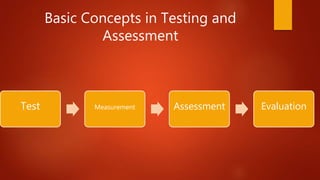
Test Measurement Assessment Evaluation
Basic Concepts in Testing and
Assessment
What is a Test?
 Most commonly used method of making measurements in
education
 An instrument or systematic procedures for measuring sample
of behaviour by posing a set of questions in a uniform manner
 Designed to measure any quality, ability, skill or knowledge
 There is always right/best and wrong answer.
What is Measurement?
 Basically assignment of numbers
 Variety of instruments such as tests, rating scales, rubrics are
used
 The process of obtaining numerical description of the degree
of individual processes
 Quantifying how much learners learned
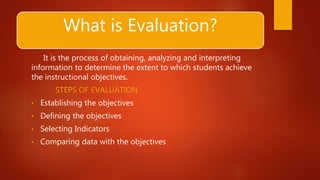
What is Evaluation?
It is the process of obtaining, analyzing and interpreting
information to determine the extent to which students achieve
the instructional objectives.
STEPS OF EVALUATION
• Establishing the objectives
• Defining the objectives
• Selecting Indicators
• Comparing data with the objectives
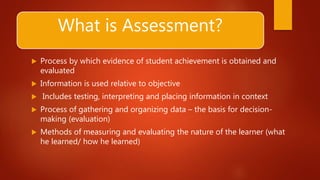
What is Assessment?
 Process by which evidence of student achievement is obtained and
evaluated
 Information is used relative to objective
 Includes testing, interpreting and placing information in context
 Process of gathering and organizing data – the basis for decision-
making (evaluation)
 Methods of measuring and evaluating the nature of the learner (what
he learned/ how he learned)
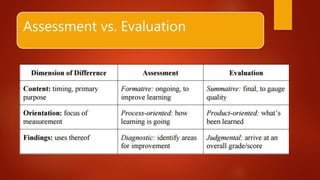
Assessment vs. Evaluation
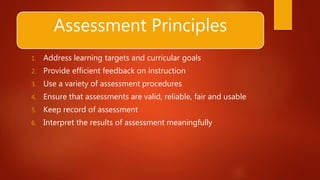
Assessment Principles
1. Address learning targets and curricular goals
2. Provide efficient feedback on instruction
3. Use a variety of assessment procedures
4. Ensure that assessments are valid, reliable, fair and usable
5. Keep record of assessment
6. Interpret the results of assessment meaningfully
Assessment Requirements
 Providing relevant measures of learning outcomes and
indirect evidence
 Determining what to be measured and defining it precisely
 Specifiying the achievement domain so that the sample of
items will represent the total domain.
Planning an Achievement Test
1. Determining the purpose of assessment
2. Developing the test specifications
3. Selecting appropriate assessment tasks
4. Preparing relevant test items
5. Assembling the test
6. Administering the test
7. Appraising the test
8. Using the results
GOAL: IMPROVED LEARNING AND INSTRUCTION
(Grounlund & Linn, 1990)
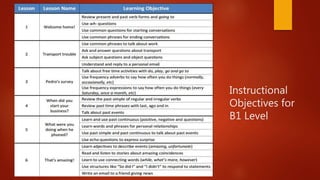
Instructional Objectives
Essentials of Instructional Objectives
• Learning Activities (means to an end)
• Learning Objectives (end result)
Components of Instructional Objectives
• Observable
• Nonobservable
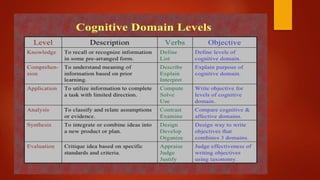
Instructional
Objectives for
B1 Level
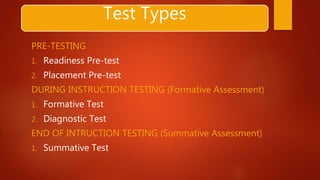
Test Types
PRE-TESTING
1. Readiness Pre-test
2. Placement Pre-test
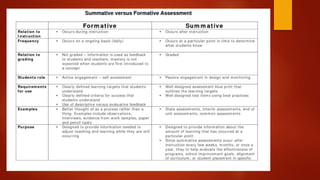
DURING INSTRUCTION TESTING (Formative Assessment)
1. Formative Test
2. Diagnostic Test
END OF INTRUCTION TESTING (Summative Assessment)
1. Summative Test
Pre-testing
They are given at the beginning of the instruction.
 To determine readiness
 To determine student placement
 To modify the instruction
 READINESS TESTS MAY BE LIMITED IN SCOPE.
Testing During Instruction
 To provide the basis for formative assessment
 To monitor learning process
 To collect corrective prescriptions for learning objectives
 To diagnose learning difficulties of students
 To provide alternative methods for learning difficulties
Types of formative tests?
Tests, quizzes, end of unit tests.
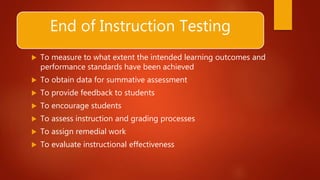
End of Instruction Testing
 To measure to what extent the intended learning outcomes and
performance standards have been achieved
 To obtain data for summative assessment
 To provide feedback to students
 To encourage students
 To assess instruction and grading processes
 To assign remedial work
 To evaluate instructional effectiveness
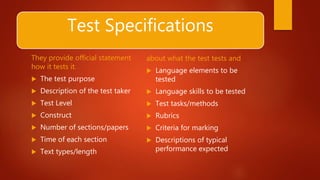
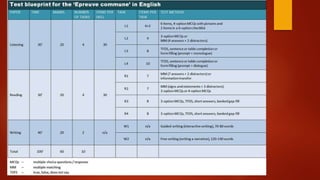
Test Specifications
They provide official statement
how it tests it.
 The test purpose
 Description of the test taker
 Test Level
 Construct
 Number of sections/papers
 Time of each section
 Text types/length
about what the test tests and
 Language elements to be
tested
 Language skills to be tested
 Test tasks/methods
 Rubrics
 Criteria for marking
 Descriptions of typical
performance expected
Test Specifications
TASK: Find the specifications listed in the hand-outs.
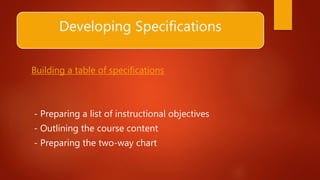
Developing Specifications
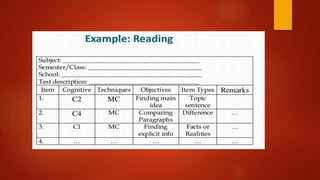
Building a table of specifications
- Preparing a list of instructional objectives
- Outlining the course content
- Preparing the two-way chart
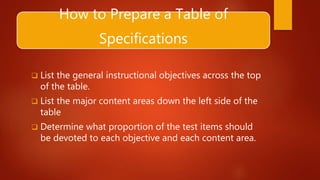
How to Prepare a Table of
Specifications
 List the general instructional objectives across the top
of the table.
 List the major content areas down the left side of the
table
 Determine what proportion of the test items should
be devoted to each objective and each content area.
Using one way classification system
 For a reading test, a list of reading skills and the number of
test items for measuring each skill may be sufficient.
 The content may vary, but the skill outcomes remain fairly
constant.
 A master list of skills can be prepared with various types of
reading material. (Criterian-referenced interpretation)
 The material is not included in the specifications, it will need
to be carefully selected.
General Classification of Test Items
Selection-typed Items
• Multiple Choice, True/False
Supply-typed Items
• Essay, Short Answer
Selecting Appropriate Types of Items
and Assessment Tasks
Classroom Test: Objective test items
• Highly structured
• Require to supply a word or two/select the correct answer
• A single right or best answer
PerformanceAssessments: Constructive responses
• Permit to organize and construct the answer in the essay form
• Require generating hypotheses, make observations, construct something, or perform for an
audiences
• No single right response; a variety of responses
The Objective Test Item
 SUPPLY TYPES
- Short answer
What is another name for blueprint of a test?
(Test Specifications)
What are the essentials of a test?
(Validity, reliability, practicality, and fairness)
The Objective Test Item
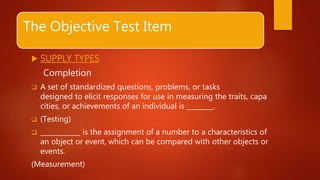
 SUPPLY TYPES
Completion
 A set of standardized questions, problems, or tasks
designed to elicit responses for use in measuring the traits, capa
cities, or achievements of an individual is ________.
 (Testing)
 ____________ is the assignment of a number to a characteristics of
an object or event, which can be compared with other objects or
events.
(Measurement)
The Objective Test Item
 SELECTION TYPES
- Matching
1. And A. Adjective
2. Dog B. Adverb
3. Jump C. Conjunction
4. She D. Noun
5. Quickly E. Preposition
F. Pronoun
The Objective Test Item
 SELECTION TYPES
True-false or Alternative Response
T F A virus is the smallest known organism.
T F An atom is the smallest particle of matter.
YES No Tigers are from the cat family.
YES No Acid turns litmus paper red.
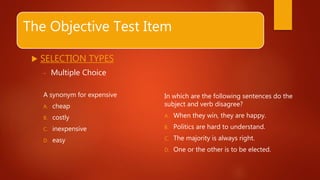
The Objective Test Item
 SELECTION TYPES
- Multiple Choice
A synonym for expensive
A. cheap
B. costly
C. inexpensive
D. easy
In which are the following sentences do the
subject and verb disagree?
A. When they win, they are happy.
B. Politics are hard to understand.
C. The majority is always right.
D. One or the other is to be elected.
Pros and Cons of Objective Tests
 Highly structured tasks that limits the type of response
 Demonstration of the specific knowledge, understanding, or
skill called for in the item.
 No redefinition of the problem or organization and
presentation of the answer.
 Objective scoring
 Quick, easy and accurate.
 On the negative side, inappropriate for measuring the ability
to measure higher level cognitive outcomes.
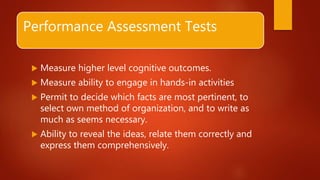
Performance Assessment Tests
 Measure higher level cognitive outcomes.
 Measure ability to engage in hands-in activities
 Permit to decide which facts are most pertinent, to
select own method of organization, and to write as
much as seems necessary.
 Ability to reveal the ideas, relate them correctly and
express them comprehensively.
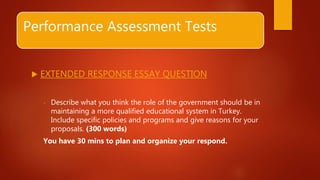
Performance Assessment Tests
 EXTENDED RESPONSE ESSAY QUESTION
- Describe what you think the role of the government should be in
maintaining a more qualified educational system in Turkey.
Include specific policies and programs and give reasons for your
proposals. (300 words)
You have 30 mins to plan and organize your respond.
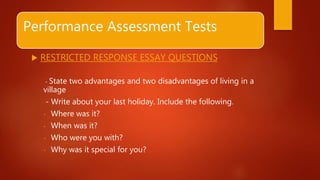
Performance Assessment Tests
 RESTRICTED RESPONSE ESSAY QUESTIONS
- State two advantages and two disadvantages of living in a
village
- Write about your last holiday. Include the following.
- Where was it?
- When was it?
- Who were you with?
- Why was it special for you?
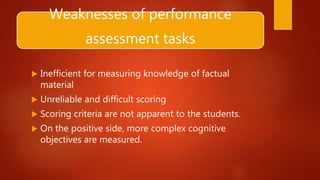
Weaknesses of performance
assessment tasks
 Inefficient for measuring knowledge of factual
material
 Unreliable and difficult scoring
 Scoring criteria are not apparent to the students.
 On the positive side, more complex cognitive
objectives are measured.
Other Types of Performance
Assessment
 EXTENDED-RESPONSE PERFORMANCE TASKS
- Prepare a video for another country and make an
oral presentation to the class using appropriate visual
displays.
Other Types of Performanse
Assessment
 RESTRICTED-RESPONSE PERFORMANCE TASKS
- Talk about your graduation prompt.
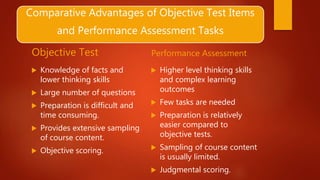
Comparative Advantages of Objective Test Items
and Performance Assessment Tasks
Objective Test
 Knowledge of facts and
lower thinking skills
 Large number of questions
 Preparation is difficult and
time consuming.
 Provides extensive sampling
of course content.
 Objective scoring.
Performance Assessment
 Higher level thinking skills
and complex learning
outcomes
 Few tasks are needed
 Preparation is relatively
easier compared to
objective tests.
 Sampling of course content
is usually limited.
 Judgmental scoring.
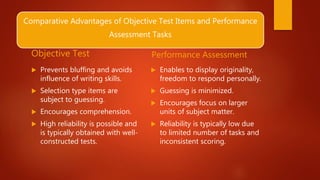
Comparative Advantages of Objective Test Items and Performance
Assessment Tasks
Objective Test
 Prevents bluffing and avoids
influence of writing skills.
 Selection type items are
subject to guessing.
 Encourages comprehension.
 High reliability is possible and
is typically obtained with well-
constructed tests.
Performance Assessment
 Enables to display originality,
freedom to respond personally.
 Guessing is minimized.
 Encourages focus on larger
units of subject matter.
 Reliability is typically low due
to limited number of tasks and
inconsistent scoring.
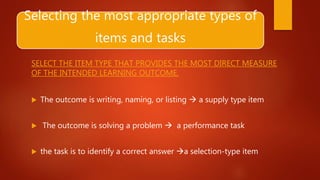
Selecting the most appropriate types of
items and tasks
SELECT THE ITEM TYPE THAT PROVIDES THE MOST DIRECT MEASURE
OF THE INTENDED LEARNING OUTCOME.
 The outcome is writing, naming, or listing  a supply type item
 The outcome is solving a problem  a performance task
 the task is to identify a correct answer a selection-type item
Eliminating Irrelevant Barriers in Test Items
 Avoiding ambiguity in statements in item roots.
 Eliminating unnecessary wording
 Making use of communicating vocabulary
 Providing clear cut and familiar instructions
 Eliminating any kind of bias in alternatives
Task: Eliminate the unnecessary wording above.
Eliminating Irrelevant Barries in Test Items
 Ambiguous Statements
 Excessive Wordiness
 Difficult Vocabulary
 Complex Sentence Structure
 Unclear Instructions
 Unclear Test Items/Tasks
 Racial, Ethnic, or Gender Bias
General Suggestions for Writing Test Items and Assessment Tasks
 Use your test specifications as a guide.
 Write more items than needed.
 Write the items in advance of the testing date.
 Write each test item so that they are to be performed
clearly.
 Write each item at an appropriate reading level.
 Write each item so that it does not provide help in
responding other items.

Test and Assessment Types

  • 1.
    Planning Assessment THE BASICTYPES OF ASSESSMENT
  • 2.
    Test Measurement AssessmentEvaluation Basic Concepts in Testing and Assessment
  • 3.
    What is aTest?  Most commonly used method of making measurements in education  An instrument or systematic procedures for measuring sample of behaviour by posing a set of questions in a uniform manner  Designed to measure any quality, ability, skill or knowledge  There is always right/best and wrong answer.
  • 4.
    What is Measurement? Basically assignment of numbers  Variety of instruments such as tests, rating scales, rubrics are used  The process of obtaining numerical description of the degree of individual processes  Quantifying how much learners learned
  • 5.
    What is Evaluation? Itis the process of obtaining, analyzing and interpreting information to determine the extent to which students achieve the instructional objectives. STEPS OF EVALUATION • Establishing the objectives • Defining the objectives • Selecting Indicators • Comparing data with the objectives
  • 6.
    What is Assessment? Process by which evidence of student achievement is obtained and evaluated  Information is used relative to objective  Includes testing, interpreting and placing information in context  Process of gathering and organizing data – the basis for decision- making (evaluation)  Methods of measuring and evaluating the nature of the learner (what he learned/ how he learned)
  • 7.
  • 8.
    Assessment Principles 1. Addresslearning targets and curricular goals 2. Provide efficient feedback on instruction 3. Use a variety of assessment procedures 4. Ensure that assessments are valid, reliable, fair and usable 5. Keep record of assessment 6. Interpret the results of assessment meaningfully
  • 9.
    Assessment Requirements  Providingrelevant measures of learning outcomes and indirect evidence  Determining what to be measured and defining it precisely  Specifiying the achievement domain so that the sample of items will represent the total domain.
  • 10.
    Planning an AchievementTest 1. Determining the purpose of assessment 2. Developing the test specifications 3. Selecting appropriate assessment tasks 4. Preparing relevant test items 5. Assembling the test 6. Administering the test 7. Appraising the test 8. Using the results GOAL: IMPROVED LEARNING AND INSTRUCTION (Grounlund & Linn, 1990)
  • 11.
    Instructional Objectives Essentials ofInstructional Objectives • Learning Activities (means to an end) • Learning Objectives (end result) Components of Instructional Objectives • Observable • Nonobservable
  • 13.
  • 14.
    Test Types PRE-TESTING 1. ReadinessPre-test 2. Placement Pre-test DURING INSTRUCTION TESTING (Formative Assessment) 1. Formative Test 2. Diagnostic Test END OF INTRUCTION TESTING (Summative Assessment) 1. Summative Test
  • 15.
    Pre-testing They are givenat the beginning of the instruction.  To determine readiness  To determine student placement  To modify the instruction  READINESS TESTS MAY BE LIMITED IN SCOPE.
  • 16.
    Testing During Instruction To provide the basis for formative assessment  To monitor learning process  To collect corrective prescriptions for learning objectives  To diagnose learning difficulties of students  To provide alternative methods for learning difficulties Types of formative tests? Tests, quizzes, end of unit tests.
  • 17.
    End of InstructionTesting  To measure to what extent the intended learning outcomes and performance standards have been achieved  To obtain data for summative assessment  To provide feedback to students  To encourage students  To assess instruction and grading processes  To assign remedial work  To evaluate instructional effectiveness
  • 19.
    Test Specifications They provideofficial statement how it tests it.  The test purpose  Description of the test taker  Test Level  Construct  Number of sections/papers  Time of each section  Text types/length about what the test tests and  Language elements to be tested  Language skills to be tested  Test tasks/methods  Rubrics  Criteria for marking  Descriptions of typical performance expected
  • 20.
    Test Specifications TASK: Findthe specifications listed in the hand-outs.
  • 21.
    Developing Specifications Building atable of specifications - Preparing a list of instructional objectives - Outlining the course content - Preparing the two-way chart
  • 23.
    How to Preparea Table of Specifications  List the general instructional objectives across the top of the table.  List the major content areas down the left side of the table  Determine what proportion of the test items should be devoted to each objective and each content area.
  • 25.
    Using one wayclassification system  For a reading test, a list of reading skills and the number of test items for measuring each skill may be sufficient.  The content may vary, but the skill outcomes remain fairly constant.  A master list of skills can be prepared with various types of reading material. (Criterian-referenced interpretation)  The material is not included in the specifications, it will need to be carefully selected.
  • 26.
    General Classification ofTest Items Selection-typed Items • Multiple Choice, True/False Supply-typed Items • Essay, Short Answer
  • 27.
    Selecting Appropriate Typesof Items and Assessment Tasks Classroom Test: Objective test items • Highly structured • Require to supply a word or two/select the correct answer • A single right or best answer PerformanceAssessments: Constructive responses • Permit to organize and construct the answer in the essay form • Require generating hypotheses, make observations, construct something, or perform for an audiences • No single right response; a variety of responses
  • 28.
    The Objective TestItem  SUPPLY TYPES - Short answer What is another name for blueprint of a test? (Test Specifications) What are the essentials of a test? (Validity, reliability, practicality, and fairness)
  • 29.
    The Objective TestItem  SUPPLY TYPES Completion  A set of standardized questions, problems, or tasks designed to elicit responses for use in measuring the traits, capa cities, or achievements of an individual is ________.  (Testing)  ____________ is the assignment of a number to a characteristics of an object or event, which can be compared with other objects or events. (Measurement)
  • 30.
    The Objective TestItem  SELECTION TYPES - Matching 1. And A. Adjective 2. Dog B. Adverb 3. Jump C. Conjunction 4. She D. Noun 5. Quickly E. Preposition F. Pronoun
  • 31.
    The Objective TestItem  SELECTION TYPES True-false or Alternative Response T F A virus is the smallest known organism. T F An atom is the smallest particle of matter. YES No Tigers are from the cat family. YES No Acid turns litmus paper red.
  • 32.
    The Objective TestItem  SELECTION TYPES - Multiple Choice A synonym for expensive A. cheap B. costly C. inexpensive D. easy In which are the following sentences do the subject and verb disagree? A. When they win, they are happy. B. Politics are hard to understand. C. The majority is always right. D. One or the other is to be elected.
  • 33.
    Pros and Consof Objective Tests  Highly structured tasks that limits the type of response  Demonstration of the specific knowledge, understanding, or skill called for in the item.  No redefinition of the problem or organization and presentation of the answer.  Objective scoring  Quick, easy and accurate.  On the negative side, inappropriate for measuring the ability to measure higher level cognitive outcomes.
  • 34.
    Performance Assessment Tests Measure higher level cognitive outcomes.  Measure ability to engage in hands-in activities  Permit to decide which facts are most pertinent, to select own method of organization, and to write as much as seems necessary.  Ability to reveal the ideas, relate them correctly and express them comprehensively.
  • 35.
    Performance Assessment Tests EXTENDED RESPONSE ESSAY QUESTION - Describe what you think the role of the government should be in maintaining a more qualified educational system in Turkey. Include specific policies and programs and give reasons for your proposals. (300 words) You have 30 mins to plan and organize your respond.
  • 36.
    Performance Assessment Tests RESTRICTED RESPONSE ESSAY QUESTIONS - State two advantages and two disadvantages of living in a village - Write about your last holiday. Include the following. - Where was it? - When was it? - Who were you with? - Why was it special for you?
  • 37.
    Weaknesses of performance assessmenttasks  Inefficient for measuring knowledge of factual material  Unreliable and difficult scoring  Scoring criteria are not apparent to the students.  On the positive side, more complex cognitive objectives are measured.
  • 38.
    Other Types ofPerformance Assessment  EXTENDED-RESPONSE PERFORMANCE TASKS - Prepare a video for another country and make an oral presentation to the class using appropriate visual displays.
  • 39.
    Other Types ofPerformanse Assessment  RESTRICTED-RESPONSE PERFORMANCE TASKS - Talk about your graduation prompt.
  • 40.
    Comparative Advantages ofObjective Test Items and Performance Assessment Tasks Objective Test  Knowledge of facts and lower thinking skills  Large number of questions  Preparation is difficult and time consuming.  Provides extensive sampling of course content.  Objective scoring. Performance Assessment  Higher level thinking skills and complex learning outcomes  Few tasks are needed  Preparation is relatively easier compared to objective tests.  Sampling of course content is usually limited.  Judgmental scoring.
  • 41.
    Comparative Advantages ofObjective Test Items and Performance Assessment Tasks Objective Test  Prevents bluffing and avoids influence of writing skills.  Selection type items are subject to guessing.  Encourages comprehension.  High reliability is possible and is typically obtained with well- constructed tests. Performance Assessment  Enables to display originality, freedom to respond personally.  Guessing is minimized.  Encourages focus on larger units of subject matter.  Reliability is typically low due to limited number of tasks and inconsistent scoring.
  • 42.
    Selecting the mostappropriate types of items and tasks SELECT THE ITEM TYPE THAT PROVIDES THE MOST DIRECT MEASURE OF THE INTENDED LEARNING OUTCOME.  The outcome is writing, naming, or listing  a supply type item  The outcome is solving a problem  a performance task  the task is to identify a correct answer a selection-type item
  • 43.
    Eliminating Irrelevant Barriersin Test Items  Avoiding ambiguity in statements in item roots.  Eliminating unnecessary wording  Making use of communicating vocabulary  Providing clear cut and familiar instructions  Eliminating any kind of bias in alternatives Task: Eliminate the unnecessary wording above.
  • 44.
    Eliminating Irrelevant Barriesin Test Items  Ambiguous Statements  Excessive Wordiness  Difficult Vocabulary  Complex Sentence Structure  Unclear Instructions  Unclear Test Items/Tasks  Racial, Ethnic, or Gender Bias
  • 45.
    General Suggestions forWriting Test Items and Assessment Tasks  Use your test specifications as a guide.  Write more items than needed.  Write the items in advance of the testing date.  Write each test item so that they are to be performed clearly.  Write each item at an appropriate reading level.  Write each item so that it does not provide help in responding other items.