DEVELOPMENT OF
ACHIEVEMENT TEST
DR.R.PUSHPA NAMDEO
ASSISTANT PROFESSOR
DEPARTMENT OF EDUCATION
MAHATMA GANDHI ANTARRASHTRIYA HINDI VISHWAVIDYALAYA
WARDHA,MH
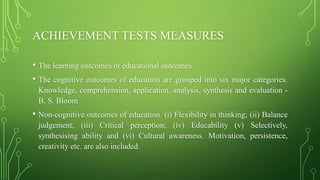
ACHIEVEMENT TESTS MEASURES
• The learning outcomes or educational outcomes.
• The cognitive outcomes of education are grouped into six major categories.
Knowledge, comprehension, application, analysis, synthesis and evaluation -
B. S. Bloom
• Non-cognitive outcomes of education. (i) Flexibility in thinking; (ii) Balance
judgement; (iii) Critical perception; (iv) Educability (v) Selectively,
synthesising ability and (vi) Cultural awareness. Motivation, persistence,
creativity etc. are also included.
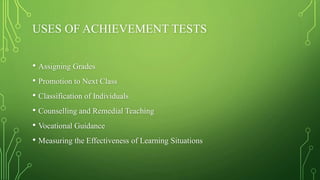
USES OF ACHIEVEMENT TESTS
• Assigning Grades
• Promotion to Next Class
• Classification of Individuals
• Counselling and Remedial Teaching
• Vocational Guidance
• Measuring the Effectiveness of Learning Situations
PREPARING A GOOD ANNUAL ACHIEVEMENT
TEST PAPER
• The first step for preparing a good test paper is to develop a design or framework.
For this:
➢Analyze the course content into different content or units and decide the weightage that is to be
given to each in the test.
➢Decide the weightage to be given to different objectives being tested.
➢Decide the weightage to be given to different forms of questions to be used in preparing a test
paper.
➢Decide the weightage to be given to time and marks for different forms of questions.
➢Decide the weightage to be given to the difficulty level in the test.
• The second step is to prepare a blueprint.
• The first step for preparing a good achievement test paper
• Preparing a table of specifications
• Decision on units and their weightage
Table I: Weightage given to different content units
Content /Units No. of Questions Weightage given(%)
Unit-1
Unit-2
Unit-3
Unit-4
Unit-5
4
5
5
4
4
18
23
23
18
18
Total 22 100
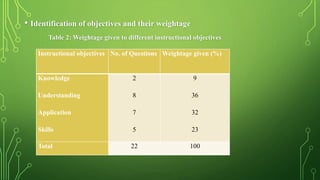
• Identification of objectives and their weightage
Table 2: Weightage given to different instructional objectives
Instructional objectives No. of Questions Weightage given (%)
Knowledge
Understanding
Application
Skills
2
8
7
5
9
36
32
23
Total 22 100
• Deciding types and number of test items
Table 3: Weightage given to different types of questions
Types of Question No. of Questions Weightage given (%)
Objective type questions
Very Short answer type questions
Short answer type question
Essay type question
10
4
5
3
45
18
23
14
Total 22 100
• Assigning weightage i.e. marks for different types of questions and number of questions.
Table 4: Weightage given to different types of questions and no. of questions in terms of marks
Types of Question Marks per Question No. of Questions Total Marks
Objective type questions
Very Short answer type questions
Short answer type question
Essay type question
1
2.5
4
10
10
4
5
3
10
10
20
30
Total 22 70
• Estimation of Time
Table 5: Weightage given to time for different types of questions
Types of questions Time per question
(in minutes)
Total number
of questions
Total Time
(in minutes)
Objective type questions
Very Short answer type questions
Short answer type question
Essay type question
1.5
5
8
15
10
4
5
3
15
20
40
45
22 120
• Assigning weightage to difficulty levels of the items
Table 6: Weightage to difficulty levels of the items
Difficulty levels Weightage given (%)
Difficult items
Average items
Easy items
25
50
25
Total 100
PREPARING BLUEPRINT
The second step is to prepare a blueprint
Table 7: Blueprint (Table of Specifications)
Objective
s →
Knowledge Understanding Application Skill
Total
Types of
Question
→
Unit↓
Obj. VSA SA E Obj. VSA SA E Obj. VSA SA E Obj. VSA SA E
Unit-1
Unit-2
Unit-3
Unit-4
Unit-5
Sub total
1(1)
1(1)
1(2.5)
1(2.5)
1(1)
1(1)
1(1)
1(1)
4(4)
1(2.5)
1(2.5)
1(4)
1(4)
2(8)
1(10)
1(10)
1(1)
1(1)
1(1)
3(3)
1(2.5)
1(2.5)
2(5)
1(4)
1(4)
1(10)
1(10)
1(1)
1(1)
2(2)
1(4)
1(4)
2(8)
1(10)
1(10)
4
5
5
4
4
22(70)
Total 2(3.5) 8(24.5) 7(22) 5(20) 22(70)
• In the blue print numbers inside the bracket represents marks per question
i.e.1(2.5)
• Entries made are only to illustrate. You have to decide about these while preparing
the blueprint. However, weightage indicated in the design to the various
objectives (2,8,7,5), content units (4,5,5,4,4) and form of questions (E= 3, S.A. =
5, VSA=4, O.T.=10) as reflected in this table of specification or blueprint.
On the basis of the above blue print, achievement test paper is prepared.
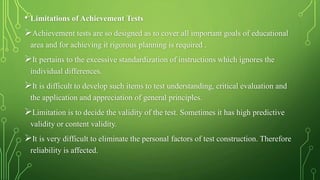
• Limitations of Achievement Tests
➢Achievement tests are so designed as to cover all important goals of educational
area and for achieving it rigorous planning is required .
➢It pertains to the excessive standardization of instructions which ignores the
individual differences.
➢It is difficult to develop such items to test understanding, critical evaluation and
the application and appreciation of general principles.
➢Limitation is to decide the validity of the test. Sometimes it has high predictive
validity or content validity.
➢It is very difficult to eliminate the personal factors of test construction. Therefore
reliability is affected.
THANK YOU

Achievement test ppt ...pdf

  • 1.
    DEVELOPMENT OF ACHIEVEMENT TEST DR.R.PUSHPANAMDEO ASSISTANT PROFESSOR DEPARTMENT OF EDUCATION MAHATMA GANDHI ANTARRASHTRIYA HINDI VISHWAVIDYALAYA WARDHA,MH
  • 2.
    ACHIEVEMENT TESTS MEASURES •The learning outcomes or educational outcomes. • The cognitive outcomes of education are grouped into six major categories. Knowledge, comprehension, application, analysis, synthesis and evaluation - B. S. Bloom • Non-cognitive outcomes of education. (i) Flexibility in thinking; (ii) Balance judgement; (iii) Critical perception; (iv) Educability (v) Selectively, synthesising ability and (vi) Cultural awareness. Motivation, persistence, creativity etc. are also included.
  • 3.
    USES OF ACHIEVEMENTTESTS • Assigning Grades • Promotion to Next Class • Classification of Individuals • Counselling and Remedial Teaching • Vocational Guidance • Measuring the Effectiveness of Learning Situations
  • 4.
    PREPARING A GOODANNUAL ACHIEVEMENT TEST PAPER • The first step for preparing a good test paper is to develop a design or framework. For this: ➢Analyze the course content into different content or units and decide the weightage that is to be given to each in the test. ➢Decide the weightage to be given to different objectives being tested. ➢Decide the weightage to be given to different forms of questions to be used in preparing a test paper. ➢Decide the weightage to be given to time and marks for different forms of questions. ➢Decide the weightage to be given to the difficulty level in the test. • The second step is to prepare a blueprint.
  • 5.
    • The firststep for preparing a good achievement test paper • Preparing a table of specifications • Decision on units and their weightage Table I: Weightage given to different content units Content /Units No. of Questions Weightage given(%) Unit-1 Unit-2 Unit-3 Unit-4 Unit-5 4 5 5 4 4 18 23 23 18 18 Total 22 100
  • 6.
    • Identification ofobjectives and their weightage Table 2: Weightage given to different instructional objectives Instructional objectives No. of Questions Weightage given (%) Knowledge Understanding Application Skills 2 8 7 5 9 36 32 23 Total 22 100
  • 7.
    • Deciding typesand number of test items Table 3: Weightage given to different types of questions Types of Question No. of Questions Weightage given (%) Objective type questions Very Short answer type questions Short answer type question Essay type question 10 4 5 3 45 18 23 14 Total 22 100
  • 8.
    • Assigning weightagei.e. marks for different types of questions and number of questions. Table 4: Weightage given to different types of questions and no. of questions in terms of marks Types of Question Marks per Question No. of Questions Total Marks Objective type questions Very Short answer type questions Short answer type question Essay type question 1 2.5 4 10 10 4 5 3 10 10 20 30 Total 22 70
  • 9.
    • Estimation ofTime Table 5: Weightage given to time for different types of questions Types of questions Time per question (in minutes) Total number of questions Total Time (in minutes) Objective type questions Very Short answer type questions Short answer type question Essay type question 1.5 5 8 15 10 4 5 3 15 20 40 45 22 120
  • 10.
    • Assigning weightageto difficulty levels of the items Table 6: Weightage to difficulty levels of the items Difficulty levels Weightage given (%) Difficult items Average items Easy items 25 50 25 Total 100
  • 11.
    PREPARING BLUEPRINT The secondstep is to prepare a blueprint Table 7: Blueprint (Table of Specifications) Objective s → Knowledge Understanding Application Skill Total Types of Question → Unit↓ Obj. VSA SA E Obj. VSA SA E Obj. VSA SA E Obj. VSA SA E Unit-1 Unit-2 Unit-3 Unit-4 Unit-5 Sub total 1(1) 1(1) 1(2.5) 1(2.5) 1(1) 1(1) 1(1) 1(1) 4(4) 1(2.5) 1(2.5) 1(4) 1(4) 2(8) 1(10) 1(10) 1(1) 1(1) 1(1) 3(3) 1(2.5) 1(2.5) 2(5) 1(4) 1(4) 1(10) 1(10) 1(1) 1(1) 2(2) 1(4) 1(4) 2(8) 1(10) 1(10) 4 5 5 4 4 22(70) Total 2(3.5) 8(24.5) 7(22) 5(20) 22(70)
  • 12.
    • In theblue print numbers inside the bracket represents marks per question i.e.1(2.5) • Entries made are only to illustrate. You have to decide about these while preparing the blueprint. However, weightage indicated in the design to the various objectives (2,8,7,5), content units (4,5,5,4,4) and form of questions (E= 3, S.A. = 5, VSA=4, O.T.=10) as reflected in this table of specification or blueprint. On the basis of the above blue print, achievement test paper is prepared.
  • 13.
    • Limitations ofAchievement Tests ➢Achievement tests are so designed as to cover all important goals of educational area and for achieving it rigorous planning is required . ➢It pertains to the excessive standardization of instructions which ignores the individual differences. ➢It is difficult to develop such items to test understanding, critical evaluation and the application and appreciation of general principles. ➢Limitation is to decide the validity of the test. Sometimes it has high predictive validity or content validity. ➢It is very difficult to eliminate the personal factors of test construction. Therefore reliability is affected.
  • 14.