Swathi E
19ued041
II.B.Ed,Physical science & English
Definition Of Achievement Test
 “Any test that measures the accomplishments of an
individual after a period of training or learning”
-NM Downie
 “the type of ability test that describe what a person has
learned to do”
- Throndike & Hagen
Meaning of achievement test
 It refer to assessments which scores are often used
to determine the level of instruction for which
students are prepared.
 It is developed to measure skill and knowledge
learned in a given grade level, usually through
planned instruction, such as training or classroom
instruction.
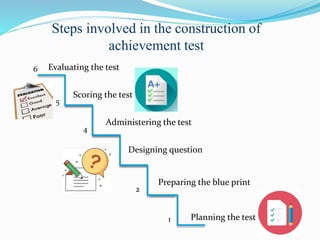
Planning the test
Preparing the blue print
Designing question
Administering the test
Scoring the test
Evaluating the test
1
2
3
4
5
6
Steps involved in the construction of
achievement test
1. Planning the test
 Weightage to objectives which means selection of obj.
and allotting marks to each
 Weightage to different area of content
 Weightage to different form of question
 Scheme of options
 Sections in the achievement test
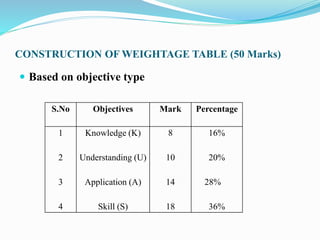
CONSTRUCTION OF WEIGHTAGE TABLE (50 Marks)
 Based on objective type
S.No Objectives Mark Percentage
1
2
3
4
Knowledge (K)
Understanding (U)
Application (A)
Skill (S)
8
10
14
18
16%
20%
28%
36%
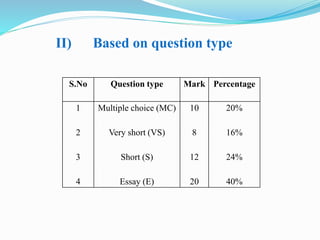
S.No Question type Mark Percentage
1
2
3
4
Multiple choice (MC)
Very short (VS)
Short (S)
Essay (E)
10
8
12
20
20%
16%
24%
40%
II) Based on question type
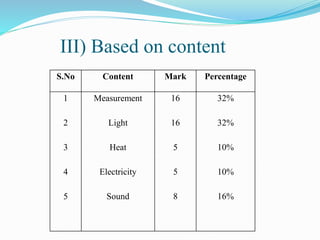
S.No Content Mark Percentage
1
2
3
4
5
Measurement
Light
Heat
Electricity
Sound
16
16
5
5
8
32%
32%
10%
10%
16%
III) Based on content
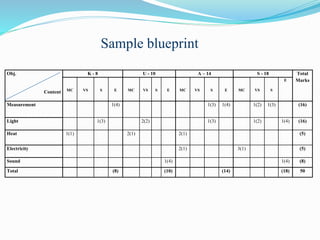
2) Preparing the blueprint
 Objectives to be tested
 Subject matter to be covered
 The form of question
Obj.
Content
K - 8 U - 10 A – 14 S - 18 Total
Marks
MC VS S E MC VS S E MC VS S E MC VS S
E
Measurement 1(4) 1(3) 1(4) 1(2) 1(3) (16)
Light 1(3) 2(2) 1(3) 1(2) 1(4) (16)
Heat 1(1) 2(1) 2(1) (5)
Electricity 2(1) 3(1) (5)
Sound 1(4) 1(4) (8)
Total (8) (10) (14) (18) 50
Sample blueprint
3) Designing question
 The next step is to design question basis of the
blueprint.
a) Defining the objective
b) Changing the objectives to specification
c) Complete knowledge of subject matter
4) Editing the question paper
 Assembling the questions on the basis of their form
e.g.
Section A - objective type
Section B - very short answer
Section C - short answer
Section D – essay type
 General instruction may be given at the beginning of a
question paper
5) Administering the test
 The key operation in the measurement of achievement
with the test is the actual use of the instrument by
students.
 Poor planning can lead to spurious result
 It involves predetermining among other things, time
of testing, place of testing, and giving of instructions.
6) Scoring key
 It is prepared for the objective questions, and a
marking scheme is made for essay and short questions.
 Marking scheme indicates:
a) The no. of point or step expected in the answer
b) The outline of each point or step expected in the
answer
c) The weightage of each of these points or steps.
7) Evaluating the test
 It the scores are extremely high, it may assume that the
test was too easy for the class
 If the scores seem very low, the test was probably too
difficult.
 A review of question paper necessitates three steps:
1. Question analysis (before the test)
2. Critical evaluation (before the test)
3. Item analysis (after the test)
a) Question wise analysis: help to know the strength
& weakness of the test.
b) Critical evaluation: helps to weed out duplication,
spelling mistakes that may exist in the paper
c) Item analysis: enables the teacher to evaluate the
effectiveness of test item
Review of question paper
Conclusion
 Achievement test scores are often used in an
educational system to determine what level of
instruction for which a student is prepared.
 Teachers use achievement tests to measure the
attainments of students.
Thank you …

Achievement test powerpoint97 2003

  • 1.
  • 2.
    Definition Of AchievementTest  “Any test that measures the accomplishments of an individual after a period of training or learning” -NM Downie  “the type of ability test that describe what a person has learned to do” - Throndike & Hagen
  • 3.
    Meaning of achievementtest  It refer to assessments which scores are often used to determine the level of instruction for which students are prepared.  It is developed to measure skill and knowledge learned in a given grade level, usually through planned instruction, such as training or classroom instruction.
  • 4.
    Planning the test Preparingthe blue print Designing question Administering the test Scoring the test Evaluating the test 1 2 3 4 5 6 Steps involved in the construction of achievement test
  • 5.
    1. Planning thetest  Weightage to objectives which means selection of obj. and allotting marks to each  Weightage to different area of content  Weightage to different form of question  Scheme of options  Sections in the achievement test
  • 6.
    CONSTRUCTION OF WEIGHTAGETABLE (50 Marks)  Based on objective type S.No Objectives Mark Percentage 1 2 3 4 Knowledge (K) Understanding (U) Application (A) Skill (S) 8 10 14 18 16% 20% 28% 36%
  • 7.
    S.No Question typeMark Percentage 1 2 3 4 Multiple choice (MC) Very short (VS) Short (S) Essay (E) 10 8 12 20 20% 16% 24% 40% II) Based on question type
  • 8.
    S.No Content MarkPercentage 1 2 3 4 5 Measurement Light Heat Electricity Sound 16 16 5 5 8 32% 32% 10% 10% 16% III) Based on content
  • 9.
    2) Preparing theblueprint  Objectives to be tested  Subject matter to be covered  The form of question
  • 10.
    Obj. Content K - 8U - 10 A – 14 S - 18 Total Marks MC VS S E MC VS S E MC VS S E MC VS S E Measurement 1(4) 1(3) 1(4) 1(2) 1(3) (16) Light 1(3) 2(2) 1(3) 1(2) 1(4) (16) Heat 1(1) 2(1) 2(1) (5) Electricity 2(1) 3(1) (5) Sound 1(4) 1(4) (8) Total (8) (10) (14) (18) 50 Sample blueprint
  • 11.
    3) Designing question The next step is to design question basis of the blueprint. a) Defining the objective b) Changing the objectives to specification c) Complete knowledge of subject matter
  • 12.
    4) Editing thequestion paper  Assembling the questions on the basis of their form e.g. Section A - objective type Section B - very short answer Section C - short answer Section D – essay type  General instruction may be given at the beginning of a question paper
  • 13.
    5) Administering thetest  The key operation in the measurement of achievement with the test is the actual use of the instrument by students.  Poor planning can lead to spurious result  It involves predetermining among other things, time of testing, place of testing, and giving of instructions.
  • 14.
    6) Scoring key It is prepared for the objective questions, and a marking scheme is made for essay and short questions.  Marking scheme indicates: a) The no. of point or step expected in the answer b) The outline of each point or step expected in the answer c) The weightage of each of these points or steps.
  • 15.
    7) Evaluating thetest  It the scores are extremely high, it may assume that the test was too easy for the class  If the scores seem very low, the test was probably too difficult.  A review of question paper necessitates three steps: 1. Question analysis (before the test) 2. Critical evaluation (before the test) 3. Item analysis (after the test)
  • 16.
    a) Question wiseanalysis: help to know the strength & weakness of the test. b) Critical evaluation: helps to weed out duplication, spelling mistakes that may exist in the paper c) Item analysis: enables the teacher to evaluate the effectiveness of test item Review of question paper
  • 17.
    Conclusion  Achievement testscores are often used in an educational system to determine what level of instruction for which a student is prepared.  Teachers use achievement tests to measure the attainments of students.
  • 18.