


Slow and fast learning with contemporary
digital technologies
Gráinne Conole, Bath Spa University
AECT conference –
Accelerate learning – racing to the future
Indianapolis, 4th November 2015
National
Teaching
Fellow 2012 Ascilite fellow 2012EDEN fellow 2013
Outline
• Education 2020
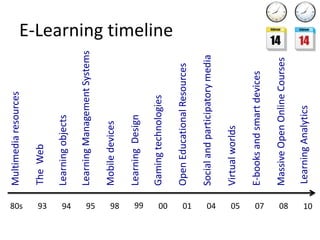
• E-learning timeline and emergent
technologies
• E-Pedagogies
• Facets of e-learning
– Openness
– Mobile learning
– Social media
– Digital identity and literacies
– Distributed cognition
• The argument for slowing down
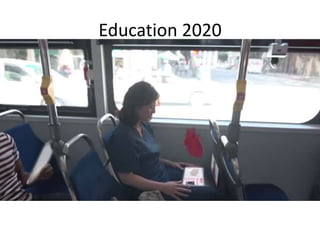
Education 2020
E-Learning timeline
Multimediaresources
80s
TheWeb
93
LearningManagementSystems
95
OpenEducationalResources
01
Mobiledevices
98
Gamingtechnologies
00 Socialandparticipatorymedia04
Virtualworlds
05
E-booksandsmartdevices
MassiveOpenOnlineCourses
07 08
LearningDesign
99
Learningobjects
94
LearningAnalytics
10
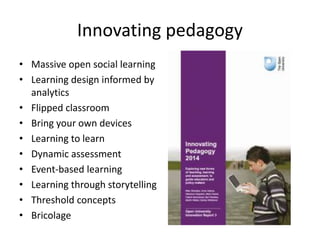
Innovating pedagogy
• Massive open social learning
• Learning design informed by
analytics
• Flipped classroom
• Bring your own devices
• Learning to learn
• Dynamic assessment
• Event-based learning
• Learning through storytelling
• Threshold concepts
• Bricolage
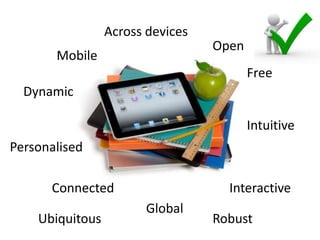
Mobile
Across devices
Dynamic
Personalised
Connected
Free
Interactive
Intuitive
Global
Open
RobustUbiquitous
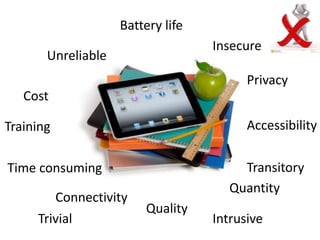
Unreliable
Battery life
Cost
Training
Time consuming
Privacy
Quantity
Accessibility
Quality
Insecure
IntrusiveTrivial
Connectivity
Transitory
https://tinyurl.com/hotelproject
1. Openness
• Digital technologies enable
more open practices
• Emergence of OER and
MOOCs
• Increase of free resource and
expertise, via Webinars, blogs,
open repositories and
journals, social media
The good and the bad…
• Transparency
• Greater reach
• Equity and social
inclusion
• Challenging existing
business models
• Disaggregation of
education
• “Laying yourself bare”
• Surveillance
• Misuse of data
• Misinterpretation
• Issues re quality and
accreditation
• Ownership
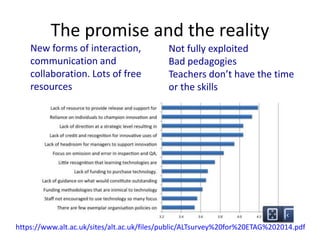
The promise and the reality
New forms of interaction,
communication and
collaboration. Lots of free
resources
Not fully exploited
Bad pedagogies
Teachers don’t have the time
or the skills
https://www.alt.ac.uk/sites/alt.ac.uk/files/public/ALTsurvey%20for%20ETAG%202014.pdf
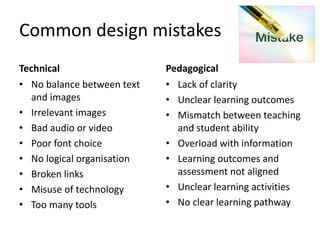
Common design mistakes
Technical
• No balance between text
and images
• Irrelevant images
• Bad audio or video
• Poor font choice
• No logical organisation
• Broken links
• Misuse of technology
• Too many tools
Pedagogical
• Lack of clarity
• Unclear learning outcomes
• Mismatch between teaching
and student ability
• Overload with information
• Learning outcomes and
assessment not aligned
• Unclear learning activities
• No clear learning pathway
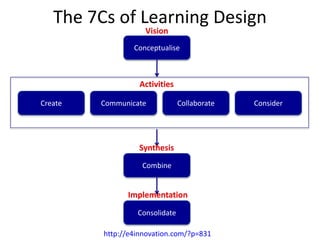
The 7Cs of Learning Design
Conceptualise
Vision
CommunicateCreate ConsiderCollaborate
Activities
Combine
Synthesis
Consolidate
Implementation
http://e4innovation.com/?p=831
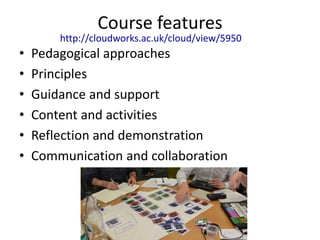
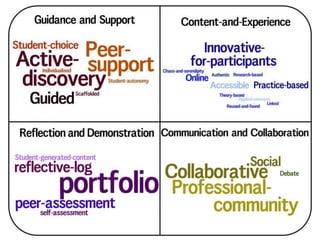
Course features
• Pedagogical approaches
• Principles
• Guidance and support
• Content and activities
• Reflection and demonstration
• Communication and collaboration
http://cloudworks.ac.uk/cloud/view/5950
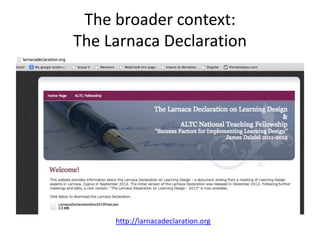
The broader context:
The Larnaca Declaration
http://larnacadeclaration.org
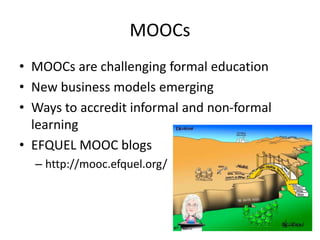
MOOCs
• MOOCs are challenging formal education
• New business models emerging
• Ways to accredit informal and non-formal
learning
• EFQUEL MOOC blogs
– http://mooc.efquel.org/
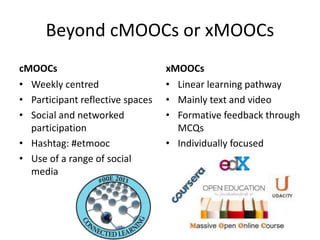
Beyond cMOOCs or xMOOCs
cMOOCs
• Weekly centred
• Participant reflective spaces
• Social and networked
participation
• Hashtag: #etmooc
• Use of a range of social
media
xMOOCs
• Linear learning pathway
• Mainly text and video
• Formative feedback through
MCQs
• Individually focused
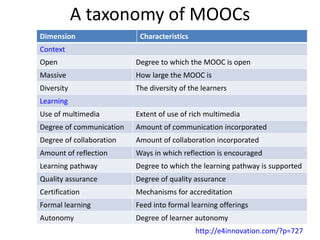
Dimension Characteristics
Context
Open Degree to which the MOOC is open
Massive How large the MOOC is
Diversity The diversity of the learners
Learning
Use of multimedia Extent of use of rich multimedia
Degree of communication Amount of communication incorporated
Degree of collaboration Amount of collaboration incorporated
Amount of reflection Ways in which reflection is encouraged
Learning pathway Degree to which the learning pathway is supported
Quality assurance Degree of quality assurance
Certification Mechanisms for accreditation
Formal learning Feed into formal learning offerings
Autonomy Degree of learner autonomy
A taxonomy of MOOCs
http://e4innovation.com/?p=727
2. Mobile learning
• Smart phones and tablets almost ubiquitous
• Learning anytime, anywhere
• Affordances of mobile
– Small and compact
– Personal
– Capturing sound, video, image
– Good battery life
– Wearable tech
– Portable
– Easy to read
– Enables learning in special locations (i.e.
fieldwork
– Feasible and affordable because of good size,
weight, screen, battery life and cost
– Range of excellent Apps to support
communication, productivity, curation and
learning
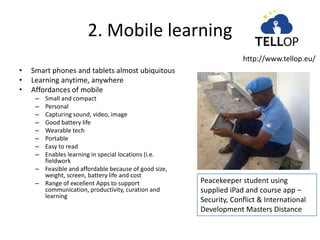
Peacekeeper student using
supplied iPad and course app –
Security, Conflict & International
Development Masters Distance
http://www.tellop.eu/
The good and the bad…
• Learning anywhere,
anytime
• Mobile ready websites
and Apps
• Learning across
contexts and devices
• Ubiquitous connectivity
• Social inclusion
• No ‘down time’
• Dependency
• Info in the Cloud
• Battery life
• Lack of digital literacy
skills to use effectively
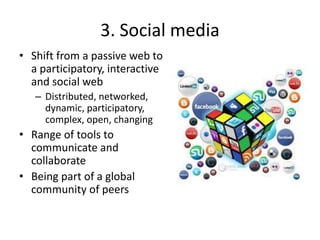
3. Social media
• Shift from a passive web to
a participatory, interactive
and social web
– Distributed, networked,
dynamic, participatory,
complex, open, changing
• Range of tools to
communicate and
collaborate
• Being part of a global
community of peers
The good and the bad…
• Rich ways to communicate
and collaborate
• Part of a global community
of peers
• Access to vast amount of
information
• Rapid dissemination of
information
• Crowd sourcing
• Lack of privacy
• Negative digital traces
• Misuse of data
• Cyberbulling and trolling
• Privacy and security
• Corporate control
• Time consuming
• Addictive
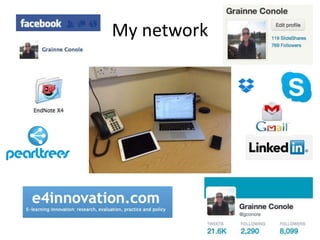
My network
The dark side…
4. Digital Identity, literacies
and creativity
• Digital identity is how you
present yourself online
• How you interact and
communicate with others
• Facets
– Reputation
– Impact
– Influence
– Productivity
– Openness
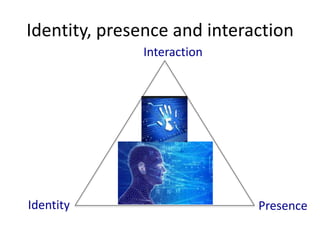
Identity, presence and interaction
Interaction
Identity Presence
Presence
• Presence (markchilds.wordpress.com)
– Mediated presence
• “being there”
• immersion
– Social presence
• projection of ourselves
• perception of others
– Copresence
• being somewhere with others
– Self presence
• or embodiment
http://www.flickr.com/photos/deadair/4250153736/
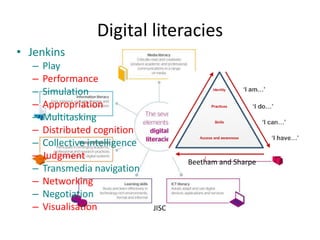
Digital literacies
JISC
Beetham and Sharpe
• Jenkins
– Play
– Performance
– Simulation
– Appropriation
– Multitasking
– Distributed cognition
– Collective intelligence
– Judgment
– Transmedia navigation
– Networking
– Negotiation
– Visualisation
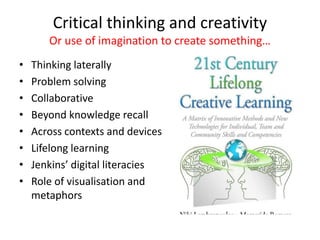
Critical thinking and creativity
Or use of imagination to create something…
• Thinking laterally
• Problem solving
• Collaborative
• Beyond knowledge recall
• Across contexts and devices
• Lifelong learning
• Jenkins’ digital literacies
• Role of visualisation and
metaphors
The good and the bad…
• Extension of ‘real’ self –
can be the same or
different
• Extended reach
• Exploiting the medium
• “Laying yourself bare”
• Misinterpretation of
identity
• Cyber-stalking
• Identity theft
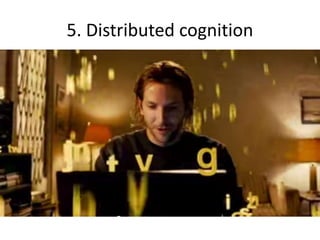
5. Distributed cognition
The good and the bad…
• “Person-Plus”
• Exploiting vast amount
of information
• Tools to curate,
manage, filter
• Enhanced capacity
• Greater cognition
• Lack of digital literacy
skills to use effectively
• Easy to get lost and
confused
• Lack of permanency
• Machines taking over..
• Over dependency
Technologies: the impact on learning
• Access to an unprecedented
amount of free tools, resources,
courses and expertise
• Instantaneous interaction and
communication
• A global, distributed community of
peers
• Fragmented identities
• Multiple ways to learn
• New forms of recognition of
learning
• But… is it to much, too fast and out
of control?
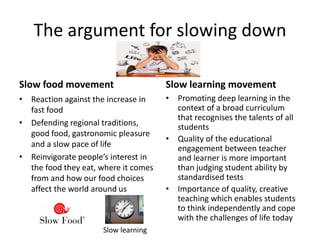
The argument for slowing down
Slow food movement
• Reaction against the increase in
fast food
• Defending regional traditions,
good food, gastronomic pleasure
and a slow pace of life
• Reinvigorate people’s interest in
the food they eat, where it comes
from and how our food choices
affect the world around us
Slow learning movement
• Promoting deep learning in the
context of a broad curriculum
that recognises the talents of all
students
• Quality of the educational
engagement between teacher
and learner is more important
than judging student ability by
standardised tests
• Importance of quality, creative
teaching which enables students
to think independently and cope
with the challenges of life today
Slow learning
Future challenges
• Disaggregating Education
• New
– Digital literacies
– Business models
– Pedagogies
– Approaches to design
• Understanding digital
identity
• Blurring of boundaries
• A move to slowing down
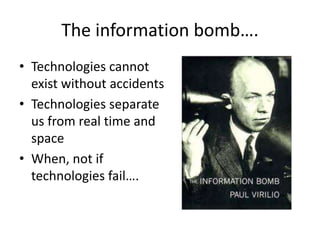
The information bomb….
• Technologies cannot
exist without accidents
• Technologies separate
us from real time and
space
• When, not if
technologies fail….
http://www.slideshare.net/GrainneConole
Email: g.conole@bathspa.ac.uk
Blog: http://e4innovation.com
Twitter: @gconole

Conole aect keynote_final

  • 1.
    Slow and fastlearning with contemporary digital technologies Gráinne Conole, Bath Spa University AECT conference – Accelerate learning – racing to the future Indianapolis, 4th November 2015 National Teaching Fellow 2012 Ascilite fellow 2012EDEN fellow 2013
  • 3.
    Outline • Education 2020 •E-learning timeline and emergent technologies • E-Pedagogies • Facets of e-learning – Openness – Mobile learning – Social media – Digital identity and literacies – Distributed cognition • The argument for slowing down
  • 4.
  • 5.
  • 6.
    Innovating pedagogy • Massiveopen social learning • Learning design informed by analytics • Flipped classroom • Bring your own devices • Learning to learn • Dynamic assessment • Event-based learning • Learning through storytelling • Threshold concepts • Bricolage
  • 7.
  • 8.
  • 9.
  • 11.
    1. Openness • Digitaltechnologies enable more open practices • Emergence of OER and MOOCs • Increase of free resource and expertise, via Webinars, blogs, open repositories and journals, social media
  • 12.
    The good andthe bad… • Transparency • Greater reach • Equity and social inclusion • Challenging existing business models • Disaggregation of education • “Laying yourself bare” • Surveillance • Misuse of data • Misinterpretation • Issues re quality and accreditation • Ownership
  • 13.
    The promise andthe reality New forms of interaction, communication and collaboration. Lots of free resources Not fully exploited Bad pedagogies Teachers don’t have the time or the skills https://www.alt.ac.uk/sites/alt.ac.uk/files/public/ALTsurvey%20for%20ETAG%202014.pdf
  • 14.
    Common design mistakes Technical •No balance between text and images • Irrelevant images • Bad audio or video • Poor font choice • No logical organisation • Broken links • Misuse of technology • Too many tools Pedagogical • Lack of clarity • Unclear learning outcomes • Mismatch between teaching and student ability • Overload with information • Learning outcomes and assessment not aligned • Unclear learning activities • No clear learning pathway
  • 15.
    The 7Cs ofLearning Design Conceptualise Vision CommunicateCreate ConsiderCollaborate Activities Combine Synthesis Consolidate Implementation http://e4innovation.com/?p=831
  • 16.
    Course features • Pedagogicalapproaches • Principles • Guidance and support • Content and activities • Reflection and demonstration • Communication and collaboration http://cloudworks.ac.uk/cloud/view/5950
  • 18.
    The broader context: TheLarnaca Declaration http://larnacadeclaration.org
  • 19.
    MOOCs • MOOCs arechallenging formal education • New business models emerging • Ways to accredit informal and non-formal learning • EFQUEL MOOC blogs – http://mooc.efquel.org/
  • 20.
    Beyond cMOOCs orxMOOCs cMOOCs • Weekly centred • Participant reflective spaces • Social and networked participation • Hashtag: #etmooc • Use of a range of social media xMOOCs • Linear learning pathway • Mainly text and video • Formative feedback through MCQs • Individually focused
  • 21.
    Dimension Characteristics Context Open Degreeto which the MOOC is open Massive How large the MOOC is Diversity The diversity of the learners Learning Use of multimedia Extent of use of rich multimedia Degree of communication Amount of communication incorporated Degree of collaboration Amount of collaboration incorporated Amount of reflection Ways in which reflection is encouraged Learning pathway Degree to which the learning pathway is supported Quality assurance Degree of quality assurance Certification Mechanisms for accreditation Formal learning Feed into formal learning offerings Autonomy Degree of learner autonomy A taxonomy of MOOCs http://e4innovation.com/?p=727
  • 23.
    2. Mobile learning •Smart phones and tablets almost ubiquitous • Learning anytime, anywhere • Affordances of mobile – Small and compact – Personal – Capturing sound, video, image – Good battery life – Wearable tech – Portable – Easy to read – Enables learning in special locations (i.e. fieldwork – Feasible and affordable because of good size, weight, screen, battery life and cost – Range of excellent Apps to support communication, productivity, curation and learning Peacekeeper student using supplied iPad and course app – Security, Conflict & International Development Masters Distance http://www.tellop.eu/
  • 24.
    The good andthe bad… • Learning anywhere, anytime • Mobile ready websites and Apps • Learning across contexts and devices • Ubiquitous connectivity • Social inclusion • No ‘down time’ • Dependency • Info in the Cloud • Battery life • Lack of digital literacy skills to use effectively
  • 25.
    3. Social media •Shift from a passive web to a participatory, interactive and social web – Distributed, networked, dynamic, participatory, complex, open, changing • Range of tools to communicate and collaborate • Being part of a global community of peers
  • 26.
    The good andthe bad… • Rich ways to communicate and collaborate • Part of a global community of peers • Access to vast amount of information • Rapid dissemination of information • Crowd sourcing • Lack of privacy • Negative digital traces • Misuse of data • Cyberbulling and trolling • Privacy and security • Corporate control • Time consuming • Addictive
  • 27.
  • 28.
  • 29.
    4. Digital Identity,literacies and creativity • Digital identity is how you present yourself online • How you interact and communicate with others • Facets – Reputation – Impact – Influence – Productivity – Openness
  • 30.
    Identity, presence andinteraction Interaction Identity Presence
  • 31.
    Presence • Presence (markchilds.wordpress.com) –Mediated presence • “being there” • immersion – Social presence • projection of ourselves • perception of others – Copresence • being somewhere with others – Self presence • or embodiment http://www.flickr.com/photos/deadair/4250153736/
  • 32.
    Digital literacies JISC Beetham andSharpe • Jenkins – Play – Performance – Simulation – Appropriation – Multitasking – Distributed cognition – Collective intelligence – Judgment – Transmedia navigation – Networking – Negotiation – Visualisation
  • 33.
    Critical thinking andcreativity Or use of imagination to create something… • Thinking laterally • Problem solving • Collaborative • Beyond knowledge recall • Across contexts and devices • Lifelong learning • Jenkins’ digital literacies • Role of visualisation and metaphors
  • 34.
    The good andthe bad… • Extension of ‘real’ self – can be the same or different • Extended reach • Exploiting the medium • “Laying yourself bare” • Misinterpretation of identity • Cyber-stalking • Identity theft
  • 35.
  • 37.
    The good andthe bad… • “Person-Plus” • Exploiting vast amount of information • Tools to curate, manage, filter • Enhanced capacity • Greater cognition • Lack of digital literacy skills to use effectively • Easy to get lost and confused • Lack of permanency • Machines taking over.. • Over dependency
  • 38.
    Technologies: the impacton learning • Access to an unprecedented amount of free tools, resources, courses and expertise • Instantaneous interaction and communication • A global, distributed community of peers • Fragmented identities • Multiple ways to learn • New forms of recognition of learning • But… is it to much, too fast and out of control?
  • 39.
    The argument forslowing down Slow food movement • Reaction against the increase in fast food • Defending regional traditions, good food, gastronomic pleasure and a slow pace of life • Reinvigorate people’s interest in the food they eat, where it comes from and how our food choices affect the world around us Slow learning movement • Promoting deep learning in the context of a broad curriculum that recognises the talents of all students • Quality of the educational engagement between teacher and learner is more important than judging student ability by standardised tests • Importance of quality, creative teaching which enables students to think independently and cope with the challenges of life today Slow learning
  • 40.
    Future challenges • DisaggregatingEducation • New – Digital literacies – Business models – Pedagogies – Approaches to design • Understanding digital identity • Blurring of boundaries • A move to slowing down
  • 41.
    The information bomb…. •Technologies cannot exist without accidents • Technologies separate us from real time and space • When, not if technologies fail….
  • 42.

Editor's Notes