
Workshop 2:
Approaches to using
technology to promote active
learning
Simon Walker
Head of Educational Development
University of Greenwich, London , UK
Online learning pedagogies at UEL
9.30 - 9.45: introductions
9.45 - 10.15: presentation:
10.15 - 11.00: hands on Moodle
activity in computer suite (part 1).
(move to ITC.01)
11.00 - 11.15 -
break/refreshments
11.15 - 11.45: plenary
11.45 - 12.15: action planning
(group work)
12.15 - 12.30: wrap up/
evaluation/close
Workshop 2: Session Outline
Context and drivers
• Curriculum design and delivery
• Pedagogies of distance learning
• Staff development
• Business models/ USP
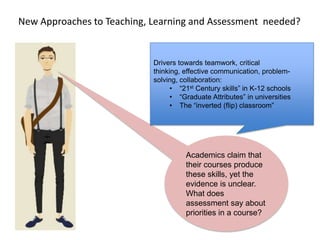
New Approaches to Teaching, Learning and Assessment needed?
Academics claim that
their courses produce
these skills, yet the
evidence is unclear.
What does
assessment say about
priorities in a course?
Drivers towards teamwork, critical
thinking, effective communication, problem-
solving, collaboration:
• “21st Century skills” in K-12 schools
• “Graduate Attributes” in universities
• The “inverted (flip) classroom”
Ref: Laurillard, D. (2012) Online support for academics' collaborative learning about teaching. Presentation. Royal
Geographic Society. Epigeum 20/10/2012
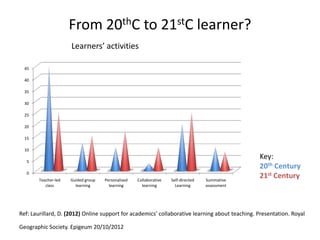
From 20thC to 21stC learner?
Learners’ activities
Key:
20th Century
21st Century0
5
10
15
20
25
30
35
40
45
Teacher-led
class
Guided group
learning
Personalised
learning
Collaborative
learning
Self-directed
Learning
Summative
assessment
Context and drivers
• Curriculum design and delivery
• Pedagogies of distance learning
• Staff development
• Business models/ USP
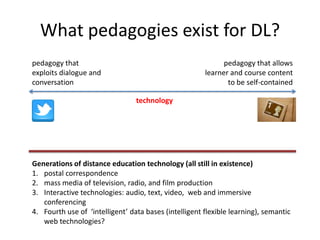
What pedagogies exist for DL?
Generations of distance education technology (all still in existence)
1. postal correspondence
2. mass media of television, radio, and film production
3. Interactive technologies: audio, text, video, web and immersive
conferencing
4. Fourth use of ‘intelligent’ data bases (intelligent flexible learning), semantic
web technologies?
pedagogy that
exploits dialogue and
conversation
pedagogy that allows
learner and course content
to be self-contained
technology
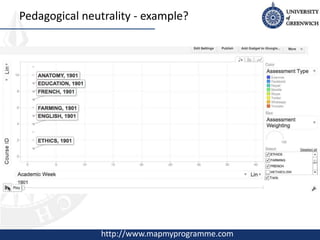
Pedagogical neutrality - example?
http://www.mapmyprogramme.com
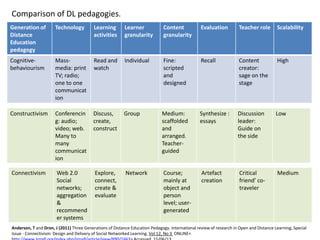
Generation of
Distance
Education
pedagogy
Technology Learning
activities
Learner
granularity
Content
granularity
Evaluation Teacher role Scalability
Cognitive-
behaviourism
Mass-
media: print
TV; radio;
one to one
communicat
ion
Read and
watch
Individual Fine:
scripted
and
designed
Recall Content
creator:
sage on the
stage
High
Constructivism Conferencin
g: audio;
video; web.
Many to
many
communicat
ion
Discuss,
create,
construct
Group Medium:
scaffolded
and
arranged.
Teacher-
guided
Synthesize :
essays
Discussion
leader:
Guide on
the side
Low
Connectivism Web 2.0
Social
networks;
aggregation
&
recommend
er systems
Explore,
connect,
create &
evaluate
Network Course;
mainly at
object and
person
level; user-
generated
Artefact
creation
Critical
friend’ co-
traveler
Medium
Comparison of DL pedagogies.
Anderson, T and Dron, J (2011) Three Generations of Distance Education Pedagogy. International review of research in Open and Distance Learning; Special
Issue - Connectivism: Design and Delivery of Social Networked Learning. Vol 12, No 3 ONLINE<
A
Associative
Focus on individual
Learning through
association and
reinforcement
Constructivist
Building on prior
knowledge
Task-orientated
Situative
Learning through
social interaction
Learning in context
Connectivist
Learning in a
networked
environment
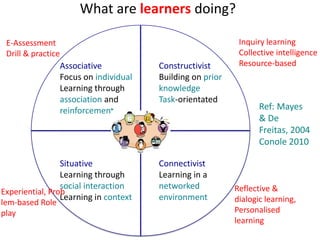
What are learners doing?
E-Assessment
Drill & practice
Inquiry learning
Collective intelligence
Resource-based
Experiential, Prob
lem-based Role
play
Reflective &
dialogic learning,
Personalised
learning
Ref: Mayes
& De
Freitas, 2004
Conole 2010
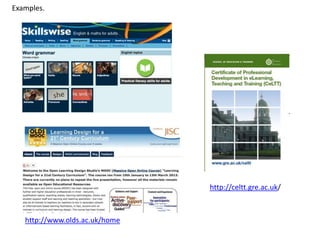
Examples.
http://www.olds.ac.uk/home
http://celtt.gre.ac.uk/
Whats a MOOC?
Design Principles
• Aggregation
• Remixing
• Re-purposing
• Personalised
• Multiple channels
• No ‘right’ pathway
Ref: Conole, G. Massive Open Online Courses
(MOOCs) -, University of Leicester
DL Forum presentation. 26th March 2013
X-mooc/ c-mooc/p-mooc/ouch
Martin Scorsese 1973 Mean Streets
Context and drivers
• Curriculum design and delivery
• Pedagogies of distance learning
• Staff development
• Business models/ USP
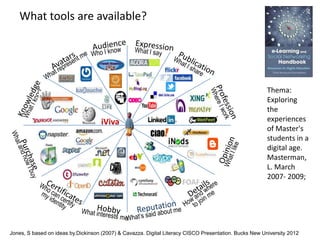
Jones, S based on ideas by.Dickinson (2007) & Cavazza. Digital Literacy CISCO Presentation. Bucks New University 2012
FOAF
iViva
What tools are available?
Thema:
Exploring
the
experiences
of Master's
students in a
digital age.
Masterman,
L. March
2007- 2009;
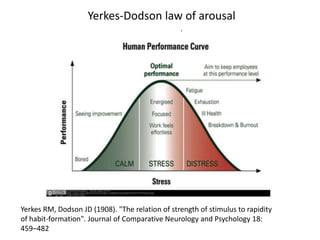
Yerkes-Dodson law of arousal
.
Yerkes RM, Dodson JD (1908). "The relation of strength of stimulus to rapidity
of habit-formation". Journal of Comparative Neurology and Psychology 18:
459–482
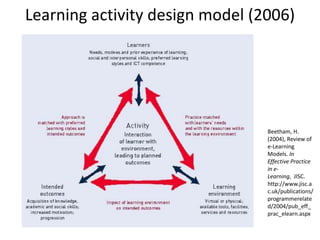
Learning activity design model (2006)
Beetham, H.
(2004), Review of
e-Learning
Models. In
Effective Practice
in e-
Learning, JISC.
http://www.jisc.a
c.uk/publications/
programmerelate
d/2004/pub_eff_
prac_elearn.aspx
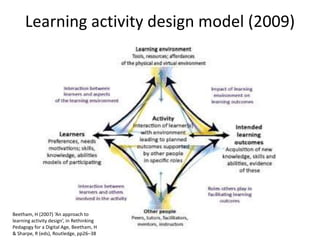
Learning activity design model (2009)
Beetham, H (2007) ‘An approach to
learning activity design’, in Rethinking
Pedagogy for a Digital Age, Beetham, H
& Sharpe, R (eds), Routledge, pp26–38
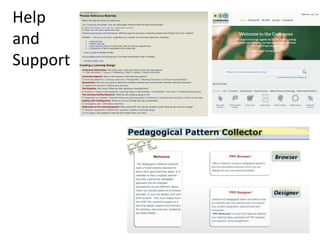
Help
and
Support
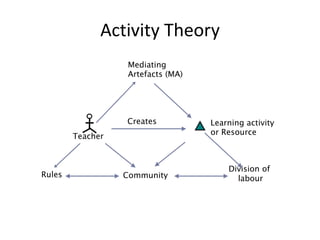
Teacher
Learning activity
or Resource
Creates
Mediating
Artefacts (MA)
Community
Division of
labourRules
Activity Theory
Context and drivers
• Curriculum design and delivery
• Pedagogies of distance learning
• Staff development
• Business models/ USP
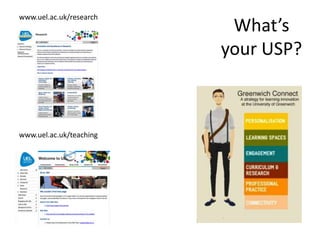
What’s
your USP?
www.uel.ac.uk/research
www.uel.ac.uk/teaching
Useful links
• Moodle Course:
https://moodle.uel.ac.uk/course/view.php?id=4860
• Digital Literacy in Higher Education:
http://dlinhe.ning.com/
• Greenwich Connect:
http://blogs.gre.ac.uk/greenwichconnect/about/
• Map my Programme:
http://www.mapmyprogramme.com/
• Larnaca Declaration on Learning Design:
http://www.larnacadeclaration.org/
• Summer of Innovation:
http://elevator.jisc.ac.uk/content/about
Hvala,谢
谢, Asanti, Dík, Tack, Danke, Merci, Tak, Kiitoksia,
köszönet, Grazie, Dank, Takk, Dzięki, Obrigado, n
aa goodee……thank you for listening and
participating.
s.walker@gre.ac.uk
Sialker
Simon Walker
Simonwalker
hugh snook

Online Pedagogy for Distance and Blended Learning. University of East London. Workshop

  • 1.
    Workshop 2: Approaches tousing technology to promote active learning Simon Walker Head of Educational Development University of Greenwich, London , UK Online learning pedagogies at UEL
  • 2.
    9.30 - 9.45:introductions 9.45 - 10.15: presentation: 10.15 - 11.00: hands on Moodle activity in computer suite (part 1). (move to ITC.01) 11.00 - 11.15 - break/refreshments 11.15 - 11.45: plenary 11.45 - 12.15: action planning (group work) 12.15 - 12.30: wrap up/ evaluation/close Workshop 2: Session Outline
  • 5.
    Context and drivers •Curriculum design and delivery • Pedagogies of distance learning • Staff development • Business models/ USP
  • 6.
    New Approaches toTeaching, Learning and Assessment needed? Academics claim that their courses produce these skills, yet the evidence is unclear. What does assessment say about priorities in a course? Drivers towards teamwork, critical thinking, effective communication, problem- solving, collaboration: • “21st Century skills” in K-12 schools • “Graduate Attributes” in universities • The “inverted (flip) classroom”
  • 7.
    Ref: Laurillard, D.(2012) Online support for academics' collaborative learning about teaching. Presentation. Royal Geographic Society. Epigeum 20/10/2012 From 20thC to 21stC learner? Learners’ activities Key: 20th Century 21st Century0 5 10 15 20 25 30 35 40 45 Teacher-led class Guided group learning Personalised learning Collaborative learning Self-directed Learning Summative assessment
  • 8.
    Context and drivers •Curriculum design and delivery • Pedagogies of distance learning • Staff development • Business models/ USP
  • 9.
    What pedagogies existfor DL? Generations of distance education technology (all still in existence) 1. postal correspondence 2. mass media of television, radio, and film production 3. Interactive technologies: audio, text, video, web and immersive conferencing 4. Fourth use of ‘intelligent’ data bases (intelligent flexible learning), semantic web technologies? pedagogy that exploits dialogue and conversation pedagogy that allows learner and course content to be self-contained technology
  • 10.
    Pedagogical neutrality -example? http://www.mapmyprogramme.com
  • 11.
    Generation of Distance Education pedagogy Technology Learning activities Learner granularity Content granularity EvaluationTeacher role Scalability Cognitive- behaviourism Mass- media: print TV; radio; one to one communicat ion Read and watch Individual Fine: scripted and designed Recall Content creator: sage on the stage High Constructivism Conferencin g: audio; video; web. Many to many communicat ion Discuss, create, construct Group Medium: scaffolded and arranged. Teacher- guided Synthesize : essays Discussion leader: Guide on the side Low Connectivism Web 2.0 Social networks; aggregation & recommend er systems Explore, connect, create & evaluate Network Course; mainly at object and person level; user- generated Artefact creation Critical friend’ co- traveler Medium Comparison of DL pedagogies. Anderson, T and Dron, J (2011) Three Generations of Distance Education Pedagogy. International review of research in Open and Distance Learning; Special Issue - Connectivism: Design and Delivery of Social Networked Learning. Vol 12, No 3 ONLINE<
  • 12.
    A Associative Focus on individual Learningthrough association and reinforcement Constructivist Building on prior knowledge Task-orientated Situative Learning through social interaction Learning in context Connectivist Learning in a networked environment What are learners doing? E-Assessment Drill & practice Inquiry learning Collective intelligence Resource-based Experiential, Prob lem-based Role play Reflective & dialogic learning, Personalised learning Ref: Mayes & De Freitas, 2004 Conole 2010
  • 13.
  • 14.
    Whats a MOOC? DesignPrinciples • Aggregation • Remixing • Re-purposing • Personalised • Multiple channels • No ‘right’ pathway Ref: Conole, G. Massive Open Online Courses (MOOCs) -, University of Leicester DL Forum presentation. 26th March 2013 X-mooc/ c-mooc/p-mooc/ouch Martin Scorsese 1973 Mean Streets
  • 16.
    Context and drivers •Curriculum design and delivery • Pedagogies of distance learning • Staff development • Business models/ USP
  • 17.
    Jones, S basedon ideas by.Dickinson (2007) & Cavazza. Digital Literacy CISCO Presentation. Bucks New University 2012 FOAF iViva What tools are available? Thema: Exploring the experiences of Master's students in a digital age. Masterman, L. March 2007- 2009;
  • 19.
    Yerkes-Dodson law ofarousal . Yerkes RM, Dodson JD (1908). "The relation of strength of stimulus to rapidity of habit-formation". Journal of Comparative Neurology and Psychology 18: 459–482
  • 20.
    Learning activity designmodel (2006) Beetham, H. (2004), Review of e-Learning Models. In Effective Practice in e- Learning, JISC. http://www.jisc.a c.uk/publications/ programmerelate d/2004/pub_eff_ prac_elearn.aspx
  • 21.
    Learning activity designmodel (2009) Beetham, H (2007) ‘An approach to learning activity design’, in Rethinking Pedagogy for a Digital Age, Beetham, H & Sharpe, R (eds), Routledge, pp26–38
  • 22.
  • 23.
    Teacher Learning activity or Resource Creates Mediating Artefacts(MA) Community Division of labourRules Activity Theory
  • 24.
    Context and drivers •Curriculum design and delivery • Pedagogies of distance learning • Staff development • Business models/ USP
  • 25.
  • 26.
    Useful links • MoodleCourse: https://moodle.uel.ac.uk/course/view.php?id=4860 • Digital Literacy in Higher Education: http://dlinhe.ning.com/ • Greenwich Connect: http://blogs.gre.ac.uk/greenwichconnect/about/ • Map my Programme: http://www.mapmyprogramme.com/ • Larnaca Declaration on Learning Design: http://www.larnacadeclaration.org/ • Summer of Innovation: http://elevator.jisc.ac.uk/content/about
  • 27.
    Hvala,谢 谢, Asanti, Dík,Tack, Danke, Merci, Tak, Kiitoksia, köszönet, Grazie, Dank, Takk, Dzięki, Obrigado, n aa goodee……thank you for listening and participating. s.walker@gre.ac.uk Sialker Simon Walker Simonwalker hugh snook

Editor's Notes

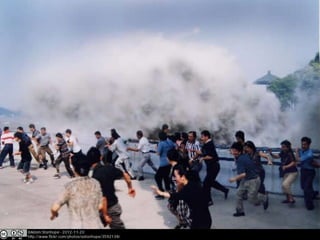
  • #5 ImagesTech can save the worldHorses fozen in icy river
  • #11 Some technologies may embody pedagogies, thereby hardening them, and it is at that point that they, of necessity, become far more influential in a learning design, the leaders of the dance rather than the partners. For example, a learning management system that sees the world in terms of courses and content will strongly encourage pedagogies that fit that model and constrain those that lack content and do not fit a content-driven course mode