Open Education: Into the Future
6th March 2019
Open Education Week Webinar
Gráinne Conole,
National Institute for Digital Learning
Dublin City University
Outline
• OECD 2015
• Affordances
• Open practices
• Impact
• Continuing Professional Development
• Learning Design Frameworks
• Learning Analytics
• Final reflections
OECD 2015
− ICT has revolutionised virtually
every aspect of our life and work
− Students unable to navigate
through a complex digital
landscape will no longer be able
to participate fully in the
economic, social and cultural life
around them
− Challenges: information overload,
plagiarism, online risks
− Students need to become critical
consumers of Internet services
and electronic media and make
informed choices
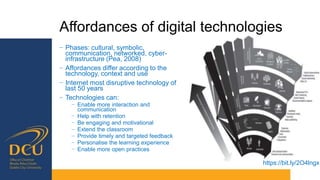
Affordances of digital technologies
− Phases: cultural, symbolic,
communication, networked, cyber-
infrastructure (Pea, 2008)
− Affordances differ according to the
technology, context and use
− Internet most disruptive technology of
last 50 years
− Technologies can:
− Enable more interaction and
communication
− Help with retention
− Be engaging and motivational
− Extend the classroom
− Provide timely and targeted feedback
− Personalise the learning experience
− Enable more open practices
https://bit.ly/2O4lngx
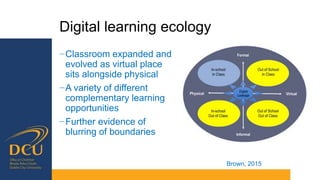
Digital learning ecology
−Classroom expanded and
evolved as virtual place
sits alongside physical
−A variety of different
complementary learning
opportunities
−Further evidence of
blurring of boundaries
Brown, 2015
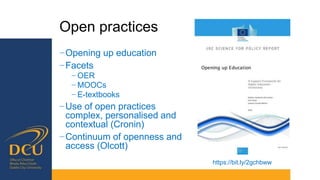
Open practices
−Opening up education
−Facets
− OER
− MOOCs
− E-textbooks
−Use of open practices
complex, personalised and
contextual (Cronin)
−Continuum of openness and
access (Olcott)
https://bit.ly/2gchbww
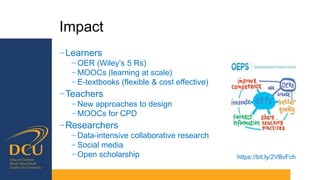
Impact
−Learners
− OER (Wiley’s 5 Rs)
− MOOCs (learning at scale)
− E-textbooks (flexible & cost effective)
−Teachers
− New approaches to design
− MOOCs for CPD
−Researchers
− Data-intensive collaborative research
− Social media
− Open scholarship https://bit.ly/2VBvFch
Challenges
−Lack of digital literacies
−Teaching the poor sister
−New forms of accreditation
−Senior management buy-in
−Appropriate CPD
−Unbundling of education
http://e4innovation.com/?p=938
Continuing Professional Learning
− Central role of the teacher
− Continuing Professional Learning
− Enable teachers to develop
innovative learning interventions
− Make effective use of digital
technologies
− Formats
− Specialised and tailored workshops
− Peer support and mentoring
− Examples of good practice
− Share and discuss practice
− Resources, OER and MOOCs
Learning Design Frameworks
−Frameworks for guiding the use of
technology/media/materials
− SAMR, SECTIONS, COACT
−Workshop approaches aimed
mainly at promoting general good
practice. i.e. social constructivist
assumptions
− 7Cs, 8LEM, ABC
−Approaches based on specific
theory of learner engagement
− ICAP
Conole, Forthcoming
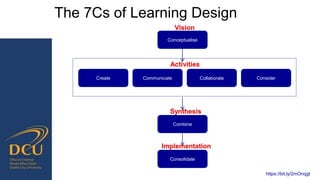
The 7Cs of Learning Design
Conceptualise
Vision
CommunicateCreate ConsiderCollaborate
Activities
Combine
Synthesis
Consolidate
Implementation
https://bit.ly/2mOnqgt
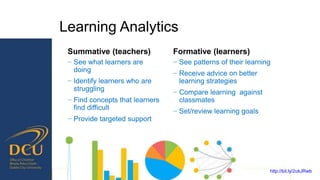
Learning Analytics
Summative (teachers)
− See what learners are
doing
− Identify learners who are
struggling
− Find concepts that learners
find difficult
− Provide targeted support
Formative (learners)
− See patterns of their learning
− Receive advice on better
learning strategies
− Compare learning against
classmates
− Set/review learning goals
http://bit.ly/2ukJRwb
Final reflections
− Digital learning ecology is complex
− More research needed to understand the
complexity
− Influence of affordances
− Understand affordances & how they support
pedagogy
− No single metaphor for 21st Century
learning
− Support for learning needs to match learner
needs and the context of learning
− Assessment needs to support deep
learning
− Needs to be purposeful & support active,
authentic and meaningful learning
Final reflections
−Teachers’ mindsets mediate
technology implementation
− Targeted and authentic CPL
−Impact of leadership and
institutional cultures
− Need to align with factors for
successful update of digital
technologies
−Refocus and change mindsets
− From education in change to
education for change
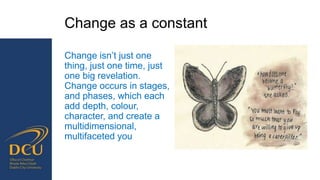
Change as a constant
Change isn’t just one
thing, just one time, just
one big revelation.
Change occurs in stages,
and phases, which each
add depth, colour,
character, and create a
multidimensional,
multifaceted you
2019 Conference
Dublin
A world top young university
Email: grainne.conole@dcu.ie
Blog: e4innovation.com
Twitter: @gconole

Open education week_webinar

  • 1.
    Open Education: Intothe Future 6th March 2019 Open Education Week Webinar Gráinne Conole, National Institute for Digital Learning Dublin City University
  • 2.
    Outline • OECD 2015 •Affordances • Open practices • Impact • Continuing Professional Development • Learning Design Frameworks • Learning Analytics • Final reflections
  • 3.
    OECD 2015 − ICThas revolutionised virtually every aspect of our life and work − Students unable to navigate through a complex digital landscape will no longer be able to participate fully in the economic, social and cultural life around them − Challenges: information overload, plagiarism, online risks − Students need to become critical consumers of Internet services and electronic media and make informed choices
  • 4.
    Affordances of digitaltechnologies − Phases: cultural, symbolic, communication, networked, cyber- infrastructure (Pea, 2008) − Affordances differ according to the technology, context and use − Internet most disruptive technology of last 50 years − Technologies can: − Enable more interaction and communication − Help with retention − Be engaging and motivational − Extend the classroom − Provide timely and targeted feedback − Personalise the learning experience − Enable more open practices https://bit.ly/2O4lngx
  • 5.
    Digital learning ecology −Classroomexpanded and evolved as virtual place sits alongside physical −A variety of different complementary learning opportunities −Further evidence of blurring of boundaries Brown, 2015
  • 6.
    Open practices −Opening upeducation −Facets − OER − MOOCs − E-textbooks −Use of open practices complex, personalised and contextual (Cronin) −Continuum of openness and access (Olcott) https://bit.ly/2gchbww
  • 7.
    Impact −Learners − OER (Wiley’s5 Rs) − MOOCs (learning at scale) − E-textbooks (flexible & cost effective) −Teachers − New approaches to design − MOOCs for CPD −Researchers − Data-intensive collaborative research − Social media − Open scholarship https://bit.ly/2VBvFch
  • 8.
    Challenges −Lack of digitalliteracies −Teaching the poor sister −New forms of accreditation −Senior management buy-in −Appropriate CPD −Unbundling of education http://e4innovation.com/?p=938
  • 9.
    Continuing Professional Learning −Central role of the teacher − Continuing Professional Learning − Enable teachers to develop innovative learning interventions − Make effective use of digital technologies − Formats − Specialised and tailored workshops − Peer support and mentoring − Examples of good practice − Share and discuss practice − Resources, OER and MOOCs
  • 10.
    Learning Design Frameworks −Frameworksfor guiding the use of technology/media/materials − SAMR, SECTIONS, COACT −Workshop approaches aimed mainly at promoting general good practice. i.e. social constructivist assumptions − 7Cs, 8LEM, ABC −Approaches based on specific theory of learner engagement − ICAP Conole, Forthcoming
  • 11.
    The 7Cs ofLearning Design Conceptualise Vision CommunicateCreate ConsiderCollaborate Activities Combine Synthesis Consolidate Implementation https://bit.ly/2mOnqgt
  • 12.
    Learning Analytics Summative (teachers) −See what learners are doing − Identify learners who are struggling − Find concepts that learners find difficult − Provide targeted support Formative (learners) − See patterns of their learning − Receive advice on better learning strategies − Compare learning against classmates − Set/review learning goals http://bit.ly/2ukJRwb
  • 13.
    Final reflections − Digitallearning ecology is complex − More research needed to understand the complexity − Influence of affordances − Understand affordances & how they support pedagogy − No single metaphor for 21st Century learning − Support for learning needs to match learner needs and the context of learning − Assessment needs to support deep learning − Needs to be purposeful & support active, authentic and meaningful learning
  • 14.
    Final reflections −Teachers’ mindsetsmediate technology implementation − Targeted and authentic CPL −Impact of leadership and institutional cultures − Need to align with factors for successful update of digital technologies −Refocus and change mindsets − From education in change to education for change
  • 15.
    Change as aconstant Change isn’t just one thing, just one time, just one big revelation. Change occurs in stages, and phases, which each add depth, colour, character, and create a multidimensional, multifaceted you
  • 16.
  • 17.
    A world topyoung university Email: grainne.conole@dcu.ie Blog: e4innovation.com Twitter: @gconole