Digital literacies and digital identities
Gráinne Conole
Bath Spa University
Internationalization, cross-border education and e-learning
Nicosia, Cyprus, 4th June 2015
National
Teaching
Fellow 2012 Ascilite fellow 2012EDEN fellow 2013
Outline
• Today’s digital landscape
• Two visions of the future:
– Education 2020
– Machines will make us extinct
• Your digital network
• Digital literacies
• Digital identity
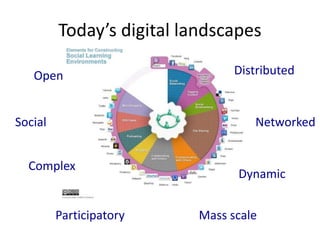
Today’s digital landscapes
Open
Social
Distributed
Participatory Mass scale
Networked
Dynamic
Complex
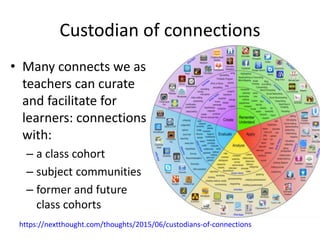
Custodian of connections
• Many connects we as
teachers can curate
and facilitate for
learners: connections
with:
– a class cohort
– subject communities
– former and future
class cohorts
https://nextthought.com/thoughts/2015/06/custodians-of-connections
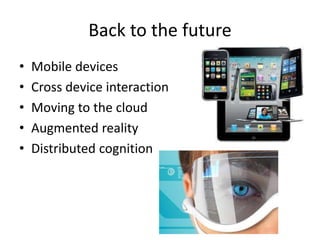
Back to the future
• Mobile devices
• Cross device interaction
• Moving to the cloud
• Augmented reality
• Distributed cognition
Two sides of a coin
• Facets of digital technologies
– Open practices
– Mobile learning
– Social media
– Digital identity
– Distributed cognition
http://e4innovation.com/?p=893
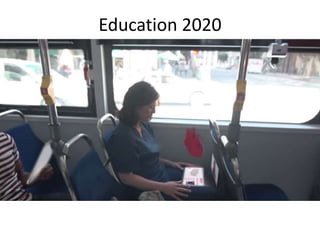
Education 2020
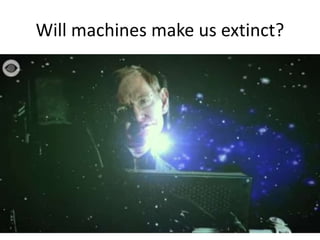
Will machines make us extinct?
Discussion
• Which video is more
likely?
• What will the future of
education and society
look like in 20, 30 years
time?
• What are the key issues
of digital technologies
for learning?
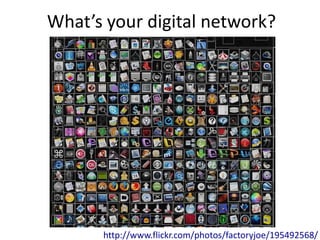
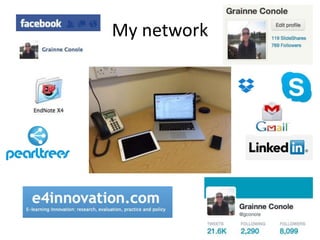
What’s your digital network?
http://www.flickr.com/photos/factoryjoe/195492568/
My network
The dark side…
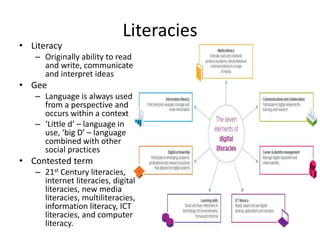
Literacies
• Literacy
– Originally ability to read
and write, communicate
and interpret ideas
• Gee
– Language is always used
from a perspective and
occurs within a context
– ‘Little d’ – language in
use, ‘big D’ – language
combined with other
social practices
• Contested term
– 21st Century literacies,
internet literacies, digital
literacies, new media
literacies, multiliteracies,
information literacy, ICT
literacies, and computer
literacy.
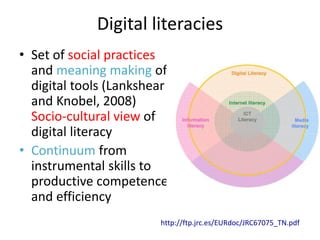
Digital literacies
• Set of social practices
and meaning making of
digital tools (Lankshear
and Knobel, 2008)
Socio-cultural view of
digital literacy
• Continuum from
instrumental skills to
productive competence
and efficiency
http://ftp.jrc.es/EURdoc/JRC67075_TN.pdf
Digital literacies
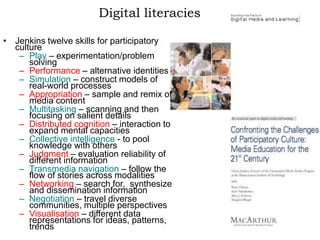
• Jenkins twelve skills for participatory
culture
– Play – experimentation/problem
solving
– Performance – alternative identities
– Simulation – construct models of
real-world processes
– Appropriation – sample and remix of
media content
– Multitasking – scanning and then
focusing on salient details
– Distributed cognition – interaction to
expand mental capacities
– Collective intelligence - to pool
knowledge with others
– Judgment – evaluation reliability of
different information
– Transmedia navigation – follow the
flow of stories across modalities
– Networking – search for, synthesize
and dissemination information
– Negotiation – travel diverse
communities, multiple perspectives
– Visualisation – different data
representations for ideas, patterns,
trends
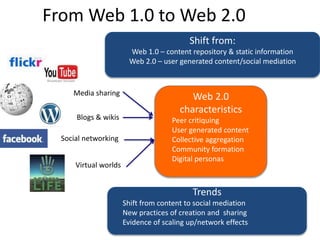
From Web 1.0 to Web 2.0
Media sharing
Blogs & wikis
Social networking
Virtual worlds
Shift from:
Web 1.0 – content repository & static information
Web 2.0 – user generated content/social mediation
Trends
Shift from content to social mediation
New practices of creation and sharing
Evidence of scaling up/network effects
Web 2.0
characteristics
Peer critiquing
User generated content
Collective aggregation
Community formation
Digital personas
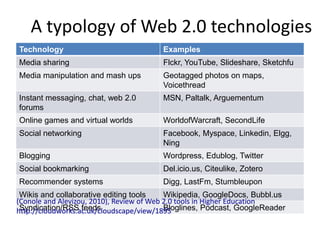
A typology of Web 2.0 technologies
Technology Examples
Media sharing Flckr, YouTube, Slideshare, Sketchfu
Media manipulation and mash ups Geotagged photos on maps,
Voicethread
Instant messaging, chat, web 2.0
forums
MSN, Paltalk, Arguementum
Online games and virtual worlds WorldofWarcraft, SecondLife
Social networking Facebook, Myspace, Linkedin, Elgg,
Ning
Blogging Wordpress, Edublog, Twitter
Social bookmarking Del.icio.us, Citeulike, Zotero
Recommender systems Digg, LastFm, Stumbleupon
Wikis and collaborative editing tools Wikipedia, GoogleDocs, Bubbl.us
Syndication/RSS feeds Bloglines, Podcast, GoogleReader
(Conole and Alevizou, 2010), Review of Web 2.0 tools in Higher Education
http://cloudworks.ac.uk/cloudscape/view/1895
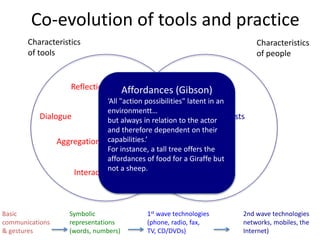
Evolving
practices
Characteristics
of people
Preferences
Skills
Interests
Context
Characteristics
of tools
Reflection
Dialogue
Aggregation
Interactivity
Affordances (Gibson)
‘All "action possibilities" latent in an
environmentt…
but always in relation to the actor
and therefore dependent on their
capabilities.’
For instance, a tall tree offers the
affordances of food for a Giraffe but
not a sheep.
Basic
communications
& gestures
Symbolic
representations
(words, numbers)
1st wave technologies
(phone, radio, fax,
TV, CD/DVDs)
2nd wave technologies
networks, mobiles, the
Internet)
Co-evolution of tools and practice
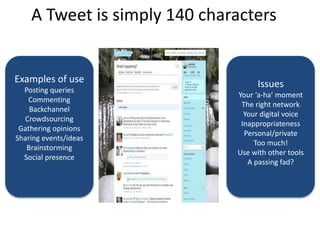
Examples of use
Posting queries
Commenting
Backchannel
Crowdsourcing
Gathering opinions
Sharing events/ideas
Brainstorming
Social presence
Issues
Your ‘a-ha’ moment
The right network
Your digital voice
Inappropriateness
Personal/private
Too much!
Use with other tools
A passing fad?
A Tweet is simply 140 characters
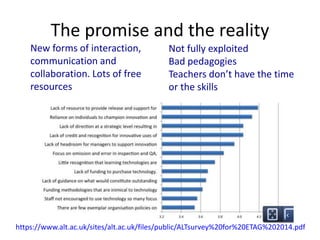
The promise and the reality
New forms of interaction,
communication and
collaboration. Lots of free
resources
Not fully exploited
Bad pedagogies
Teachers don’t have the time
or the skills
https://www.alt.ac.uk/sites/alt.ac.uk/files/public/ALTsurvey%20for%20ETAG%202014.pdf
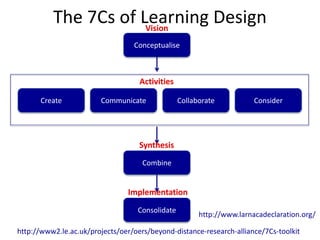
The 7Cs of Learning Design
Conceptualise
Vision
CommunicateCreate ConsiderCollaborate
Activities
Combine
Synthesis
Consolidate
Implementation
http://www2.le.ac.uk/projects/oer/oers/beyond-distance-research-alliance/7Cs-toolkit
http://www.larnacadeclaration.org/
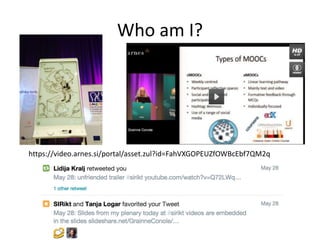
Who am I?
https://video.arnes.si/portal/asset.zul?id=FahVXGOPEUZfOWBcEbf7QM2q
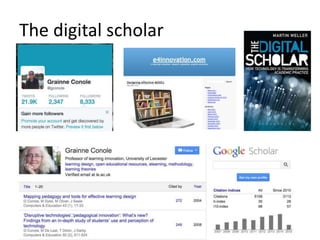
The digital scholar
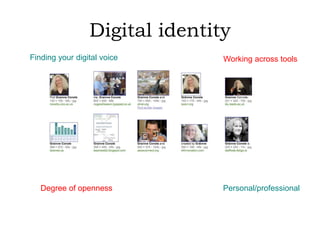
Digital identity
Finding your digital voice Working across tools
Degree of openness Personal/professional
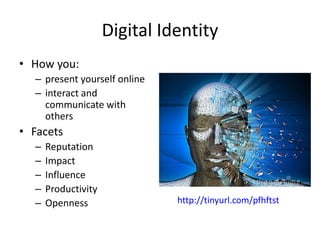
Digital Identity
• How you:
– present yourself online
– interact and
communicate with
others
• Facets
– Reputation
– Impact
– Influence
– Productivity
– Openness http://tinyurl.com/pfhftst
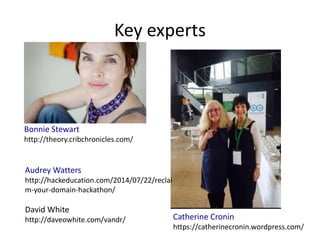
Key experts
Bonnie Stewart
http://theory.cribchronicles.com/
Catherine Cronin
https://catherinecronin.wordpress.com/
Audrey Watters
http://hackeducation.com/2014/07/22/reclai
m-your-domain-hackathon/
David White
http://daveowhite.com/vandr/
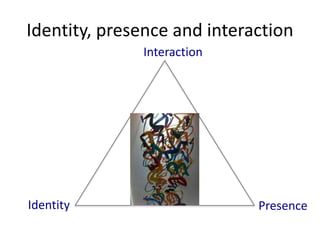
Identity, presence and interaction
Interaction
Identity Presence
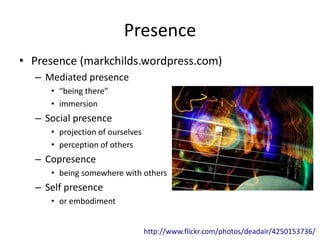
Presence
• Presence (markchilds.wordpress.com)
– Mediated presence
• “being there”
• immersion
– Social presence
• projection of ourselves
• perception of others
– Copresence
• being somewhere with others
– Self presence
• or embodiment
http://www.flickr.com/photos/deadair/4250153736/
The good and the bad…
• Extension of ‘real’ self –
can be the same or
different
• Extended reach
• Exploiting the medium
• “Laying yourself bare”
• Misinterpretation of
identity
• Cyber-stalking
• Identity theft
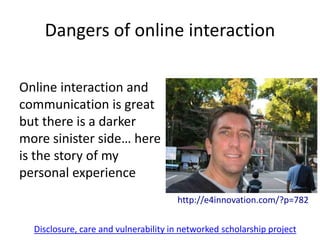
Dangers of online interaction
http://e4innovation.com/?p=782
Online interaction and
communication is great
but there is a darker
more sinister side… here
is the story of my
personal experience
Disclosure, care and vulnerability in networked scholarship project
Future challenges
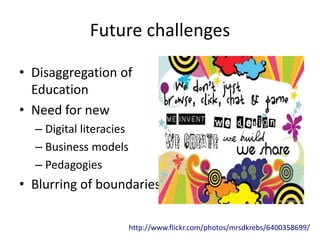
• Disaggregation of
Education
• Need for new
– Digital literacies
– Business models
– Pedagogies
• Blurring of boundaries
http://www.flickr.com/photos/mrsdkrebs/6400358699/
The information bomb….
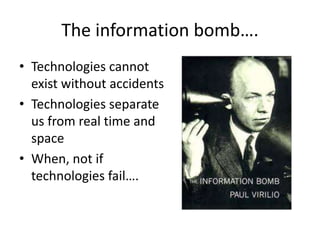
• Technologies cannot
exist without accidents
• Technologies separate
us from real time and
space
• When, not if
technologies fail….
http://www.slideshare.net/GrainneConole
g.conole@bathspa.ac.uk
http://e4innovation.com
@gconole

Conole plenary Cyprus 4 June 2014

  • 1.
    Digital literacies anddigital identities Gráinne Conole Bath Spa University Internationalization, cross-border education and e-learning Nicosia, Cyprus, 4th June 2015 National Teaching Fellow 2012 Ascilite fellow 2012EDEN fellow 2013
  • 3.
    Outline • Today’s digitallandscape • Two visions of the future: – Education 2020 – Machines will make us extinct • Your digital network • Digital literacies • Digital identity
  • 4.
  • 5.
    Custodian of connections •Many connects we as teachers can curate and facilitate for learners: connections with: – a class cohort – subject communities – former and future class cohorts https://nextthought.com/thoughts/2015/06/custodians-of-connections
  • 7.
    Back to thefuture • Mobile devices • Cross device interaction • Moving to the cloud • Augmented reality • Distributed cognition
  • 8.
    Two sides ofa coin • Facets of digital technologies – Open practices – Mobile learning – Social media – Digital identity – Distributed cognition http://e4innovation.com/?p=893
  • 9.
  • 10.
    Will machines makeus extinct?
  • 11.
    Discussion • Which videois more likely? • What will the future of education and society look like in 20, 30 years time? • What are the key issues of digital technologies for learning?
  • 12.
    What’s your digitalnetwork? http://www.flickr.com/photos/factoryjoe/195492568/
  • 13.
  • 14.
  • 15.
    Literacies • Literacy – Originallyability to read and write, communicate and interpret ideas • Gee – Language is always used from a perspective and occurs within a context – ‘Little d’ – language in use, ‘big D’ – language combined with other social practices • Contested term – 21st Century literacies, internet literacies, digital literacies, new media literacies, multiliteracies, information literacy, ICT literacies, and computer literacy.
  • 16.
    Digital literacies • Setof social practices and meaning making of digital tools (Lankshear and Knobel, 2008) Socio-cultural view of digital literacy • Continuum from instrumental skills to productive competence and efficiency http://ftp.jrc.es/EURdoc/JRC67075_TN.pdf
  • 17.
    Digital literacies • Jenkinstwelve skills for participatory culture – Play – experimentation/problem solving – Performance – alternative identities – Simulation – construct models of real-world processes – Appropriation – sample and remix of media content – Multitasking – scanning and then focusing on salient details – Distributed cognition – interaction to expand mental capacities – Collective intelligence - to pool knowledge with others – Judgment – evaluation reliability of different information – Transmedia navigation – follow the flow of stories across modalities – Networking – search for, synthesize and dissemination information – Negotiation – travel diverse communities, multiple perspectives – Visualisation – different data representations for ideas, patterns, trends
  • 18.
    From Web 1.0to Web 2.0 Media sharing Blogs & wikis Social networking Virtual worlds Shift from: Web 1.0 – content repository & static information Web 2.0 – user generated content/social mediation Trends Shift from content to social mediation New practices of creation and sharing Evidence of scaling up/network effects Web 2.0 characteristics Peer critiquing User generated content Collective aggregation Community formation Digital personas
  • 19.
    A typology ofWeb 2.0 technologies Technology Examples Media sharing Flckr, YouTube, Slideshare, Sketchfu Media manipulation and mash ups Geotagged photos on maps, Voicethread Instant messaging, chat, web 2.0 forums MSN, Paltalk, Arguementum Online games and virtual worlds WorldofWarcraft, SecondLife Social networking Facebook, Myspace, Linkedin, Elgg, Ning Blogging Wordpress, Edublog, Twitter Social bookmarking Del.icio.us, Citeulike, Zotero Recommender systems Digg, LastFm, Stumbleupon Wikis and collaborative editing tools Wikipedia, GoogleDocs, Bubbl.us Syndication/RSS feeds Bloglines, Podcast, GoogleReader (Conole and Alevizou, 2010), Review of Web 2.0 tools in Higher Education http://cloudworks.ac.uk/cloudscape/view/1895
  • 20.
    Evolving practices Characteristics of people Preferences Skills Interests Context Characteristics of tools Reflection Dialogue Aggregation Interactivity Affordances(Gibson) ‘All "action possibilities" latent in an environmentt… but always in relation to the actor and therefore dependent on their capabilities.’ For instance, a tall tree offers the affordances of food for a Giraffe but not a sheep. Basic communications & gestures Symbolic representations (words, numbers) 1st wave technologies (phone, radio, fax, TV, CD/DVDs) 2nd wave technologies networks, mobiles, the Internet) Co-evolution of tools and practice
  • 21.
    Examples of use Postingqueries Commenting Backchannel Crowdsourcing Gathering opinions Sharing events/ideas Brainstorming Social presence Issues Your ‘a-ha’ moment The right network Your digital voice Inappropriateness Personal/private Too much! Use with other tools A passing fad? A Tweet is simply 140 characters
  • 22.
    The promise andthe reality New forms of interaction, communication and collaboration. Lots of free resources Not fully exploited Bad pedagogies Teachers don’t have the time or the skills https://www.alt.ac.uk/sites/alt.ac.uk/files/public/ALTsurvey%20for%20ETAG%202014.pdf
  • 23.
    The 7Cs ofLearning Design Conceptualise Vision CommunicateCreate ConsiderCollaborate Activities Combine Synthesis Consolidate Implementation http://www2.le.ac.uk/projects/oer/oers/beyond-distance-research-alliance/7Cs-toolkit http://www.larnacadeclaration.org/
  • 24.
  • 25.
  • 26.
    Digital identity Finding yourdigital voice Working across tools Degree of openness Personal/professional
  • 27.
    Digital Identity • Howyou: – present yourself online – interact and communicate with others • Facets – Reputation – Impact – Influence – Productivity – Openness http://tinyurl.com/pfhftst
  • 28.
    Key experts Bonnie Stewart http://theory.cribchronicles.com/ CatherineCronin https://catherinecronin.wordpress.com/ Audrey Watters http://hackeducation.com/2014/07/22/reclai m-your-domain-hackathon/ David White http://daveowhite.com/vandr/
  • 29.
    Identity, presence andinteraction Interaction Identity Presence
  • 30.
    Presence • Presence (markchilds.wordpress.com) –Mediated presence • “being there” • immersion – Social presence • projection of ourselves • perception of others – Copresence • being somewhere with others – Self presence • or embodiment http://www.flickr.com/photos/deadair/4250153736/
  • 31.
    The good andthe bad… • Extension of ‘real’ self – can be the same or different • Extended reach • Exploiting the medium • “Laying yourself bare” • Misinterpretation of identity • Cyber-stalking • Identity theft
  • 32.
    Dangers of onlineinteraction http://e4innovation.com/?p=782 Online interaction and communication is great but there is a darker more sinister side… here is the story of my personal experience Disclosure, care and vulnerability in networked scholarship project
  • 33.
    Future challenges • Disaggregationof Education • Need for new – Digital literacies – Business models – Pedagogies • Blurring of boundaries http://www.flickr.com/photos/mrsdkrebs/6400358699/
  • 34.
    The information bomb…. •Technologies cannot exist without accidents • Technologies separate us from real time and space • When, not if technologies fail….
  • 35.