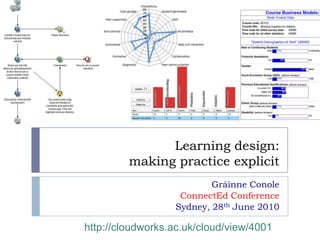
Learning design: making practice explicit Gráinne ConoleConnectEd ConferenceSydney, 28th June 2010http://cloudworks.ac.uk/cloud/view/4001
A little context…My background:Science & Arts: PhD ChemistryProfessor of e-learningLearners’ and teachers’ experiences of using technologiesNew approaches to designOpen Educational ResourcesLearning theoriesStrategy and policy
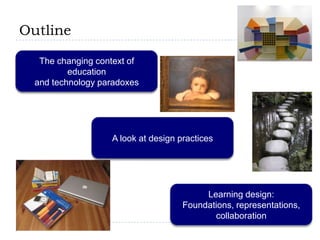
OutlineThe changing context of educationand technology paradoxesA look at design practicesLearning design:Foundations, representations, collaboration
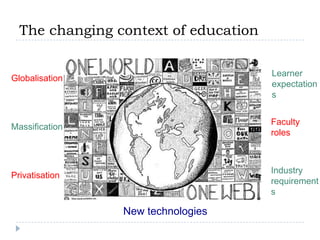
Learner expectationsGlobalisationFacultyrolesMassificationIndustry requirementsPrivatisationNew technologiesThe changing context of education
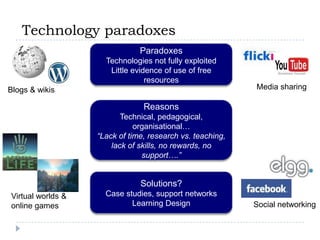
Technology paradoxesParadoxesTechnologies not fully exploitedLittle evidence of use of free resourcesMedia sharingBlogs & wikisReasonsTechnical, pedagogical, organisational…“Lack of time, research vs. teaching, lack of skills, no rewards, no support….”Solutions?Case studies, support networksLearning DesignVirtual worlds &online gamesSocial networking
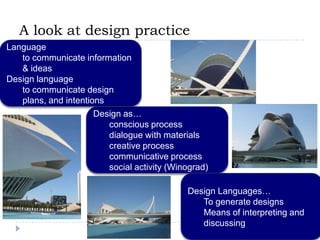
A look at design practiceLanguageto communicate information& ideasDesign languageto communicate design plans, and intentionsDesign as…conscious processdialogue with materialscreative processcommunicative processsocial activity (Winograd)Design Languages…To generate designsMeans of interpreting and discussing
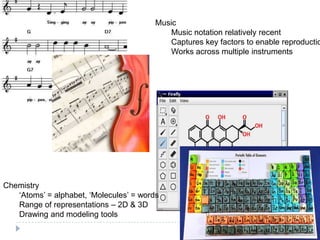
MusicMusic notation relatively recent Captures key factors to enable reproductionWorks across multiple instrumentsChemistry‘Atoms’ = alphabet, ‘Molecules’ = wordsRange of representations – 2D & 3DDrawing and modeling tools
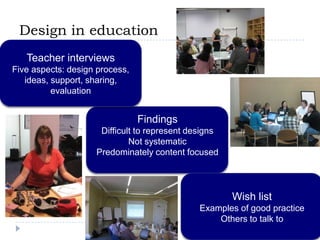
Design in educationTeacher interviewsFive aspects: design process, ideas, support, sharing, evaluationFindingsDifficult to represent designsNot systematicPredominately content focusedWish listExamples of good practiceOthers to talk to
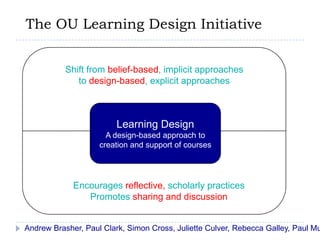
The OU Learning Design InitiativeShift from belief-based, implicit approaches to design-based, explicit approachesLearning DesignA design-based approach to creation and support of coursesEncourages reflective, scholarly practicesPromotes sharing and discussionAndrew Brasher, Paul Clark, Simon Cross, Juliette Culver, Rebecca Galley, Paul Mundin
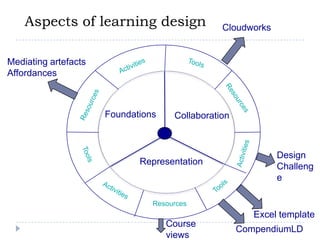
Aspects of learning designMediating artefactsAffordancesToolsActivitiesCloudworksCourseviewsResourcesDesignChallengeResourcesFoundationsCollaborationRepresentationActivitiesToolsToolsActivitiesResourcesExcel templateCompendiumLD
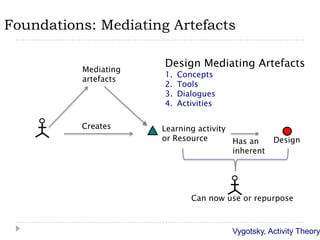
Foundations: Mediating ArtefactsDesignLearning activityor ResourceCan now use or repurposeHas an inherentDesign Mediating ArtefactsConceptsToolsDialoguesActivitiesMediating artefactsCreatesVygotsky, Activity Theory
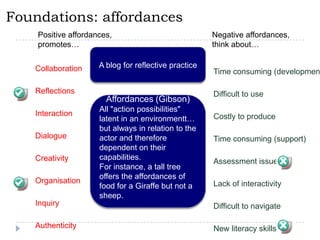
Foundations: affordancesPositive affordances, promotes… Negative affordances, think about… A blog for reflective practiceCollaborationTime consuming (development)ReflectionsDifficult to useAffordances (Gibson)All "action possibilities" latent in an environmentt…but always in relation to the actor and therefore dependent on their capabilities.For instance, a tall tree offers the affordances of food for a Giraffe but not a sheep.InteractionCostly to produceDialogueTime consuming (support)CreativityAssessment issuesOrganisationLack of interactivityInquiryDifficult to navigateAuthenticityNew literacy skills
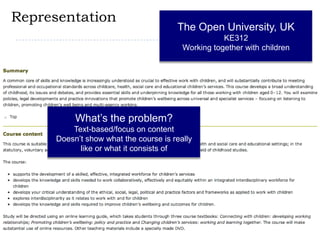
RepresentationThe Open University, UKKE312Working together with childrenWhat’s the problem?Text-based/focus on contentDoesn’t show what the course is really like or what it consists of
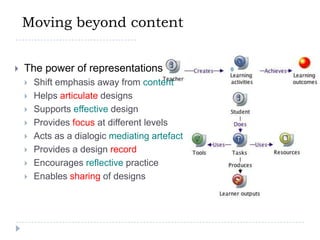
Moving beyond contentThe power of representationsShift emphasis away from contentHelps articulate designsSupports effective designProvides focus at different levelsActs as a dialogic mediating artefactProvides a design recordEncourages reflective practiceEnables sharing of designs
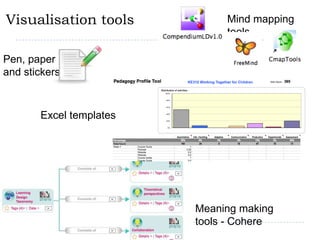
Visualisation toolsMind mapping toolsPen, paper and stickersExcel templatesMeaning making tools - Cohere
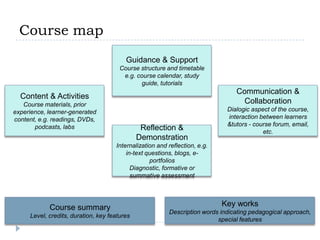
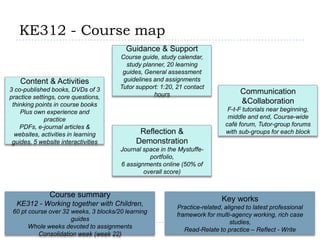
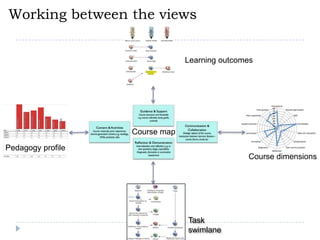
Guidance & SupportCourse structure and timetablee.g. course calendar, study guide, tutorialsContent & ActivitiesCourse materials, prior experience, learner-generated content, e.g. readings, DVDs, podcasts, labsCommunication & CollaborationDialogic aspect of the course, interaction between learners &tutors - course forum, email, etc.Reflection & DemonstrationInternalization and reflection, e.g. in-text questions, blogs, e-portfoliosDiagnostic, formative or summative assessment Course summaryLevel, credits, duration, key featuresKey worksDescription words indicating pedagogical approach, special featuresCourse map
Guidance & SupportCourse guide, study calendar, study planner, 20 learning guides, General assessment guidelines and assignmentsTutor support: 1:20, 21 contact hours Content & Activities3 co-published books, DVDs of 3 practice settings, core questions, thinking points in course booksPlus own experience and practicePDFs, e-journal articles & websites, activities in learning guides, 5 website interactivitiesCommunication & CollaborationF-t-F tutorials near beginning, middle and end, Course-wide café forum, Tutor-group forums with sub-groups for each block Reflection & DemonstrationJournal space in the Mystuffe-portfolio, 6 assignments online (50% of overall score)Course summaryKE312 - Working together with Children, 60 pt course over 32 weeks, 3 blocks/20 learning guidesWhole weeks devoted to assignmentsConsolidation week (week 22)Key worksPractice-related, aligned to latest professional framework for multi-agency working, rich case studies, Read-Relate to practice – Reflect - WriteKE312 - Course map
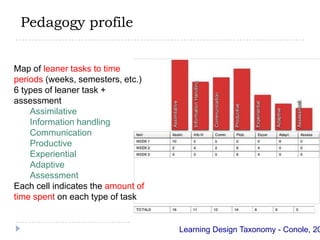
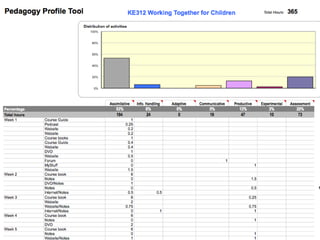
Pedagogy profileMap of leaner tasks to time periods (weeks, semesters, etc.)6 types of leaner task + assessmentAssimilativeInformation handlingCommunicationProductiveExperientialAdaptiveAssessmentEach cell indicates the amount of time spent on each type of taskLearning Design Taxonomy - Conole, 2008
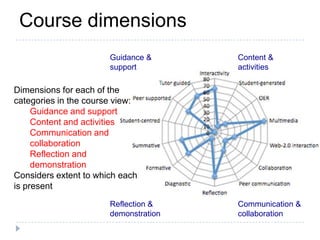
Course dimensionsContent & activitiesGuidance & supportDimensions for each of the categories in the course view:Guidance and supportContent and activitiesCommunication and collaborationReflection and demonstrationConsiders extent to which each is presentReflection & demonstrationCommunication & collaboration
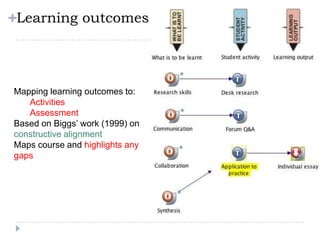
Learning outcomesMapping learning outcomes to:ActivitiesAssessmentBased on Biggs’ work (1999) on constructive alignmentMaps course and highlights any gaps
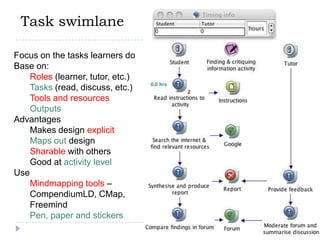
Task swimlaneFocus on the tasks learners doBase on:Roles (learner, tutor, etc.)Tasks (read, discuss, etc.)Tools and resourcesOutputsAdvantagesMakes design explicitMaps out designSharable with othersGood at activity levelUseMindmapping tools – CompendiumLD, CMap, FreemindPen, paper and stickers
Working between the viewsCourse mapCourse dimensionsPedagogy profileLearning outcomesTask swimlane
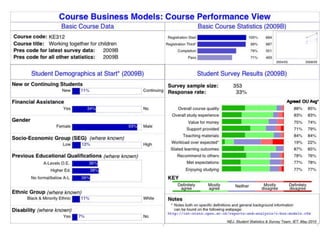
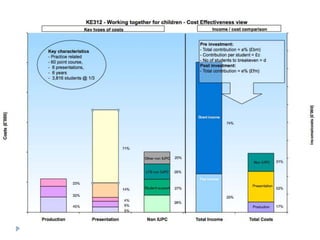
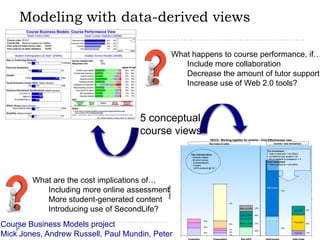
Modeling with data-derived viewsWhat happens to course performance, if…Include more collaborationDecrease the amount of tutor supportIncrease use of Web 2.0 tools?5 conceptual course viewsWhat are the cost implications of…Including more online assessmentMore student-generated contentIntroducing use of SecondLife?Course Business Models projectMick Jones, Andrew Russell, Paul Mundin, Peter Wilson
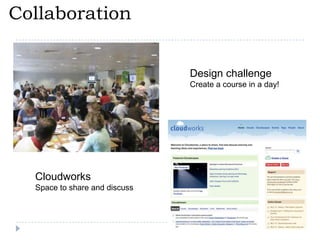
CollaborationDesign challengeCreate a course in a day!CloudworksSpace to share and discuss
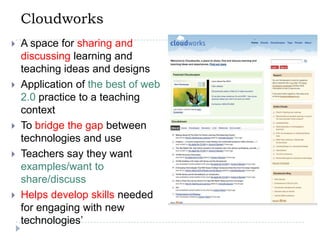
CloudworksA space for sharing and discussing learning and teaching ideas and designsApplication of the best of web 2.0 practice to a teaching contextTo bridge the gap between technologies and useTeachers say they want examples/want to share/discussHelps develop skills needed for engaging with new technologies’
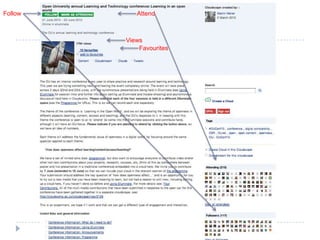
Quick language guideCloudworks speakPlan EnglishCloud:Cloudscape:Activity stream:Favourites:RSS feeds:Follow:Attend:Anything to do with learning & teachingAcollection of cloudsLatestactivitieson Cloudscapes or peopleVote for things you likeCloudscapes or peopleCloudscapes, Clouds, peopleConferences, workshops, events
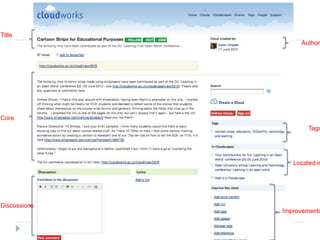
TitleAuthorCoreTagsLocated inDiscussionsImprovements
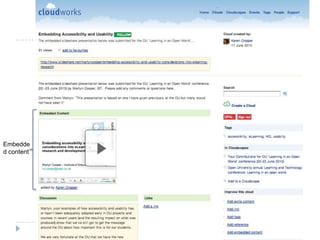
Embedded content
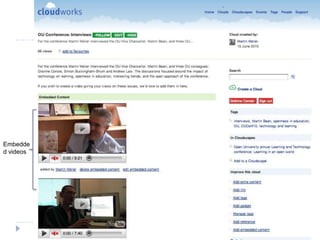
Embedded videos
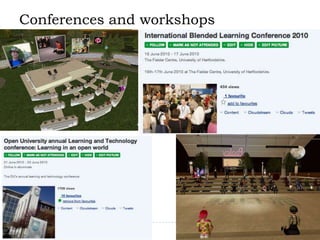
Conferences and workshops
FollowAttendViewsFavourites
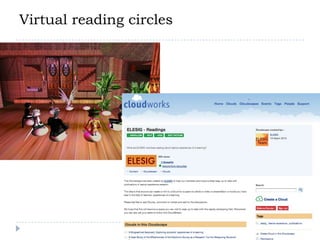
Virtual reading circles
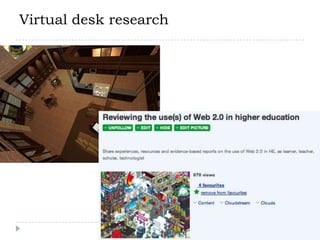
Virtual desk research
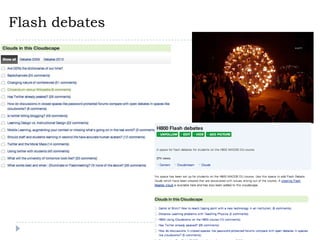
Flash debates
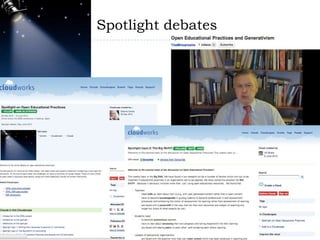
Spotlight debates
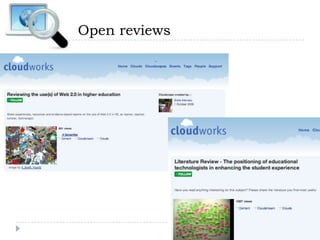
Open reviews
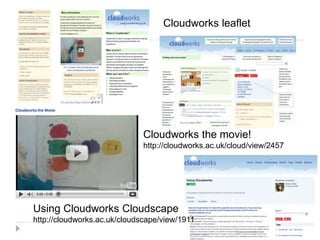
Cloudworks leafletCloudworks the movie!http://cloudworks.ac.uk/cloud/view/2457Using Cloudworks Cloudscapehttp://cloudworks.ac.uk/cloudscape/view/1911Help
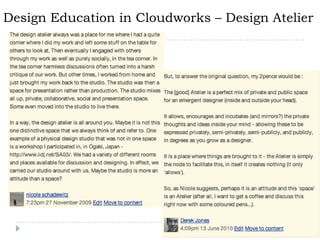
Design Education in Cloudworks – Design Atelier
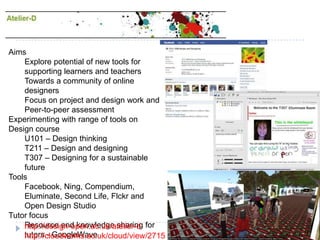
AimsExplore potential of new tools for supporting learners and teachersTowards a community of online designersFocus on project and design work and Peer-to-peer assessmentExperimenting with range of tools on Design course U101 – Design thinkingT211 – Design and designing T307 – Designing for a sustainable futureToolsFacebook, Ning, Compendium, Eluminate, Second Life, Flckr and Open Design StudioTutor focusResource and knowledge sharing for tutors - GoogleWavehttp://design-open.ac.uk/atelier-dhttp://cloudworks.ac.uk/cloud/view/2715
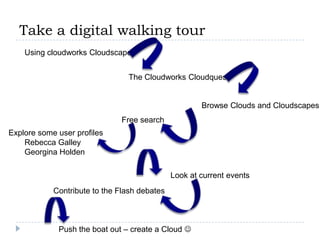
Take a digital walking tourUsing cloudworks CloudscapesThe Cloudworks CloudquestBrowse Clouds and CloudscapesFree searchExplore some user profilesRebecca GalleyGeorgina HoldenLook at current eventsContribute to the Flash debatesPush the boat out – create a Cloud 
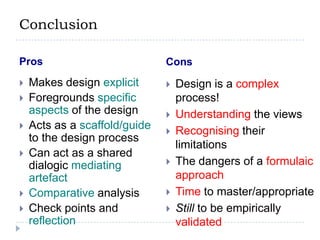
ConclusionProsConsMakes design explicitForegrounds specific aspects of the designActs as a scaffold/guide to the design processCan act as a shared dialogic mediating artefactComparative analysisCheck points and reflectionDesign is a complex process!Understanding the viewsRecognising their limitationsThe dangers of a formulaic approachTime to master/appropriateStill to be empirically validated
AcknowledgementsMolecule http://www.flickr.com/photos/8272941@N07/498827420/Periodic table http://www.flickr.com/photos/chemheritage/3984920162/Music sheet http://www.flickr.com/photos/anyaka/21848267/One world http://www.flickr.com/photos/psd/2731067095/World of warcraft http://www.flickr.com/photos/shardsofblue/3981216281/Questionmarkhttp://www.flickr.com/photos/crystaljingsr/3914729343/ 

Connect ed conole

  • 1.
    Learning design: makingpractice explicit Gráinne ConoleConnectEd ConferenceSydney, 28th June 2010http://cloudworks.ac.uk/cloud/view/4001
  • 2.
    A little context…Mybackground:Science & Arts: PhD ChemistryProfessor of e-learningLearners’ and teachers’ experiences of using technologiesNew approaches to designOpen Educational ResourcesLearning theoriesStrategy and policy
  • 3.
    OutlineThe changing contextof educationand technology paradoxesA look at design practicesLearning design:Foundations, representations, collaboration
  • 4.
  • 5.
    Technology paradoxesParadoxesTechnologies notfully exploitedLittle evidence of use of free resourcesMedia sharingBlogs & wikisReasonsTechnical, pedagogical, organisational…“Lack of time, research vs. teaching, lack of skills, no rewards, no support….”Solutions?Case studies, support networksLearning DesignVirtual worlds &online gamesSocial networking
  • 6.
    A look atdesign practiceLanguageto communicate information& ideasDesign languageto communicate design plans, and intentionsDesign as…conscious processdialogue with materialscreative processcommunicative processsocial activity (Winograd)Design Languages…To generate designsMeans of interpreting and discussing
  • 7.
    MusicMusic notation relativelyrecent Captures key factors to enable reproductionWorks across multiple instrumentsChemistry‘Atoms’ = alphabet, ‘Molecules’ = wordsRange of representations – 2D & 3DDrawing and modeling tools
  • 8.
    Design in educationTeacherinterviewsFive aspects: design process, ideas, support, sharing, evaluationFindingsDifficult to represent designsNot systematicPredominately content focusedWish listExamples of good practiceOthers to talk to
  • 9.
    The OU LearningDesign InitiativeShift from belief-based, implicit approaches to design-based, explicit approachesLearning DesignA design-based approach to creation and support of coursesEncourages reflective, scholarly practicesPromotes sharing and discussionAndrew Brasher, Paul Clark, Simon Cross, Juliette Culver, Rebecca Galley, Paul Mundin
  • 10.
    Aspects of learningdesignMediating artefactsAffordancesToolsActivitiesCloudworksCourseviewsResourcesDesignChallengeResourcesFoundationsCollaborationRepresentationActivitiesToolsToolsActivitiesResourcesExcel templateCompendiumLD
  • 11.
    Foundations: Mediating ArtefactsDesignLearningactivityor ResourceCan now use or repurposeHas an inherentDesign Mediating ArtefactsConceptsToolsDialoguesActivitiesMediating artefactsCreatesVygotsky, Activity Theory
  • 12.
    Foundations: affordancesPositive affordances,promotes… Negative affordances, think about… A blog for reflective practiceCollaborationTime consuming (development)ReflectionsDifficult to useAffordances (Gibson)All "action possibilities" latent in an environmentt…but always in relation to the actor and therefore dependent on their capabilities.For instance, a tall tree offers the affordances of food for a Giraffe but not a sheep.InteractionCostly to produceDialogueTime consuming (support)CreativityAssessment issuesOrganisationLack of interactivityInquiryDifficult to navigateAuthenticityNew literacy skills
  • 13.
    RepresentationThe Open University,UKKE312Working together with childrenWhat’s the problem?Text-based/focus on contentDoesn’t show what the course is really like or what it consists of
  • 14.
    Moving beyond contentThepower of representationsShift emphasis away from contentHelps articulate designsSupports effective designProvides focus at different levelsActs as a dialogic mediating artefactProvides a design recordEncourages reflective practiceEnables sharing of designs
  • 15.
    Visualisation toolsMind mappingtoolsPen, paper and stickersExcel templatesMeaning making tools - Cohere
  • 16.
    Guidance & SupportCoursestructure and timetablee.g. course calendar, study guide, tutorialsContent & ActivitiesCourse materials, prior experience, learner-generated content, e.g. readings, DVDs, podcasts, labsCommunication & CollaborationDialogic aspect of the course, interaction between learners &tutors - course forum, email, etc.Reflection & DemonstrationInternalization and reflection, e.g. in-text questions, blogs, e-portfoliosDiagnostic, formative or summative assessment Course summaryLevel, credits, duration, key featuresKey worksDescription words indicating pedagogical approach, special featuresCourse map
  • 17.
    Guidance & SupportCourseguide, study calendar, study planner, 20 learning guides, General assessment guidelines and assignmentsTutor support: 1:20, 21 contact hours Content & Activities3 co-published books, DVDs of 3 practice settings, core questions, thinking points in course booksPlus own experience and practicePDFs, e-journal articles & websites, activities in learning guides, 5 website interactivitiesCommunication & CollaborationF-t-F tutorials near beginning, middle and end, Course-wide café forum, Tutor-group forums with sub-groups for each block Reflection & DemonstrationJournal space in the Mystuffe-portfolio, 6 assignments online (50% of overall score)Course summaryKE312 - Working together with Children, 60 pt course over 32 weeks, 3 blocks/20 learning guidesWhole weeks devoted to assignmentsConsolidation week (week 22)Key worksPractice-related, aligned to latest professional framework for multi-agency working, rich case studies, Read-Relate to practice – Reflect - WriteKE312 - Course map
  • 18.
    Pedagogy profileMap ofleaner tasks to time periods (weeks, semesters, etc.)6 types of leaner task + assessmentAssimilativeInformation handlingCommunicationProductiveExperientialAdaptiveAssessmentEach cell indicates the amount of time spent on each type of taskLearning Design Taxonomy - Conole, 2008
  • 20.
    Course dimensionsContent &activitiesGuidance & supportDimensions for each of the categories in the course view:Guidance and supportContent and activitiesCommunication and collaborationReflection and demonstrationConsiders extent to which each is presentReflection & demonstrationCommunication & collaboration
  • 21.
    Learning outcomesMapping learningoutcomes to:ActivitiesAssessmentBased on Biggs’ work (1999) on constructive alignmentMaps course and highlights any gaps
  • 22.
    Task swimlaneFocus onthe tasks learners doBase on:Roles (learner, tutor, etc.)Tasks (read, discuss, etc.)Tools and resourcesOutputsAdvantagesMakes design explicitMaps out designSharable with othersGood at activity levelUseMindmapping tools – CompendiumLD, CMap, FreemindPen, paper and stickers
  • 25.
    Working between theviewsCourse mapCourse dimensionsPedagogy profileLearning outcomesTask swimlane
  • 26.
    Modeling with data-derivedviewsWhat happens to course performance, if…Include more collaborationDecrease the amount of tutor supportIncrease use of Web 2.0 tools?5 conceptual course viewsWhat are the cost implications of…Including more online assessmentMore student-generated contentIntroducing use of SecondLife?Course Business Models projectMick Jones, Andrew Russell, Paul Mundin, Peter Wilson
  • 27.
    CollaborationDesign challengeCreate acourse in a day!CloudworksSpace to share and discuss
  • 28.
    CloudworksA space forsharing and discussing learning and teaching ideas and designsApplication of the best of web 2.0 practice to a teaching contextTo bridge the gap between technologies and useTeachers say they want examples/want to share/discussHelps develop skills needed for engaging with new technologies’
  • 29.
    Quick language guideCloudworksspeakPlan EnglishCloud:Cloudscape:Activity stream:Favourites:RSS feeds:Follow:Attend:Anything to do with learning & teachingAcollection of cloudsLatestactivitieson Cloudscapes or peopleVote for things you likeCloudscapes or peopleCloudscapes, Clouds, peopleConferences, workshops, events
  • 30.
  • 31.
  • 32.
  • 33.
  • 34.
  • 35.
  • 36.
  • 37.
  • 38.
  • 39.
  • 40.
    Cloudworks leafletCloudworks themovie!http://cloudworks.ac.uk/cloud/view/2457Using Cloudworks Cloudscapehttp://cloudworks.ac.uk/cloudscape/view/1911Help
  • 41.
    Design Education inCloudworks – Design Atelier
  • 42.
    AimsExplore potential ofnew tools for supporting learners and teachersTowards a community of online designersFocus on project and design work and Peer-to-peer assessmentExperimenting with range of tools on Design course U101 – Design thinkingT211 – Design and designing T307 – Designing for a sustainable futureToolsFacebook, Ning, Compendium, Eluminate, Second Life, Flckr and Open Design StudioTutor focusResource and knowledge sharing for tutors - GoogleWavehttp://design-open.ac.uk/atelier-dhttp://cloudworks.ac.uk/cloud/view/2715
  • 43.
    Take a digitalwalking tourUsing cloudworks CloudscapesThe Cloudworks CloudquestBrowse Clouds and CloudscapesFree searchExplore some user profilesRebecca GalleyGeorgina HoldenLook at current eventsContribute to the Flash debatesPush the boat out – create a Cloud 
  • 44.
    ConclusionProsConsMakes design explicitForegroundsspecific aspects of the designActs as a scaffold/guide to the design processCan act as a shared dialogic mediating artefactComparative analysisCheck points and reflectionDesign is a complex process!Understanding the viewsRecognising their limitationsThe dangers of a formulaic approachTime to master/appropriateStill to be empirically validated
  • 45.
    AcknowledgementsMolecule http://www.flickr.com/photos/8272941@N07/498827420/Periodic tablehttp://www.flickr.com/photos/chemheritage/3984920162/Music sheet http://www.flickr.com/photos/anyaka/21848267/One world http://www.flickr.com/photos/psd/2731067095/World of warcraft http://www.flickr.com/photos/shardsofblue/3981216281/Questionmarkhttp://www.flickr.com/photos/crystaljingsr/3914729343/