Designing effective MOOCs
Gráinne Conole, Bath Spa University
Nicosia, Cyprus
National
Teaching
Fellow 2012 Ascilite fellow 2012EDEN fellow 2013
Outline
• The importance of e-learning
• E-learning timeline and
emergent technologies
• E-Pedagogies
• Social media
• What is good learning?
• The 7Cs of Learning Design
– Designing Courses
– Evaluating Courses
Education 2020
Barriers to adoption
• Lack of digital literacy skills
• No reward for teaching
• Competition from other
providers
• Scaling innovation
• Democratisation
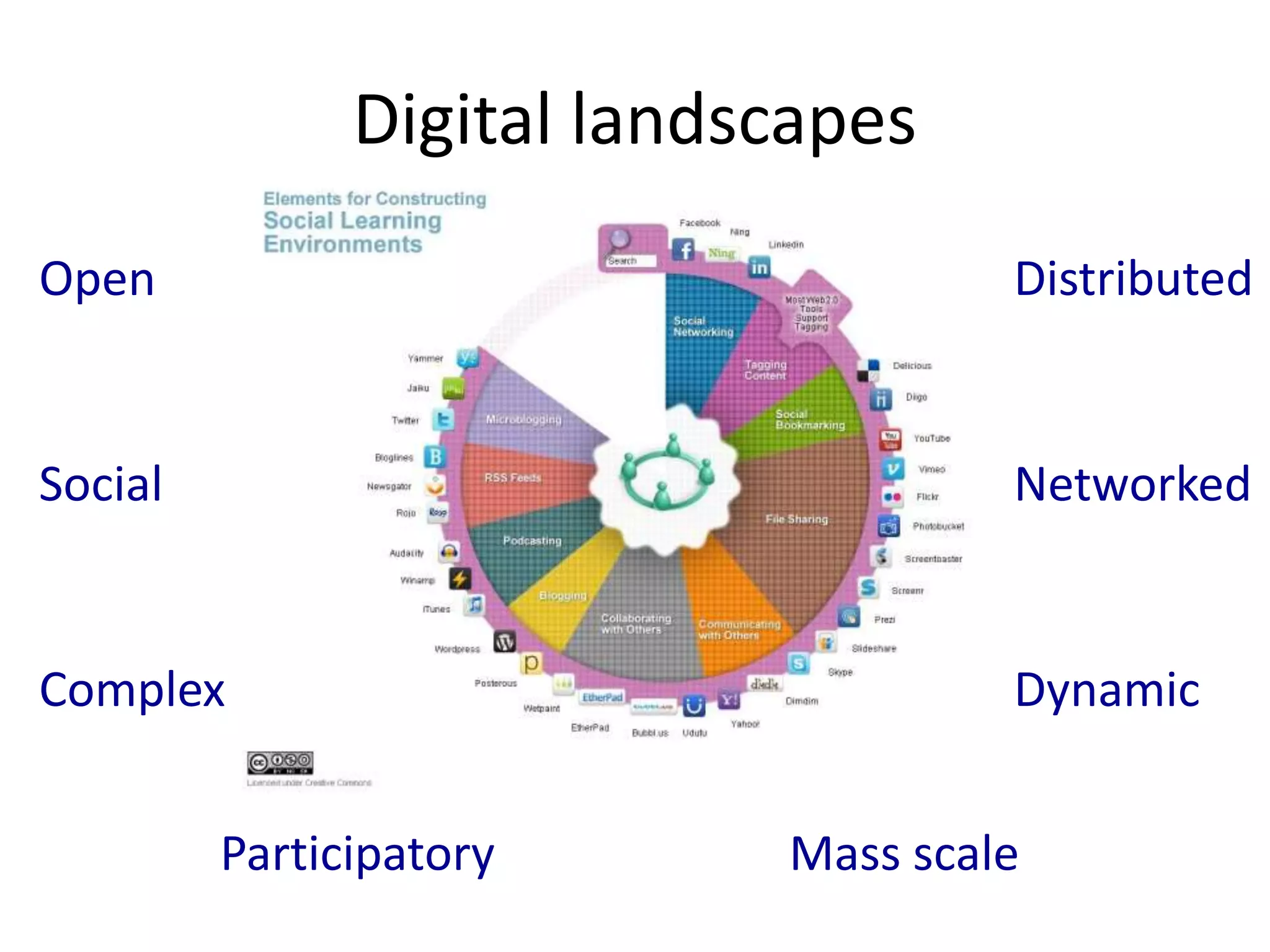
Digital landscapes
Open
Social
Distributed
Participatory Mass scale
Networked
Complex Dynamic
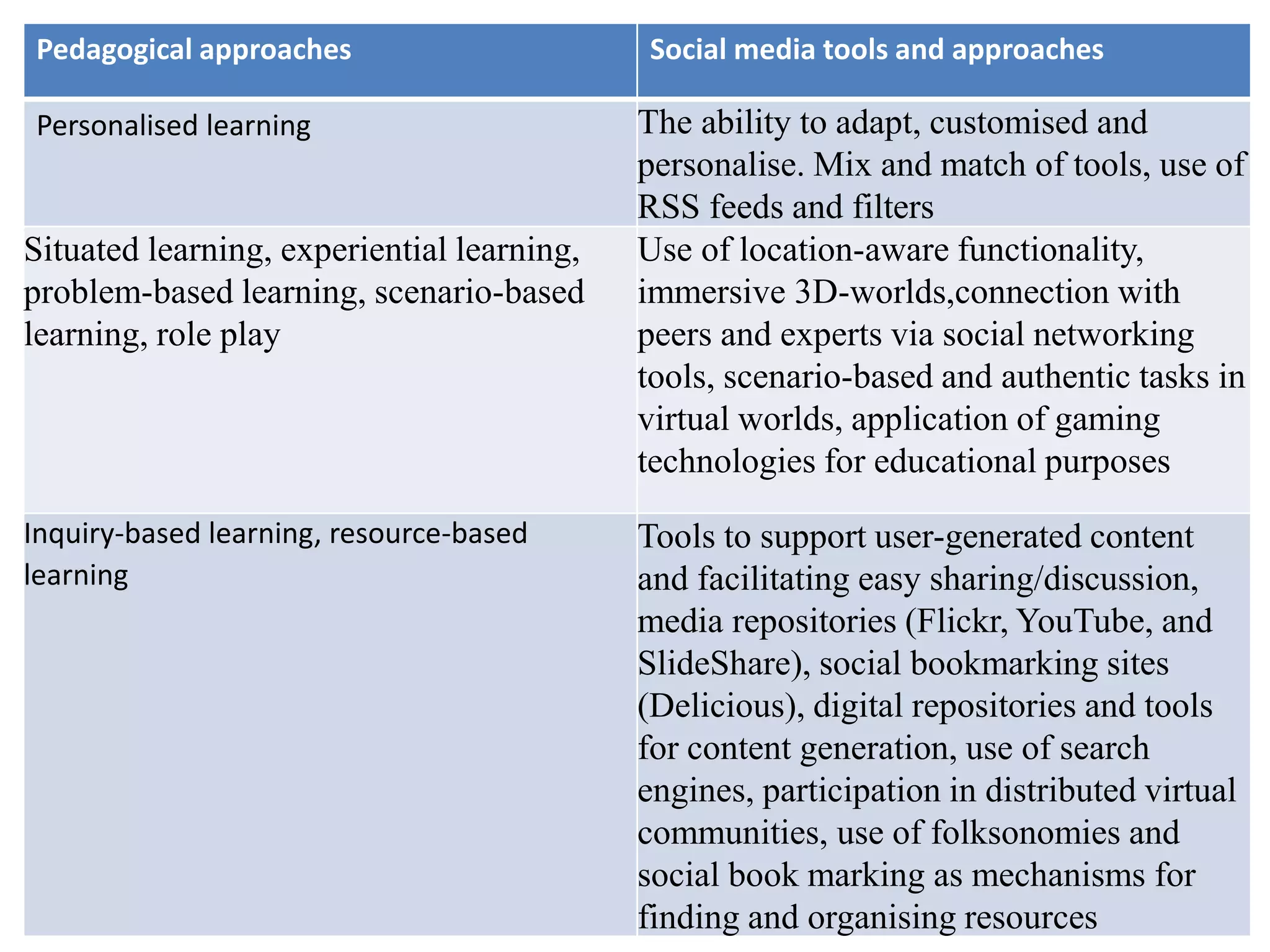
Pedagogical approaches Social media tools and approaches
Personalised learning The ability to adapt, customised and
personalise. Mix and match of tools, use of
RSS feeds and filters
Situated learning, experiential learning,
problem-based learning, scenario-based
learning, role play
Use of location-aware functionality,
immersive 3D-worlds,connection with
peers and experts via social networking
tools, scenario-based and authentic tasks in
virtual worlds, application of gaming
technologies for educational purposes
Inquiry-based learning, resource-based
learning
Tools to support user-generated content
and facilitating easy sharing/discussion,
media repositories (Flickr, YouTube, and
SlideShare), social bookmarking sites
(Delicious), digital repositories and tools
for content generation, use of search
engines, participation in distributed virtual
communities, use of folksonomies and
social book marking as mechanisms for
finding and organising resources
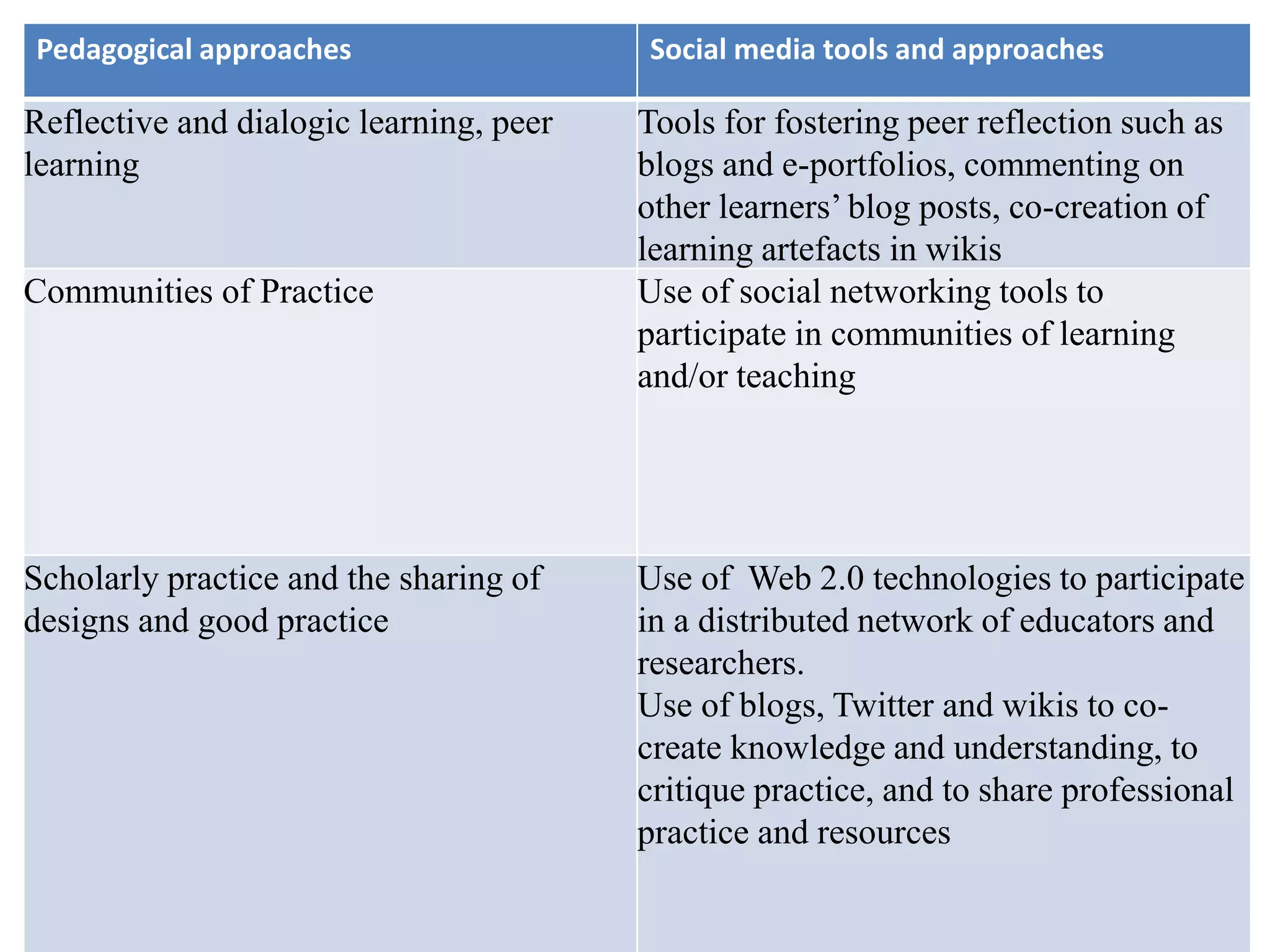
Pedagogical approaches Social media tools and approaches
Reflective and dialogic learning, peer
learning
Tools for fostering peer reflection such as
blogs and e-portfolios, commenting on
other learners’ blog posts, co-creation of
learning artefacts in wikis
Communities of Practice Use of social networking tools to
participate in communities of learning
and/or teaching
Scholarly practice and the sharing of
designs and good practice
Use of Web 2.0 technologies to participate
in a distributed network of educators and
researchers.
Use of blogs, Twitter and wikis to co-
create knowledge and understanding, to
critique practice, and to share professional
practice and resources
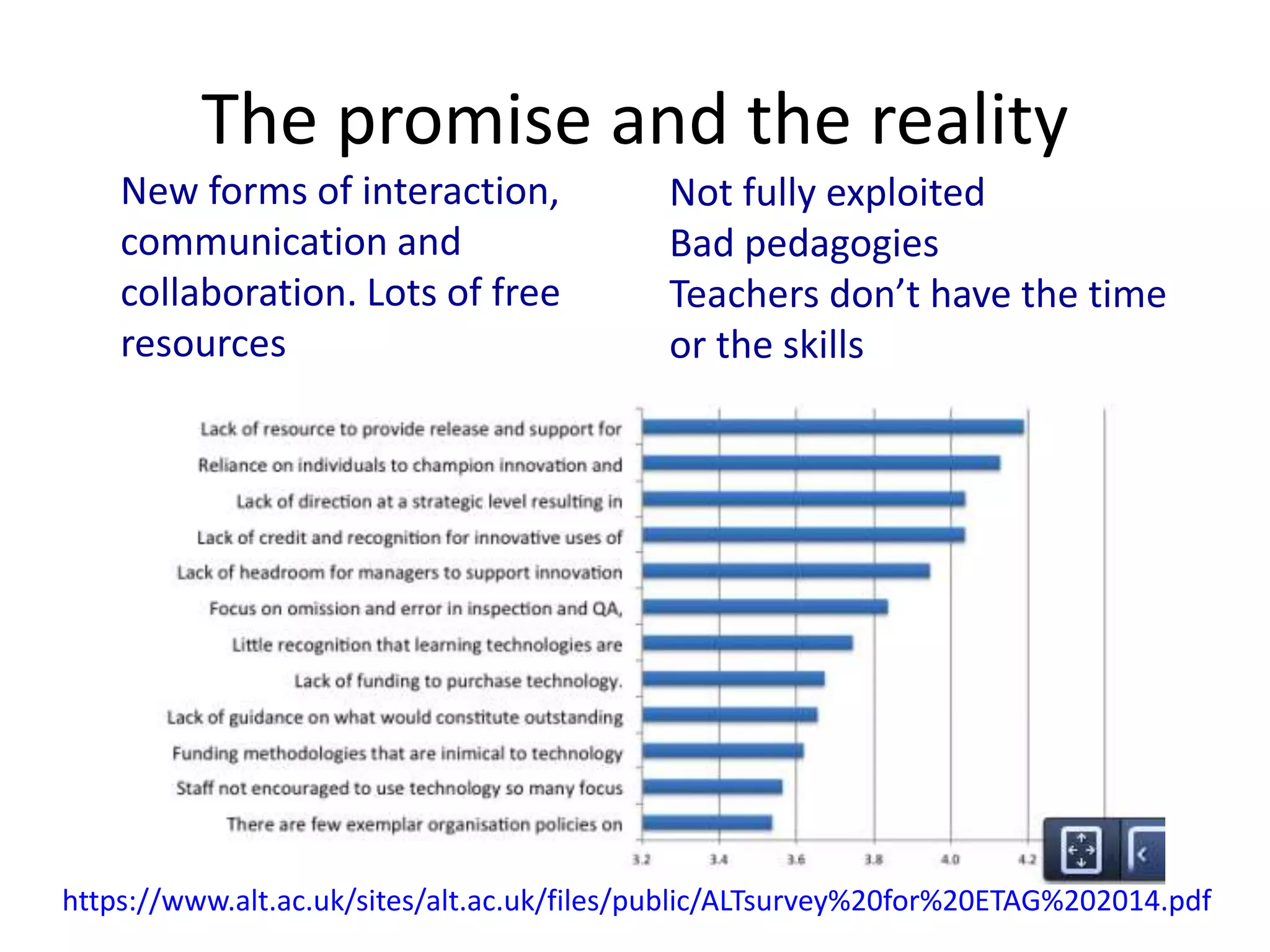
The promise and the reality
New forms of interaction,
communication and
collaboration. Lots of free
resources
Not fully exploited
Bad pedagogies
Teachers don’t have the time
or the skills
https://www.alt.ac.uk/sites/alt.ac.uk/files/public/ALTsurvey%20for%20ETAG%202014.pdf
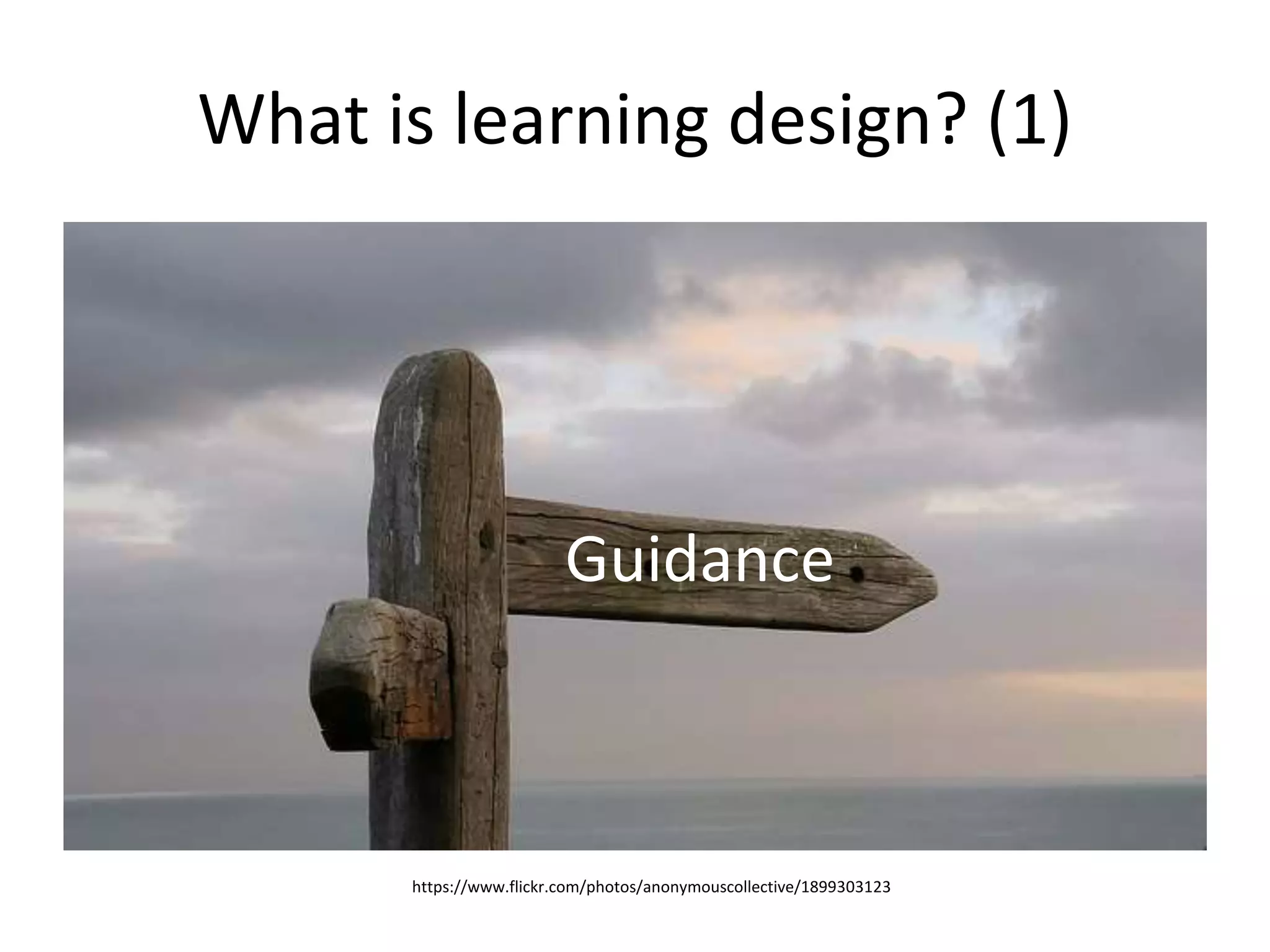
What is learning design? (1)
Guidance
https://www.flickr.com/photos/anonymouscollective/1899303123
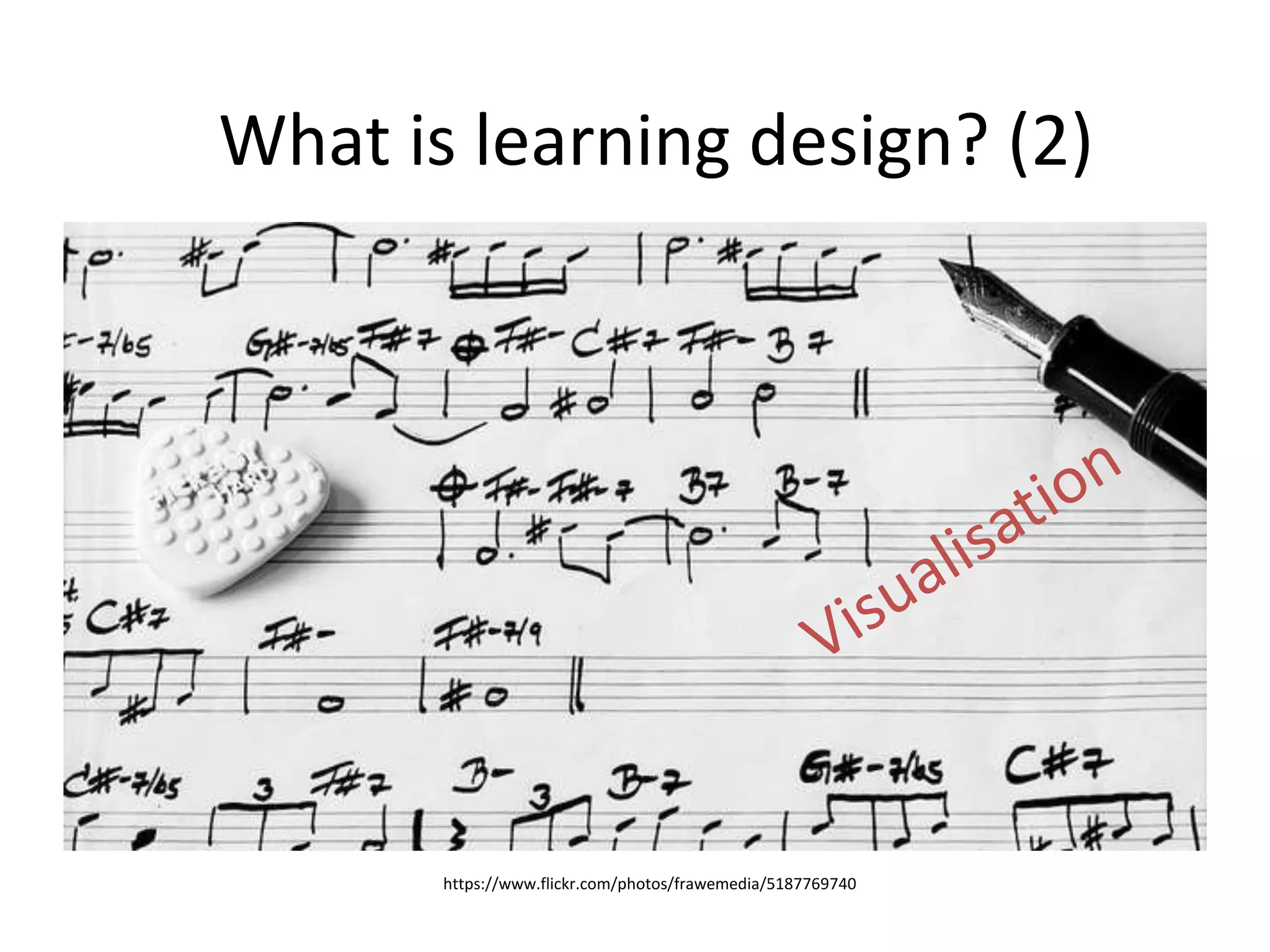
What is learning design? (2)
https://www.flickr.com/photos/frawemedia/5187769740
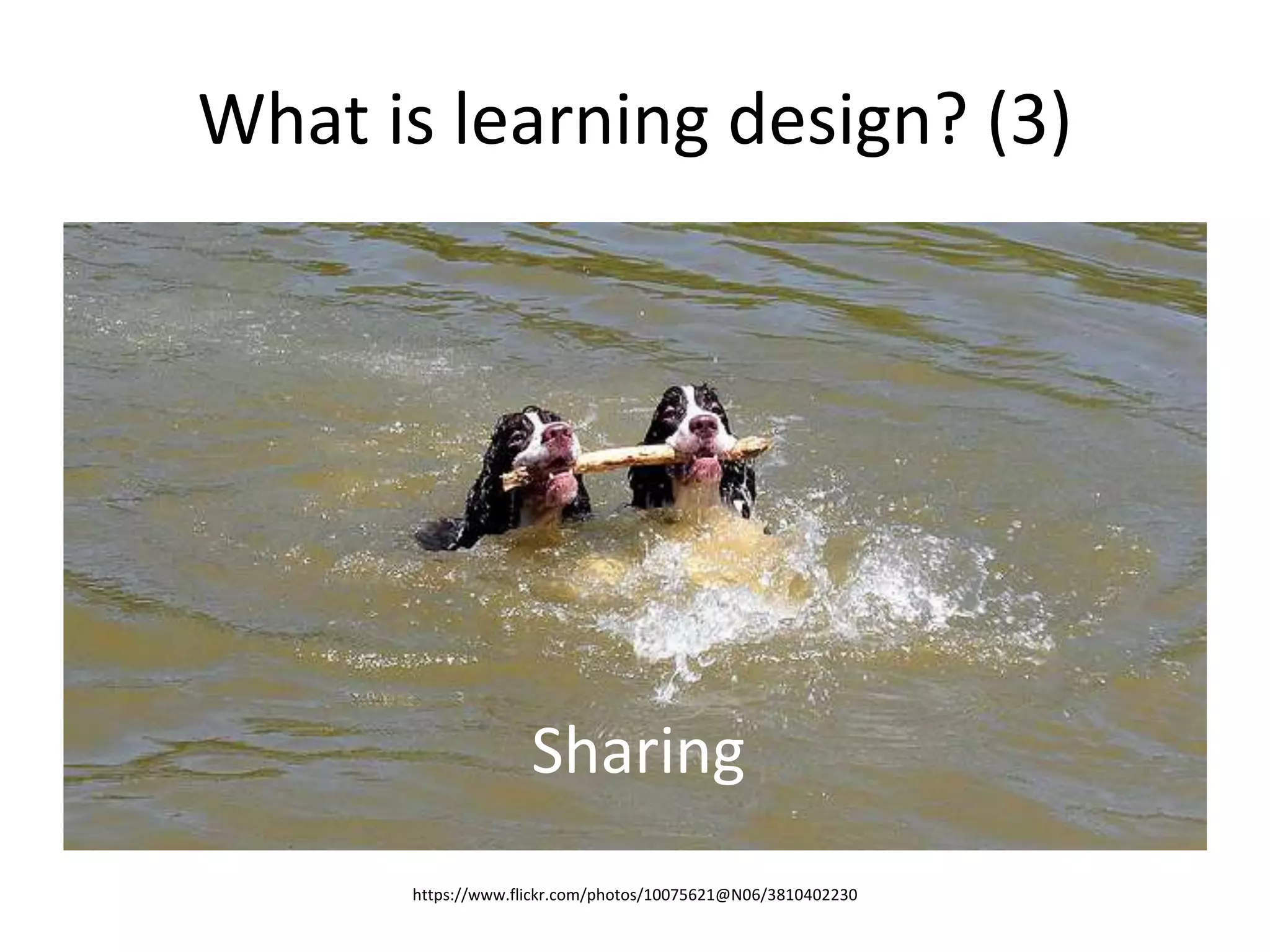
What is learning design? (3)
https://www.flickr.com/photos/10075621@N06/3810402230
Sharing
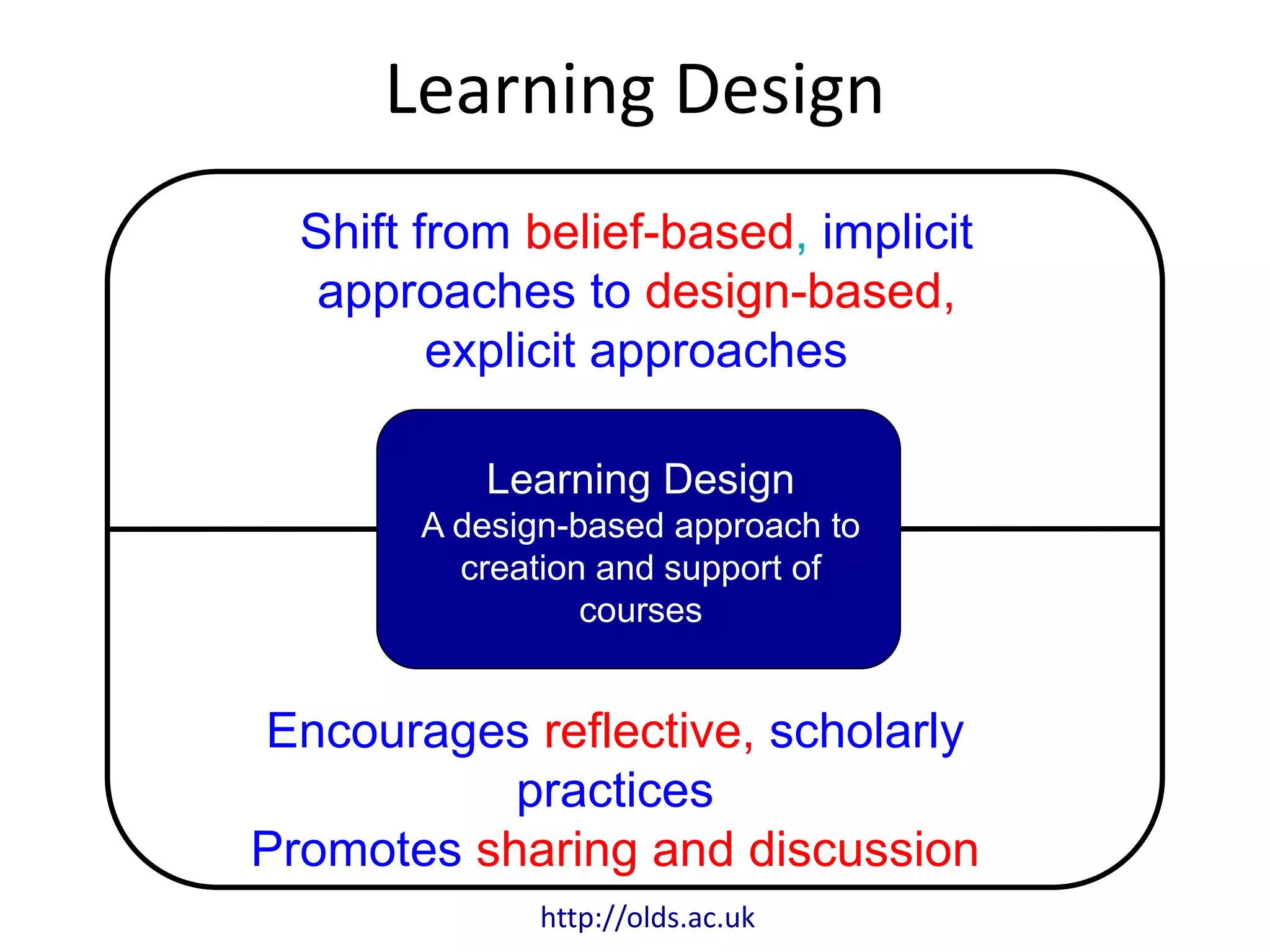
Learning Design
Shift from belief-based, implicit
approaches to design-based,
explicit approaches
Encourages reflective, scholarly
practices
Promotes sharing and discussion
Learning Design
A design-based approach to
creation and support of
courses
http://olds.ac.uk
http://www.larnacadeclaration.org/
• What is Learning Design?
• Teachers need help with making effective design
decisions that are pedagogically based and make
appropriate use of digital technologoies
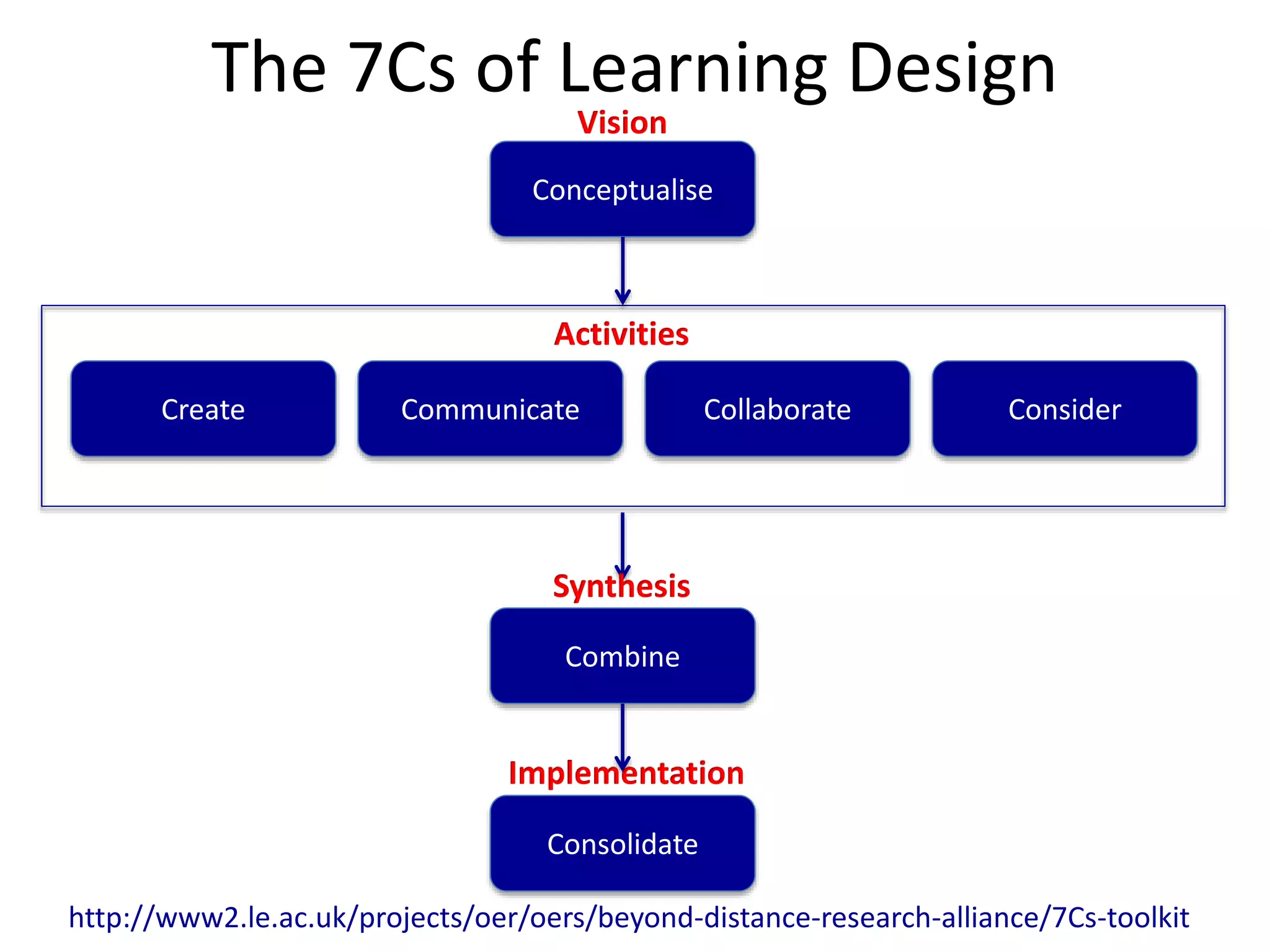
The 7Cs of Learning Design
Conceptualise
Vision
CommunicateCreate ConsiderCollaborate
Activities
Combine
Synthesis
Consolidate
Implementation
http://www2.le.ac.uk/projects/oer/oers/beyond-distance-research-alliance/7Cs-toolkit
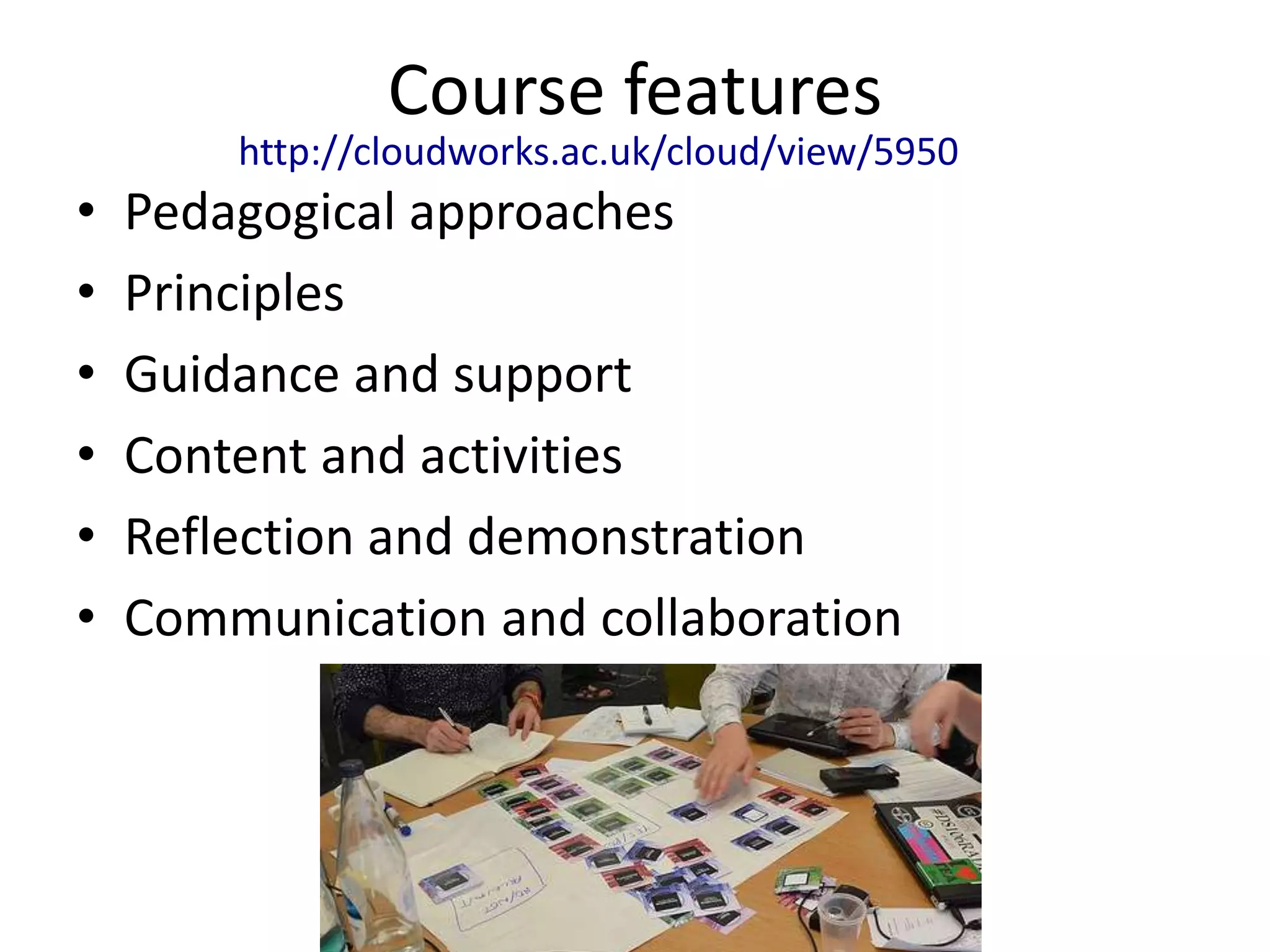
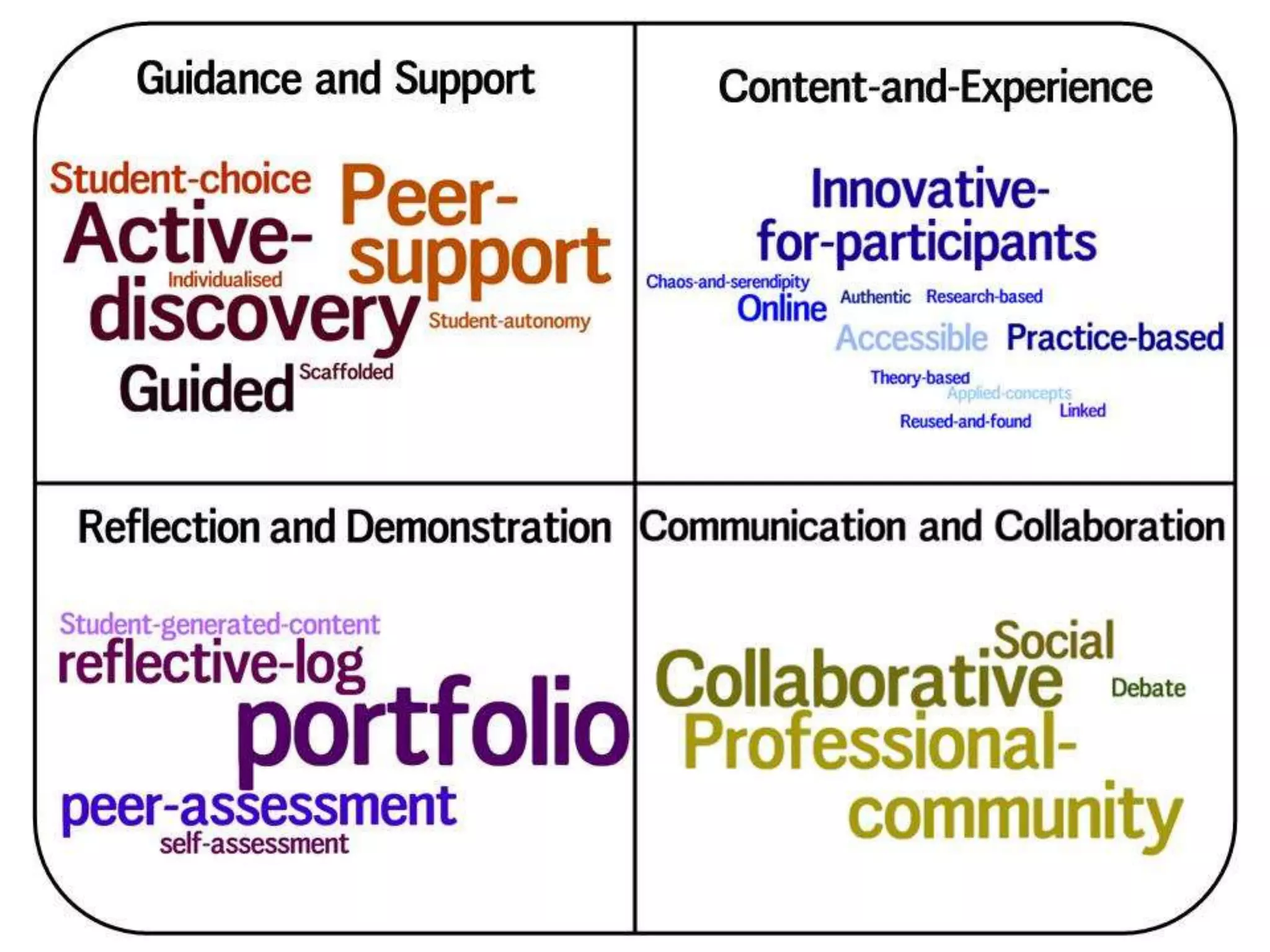
Course features
• Pedagogical approaches
• Principles
• Guidance and support
• Content and activities
• Reflection and demonstration
• Communication and collaboration
http://cloudworks.ac.uk/cloud/view/5950
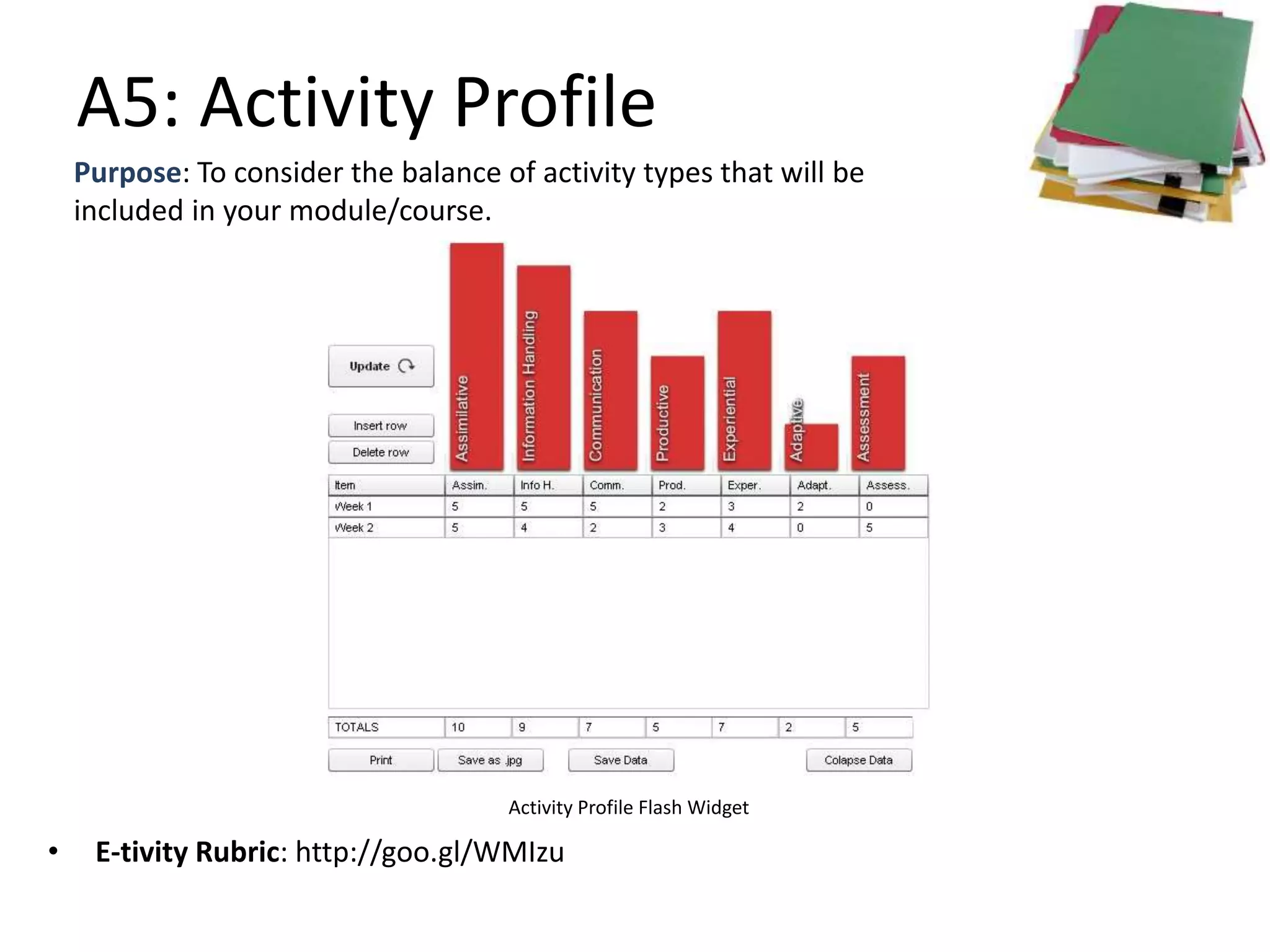
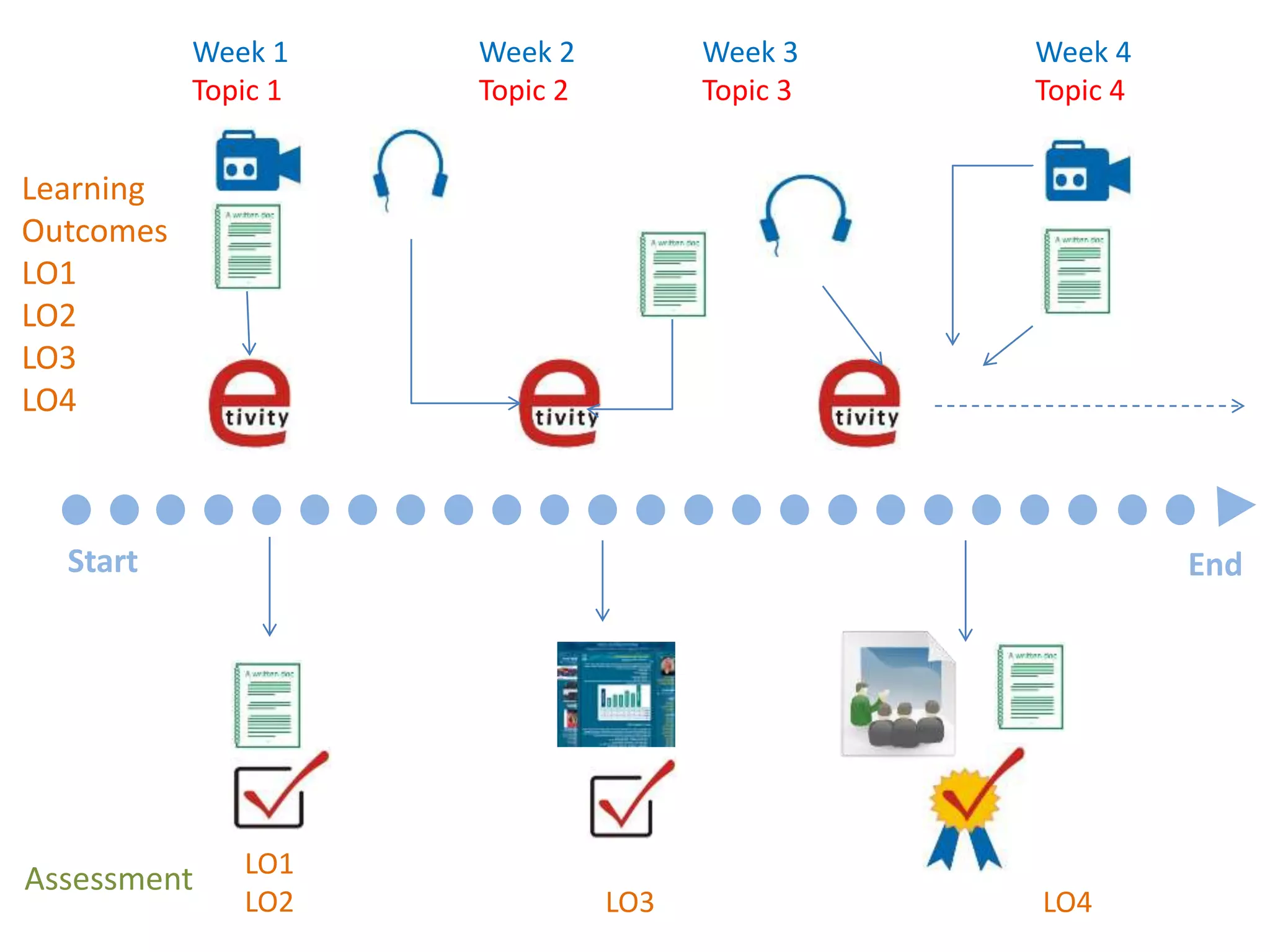
A5: Activity Profile
• E-tivity Rubric: http://goo.gl/WMIzu
Purpose: To consider the balance of activity types that will be
included in your module/course.
Activity Profile Flash Widget
Start End
Learning
Outcomes
LO1
LO2
LO3
LO4
Assessment LO1
LO2 LO3 LO4
Week 1
Topic 1
Week 2
Topic 2
Week 3
Topic 3
Week 4
Topic 4
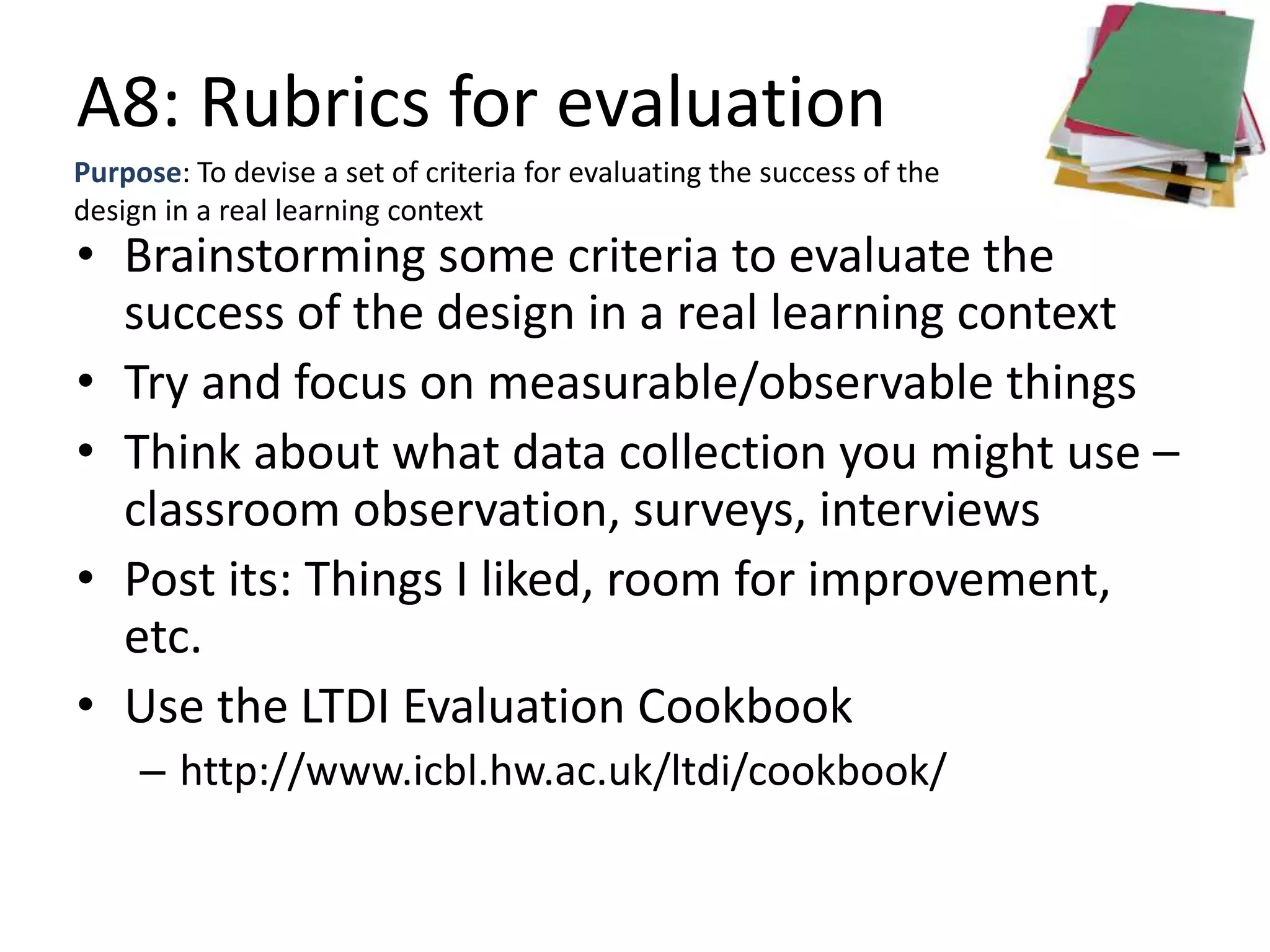
A8: Rubrics for evaluation
Purpose: To devise a set of criteria for evaluating the success of the
design in a real learning context
• Brainstorming some criteria to evaluate the
success of the design in a real learning context
• Try and focus on measurable/observable things
• Think about what data collection you might use –
classroom observation, surveys, interviews
• Post its: Things I liked, room for improvement,
etc.
• Use the LTDI Evaluation Cookbook
– http://www.icbl.hw.ac.uk/ltdi/cookbook/
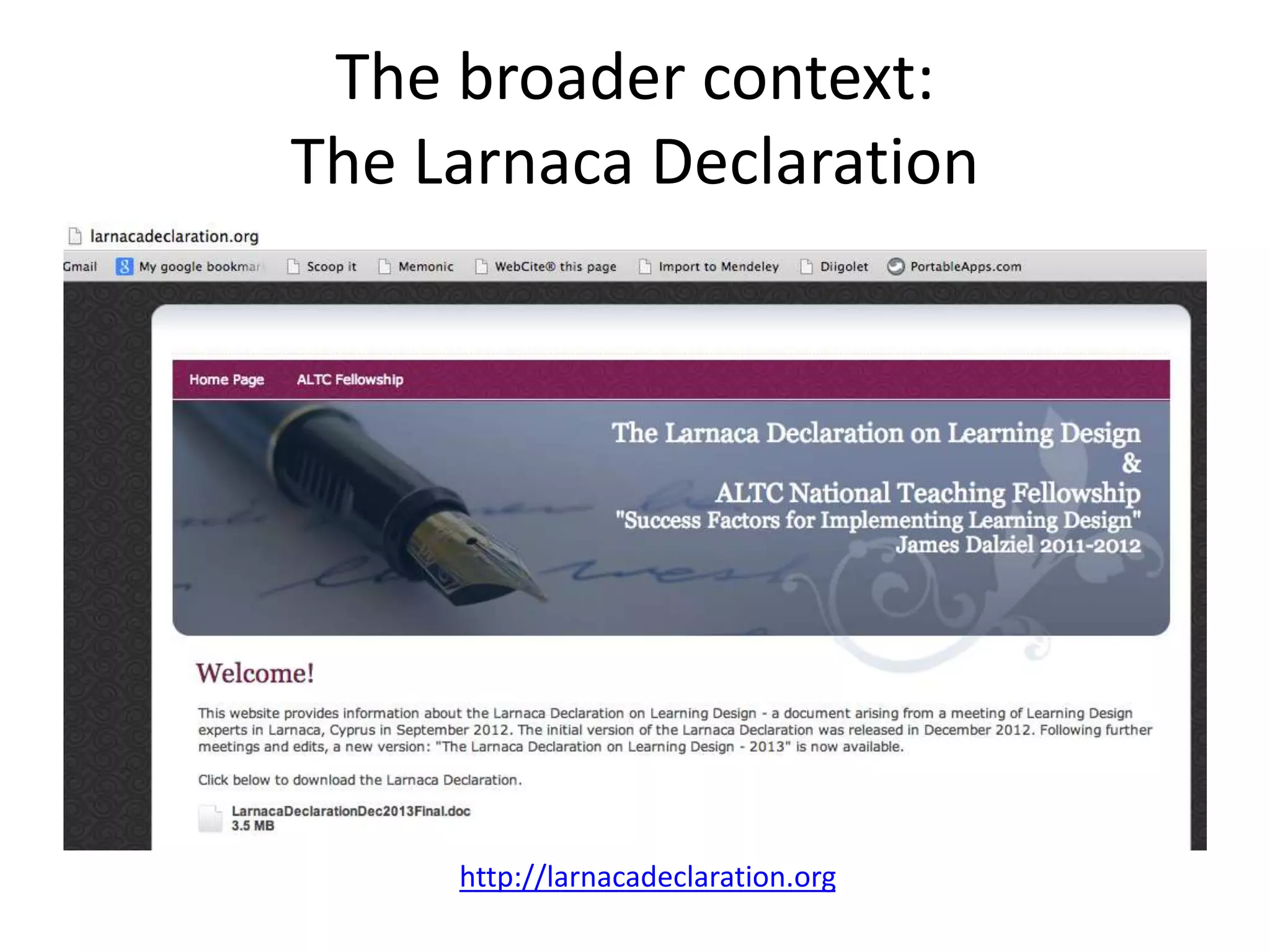
The broader context:
The Larnaca Declaration
http://larnacadeclaration.org
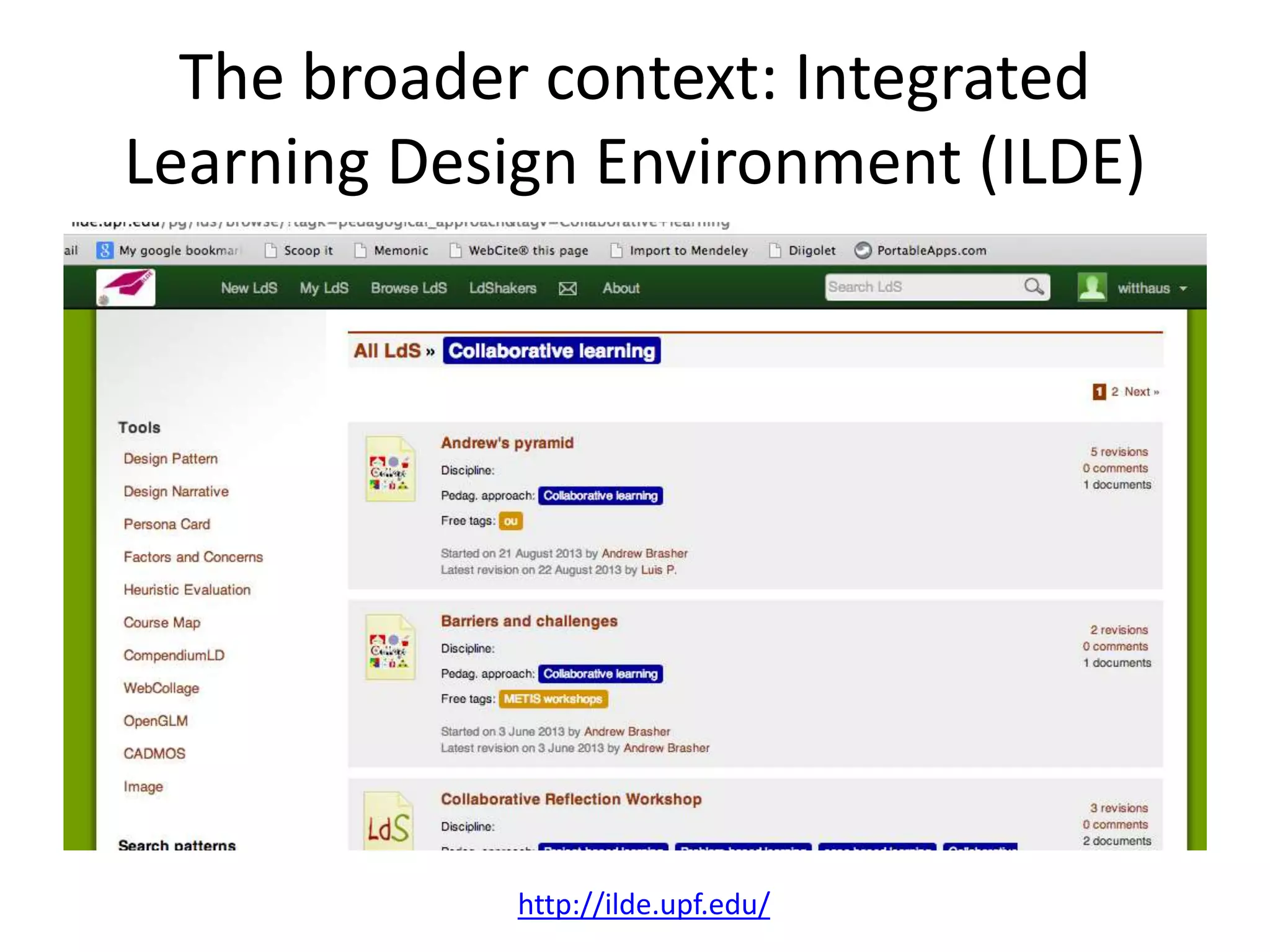
The broader context: Integrated
Learning Design Environment (ILDE)
http://ilde.upf.edu/
MOOCs
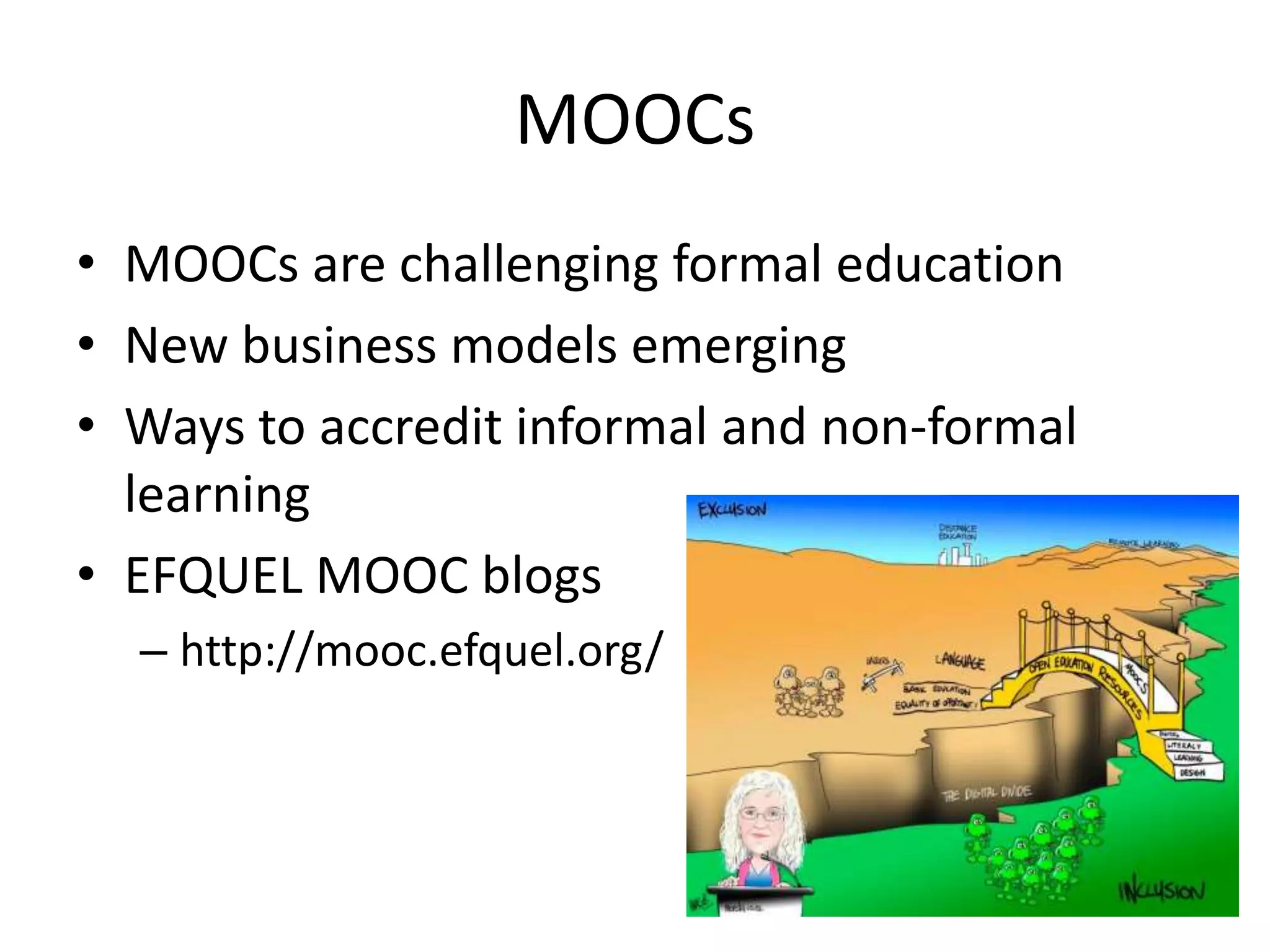
• MOOCs are challenging formal education
• New business models emerging
• Ways to accredit informal and non-formal
learning
• EFQUEL MOOC blogs
– http://mooc.efquel.org/
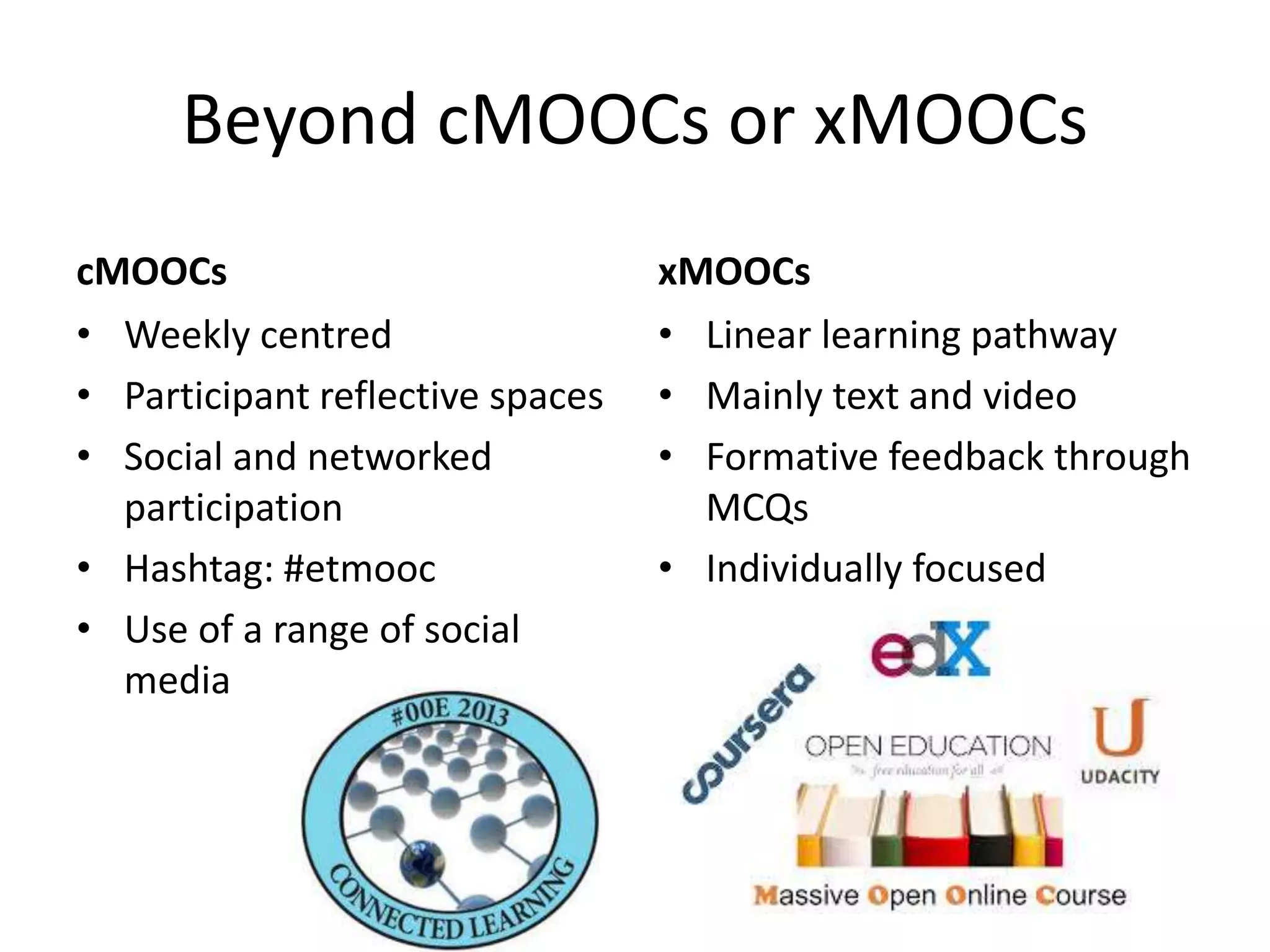
Beyond cMOOCs or xMOOCs
cMOOCs
• Weekly centred
• Participant reflective spaces
• Social and networked
participation
• Hashtag: #etmooc
• Use of a range of social
media
xMOOCs
• Linear learning pathway
• Mainly text and video
• Formative feedback through
MCQs
• Individually focused
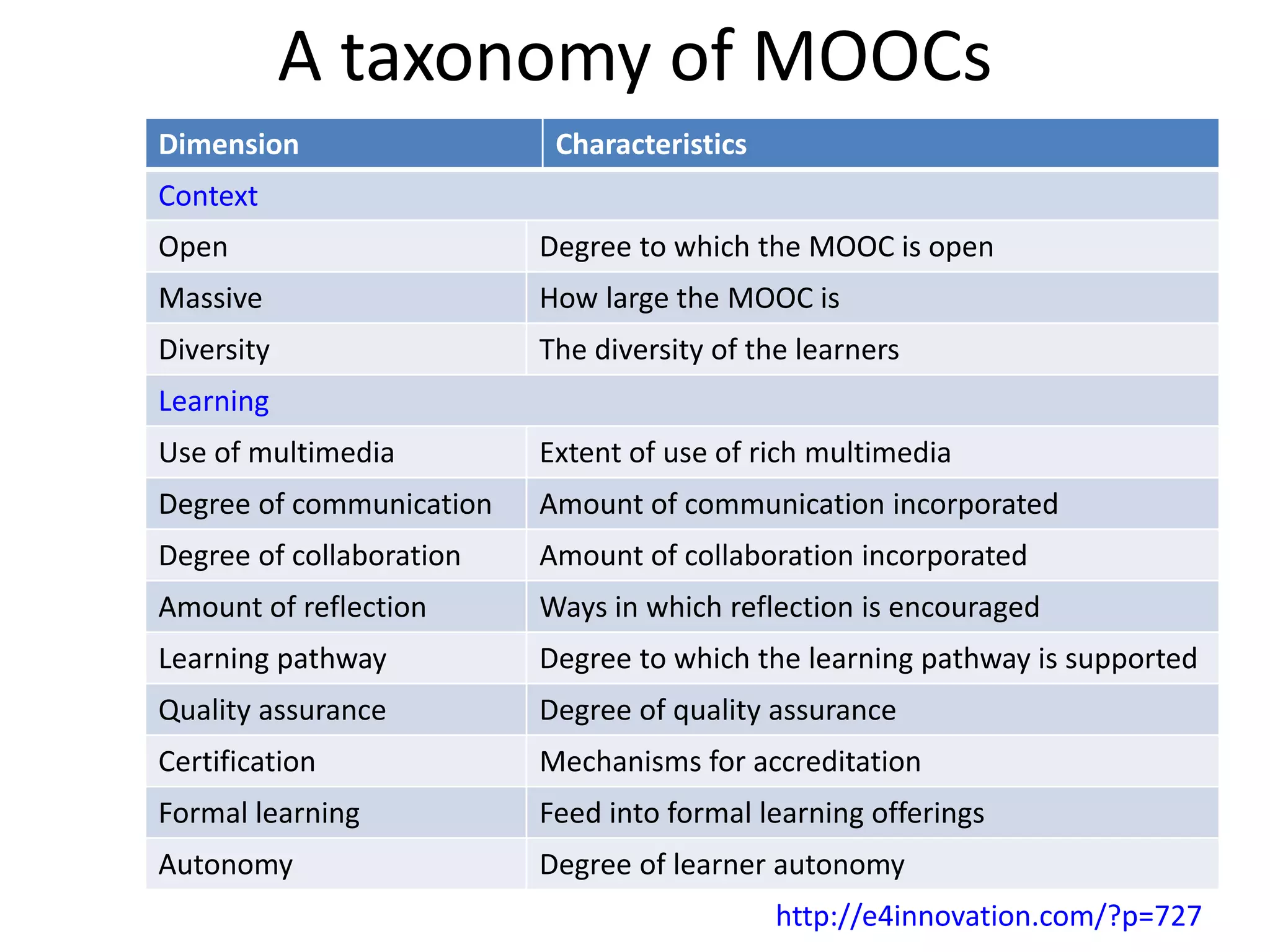
Dimension Characteristics
Context
Open Degree to which the MOOC is open
Massive How large the MOOC is
Diversity The diversity of the learners
Learning
Use of multimedia Extent of use of rich multimedia
Degree of communication Amount of communication incorporated
Degree of collaboration Amount of collaboration incorporated
Amount of reflection Ways in which reflection is encouraged
Learning pathway Degree to which the learning pathway is supported
Quality assurance Degree of quality assurance
Certification Mechanisms for accreditation
Formal learning Feed into formal learning offerings
Autonomy Degree of learner autonomy
A taxonomy of MOOCs
http://e4innovation.com/?p=727
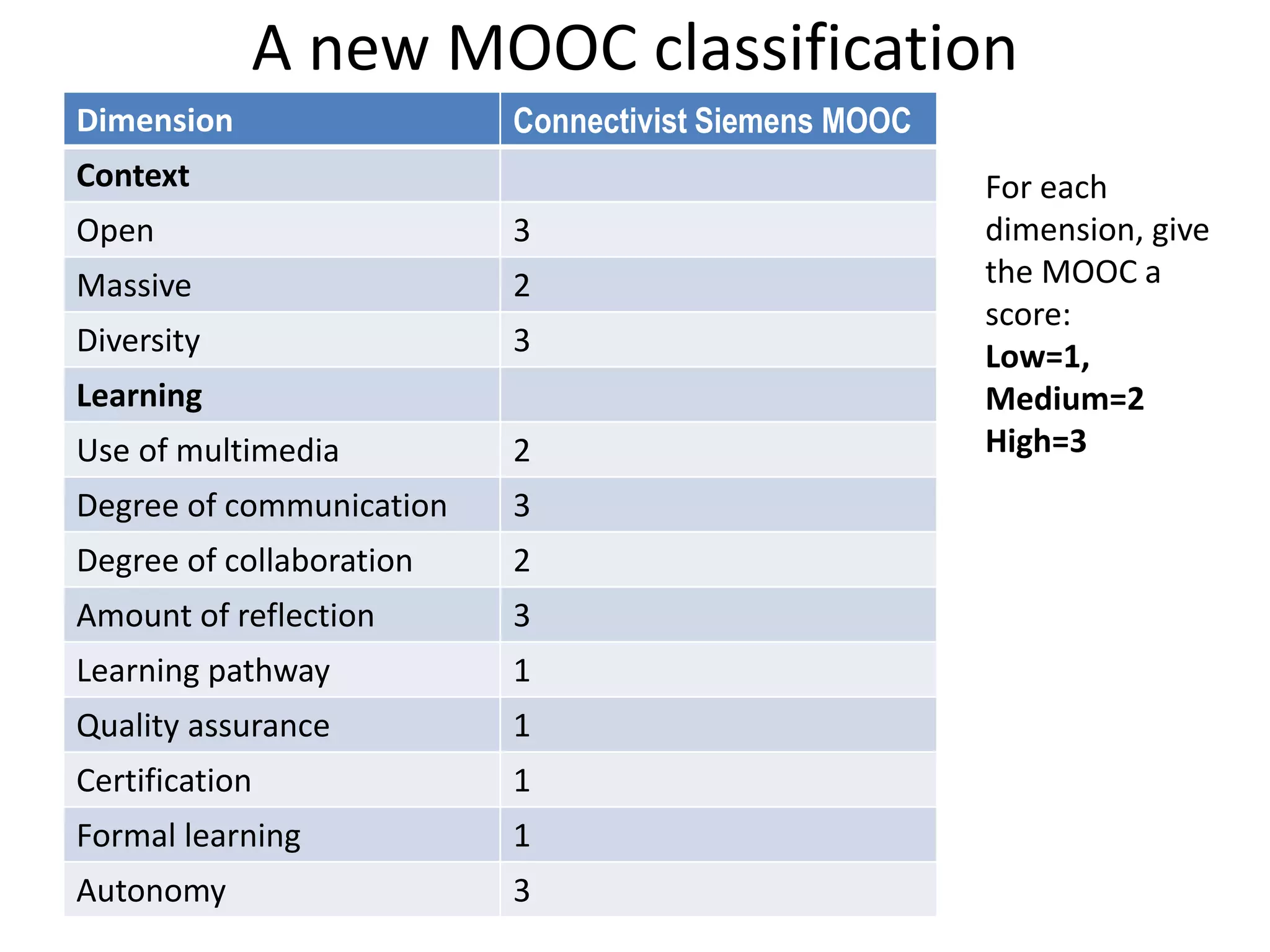
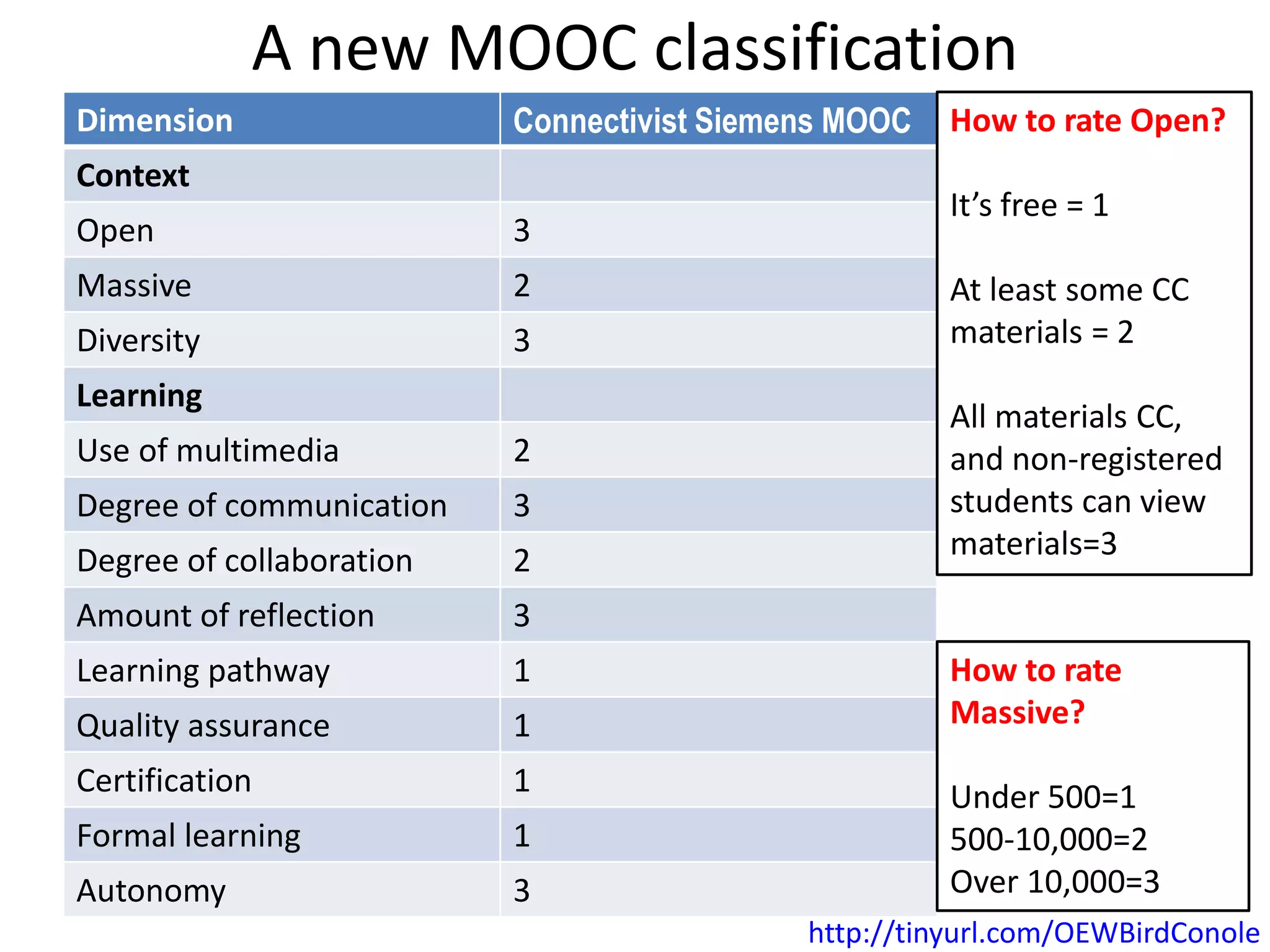
A new MOOC classification
Dimension Connectivist Siemens MOOC
Context
Open 3
Massive 2
Diversity 3
Learning
Use of multimedia 2
Degree of communication 3
Degree of collaboration 2
Amount of reflection 3
Learning pathway 1
Quality assurance 1
Certification 1
Formal learning 1
Autonomy 3
For each
dimension, give
the MOOC a
score:
Low=1,
Medium=2
High=3
A new MOOC classification
Dimension Connectivist Siemens MOOC
Context
Open 3
Massive 2
Diversity 3
Learning
Use of multimedia 2
Degree of communication 3
Degree of collaboration 2
Amount of reflection 3
Learning pathway 1
Quality assurance 1
Certification 1
Formal learning 1
Autonomy 3
How to rate Open?
It’s free = 1
At least some CC
materials = 2
All materials CC,
and non-registered
students can view
materials=3
How to rate
Massive?
Under 500=1
500-10,000=2
Over 10,000=3
http://tinyurl.com/OEWBirdConole
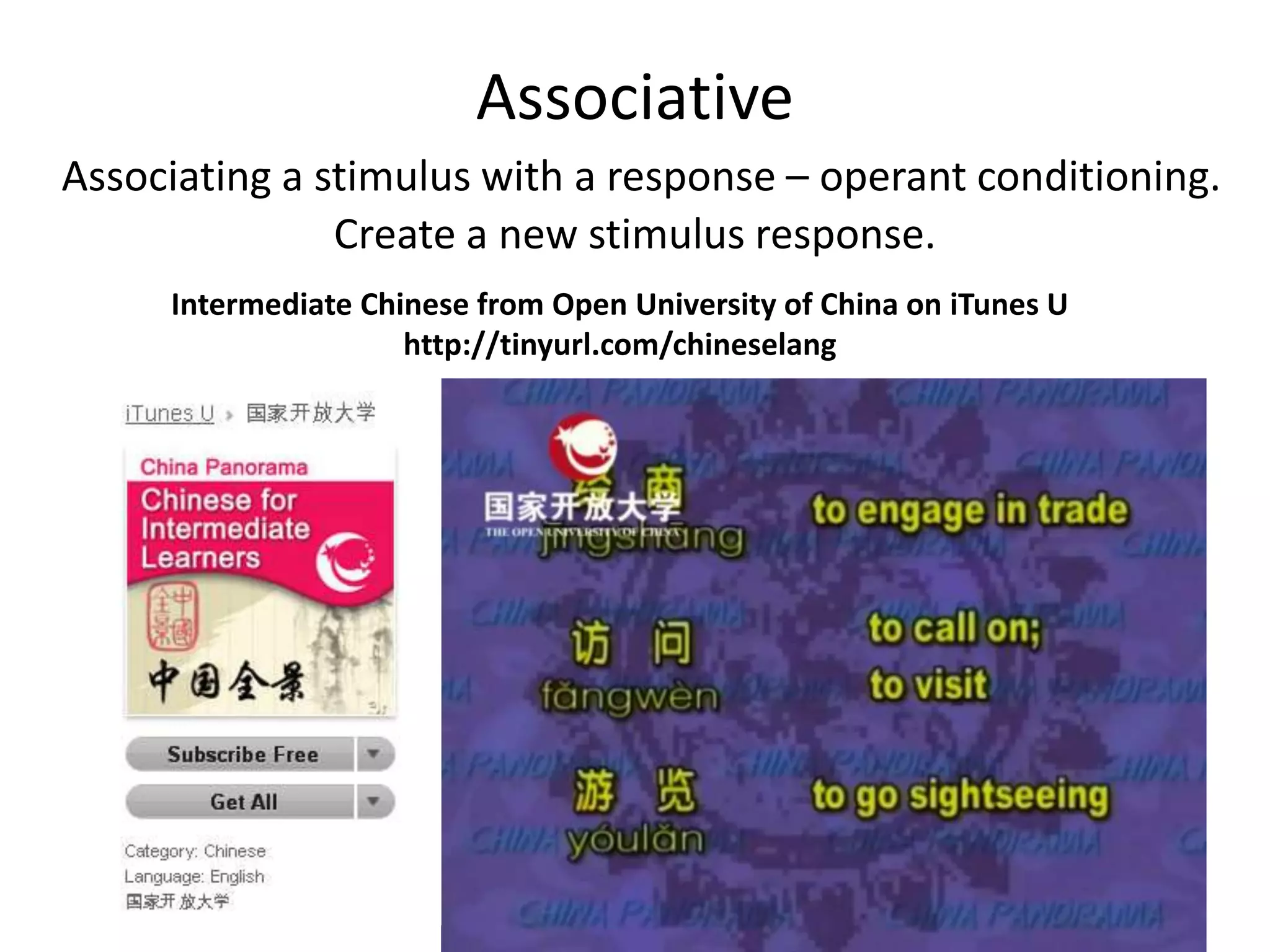
Associative
Associating a stimulus with a response – operant conditioning.
Create a new stimulus response.
Intermediate Chinese from Open University of China on iTunes U
http://tinyurl.com/chineselang
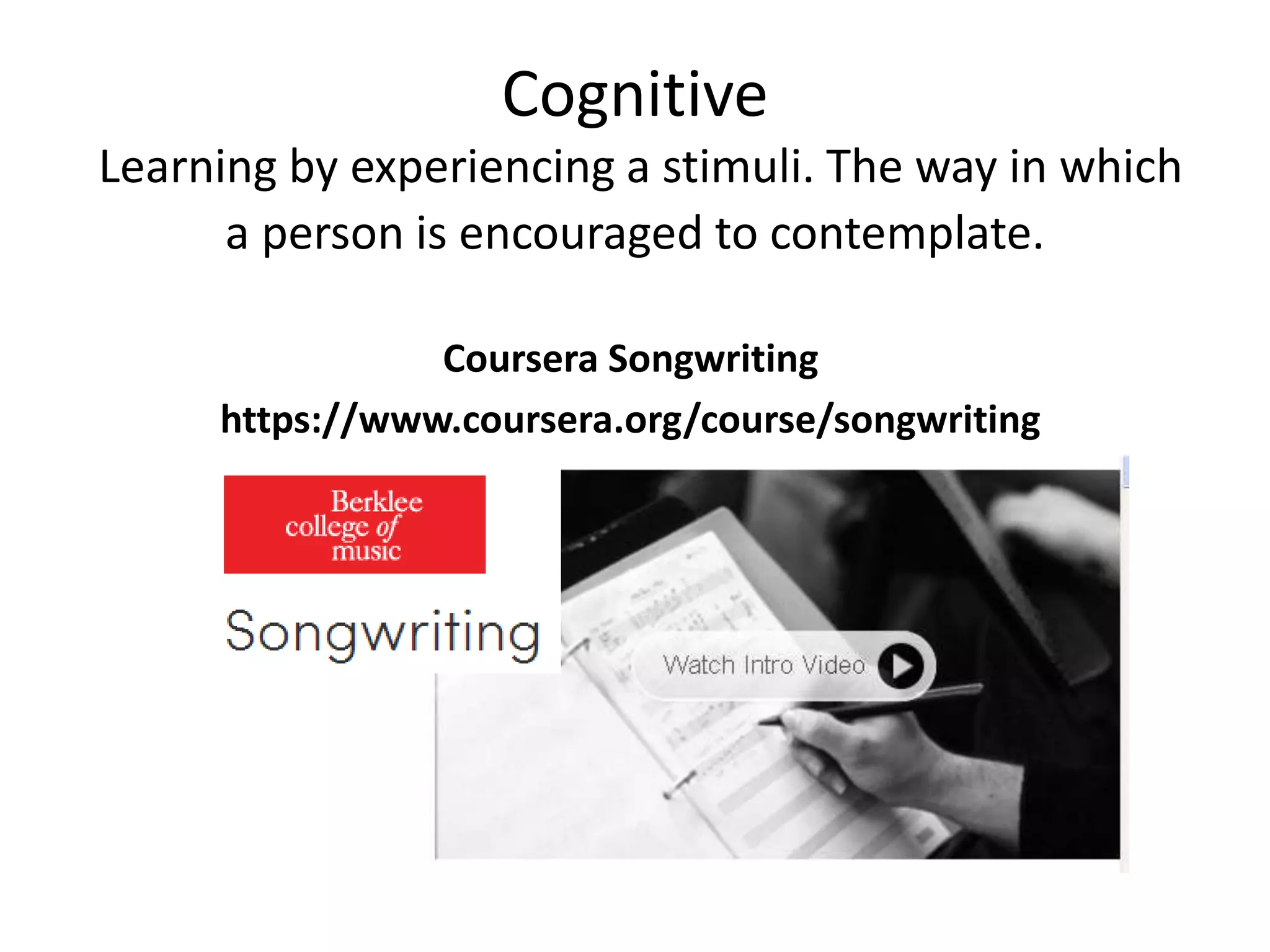
Cognitive
Learning by experiencing a stimuli. The way in which
a person is encouraged to contemplate.
Coursera Songwriting
https://www.coursera.org/course/songwriting
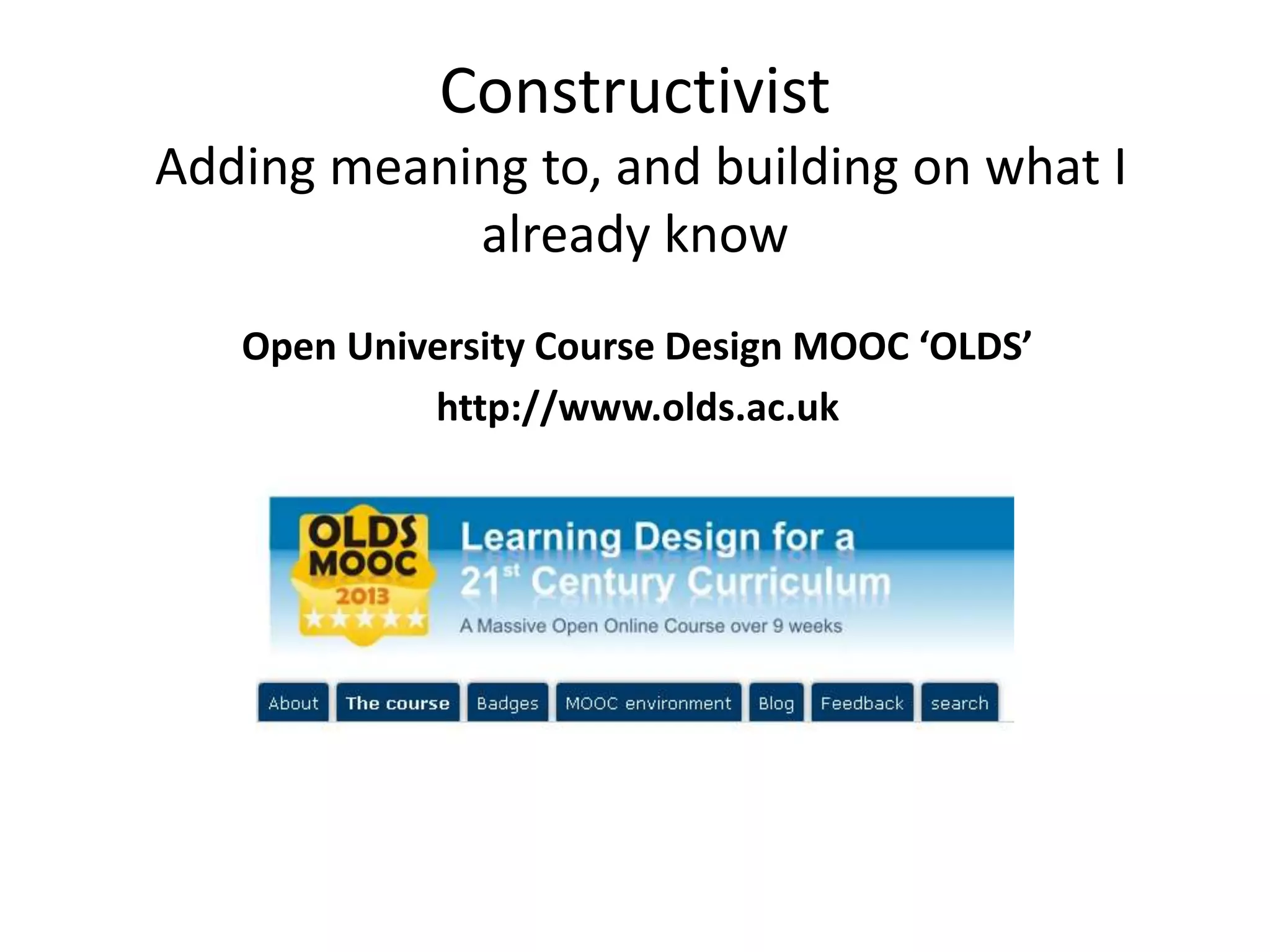
Constructivist
Adding meaning to, and building on what I
already know
Open University Course Design MOOC ‘OLDS’
http://www.olds.ac.uk
Situative
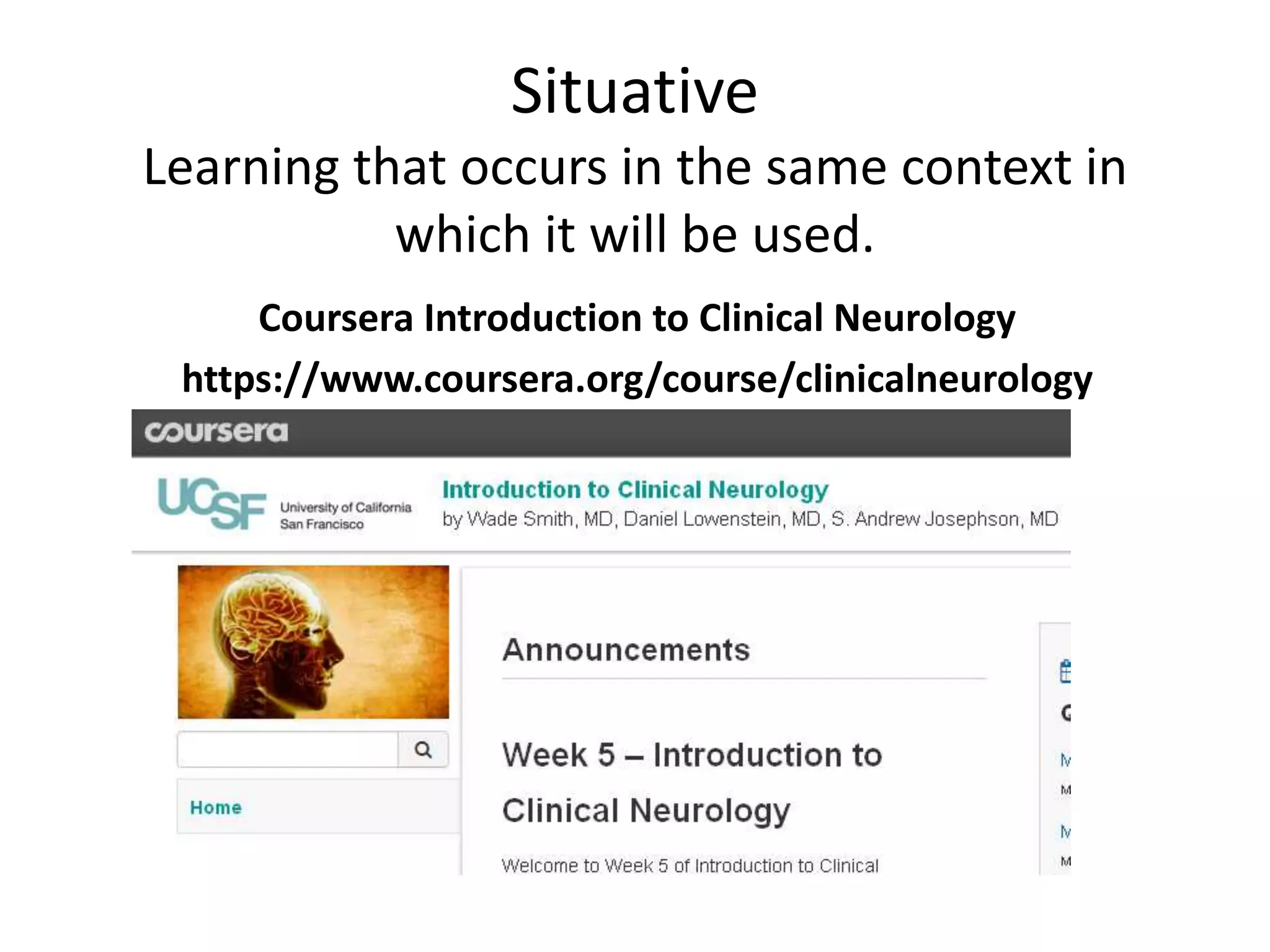
Learning that occurs in the same context in
which it will be used.
Coursera Introduction to Clinical Neurology
https://www.coursera.org/course/clinicalneurology
Connectivist
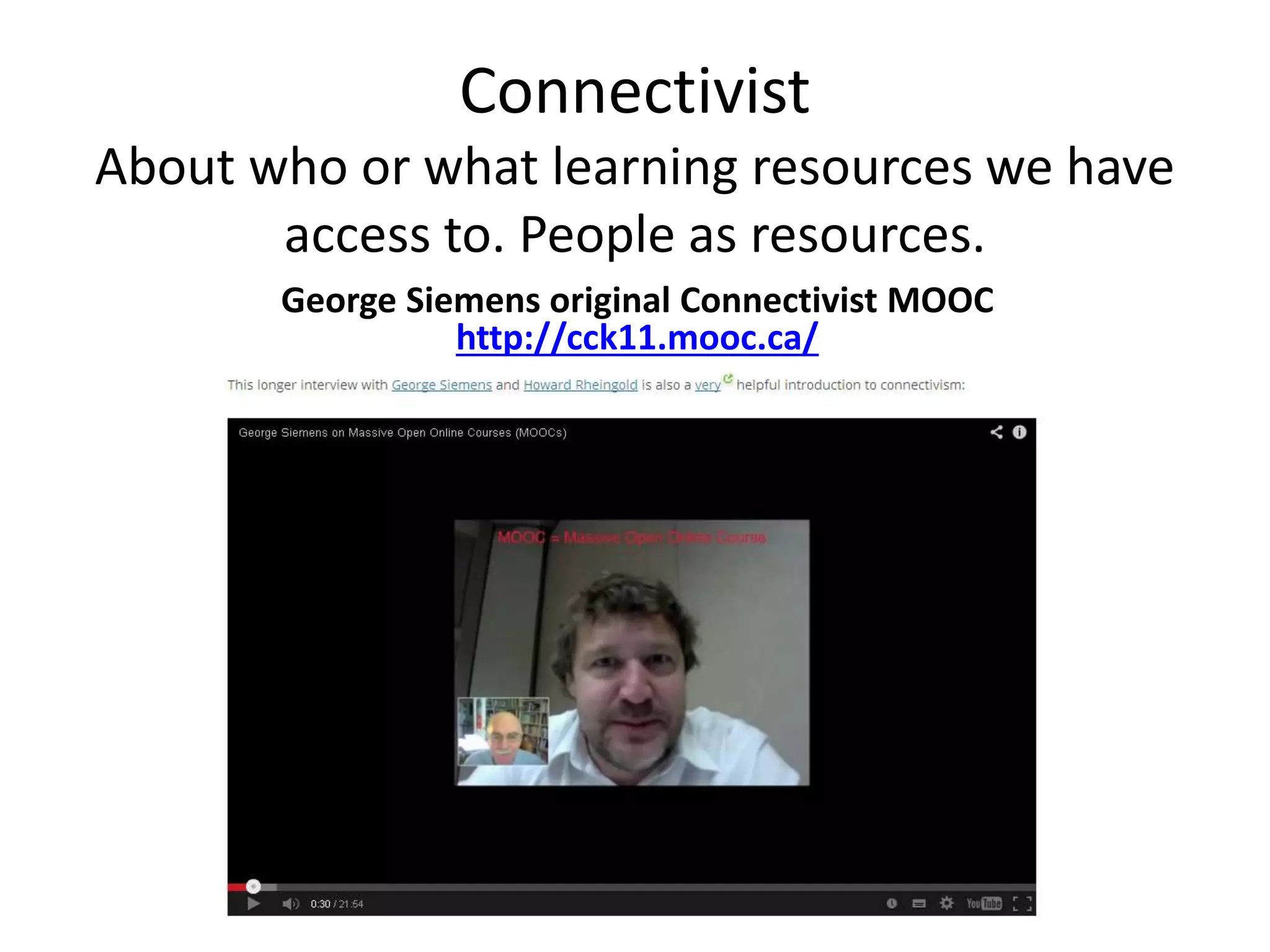
About who or what learning resources we have
access to. People as resources.
George Siemens original Connectivist MOOC
http://cck11.mooc.ca/
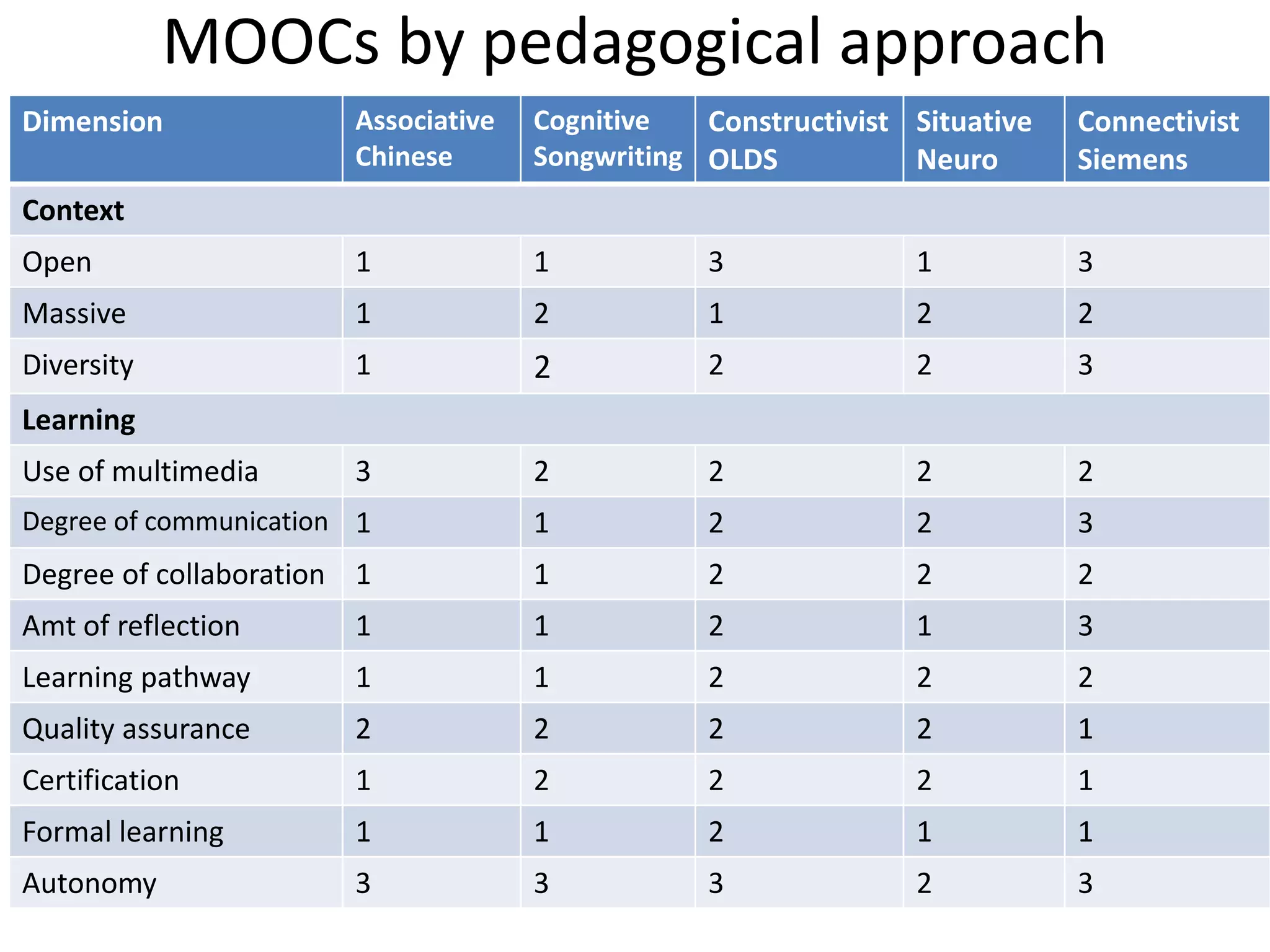
MOOCs by pedagogical approach
Dimension Associative
Chinese
Cognitive
Songwriting
Constructivist
OLDS
Situative
Neuro
Connectivist
Siemens
Context
Open 1 1 3 1 3
Massive 1 2 1 2 2
Diversity 1 2 2 2 3
Learning
Use of multimedia 3 2 2 2 2
Degree of communication 1 1 2 2 3
Degree of collaboration 1 1 2 2 2
Amt of reflection 1 1 2 1 3
Learning pathway 1 1 2 2 2
Quality assurance 2 2 2 2 1
Certification 1 2 2 2 1
Formal learning 1 1 2 1 1
Autonomy 3 3 3 2 3
http://www.le.ac.uk/ili
http://www.slideshare.net/GrainneConole
grainne.conole@le.ac.uk
http://e4innovation.com
@gconole

Conole designing effective_moo_cs

  • 1.
    Designing effective MOOCs GráinneConole, Bath Spa University Nicosia, Cyprus National Teaching Fellow 2012 Ascilite fellow 2012EDEN fellow 2013
  • 2.
    Outline • The importanceof e-learning • E-learning timeline and emergent technologies • E-Pedagogies • Social media • What is good learning? • The 7Cs of Learning Design – Designing Courses – Evaluating Courses
  • 3.
  • 4.
    Barriers to adoption •Lack of digital literacy skills • No reward for teaching • Competition from other providers • Scaling innovation • Democratisation
  • 5.
  • 6.
    Pedagogical approaches Socialmedia tools and approaches Personalised learning The ability to adapt, customised and personalise. Mix and match of tools, use of RSS feeds and filters Situated learning, experiential learning, problem-based learning, scenario-based learning, role play Use of location-aware functionality, immersive 3D-worlds,connection with peers and experts via social networking tools, scenario-based and authentic tasks in virtual worlds, application of gaming technologies for educational purposes Inquiry-based learning, resource-based learning Tools to support user-generated content and facilitating easy sharing/discussion, media repositories (Flickr, YouTube, and SlideShare), social bookmarking sites (Delicious), digital repositories and tools for content generation, use of search engines, participation in distributed virtual communities, use of folksonomies and social book marking as mechanisms for finding and organising resources
  • 7.
    Pedagogical approaches Socialmedia tools and approaches Reflective and dialogic learning, peer learning Tools for fostering peer reflection such as blogs and e-portfolios, commenting on other learners’ blog posts, co-creation of learning artefacts in wikis Communities of Practice Use of social networking tools to participate in communities of learning and/or teaching Scholarly practice and the sharing of designs and good practice Use of Web 2.0 technologies to participate in a distributed network of educators and researchers. Use of blogs, Twitter and wikis to co- create knowledge and understanding, to critique practice, and to share professional practice and resources
  • 8.
    The promise andthe reality New forms of interaction, communication and collaboration. Lots of free resources Not fully exploited Bad pedagogies Teachers don’t have the time or the skills https://www.alt.ac.uk/sites/alt.ac.uk/files/public/ALTsurvey%20for%20ETAG%202014.pdf
  • 9.
    What is learningdesign? (1) Guidance https://www.flickr.com/photos/anonymouscollective/1899303123
  • 10.
    What is learningdesign? (2) https://www.flickr.com/photos/frawemedia/5187769740
  • 11.
    What is learningdesign? (3) https://www.flickr.com/photos/10075621@N06/3810402230 Sharing
  • 12.
    Learning Design Shift frombelief-based, implicit approaches to design-based, explicit approaches Encourages reflective, scholarly practices Promotes sharing and discussion Learning Design A design-based approach to creation and support of courses http://olds.ac.uk
  • 13.
    http://www.larnacadeclaration.org/ • What isLearning Design? • Teachers need help with making effective design decisions that are pedagogically based and make appropriate use of digital technologoies
  • 14.
    The 7Cs ofLearning Design Conceptualise Vision CommunicateCreate ConsiderCollaborate Activities Combine Synthesis Consolidate Implementation http://www2.le.ac.uk/projects/oer/oers/beyond-distance-research-alliance/7Cs-toolkit
  • 15.
    Course features • Pedagogicalapproaches • Principles • Guidance and support • Content and activities • Reflection and demonstration • Communication and collaboration http://cloudworks.ac.uk/cloud/view/5950
  • 17.
    A5: Activity Profile •E-tivity Rubric: http://goo.gl/WMIzu Purpose: To consider the balance of activity types that will be included in your module/course. Activity Profile Flash Widget
  • 18.
    Start End Learning Outcomes LO1 LO2 LO3 LO4 Assessment LO1 LO2LO3 LO4 Week 1 Topic 1 Week 2 Topic 2 Week 3 Topic 3 Week 4 Topic 4
  • 19.
    A8: Rubrics forevaluation Purpose: To devise a set of criteria for evaluating the success of the design in a real learning context • Brainstorming some criteria to evaluate the success of the design in a real learning context • Try and focus on measurable/observable things • Think about what data collection you might use – classroom observation, surveys, interviews • Post its: Things I liked, room for improvement, etc. • Use the LTDI Evaluation Cookbook – http://www.icbl.hw.ac.uk/ltdi/cookbook/
  • 20.
    The broader context: TheLarnaca Declaration http://larnacadeclaration.org
  • 21.
    The broader context:Integrated Learning Design Environment (ILDE) http://ilde.upf.edu/
  • 22.
    MOOCs • MOOCs arechallenging formal education • New business models emerging • Ways to accredit informal and non-formal learning • EFQUEL MOOC blogs – http://mooc.efquel.org/
  • 23.
    Beyond cMOOCs orxMOOCs cMOOCs • Weekly centred • Participant reflective spaces • Social and networked participation • Hashtag: #etmooc • Use of a range of social media xMOOCs • Linear learning pathway • Mainly text and video • Formative feedback through MCQs • Individually focused
  • 24.
    Dimension Characteristics Context Open Degreeto which the MOOC is open Massive How large the MOOC is Diversity The diversity of the learners Learning Use of multimedia Extent of use of rich multimedia Degree of communication Amount of communication incorporated Degree of collaboration Amount of collaboration incorporated Amount of reflection Ways in which reflection is encouraged Learning pathway Degree to which the learning pathway is supported Quality assurance Degree of quality assurance Certification Mechanisms for accreditation Formal learning Feed into formal learning offerings Autonomy Degree of learner autonomy A taxonomy of MOOCs http://e4innovation.com/?p=727
  • 25.
    A new MOOCclassification Dimension Connectivist Siemens MOOC Context Open 3 Massive 2 Diversity 3 Learning Use of multimedia 2 Degree of communication 3 Degree of collaboration 2 Amount of reflection 3 Learning pathway 1 Quality assurance 1 Certification 1 Formal learning 1 Autonomy 3 For each dimension, give the MOOC a score: Low=1, Medium=2 High=3
  • 26.
    A new MOOCclassification Dimension Connectivist Siemens MOOC Context Open 3 Massive 2 Diversity 3 Learning Use of multimedia 2 Degree of communication 3 Degree of collaboration 2 Amount of reflection 3 Learning pathway 1 Quality assurance 1 Certification 1 Formal learning 1 Autonomy 3 How to rate Open? It’s free = 1 At least some CC materials = 2 All materials CC, and non-registered students can view materials=3 How to rate Massive? Under 500=1 500-10,000=2 Over 10,000=3 http://tinyurl.com/OEWBirdConole
  • 27.
    Associative Associating a stimuluswith a response – operant conditioning. Create a new stimulus response. Intermediate Chinese from Open University of China on iTunes U http://tinyurl.com/chineselang
  • 28.
    Cognitive Learning by experiencinga stimuli. The way in which a person is encouraged to contemplate. Coursera Songwriting https://www.coursera.org/course/songwriting
  • 29.
    Constructivist Adding meaning to,and building on what I already know Open University Course Design MOOC ‘OLDS’ http://www.olds.ac.uk
  • 30.
    Situative Learning that occursin the same context in which it will be used. Coursera Introduction to Clinical Neurology https://www.coursera.org/course/clinicalneurology
  • 31.
    Connectivist About who orwhat learning resources we have access to. People as resources. George Siemens original Connectivist MOOC http://cck11.mooc.ca/
  • 32.
    MOOCs by pedagogicalapproach Dimension Associative Chinese Cognitive Songwriting Constructivist OLDS Situative Neuro Connectivist Siemens Context Open 1 1 3 1 3 Massive 1 2 1 2 2 Diversity 1 2 2 2 3 Learning Use of multimedia 3 2 2 2 2 Degree of communication 1 1 2 2 3 Degree of collaboration 1 1 2 2 2 Amt of reflection 1 1 2 1 3 Learning pathway 1 1 2 2 2 Quality assurance 2 2 2 2 1 Certification 1 2 2 2 1 Formal learning 1 1 2 1 1 Autonomy 3 3 3 2 3
  • 34.