




A vision for the future of Technology
Enhanced Learning: key trends and
implications
11th March 2019
University College Dublin
Gráinne Conole, Dublin City University
2019 Conference
Dublin
Outline
− The Irish e-learning landscape
− EENEE report
− Theoretical lens
− Today’s digital society
− Affordances
− Opportunities
− Top ten trends
− Open practices
− Pedagogy
− Continuing Professional Development
− Learning Design and Analytics
− Beware of the rhetoric
− Reflections
https://bit.ly/2H4tpqL
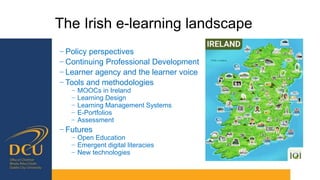
The Irish e-learning landscape
− Policy perspectives
− Continuing Professional Development
− Learner agency and the learner voice
− Tools and methodologies
− MOOCs in Ireland
− Learning Design
− Learning Management Systems
− E-Portfolios
− Assessment
− Futures
− Open Education
− Emergent digital literacies
− New technologies
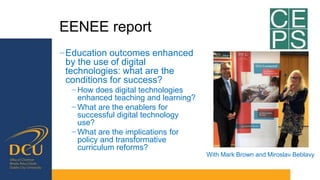
EENEE report
−Education outcomes enhanced
by the use of digital
technologies: what are the
conditions for success?
− How does digital technologies
enhanced teaching and learning?
− What are the enablers for
successful digital technology
use?
− What are the implications for
policy and transformative
curriculum reforms?
With Mark Brown and Miroslav Beblavy
Outline of the report
• Foregrounding literature
• Theoretical lens
• Changing nature of the digital society
• Affordances of digital technology
• Effective pedagogy for innovation
• Continuous Professional Learning
• Barriers
• Principles and recommendations
• Final reflections
OECD 2015
− ICT has revolutionised virtually
every aspect of our life and work
− Students unable to navigate
through a complex digital
landscape will no longer be able
to participate fully in the
economic, social and cultural life
around them
− Challenges: information overload,
plagiarism, online risks
− Students need to become critical
consumers of Internet services
and electronic media and make
informed choices
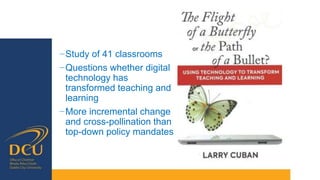
−Study of 41 classrooms
−Questions whether digital
technology has
transformed teaching and
learning
−More incremental change
and cross-pollination than
top-down policy mandates
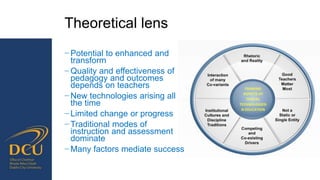
Theoretical lens
− Potential to enhanced and
transform
− Quality and effectiveness of
pedagogy and outcomes
depends on teachers
− New technologies arising all
the time
− Limited change or progress
− Traditional modes of
instruction and assessment
dominate
− Many factors mediate success
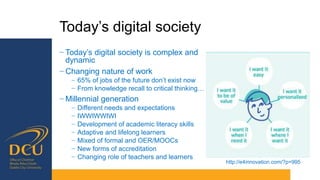
Today’s digital society
− Today’s digital society is complex and
dynamic
− Changing nature of work
− 65% of jobs of the future don’t exist now
− From knowledge recall to critical thinking…
− Millennial generation
− Different needs and expectations
− IWWIWWIWI
− Development of academic literacy skills
− Adaptive and lifelong learners
− Mixed of formal and OER/MOOCs
− New forms of accreditation
− Changing role of teachers and learners
http://e4innovation.com/?p=995
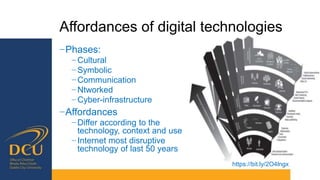
Affordances of digital technologies
−Phases:
− Cultural
− Symbolic
− Communication
− Ntworked
− Cyber-infrastructure
−Affordances
− Differ according to the
technology, context and use
− Internet most disruptive
technology of last 50 years
https://bit.ly/2O4lngx
Opportunities
• Technologies can:
• Enable more interaction &
communication
• Help with retention
• Be engaging & motivational
• Extend the classroom
• Provide timely and targeted feedback
• Personalise the learning experience
• BUT: technology is not a single entity; no
single all-encompassing answer can be
provided to the question of impact on
educational outcomes
https://bit.ly/2JeC4VS
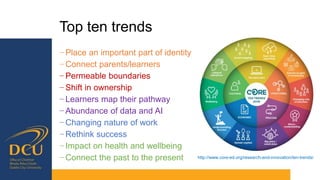
Top ten trends
− Place an important part of identity
− Connect parents/learners
− Permeable boundaries
− Shift in ownership
− Learners map their pathway
− Abundance of data and AI
− Changing nature of work
− Rethink success
− Impact on health and wellbeing
− Connect the past to the present http://www.core-ed.org/research-and-innovation/ten-trends/
Open practices
− Opening up education
− Facets
− OER
− MOOCs
− E-textbooks
− Use of open practices
complex, personalised
and contextual (Cronin)
− Continuum of openness
and access (Olcott)
https://bit.ly/2gchbww
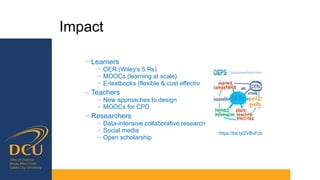
Impact
− Learners
− OER (Wiley’s 5 Rs)
− MOOCs (learning at scale)
− E-textbooks (flexible & cost effective)
− Teachers
− New approaches to design
− MOOCs for CPD
− Researchers
− Data-intensive collaborative research
− Social media
− Open scholarship
https://bit.ly/2VBvFch
Future of open learning: challenges
− Lack of digital literacies
− Teaching the poor sister
− New forms of
accreditation
− Senior management
buy-in
− Appropriate CPD
− Unbundling of education
http://e4innovation.com/?p=938
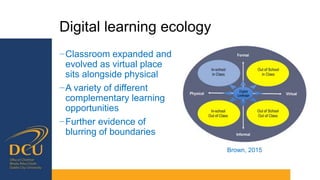
Digital learning ecology
−Classroom expanded and
evolved as virtual place
sits alongside physical
−A variety of different
complementary learning
opportunities
−Further evidence of
blurring of boundaries
Brown, 2015
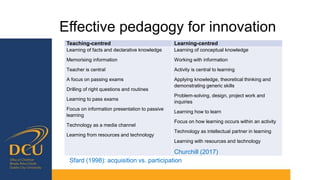
Effective pedagogy for innovation
Teaching-centred Learning-centred
Learning of facts and declarative knowledge
Memorising information
Teacher is central
A focus on passing exams
Drilling of right questions and routines
Learning to pass exams
Focus on information presentation to passive
learning
Technology as a media channel
Learning from resources and technology
Learning of conceptual knowledge
Working with information
Activity is central to learning
Applying knowledge, theoretical thinking and
demonstrating generic skills
Problem-solving, design, project work and
inquiries
Learning how to learn
Focus on how learning occurs within an activity
Technology as intellectual partner in learning
Learning with resources and technology
Churchill (2017)
Sfard (1998): acquisition vs. participation
The parameters of effective design
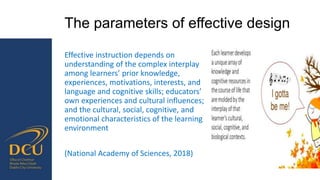
Effective instruction depends on
understanding of the complex interplay
among learners’ prior knowledge,
experiences, motivations, interests, and
language and cognitive skills; educators’
own experiences and cultural influences;
and the cultural, social, cognitive, and
emotional characteristics of the learning
environment
(National Academy of Sciences, 2018)
Brown 2008
A pedagogical compass
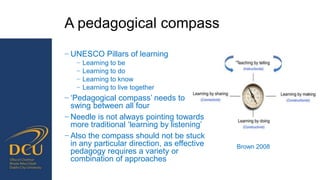
− UNESCO Pillars of learning
− Learning to be
− Learning to do
− Learning to know
− Learning to live together
− ‘Pedagogical compass’ needs to
swing between all four
− Needle is not always pointing towards
more traditional ‘learning by listening’
− Also the compass should not be stuck
in any particular direction, as effective
pedagogy requires a variety or
combination of approaches
Constraints and conflicts
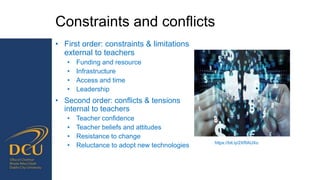
• First order: constraints & limitations
external to teachers
• Funding and resource
• Infrastructure
• Access and time
• Leadership
• Second order: conflicts & tensions
internal to teachers
• Teacher confidence
• Teacher beliefs and attitudes
• Resistance to change
• Reluctance to adopt new technologies https://bit.ly/2XRAUXo
Continuing Professional Learning
− Central role of the teacher
− Continuing Professional Learning
− Enable teachers to develop
innovative learning interventions
− Make effective use of digital
technologies
− Formats
− Specialised and tailored workshops
− Peer support and mentoring
− Examples of good practice
− Share and discuss practice
− Resources, OER and MOOCs
https://bit.ly/2UkM1G1
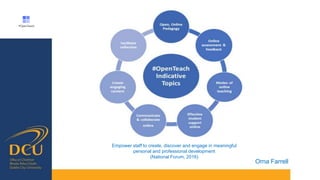
Empower staff to create, discover and engage in meaningful
personal and professional development
(National Forum, 2016)
Orna Farrell
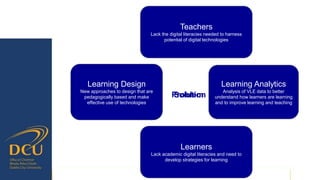
Problem
Learning Design
New approaches to design that are
pedagogically based and make
effective use of technologies
Learning Analytics
Analysis of VLE data to better
understand how learners are learning
and to improve learning and teaching
Solution
Teachers
Lack the digital literacies needed to harness
potential of digital technologies
Learners
Lack academic digital literacies and need to
develop strategies for learning
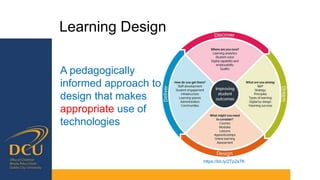
Learning Design
A pedagogically
informed approach to
design that makes
appropriate use of
technologies
https://bit.ly/2Tp2s7K
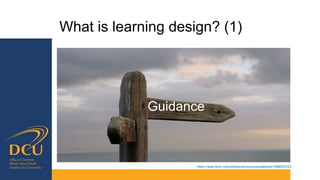
What is learning design? (1)
Guidance
https://www.flickr.com/photos/anonymouscollective/1899303123
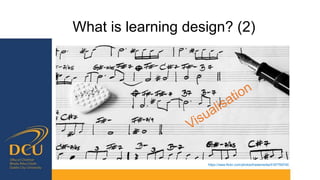
What is learning design? (2)
https://www.flickr.com/photos/frawemedia/5187769740
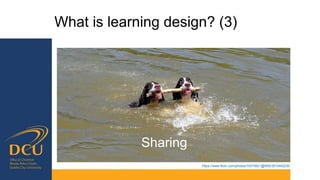
What is learning design? (3)
https://www.flickr.com/photos/10075621@N06/3810402230
Sharing
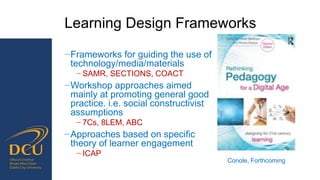
Learning Design Frameworks
−Frameworks for guiding the use of
technology/media/materials
− SAMR, SECTIONS, COACT
−Workshop approaches aimed
mainly at promoting general good
practice. i.e. social constructivist
assumptions
− 7Cs, 8LEM, ABC
−Approaches based on specific
theory of learner engagement
− ICAP
Conole, Forthcoming
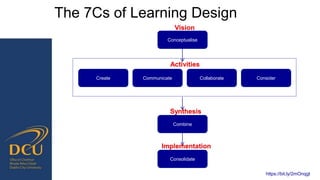
The 7Cs of Learning Design
Conceptualise
Vision
CommunicateCreate ConsiderCollaborate
Activities
Combine
Synthesis
Consolidate
Implementation
https://bit.ly/2mOnqgt
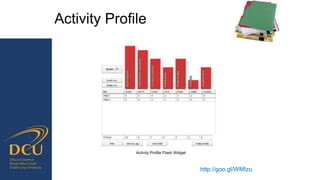
Activity Profile
http://goo.gl/WMIzu
Activity Profile Flash Widget
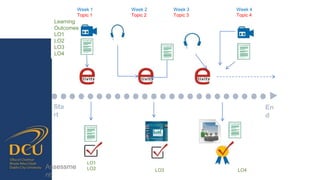
Sta
rt
En
d
Learning
Outcomes
LO1
LO2
LO3
LO4
Assessme
nt
LO1
LO2 LO3 LO4
Week 1
Topic 1
Week 2
Topic 2
Week 3
Topic 3
Week 4
Topic 4
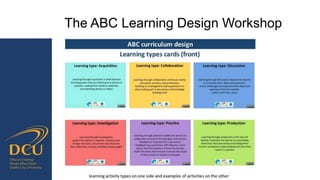
The ABC Learning Design Workshop
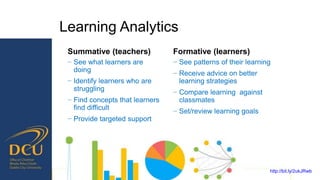
Learning Analytics
Summative (teachers)
− See what learners are
doing
− Identify learners who are
struggling
− Find concepts that learners
find difficult
− Provide targeted support
Formative (learners)
− See patterns of their learning
− Receive advice on better
learning strategies
− Compare learning against
classmates
− Set/review learning goals
http://bit.ly/2ukJRwb
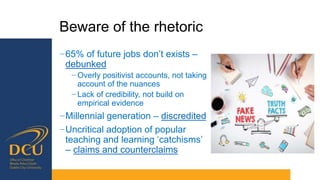
Beware of the rhetoric
−65% of future jobs don’t exists –
debunked
− Overly positivist accounts, not taking
account of the nuances
− Lack of credibility, not build on
empirical evidence
−Millennial generation – discredited
−Uncritical adoption of popular
teaching and learning ‘catchisms’
– claims and counterclaims
Reflections
− Digital learning ecology is complex
− More research needed to understand the
complexity
− Influence of affordances
− Understand affordances & how they support
pedagogy
− No single metaphor for 21st Century
learning
− Support for learning needs to match learner
needs and the context of learning
− Assessment needs to support deep
learning
− Needs to be purposeful & support active,
authentic and meaningful learning
Reflections
−Teachers’ mindsets mediate
technology implementation
− Targeted and authentic CPL
−Impact of leadership and
institutional cultures
− Need to align with factors for
successful update of digital
technologies
−Refocus and change mindsets
− From education in change to
education for change
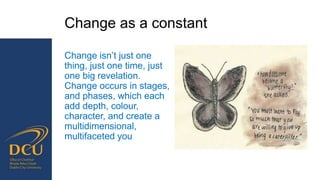
Change as a constant
Change isn’t just one
thing, just one time, just
one big revelation.
Change occurs in stages,
and phases, which each
add depth, colour,
character, and create a
multidimensional,
multifaceted you
Go raibh maith
agaibh!
Thank you
A world top young university
Email: grainne.conole@dcu.ie
Blog: e4innovation.com
Twitter: @gconole

Conole ucd 11_march

  • 1.
    A vision forthe future of Technology Enhanced Learning: key trends and implications 11th March 2019 University College Dublin Gráinne Conole, Dublin City University
  • 5.
  • 6.
    Outline − The Irishe-learning landscape − EENEE report − Theoretical lens − Today’s digital society − Affordances − Opportunities − Top ten trends − Open practices − Pedagogy − Continuing Professional Development − Learning Design and Analytics − Beware of the rhetoric − Reflections https://bit.ly/2H4tpqL
  • 7.
    The Irish e-learninglandscape − Policy perspectives − Continuing Professional Development − Learner agency and the learner voice − Tools and methodologies − MOOCs in Ireland − Learning Design − Learning Management Systems − E-Portfolios − Assessment − Futures − Open Education − Emergent digital literacies − New technologies
  • 8.
    EENEE report −Education outcomesenhanced by the use of digital technologies: what are the conditions for success? − How does digital technologies enhanced teaching and learning? − What are the enablers for successful digital technology use? − What are the implications for policy and transformative curriculum reforms? With Mark Brown and Miroslav Beblavy
  • 9.
    Outline of thereport • Foregrounding literature • Theoretical lens • Changing nature of the digital society • Affordances of digital technology • Effective pedagogy for innovation • Continuous Professional Learning • Barriers • Principles and recommendations • Final reflections
  • 10.
    OECD 2015 − ICThas revolutionised virtually every aspect of our life and work − Students unable to navigate through a complex digital landscape will no longer be able to participate fully in the economic, social and cultural life around them − Challenges: information overload, plagiarism, online risks − Students need to become critical consumers of Internet services and electronic media and make informed choices
  • 11.
    −Study of 41classrooms −Questions whether digital technology has transformed teaching and learning −More incremental change and cross-pollination than top-down policy mandates
  • 12.
    Theoretical lens − Potentialto enhanced and transform − Quality and effectiveness of pedagogy and outcomes depends on teachers − New technologies arising all the time − Limited change or progress − Traditional modes of instruction and assessment dominate − Many factors mediate success
  • 13.
    Today’s digital society −Today’s digital society is complex and dynamic − Changing nature of work − 65% of jobs of the future don’t exist now − From knowledge recall to critical thinking… − Millennial generation − Different needs and expectations − IWWIWWIWI − Development of academic literacy skills − Adaptive and lifelong learners − Mixed of formal and OER/MOOCs − New forms of accreditation − Changing role of teachers and learners http://e4innovation.com/?p=995
  • 15.
    Affordances of digitaltechnologies −Phases: − Cultural − Symbolic − Communication − Ntworked − Cyber-infrastructure −Affordances − Differ according to the technology, context and use − Internet most disruptive technology of last 50 years https://bit.ly/2O4lngx
  • 16.
    Opportunities • Technologies can: •Enable more interaction & communication • Help with retention • Be engaging & motivational • Extend the classroom • Provide timely and targeted feedback • Personalise the learning experience • BUT: technology is not a single entity; no single all-encompassing answer can be provided to the question of impact on educational outcomes
  • 18.
  • 19.
    Top ten trends −Place an important part of identity − Connect parents/learners − Permeable boundaries − Shift in ownership − Learners map their pathway − Abundance of data and AI − Changing nature of work − Rethink success − Impact on health and wellbeing − Connect the past to the present http://www.core-ed.org/research-and-innovation/ten-trends/
  • 20.
    Open practices − Openingup education − Facets − OER − MOOCs − E-textbooks − Use of open practices complex, personalised and contextual (Cronin) − Continuum of openness and access (Olcott) https://bit.ly/2gchbww
  • 21.
    Impact − Learners − OER(Wiley’s 5 Rs) − MOOCs (learning at scale) − E-textbooks (flexible & cost effective) − Teachers − New approaches to design − MOOCs for CPD − Researchers − Data-intensive collaborative research − Social media − Open scholarship https://bit.ly/2VBvFch
  • 22.
    Future of openlearning: challenges − Lack of digital literacies − Teaching the poor sister − New forms of accreditation − Senior management buy-in − Appropriate CPD − Unbundling of education http://e4innovation.com/?p=938
  • 23.
    Digital learning ecology −Classroomexpanded and evolved as virtual place sits alongside physical −A variety of different complementary learning opportunities −Further evidence of blurring of boundaries Brown, 2015
  • 24.
    Effective pedagogy forinnovation Teaching-centred Learning-centred Learning of facts and declarative knowledge Memorising information Teacher is central A focus on passing exams Drilling of right questions and routines Learning to pass exams Focus on information presentation to passive learning Technology as a media channel Learning from resources and technology Learning of conceptual knowledge Working with information Activity is central to learning Applying knowledge, theoretical thinking and demonstrating generic skills Problem-solving, design, project work and inquiries Learning how to learn Focus on how learning occurs within an activity Technology as intellectual partner in learning Learning with resources and technology Churchill (2017) Sfard (1998): acquisition vs. participation
  • 27.
    The parameters ofeffective design Effective instruction depends on understanding of the complex interplay among learners’ prior knowledge, experiences, motivations, interests, and language and cognitive skills; educators’ own experiences and cultural influences; and the cultural, social, cognitive, and emotional characteristics of the learning environment (National Academy of Sciences, 2018)
  • 28.
    Brown 2008 A pedagogicalcompass − UNESCO Pillars of learning − Learning to be − Learning to do − Learning to know − Learning to live together − ‘Pedagogical compass’ needs to swing between all four − Needle is not always pointing towards more traditional ‘learning by listening’ − Also the compass should not be stuck in any particular direction, as effective pedagogy requires a variety or combination of approaches
  • 29.
    Constraints and conflicts •First order: constraints & limitations external to teachers • Funding and resource • Infrastructure • Access and time • Leadership • Second order: conflicts & tensions internal to teachers • Teacher confidence • Teacher beliefs and attitudes • Resistance to change • Reluctance to adopt new technologies https://bit.ly/2XRAUXo
  • 30.
    Continuing Professional Learning −Central role of the teacher − Continuing Professional Learning − Enable teachers to develop innovative learning interventions − Make effective use of digital technologies − Formats − Specialised and tailored workshops − Peer support and mentoring − Examples of good practice − Share and discuss practice − Resources, OER and MOOCs https://bit.ly/2UkM1G1
  • 31.
    Empower staff tocreate, discover and engage in meaningful personal and professional development (National Forum, 2016) Orna Farrell
  • 32.
    Problem Learning Design New approachesto design that are pedagogically based and make effective use of technologies Learning Analytics Analysis of VLE data to better understand how learners are learning and to improve learning and teaching Solution Teachers Lack the digital literacies needed to harness potential of digital technologies Learners Lack academic digital literacies and need to develop strategies for learning
  • 33.
    Learning Design A pedagogically informedapproach to design that makes appropriate use of technologies https://bit.ly/2Tp2s7K
  • 34.
    What is learningdesign? (1) Guidance https://www.flickr.com/photos/anonymouscollective/1899303123
  • 35.
    What is learningdesign? (2) https://www.flickr.com/photos/frawemedia/5187769740
  • 36.
    What is learningdesign? (3) https://www.flickr.com/photos/10075621@N06/3810402230 Sharing
  • 37.
    Learning Design Frameworks −Frameworksfor guiding the use of technology/media/materials − SAMR, SECTIONS, COACT −Workshop approaches aimed mainly at promoting general good practice. i.e. social constructivist assumptions − 7Cs, 8LEM, ABC −Approaches based on specific theory of learner engagement − ICAP Conole, Forthcoming
  • 38.
    The 7Cs ofLearning Design Conceptualise Vision CommunicateCreate ConsiderCollaborate Activities Combine Synthesis Consolidate Implementation https://bit.ly/2mOnqgt
  • 39.
  • 40.
    Sta rt En d Learning Outcomes LO1 LO2 LO3 LO4 Assessme nt LO1 LO2 LO3 LO4 Week1 Topic 1 Week 2 Topic 2 Week 3 Topic 3 Week 4 Topic 4
  • 41.
    The ABC LearningDesign Workshop
  • 42.
    Learning Analytics Summative (teachers) −See what learners are doing − Identify learners who are struggling − Find concepts that learners find difficult − Provide targeted support Formative (learners) − See patterns of their learning − Receive advice on better learning strategies − Compare learning against classmates − Set/review learning goals http://bit.ly/2ukJRwb
  • 43.
    Beware of therhetoric −65% of future jobs don’t exists – debunked − Overly positivist accounts, not taking account of the nuances − Lack of credibility, not build on empirical evidence −Millennial generation – discredited −Uncritical adoption of popular teaching and learning ‘catchisms’ – claims and counterclaims
  • 44.
    Reflections − Digital learningecology is complex − More research needed to understand the complexity − Influence of affordances − Understand affordances & how they support pedagogy − No single metaphor for 21st Century learning − Support for learning needs to match learner needs and the context of learning − Assessment needs to support deep learning − Needs to be purposeful & support active, authentic and meaningful learning
  • 45.
    Reflections −Teachers’ mindsets mediate technologyimplementation − Targeted and authentic CPL −Impact of leadership and institutional cultures − Need to align with factors for successful update of digital technologies −Refocus and change mindsets − From education in change to education for change
  • 46.
    Change as aconstant Change isn’t just one thing, just one time, just one big revelation. Change occurs in stages, and phases, which each add depth, colour, character, and create a multidimensional, multifaceted you
  • 47.
  • 48.
    A world topyoung university Email: grainne.conole@dcu.ie Blog: e4innovation.com Twitter: @gconole