EdTech: communicating,
learning in virtual presence
(part of a flipped lecture on MOOC, mLearning
within a blended learning course)
Inge (Ignatia) de Waard
This presentation is part of a flipped lecture. The lecture
description can be found here (google doc). Prior to the
lecture, learners had to engage in a MOOC discussion
forum, after this lecture a fishbowl discussion took place.
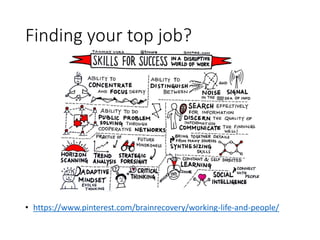
Finding your top job?
• https://www.pinterest.com/brainrecovery/working-life-and-people/
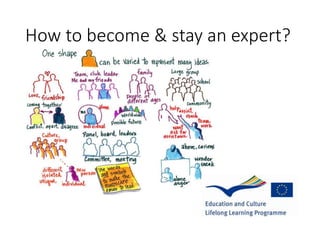
How to become & stay an expert?
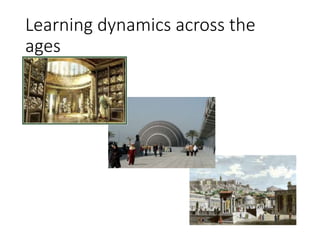
Learning dynamics across the
ages
Similarities…
• Language unification (scientific language: Latin/Greec,
Spanish in the Golden Era, Arabic Golden Age)
• Exchanging technology (knowledge, papyrus, books,
engineering)… walks, talks, discussions
• Networking and strengthening ties
• Power supporting and stimulating networks (e.g. Medici,
Carnegie…)
… it still works
• Global languages take over
• Technology links people worldwide
• Networking on a global scale
• Global corporate power: Google, Amazon, Facebook,
MOOCs …
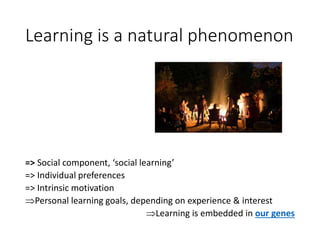
Learning is a natural phenomenon
=> Social component, ‘social learning’
=> Individual preferences
=> Intrinsic motivation
Personal learning goals, depending on experience & interest
Learning is embedded in our genes
Educational technology builds upon
age-long proven learning dynamics
Adds:
• Reach: global
• Size: connecting more people
• Speed of knowledge exchange
• Distributed content & knowledge creation
Risks
• Filtering existing knowledge
• Less critical curation of information
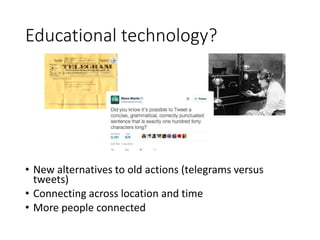
Educational technology?
• New alternatives to old actions (telegrams versus
tweets)
• Connecting across location and time
• More people connected
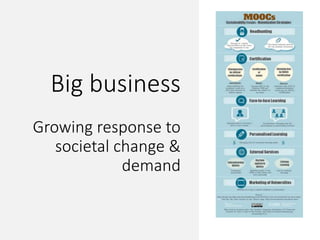
Big business
Growing response to
societal change &
demand
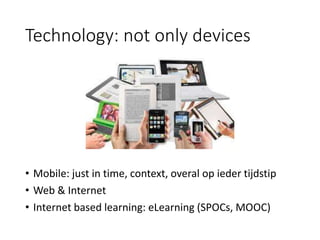
Technology: not only devices
• Mobile: just in time, context, overal op ieder tijdstip
• Web & Internet
• Internet based learning: eLearning (SPOCs, MOOC)
‘Hidden’ within technology
• Algorithms (providing Big Data, offering personalised search
information…)
• Potential filter bubbles due to black boxes (professional hair
due, unprofessional hair due)
• Data dispersed to others, who has access to what?
Learning with less boundaries
• Anytime (synchronous EdTech (hang-out, skype meetings…) or/and
asynchronous (social media or forum discussions, peer-to-peer reviews, …)
• Anyplace: using your own device (BYOD), or accessing through other devices
wherever you are
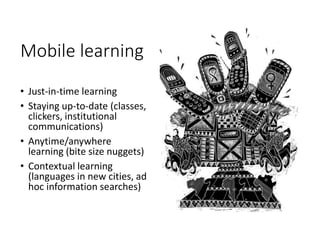
Mobile learning
• Just-in-time learning
• Staying up-to-date (classes,
clickers, institutional
communications)
• Anytime/anywhere
learning (bite size nuggets)
• Contextual learning
(languages in new cities, ad
hoc information searches)
MOOCs
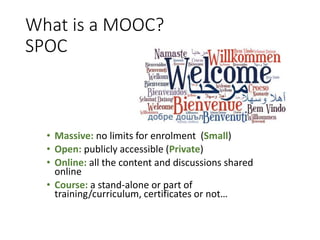
What is a MOOC?
SPOC
• Massive: no limits for enrolment (Small)
• Open: publicly accessible (Private)
• Online: all the content and discussions shared
online
• Course: a stand-alone or part of
training/curriculum, certificates or not…
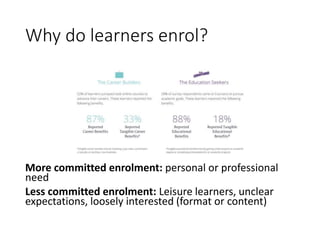
Why do learners enrol?
More committed enrolment: personal or professional
need
Less committed enrolment: Leisure learners, unclear
expectations, loosely interested (format or content)
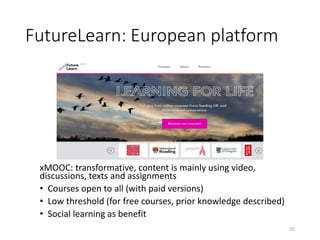
FutureLearn: European platform
xMOOC: transformative, content is mainly using video,
discussions, texts and assignments
• Courses open to all (with paid versions)
• Low threshold (for free courses, prior knowledge described)
• Social learning as benefit
20
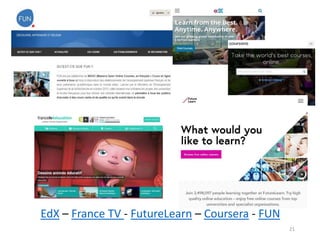
EdX – France TV - FutureLearn – Coursera - FUN
21
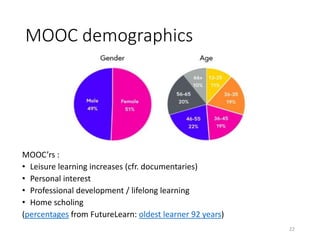
MOOC demographics
MOOC’rs :
• Leisure learning increases (cfr. documentaries)
• Personal interest
• Professional development / lifelong learning
• Home scholing
(percentages from FutureLearn: oldest learner 92 years)
22
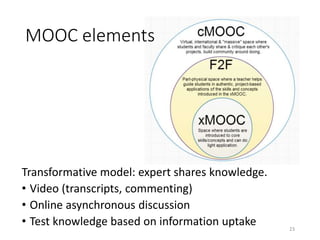
Transformative model: expert shares knowledge.
• Video (transcripts, commenting)
• Online asynchronous discussion

• Test knowledge based on information uptake
MOOC elements
23
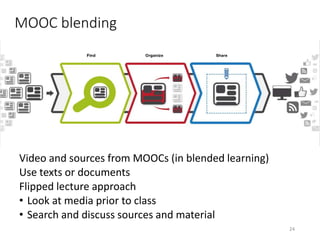
MOOC blending
Video and sources from MOOCs (in blended learning)
Use texts or documents
Flipped lecture approach
• Look at media prior to class
• Search and discuss sources and material
24
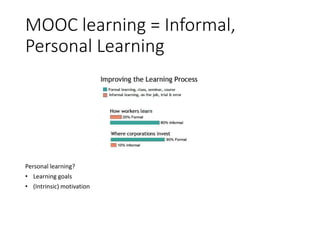
MOOC learning = Informal,
Personal Learning
Personal learning?
• Learning goals
• (Intrinsic) motivation
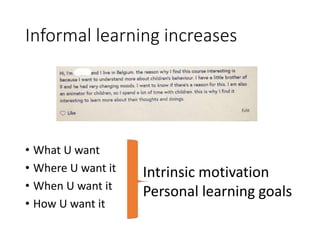
Informal learning increases
• What U want
• Where U want it
• When U want it
• How U want it
Intrinsic motivation
Personal learning goals
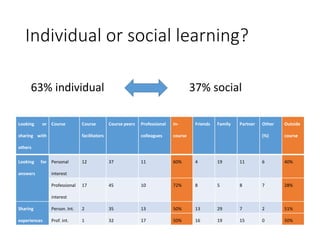
Individual or social learning?
63% individual 37% social
Looking or
sharing with
others
Course Course
facilitators
Course peers Professional
colleagues
In-
course
Friends Family Partner Other
(%)
Outside
course
Looking for
answers
Personal
interest
12 37 11 60% 4 19 11 6 40%
Professional
interest
17 45 10 72% 8 5 8 7 28%
Sharing
experiences
Person. Int. 2 35 13 50% 13 29 7 2 51%
Prof. int. 1 32 17 50% 16 19 15 0 50%
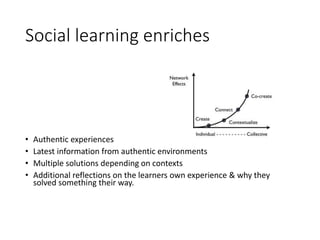
Social learning enriches
• Authentic experiences
• Latest information from authentic environments
• Multiple solutions depending on contexts
• Additional reflections on the learners own experience & why they
solved something their way.
BUT! The MOOC Effect
• Bigger universities have more financial means
• Algorithms from Big Data / data mining (more personalised learner
support)
• Are we on our way towards global universities or niche universities?
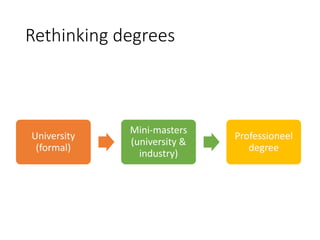
Rethinking degrees
University
(formal)
Mini-masters
(university &
industry)
Professioneel
degree
Choices will become more focused:
education/industry/politics
• Promoting STEM:
based on work (critical
voices)
• Pre-assessments
(competencies:
innovation, cognitive
excellence,
entrepreneurship…)
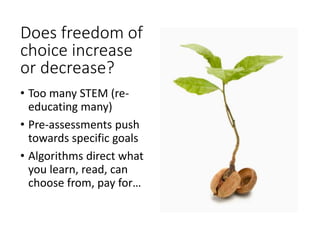
Does freedom of
choice increase
or decrease?
• Too many STEM (re-
educating many)
• Pre-assessments push
towards specific goals
• Algorithms direct what
you learn, read, can
choose from, pay for…
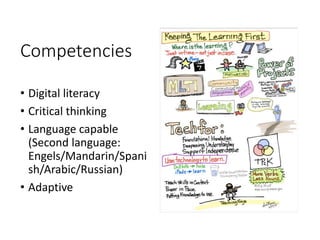
Competencies
• Digital literacy
• Critical thinking
• Language capable
(Second language:
Engels/Mandarin/Spani
sh/Arabic/Russian)
• Adaptive
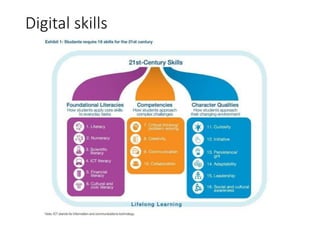
Digital skills
Your critical thoughts
Screenshots of your submissions
(covering: algorithms, clickbaits, fake news, social media
angles, being and staying critical, blurring of
personal/professional IDs, ethics)
Examples of the anonymised screenshots are given at this
moment, organised per topic
• First question: does technology have a
communicative benefit to learn a particular
subject? Why?
• Why did you decide to study at this particular
university?
If you could study at any university, which one
would you choose? Why?
• Who do you learn from?
• Do they have opposing ideas or most of the time
similar ideas?
• What is your prefered way of learning? Which
sources do you use? Why?
• What was your reason for choosing this MOOC?
• Do you consider yourself digitally literate? On
what do you base your opinion?
• Which algorithm would you like to develop? What
would be its purpose? How would this affect
communication?
• Which type of media helps you learn (skype,
video, texts (books, papers), discussion forums,
audio books, podcasts, mobile applications/apps,
games, …)? Which one do you prefer?
• What is your prefered way of learning (individual
or social)? Why?
• How critical are you when you read information?
Who taught you to think critically? Where do you
get your factual information from?
• On what basis would you select material for a
lecture? On what basis would you decide to add
some information? Which types of media would
you use?
• On what occasion do you use your smartphone for
learning? What is the advantage of using your
smartphone on those occasions?

EdTech: communicating and learning virtually - Example of a flipped lecture

  • 1.
    EdTech: communicating, learning invirtual presence (part of a flipped lecture on MOOC, mLearning within a blended learning course) Inge (Ignatia) de Waard
  • 2.
    This presentation ispart of a flipped lecture. The lecture description can be found here (google doc). Prior to the lecture, learners had to engage in a MOOC discussion forum, after this lecture a fishbowl discussion took place.
  • 3.
    Finding your topjob? • https://www.pinterest.com/brainrecovery/working-life-and-people/
  • 4.
    How to become& stay an expert?
  • 5.
  • 6.
    Similarities… • Language unification(scientific language: Latin/Greec, Spanish in the Golden Era, Arabic Golden Age) • Exchanging technology (knowledge, papyrus, books, engineering)… walks, talks, discussions • Networking and strengthening ties • Power supporting and stimulating networks (e.g. Medici, Carnegie…)
  • 7.
    … it stillworks • Global languages take over • Technology links people worldwide • Networking on a global scale • Global corporate power: Google, Amazon, Facebook, MOOCs …
  • 8.
    Learning is anatural phenomenon => Social component, ‘social learning’ => Individual preferences => Intrinsic motivation Personal learning goals, depending on experience & interest Learning is embedded in our genes
  • 9.
    Educational technology buildsupon age-long proven learning dynamics Adds: • Reach: global • Size: connecting more people • Speed of knowledge exchange • Distributed content & knowledge creation Risks • Filtering existing knowledge • Less critical curation of information
  • 10.
    Educational technology? • Newalternatives to old actions (telegrams versus tweets) • Connecting across location and time • More people connected
  • 11.
    Big business Growing responseto societal change & demand
  • 12.
    Technology: not onlydevices • Mobile: just in time, context, overal op ieder tijdstip • Web & Internet • Internet based learning: eLearning (SPOCs, MOOC)
  • 13.
    ‘Hidden’ within technology •Algorithms (providing Big Data, offering personalised search information…) • Potential filter bubbles due to black boxes (professional hair due, unprofessional hair due) • Data dispersed to others, who has access to what?
  • 14.
    Learning with lessboundaries • Anytime (synchronous EdTech (hang-out, skype meetings…) or/and asynchronous (social media or forum discussions, peer-to-peer reviews, …) • Anyplace: using your own device (BYOD), or accessing through other devices wherever you are
  • 15.
    Mobile learning • Just-in-timelearning • Staying up-to-date (classes, clickers, institutional communications) • Anytime/anywhere learning (bite size nuggets) • Contextual learning (languages in new cities, ad hoc information searches)
  • 17.
  • 18.
    What is aMOOC? SPOC • Massive: no limits for enrolment (Small) • Open: publicly accessible (Private) • Online: all the content and discussions shared online • Course: a stand-alone or part of training/curriculum, certificates or not…
  • 19.
    Why do learnersenrol? More committed enrolment: personal or professional need Less committed enrolment: Leisure learners, unclear expectations, loosely interested (format or content)
  • 20.
    FutureLearn: European platform xMOOC:transformative, content is mainly using video, discussions, texts and assignments • Courses open to all (with paid versions) • Low threshold (for free courses, prior knowledge described) • Social learning as benefit 20
  • 21.
    EdX – FranceTV - FutureLearn – Coursera - FUN 21
  • 22.
    MOOC demographics MOOC’rs : •Leisure learning increases (cfr. documentaries) • Personal interest • Professional development / lifelong learning • Home scholing (percentages from FutureLearn: oldest learner 92 years) 22
  • 23.
    Transformative model: expertshares knowledge. • Video (transcripts, commenting) • Online asynchronous discussion • Test knowledge based on information uptake MOOC elements 23
  • 24.
    MOOC blending Video andsources from MOOCs (in blended learning) Use texts or documents Flipped lecture approach • Look at media prior to class • Search and discuss sources and material 24
  • 25.
    MOOC learning =Informal, Personal Learning Personal learning? • Learning goals • (Intrinsic) motivation
  • 26.
    Informal learning increases •What U want • Where U want it • When U want it • How U want it Intrinsic motivation Personal learning goals
  • 27.
    Individual or sociallearning? 63% individual 37% social Looking or sharing with others Course Course facilitators Course peers Professional colleagues In- course Friends Family Partner Other (%) Outside course Looking for answers Personal interest 12 37 11 60% 4 19 11 6 40% Professional interest 17 45 10 72% 8 5 8 7 28% Sharing experiences Person. Int. 2 35 13 50% 13 29 7 2 51% Prof. int. 1 32 17 50% 16 19 15 0 50%
  • 28.
    Social learning enriches •Authentic experiences • Latest information from authentic environments • Multiple solutions depending on contexts • Additional reflections on the learners own experience & why they solved something their way.
  • 29.
    BUT! The MOOCEffect • Bigger universities have more financial means • Algorithms from Big Data / data mining (more personalised learner support) • Are we on our way towards global universities or niche universities?
  • 30.
  • 31.
    Choices will becomemore focused: education/industry/politics • Promoting STEM: based on work (critical voices) • Pre-assessments (competencies: innovation, cognitive excellence, entrepreneurship…)
  • 32.
    Does freedom of choiceincrease or decrease? • Too many STEM (re- educating many) • Pre-assessments push towards specific goals • Algorithms direct what you learn, read, can choose from, pay for…
  • 33.
    Competencies • Digital literacy •Critical thinking • Language capable (Second language: Engels/Mandarin/Spani sh/Arabic/Russian) • Adaptive
  • 34.
  • 35.
    Your critical thoughts Screenshotsof your submissions (covering: algorithms, clickbaits, fake news, social media angles, being and staying critical, blurring of personal/professional IDs, ethics) Examples of the anonymised screenshots are given at this moment, organised per topic
  • 37.
    • First question:does technology have a communicative benefit to learn a particular subject? Why?
  • 38.
    • Why didyou decide to study at this particular university? If you could study at any university, which one would you choose? Why?
  • 39.
    • Who doyou learn from? • Do they have opposing ideas or most of the time similar ideas?
  • 40.
    • What isyour prefered way of learning? Which sources do you use? Why?
  • 41.
    • What wasyour reason for choosing this MOOC?
  • 42.
    • Do youconsider yourself digitally literate? On what do you base your opinion?
  • 43.
    • Which algorithmwould you like to develop? What would be its purpose? How would this affect communication?
  • 44.
    • Which typeof media helps you learn (skype, video, texts (books, papers), discussion forums, audio books, podcasts, mobile applications/apps, games, …)? Which one do you prefer?
  • 45.
    • What isyour prefered way of learning (individual or social)? Why?
  • 46.
    • How criticalare you when you read information? Who taught you to think critically? Where do you get your factual information from?
  • 47.
    • On whatbasis would you select material for a lecture? On what basis would you decide to add some information? Which types of media would you use?
  • 48.
    • On whatoccasion do you use your smartphone for learning? What is the advantage of using your smartphone on those occasions?

Editor's Notes

  • #5 Picture http://education.jhu.edu/PD/newhorizons/strategies/topics/Graphic%20Tools%20for%20Learning/margulies.htm
  • #9 Although learning can differ in many ways, it all comes down to creating a learning environment which mimics our own, genetically embedded learning characteristics. This means that an ideal, open learning environment allows people to learn in their own way, using their preferred devices (or materials), choosing their own learning path from all the content that is available. But no matter which informal, natural learning we look at, it does have some general characteristics: social component, catering to the individual preferences, evoking emotions, and challenging the mind. And with insights into genetics, we are starting to understand the genetical foundation of learning as well. Sitting around the campfire or gathering around the water cooler (exchanging ideas) => Social component, social learning Looking up content when & where we like it (library, google, books, the past, people in your network) => Individual preferences (content, context and familiarity) You love a topic, or you hate it… motivational drive => Emotion defines Motivational action (follow-up with steps & ratio - Motivational Currents – Dornyei) SUDOKU, crossword puzzles are only fun when they are challenging => Challenges are needed to achieve a mental state of accomplishment (the Flow – csikszentmihalyi &) And learning has a genetic factor: our learning genes.
  • #11 https://blog.kaspersky.com/telegraph-grandpa-of-internet/9034/
  • #19 It is crucial to have a very clear understanding on the definition of a MOOC inside of the organisation. There are multiple MOOC formats out there, multiple experiences and a lot of ongoing debates on the pro’s and con’s of MOOCs, which means that different people have different views and experiences. Coming to a shared meaning of what a MOOC will make it easier to work as a team towards a succesfull MOOC.
  • #20 MOOC learners have various reasons to enroll in a MOOC, but most importantly is the personal benefit Research results can be found here: https://www.insidehighered.com/news/2015/09/23/study-finds-tangible-benefits-learners-courseras-massive-open-online-courses
  • #24 Picture: https://mikecaulfield.files.wordpress.com/2013/07/xmooc-is-a-chewy-center.png
  • #26 MOOC learning comes close to Informal, Personal Learning, and as such natural learning. Any learner is free to engage to as much, or as little as they want. This has consequences for the actions learners take within MOOCs. This also means that personal learning goals and personal motivation are more important, as such, any course that offers ways to let the learner fine-tune the content or the tasks to fit their own personal learning goals, and fit their intrinsic motivation, will be appreciated more. Which basically means learners will stick to the course longer, or select more portions of the course to follow. Learners have always preferred informal learning to reach their learning goals, but MOOC offer a nice option in between the formal and informal learning offerings. I will come back to that later on in the presentation, when more information is shared on the overall MOOC experience.
  • #29 Network effects from Harold Jarche
  • #35 https://www.weforum.org/agenda/2016/03/21st-century-skills-future-jobs-students/