
http://flickr.com/photos/7447470@N06/1345266896/ HOW WEB TECHNOLOGY IS REVOLUTIONISING EDUCATION (Curtis Bonk)
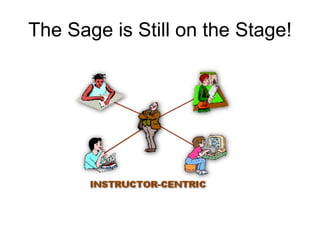
The Sage is Still on the Stage!
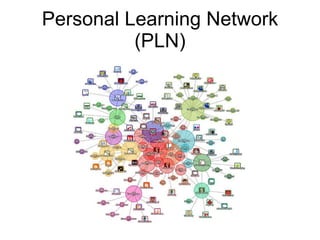
Personal Learning Network (PLN)
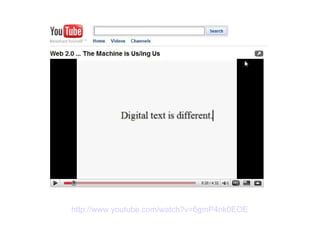
http://www.youtube.com/watch?v=6gmP4nk0EOE
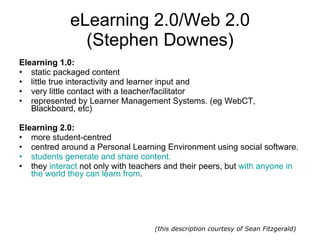
eLearning 2.0/Web 2.0 (Stephen Downes) Elearning 1.0: static packaged content  little true interactivity and learner input and  very little contact with a teacher/facilitator represented by Learner Management Systems. (eg WebCT, Blackboard, etc)  Elearning 2.0: more student-centred centred around a Personal Learning Environment using social software.  students generate and share content.   they  interact  not only with teachers and their peers, but  with anyone in the world they can learn from . (this description courtesy of Sean Fitzgerald)
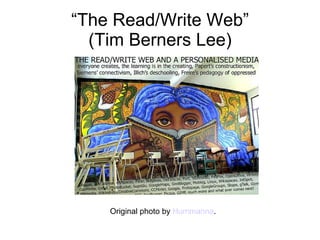
“ The Read/Write Web” (Tim Berners Lee) Original photo by  Hummanna .
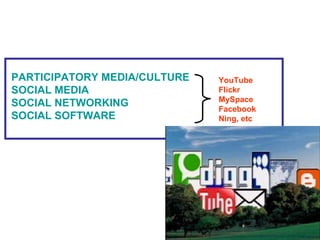
PARTICIPATORY MEDIA/CULTURE SOCIAL MEDIA  SOCIAL NETWORKING SOCIAL SOFTWARE YouTube Flickr MySpace Facebook Ning, etc
WHAT HAS CHANGED? (the  locus of control  is shifting) Decline of the Gatekeepers Publish then evaluate Content Creators; Content Rankers Everyone has access to everything The World is Flat  (Thomas Friedman)  “ People just don’t subscribe to magazines anymore; they also subscribe to people.”
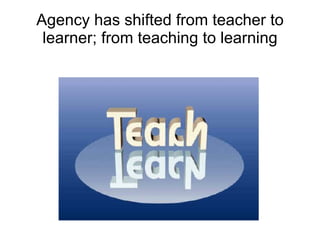
Agency has shifted from teacher to learner; from teaching to learning
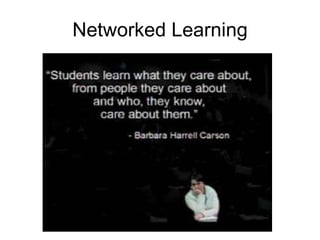
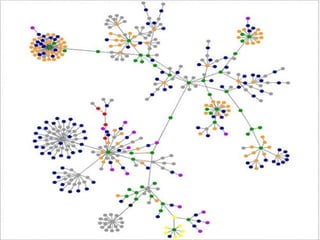
Networked Learning
 
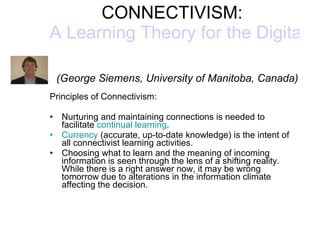
CONNECTIVISM:  A Learning Theory for the Digital Age     (George Siemens, University of Manitoba, Canada) Principles of Connectivism: Nurturing and maintaining connections is needed to facilitate  continual learning .  Currency  (accurate, up-to-date knowledge) is the intent of all connectivist learning activities.  Choosing what to learn and the meaning of incoming information is seen through the lens of a shifting reality. While there is a right answer now, it may be wrong tomorrow due to alterations in the information climate affecting the decision.
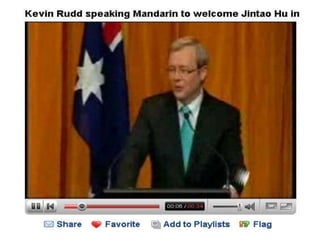
http://www.youtube.com/watch?v=L4CR3GoB3YY A GLOBAL AUDIENCE
 
9000 hrs of extra content each day (approx 20 hrs/minute) In 6 months generates as much content as major broadcasters in US did in 60 years Superb video from Michael Wesch:  An Anthropological Introduction to YouTube www.youtube.com/watch?v=TPAO-lZ4_hU
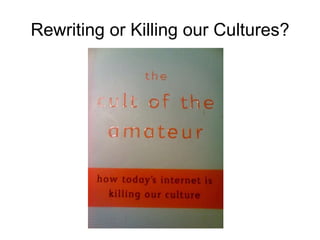
Rewriting or Killing our Cultures?
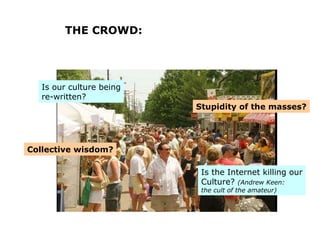
THE CROWD: Collective wisdom? Stupidity of the masses? Is our culture being re-written? Is the Internet killing our Culture?  (Andrew Keen: the cult of the amateur)
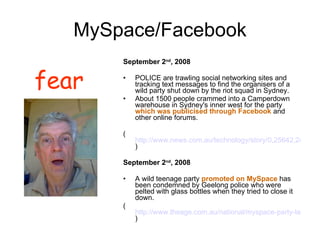
MySpace/Facebook September 2 nd , 2008 POLICE are trawling social networking sites and tracking text messages to find the organisers of a wild party shut down by the riot squad in Sydney.  About 1500 people crammed into a Camperdown warehouse in Sydney's inner west for the party  which was publicised through Facebook  and other online forums.  ( http://www.news.com.au/technology/story/0,25642,24273455-5014108,00.html ) September 2 nd , 2008 A wild teenage party  promoted on MySpace  has been condemned by Geelong police who were pelted with glass bottles when they tried to close it down. ( http://www.theage.com.au/national/myspace-party-teens-pelt police-with-bottles-20080902-47hg.html ) fear
 
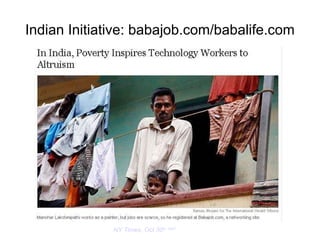
Indian Initiative: babajob.com/babalife.com NY Times, Oct 30 th, 2007
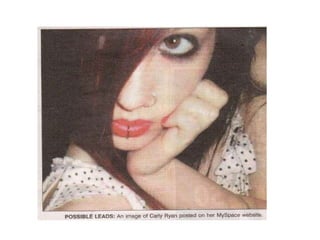
Are we sociologically ready? What are our  ethical responsibilities  as adults/educators : to our children/students? to ourselves?  (teacher sacked for    posting photo on MySpace)
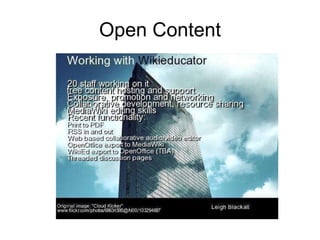
Open Content
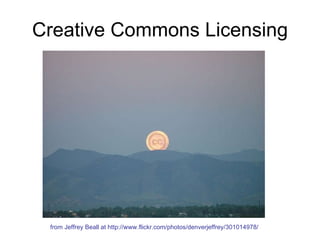
Creative Commons Licensing from Jeffrey Beall at http://www.flickr.com/photos/denverjeffrey/301014978/
TIME: end user innovation  (http://www.time.com/time/business/article/0,8599,1902604,00.html) 'mid-career professionals‘ are predominant users Exemplifies power of networks (PLNs) Is revolutionising the way we communicate Powerful real time search tool
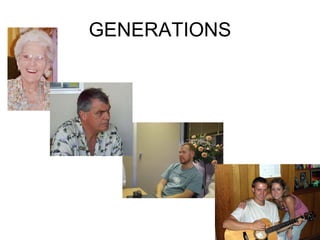
GENERATIONS
GENERATIONS Now possible to delineate characteristics of 4 different generations – Veterans, Boomers, X, and Y Danger of stereotyping
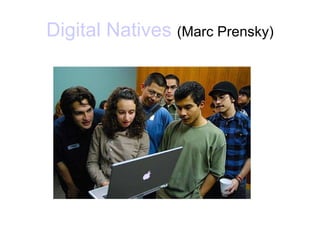
Digital Natives   (Marc Prensky) http://www.flickr.com/photos/30864080@N00/347520047
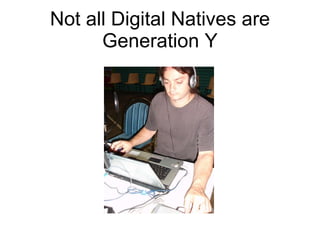
Not all Digital Natives are Generation Y http://flickr.com/photos/stephanridgway/1460848008/
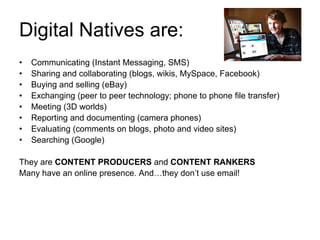
Digital Natives are: Communicating  (Instant Messaging, SMS) Sharing and collaborating  (blogs, wikis, MySpace, Facebook) Buying and selling  (eBay) Exchanging  (peer to peer technology; phone to phone file transfer) Meeting  (3D worlds) Reporting and documenting  (camera phones) Evaluating  (comments on blogs, photo and video sites) Searching  (Google) They are  CONTENT PRODUCERS  and  CONTENT RANKERS Many have an online presence. And…they don’t use email!
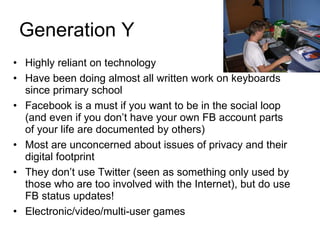
Generation Y Highly reliant on technology Have been doing almost all written work on keyboards since primary school Facebook is a must if you want to be in the social loop (and even if you don’t have your own FB account parts of your life are documented by others) Most are unconcerned about issues of privacy and their digital footprint They don’t use Twitter (seen as something only used by those who are too involved with the Internet), but do use FB status updates! Electronic/video/multi-user games
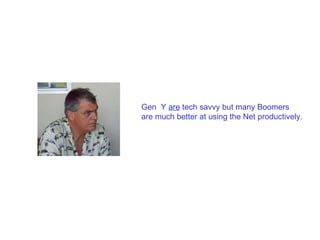
Gen  Y  are  tech savvy but many  Boomers  are much better at using the Net productively.
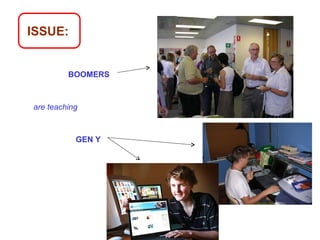
DIGITAL IMMIGRANTS ISSUE: are teaching DIGITAL  NATIVES BOOMERS are teaching GEN Y
Whither the Learning Management System (LMS)? WebCT has gone; Bb decreasing market share Moodle is the rising star – why? Open Source
Proprietary v Open Source Proprietary Expensive Sophisticated appearance by default Locked in to fixed product for extended periods Open Source Free or very cheap Host can modify product as often as desired Philosophy of collaboration and sharing May not look as sophisticated but level of functionality matches proprietary products
Microsoft working on integration with Moodle  (that's all you need to know!)  http://www.educationlabs.com/projects/moodleproduct/Pages/default.aspx New version 2 will allow embedded media in discussion forums  (cf Google Wave) Should be available mid 2010
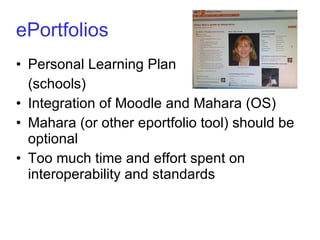
ePortfolios Personal Learning Plan  (schools) Integration of Moodle and Mahara (OS) Mahara (or other eportfolio tool) should be optional Too much time and effort spent on interoperability and standards


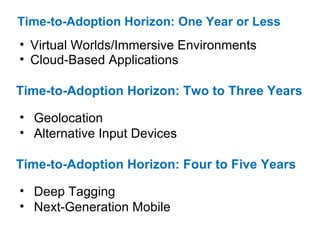
Time-to-Adoption Horizon: One Year or Less   Virtual Worlds/Immersive Environments  Cloud-Based Applications  Time-to-Adoption Horizon: Two to Three Years Geolocation  Alternative Input Devices  Time-to-Adoption Horizon: Four to Five Years Deep Tagging  Next-Generation Mobile
Time-to-Adoption Horizon: One Year or Less Virtual Worlds/ ImmersiveEnvironments  Cloud-Based Applications
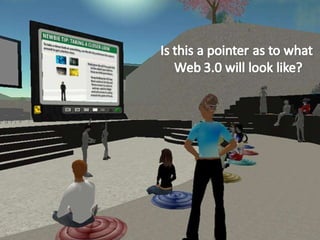
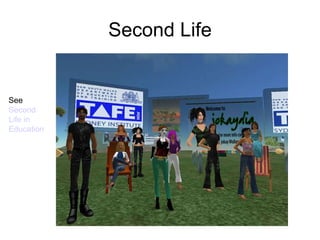
Second Life See  Second  Life in  Education
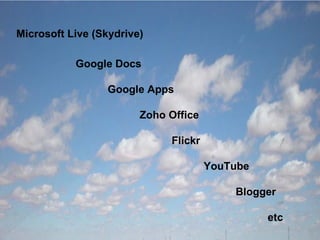
Google Docs Google Apps Zoho Office Flickr YouTube Blogger etc Microsoft Live (Skydrive)
Time-to-Adoption Horizon: Two to Three Years   Geolocation  Alternative Input Devices
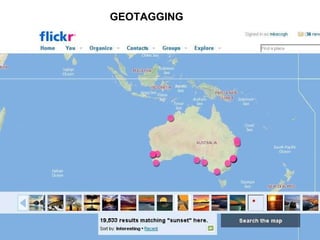
GEOTAGGING
Time-to-Adoption Horizon: Four to Five Years   Deep Tagging  Next-Generation Mobile
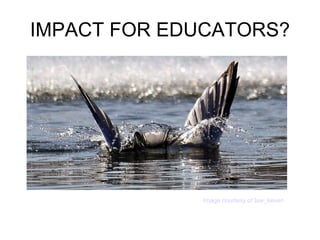
IMPACT FOR EDUCATORS? Image courtesy of law_keven
Learning in the 21 st  Century “  I have seen predictions that a student doing a 3 year course by 2012 will experience the situation where most of the knowledge they have gained in year one will be completely out of date by the time they finish year 3.” “… the only sustainable approach…will be to find the learning and teaching strategies which will ensure that people embrace attitudes and behaviours anchored in lifelong learning.” “ It is becoming …an imperative for industry to have staff who are lifelong learners and highly ICT literate.” Greg Black, CEO, education.au (Campus Review 16/10/07)
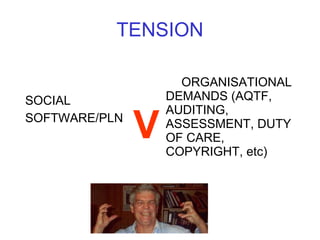
TENSION SOCIAL SOFTWARE/PLN ORGANISATIONAL DEMANDS (AQTF, AUDITING, ASSESSMENT, DUTY OF CARE, COPYRIGHT, etc) V
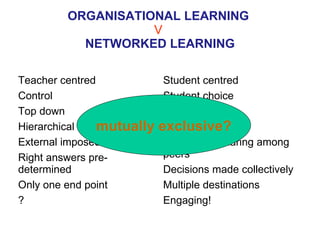
ORGANISATIONAL LEARNING  V   NETWORKED LEARNING Teacher centred Control Top down Hierarchical External imposed authority Right answers pre-determined Only one end point ? Student centred Student choice Bottom up Distributive (flat) Knowledge sharing among peers Decisions made collectively Multiple destinations Engaging! mutually exclusive?
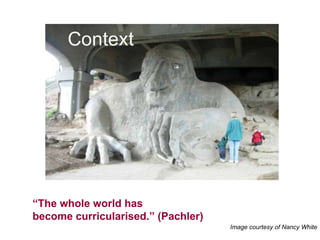
“ The whole world has  become curricularised.” (Pachler) Image courtesy of Nancy White
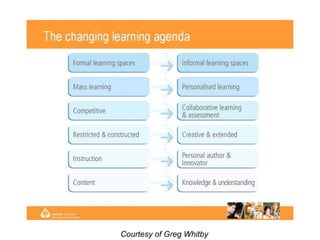
Courtesy of Greg Whitby
Extent of Change? It is not all or nothing; it is gradual and context dependent Not all activity will be on the right hand side Personal values may dictate the rate at which you adopt changed approaches  (if at all!)
Awareness or a Set of Skills? New Practices predicated upon an awareness that things have changed…
Employability Skills Communication  Teamwork  Problem Solving  Initiative and Enterprise  Planning and Organising  Self-management  Learning  Technology
Where to Begin? (You) Join an online community or email list Ask questions and initiate discussions about your interests and needs Start publishing or tracking blogs, podcasts Create a Twitter account  (or Yammer for a walled garden equivalent) Do an  online course in multiliteracy;  23 things Create social bookmarking and photosharing accounts Create media – start simple:  Upload photos to Flickr; comment on others’ photos create Digital Stories (Photostory, Moviemaker) and upload to YouTube Search YouTube and other video repositories for educational content Create a Ning or Facebook account for friends or family Use a wiki or Google Docs to collaborate on a small project  Place yourself in the new  habitus of learning   – you need to do it to understand and internalise the power of networks; reading and observing will not achieve this philosophical seachange
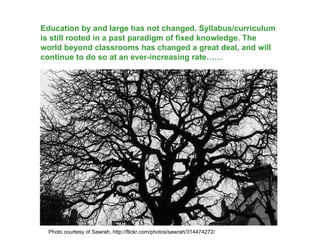
Education by and large has not changed. Syllabus/curriculum is still rooted in a past paradigm of fixed knowledge. The world beyond classrooms has changed a great deal, and will continue to do so at an ever-increasing rate…… Photo courtesy of Sawrah, http://flickr.com/photos/sawrah/314474272/
Libraries v Classrooms?  Check the 5 minute video at  http://www.youtube.com/watch?v=999ZEf2EpHg
Michael Coghlan [email_address] THANK YOU FOR LISTENING! This presentation on the web at XXXXXXXX

How Web2 Is Revolutionising Education

  • 1.
    http://flickr.com/photos/7447470@N06/1345266896/ HOW WEBTECHNOLOGY IS REVOLUTIONISING EDUCATION (Curtis Bonk)
  • 2.
    The Sage isStill on the Stage!
  • 3.
  • 4.
  • 5.
    eLearning 2.0/Web 2.0(Stephen Downes) Elearning 1.0: static packaged content little true interactivity and learner input and very little contact with a teacher/facilitator represented by Learner Management Systems. (eg WebCT, Blackboard, etc) Elearning 2.0: more student-centred centred around a Personal Learning Environment using social software. students generate and share content. they interact not only with teachers and their peers, but with anyone in the world they can learn from . (this description courtesy of Sean Fitzgerald)
  • 6.
    “ The Read/WriteWeb” (Tim Berners Lee) Original photo by Hummanna .
  • 7.
    PARTICIPATORY MEDIA/CULTURE SOCIALMEDIA SOCIAL NETWORKING SOCIAL SOFTWARE YouTube Flickr MySpace Facebook Ning, etc
  • 8.
    WHAT HAS CHANGED?(the locus of control is shifting) Decline of the Gatekeepers Publish then evaluate Content Creators; Content Rankers Everyone has access to everything The World is Flat (Thomas Friedman) “ People just don’t subscribe to magazines anymore; they also subscribe to people.”
  • 9.
    Agency has shiftedfrom teacher to learner; from teaching to learning
  • 10.
  • 11.
  • 12.
    CONNECTIVISM: ALearning Theory for the Digital Age (George Siemens, University of Manitoba, Canada) Principles of Connectivism: Nurturing and maintaining connections is needed to facilitate continual learning . Currency (accurate, up-to-date knowledge) is the intent of all connectivist learning activities. Choosing what to learn and the meaning of incoming information is seen through the lens of a shifting reality. While there is a right answer now, it may be wrong tomorrow due to alterations in the information climate affecting the decision.
  • 13.
  • 14.
  • 15.
    9000 hrs ofextra content each day (approx 20 hrs/minute) In 6 months generates as much content as major broadcasters in US did in 60 years Superb video from Michael Wesch: An Anthropological Introduction to YouTube www.youtube.com/watch?v=TPAO-lZ4_hU
  • 16.
    Rewriting or Killingour Cultures?
  • 17.
    THE CROWD: Collectivewisdom? Stupidity of the masses? Is our culture being re-written? Is the Internet killing our Culture? (Andrew Keen: the cult of the amateur)
  • 18.
    MySpace/Facebook September 2nd , 2008 POLICE are trawling social networking sites and tracking text messages to find the organisers of a wild party shut down by the riot squad in Sydney. About 1500 people crammed into a Camperdown warehouse in Sydney's inner west for the party which was publicised through Facebook and other online forums. ( http://www.news.com.au/technology/story/0,25642,24273455-5014108,00.html ) September 2 nd , 2008 A wild teenage party promoted on MySpace has been condemned by Geelong police who were pelted with glass bottles when they tried to close it down. ( http://www.theage.com.au/national/myspace-party-teens-pelt police-with-bottles-20080902-47hg.html ) fear
  • 19.
  • 20.
  • 21.
    Are we sociologicallyready? What are our ethical responsibilities as adults/educators : to our children/students? to ourselves? (teacher sacked for posting photo on MySpace)
  • 22.
  • 23.
    Creative Commons Licensingfrom Jeffrey Beall at http://www.flickr.com/photos/denverjeffrey/301014978/
  • 24.
    TIME: end userinnovation (http://www.time.com/time/business/article/0,8599,1902604,00.html) 'mid-career professionals‘ are predominant users Exemplifies power of networks (PLNs) Is revolutionising the way we communicate Powerful real time search tool
  • 25.
  • 26.
    GENERATIONS Now possibleto delineate characteristics of 4 different generations – Veterans, Boomers, X, and Y Danger of stereotyping
  • 27.
    Digital Natives (Marc Prensky) http://www.flickr.com/photos/30864080@N00/347520047
  • 28.
    Not all DigitalNatives are Generation Y http://flickr.com/photos/stephanridgway/1460848008/
  • 29.
    Digital Natives are:Communicating (Instant Messaging, SMS) Sharing and collaborating (blogs, wikis, MySpace, Facebook) Buying and selling (eBay) Exchanging (peer to peer technology; phone to phone file transfer) Meeting (3D worlds) Reporting and documenting (camera phones) Evaluating (comments on blogs, photo and video sites) Searching (Google) They are CONTENT PRODUCERS and CONTENT RANKERS Many have an online presence. And…they don’t use email!
  • 30.
    Generation Y Highlyreliant on technology Have been doing almost all written work on keyboards since primary school Facebook is a must if you want to be in the social loop (and even if you don’t have your own FB account parts of your life are documented by others) Most are unconcerned about issues of privacy and their digital footprint They don’t use Twitter (seen as something only used by those who are too involved with the Internet), but do use FB status updates! Electronic/video/multi-user games
  • 31.
    Gen Y are tech savvy but many Boomers are much better at using the Net productively.
  • 32.
    DIGITAL IMMIGRANTS ISSUE:are teaching DIGITAL NATIVES BOOMERS are teaching GEN Y
  • 33.
    Whither the LearningManagement System (LMS)? WebCT has gone; Bb decreasing market share Moodle is the rising star – why? Open Source
  • 34.
    Proprietary v OpenSource Proprietary Expensive Sophisticated appearance by default Locked in to fixed product for extended periods Open Source Free or very cheap Host can modify product as often as desired Philosophy of collaboration and sharing May not look as sophisticated but level of functionality matches proprietary products
  • 35.
    Microsoft working onintegration with Moodle (that's all you need to know!) http://www.educationlabs.com/projects/moodleproduct/Pages/default.aspx New version 2 will allow embedded media in discussion forums (cf Google Wave) Should be available mid 2010
  • 36.
    ePortfolios Personal LearningPlan (schools) Integration of Moodle and Mahara (OS) Mahara (or other eportfolio tool) should be optional Too much time and effort spent on interoperability and standards
  • 37.
  • 38.
  • 39.
  • 40.
    Time-to-Adoption Horizon: OneYear or Less Virtual Worlds/Immersive Environments Cloud-Based Applications Time-to-Adoption Horizon: Two to Three Years Geolocation Alternative Input Devices Time-to-Adoption Horizon: Four to Five Years Deep Tagging Next-Generation Mobile
  • 41.
    Time-to-Adoption Horizon: OneYear or Less Virtual Worlds/ ImmersiveEnvironments Cloud-Based Applications
  • 42.
    Second Life See Second Life in Education
  • 43.
    Google Docs GoogleApps Zoho Office Flickr YouTube Blogger etc Microsoft Live (Skydrive)
  • 44.
    Time-to-Adoption Horizon: Twoto Three Years Geolocation Alternative Input Devices
  • 45.
  • 46.
    Time-to-Adoption Horizon: Fourto Five Years Deep Tagging Next-Generation Mobile
  • 47.
    IMPACT FOR EDUCATORS?Image courtesy of law_keven
  • 48.
    Learning in the21 st Century “ I have seen predictions that a student doing a 3 year course by 2012 will experience the situation where most of the knowledge they have gained in year one will be completely out of date by the time they finish year 3.” “… the only sustainable approach…will be to find the learning and teaching strategies which will ensure that people embrace attitudes and behaviours anchored in lifelong learning.” “ It is becoming …an imperative for industry to have staff who are lifelong learners and highly ICT literate.” Greg Black, CEO, education.au (Campus Review 16/10/07)
  • 49.
    TENSION SOCIAL SOFTWARE/PLNORGANISATIONAL DEMANDS (AQTF, AUDITING, ASSESSMENT, DUTY OF CARE, COPYRIGHT, etc) V
  • 50.
    ORGANISATIONAL LEARNING V NETWORKED LEARNING Teacher centred Control Top down Hierarchical External imposed authority Right answers pre-determined Only one end point ? Student centred Student choice Bottom up Distributive (flat) Knowledge sharing among peers Decisions made collectively Multiple destinations Engaging! mutually exclusive?
  • 51.
    “ The wholeworld has become curricularised.” (Pachler) Image courtesy of Nancy White
  • 52.
  • 53.
    Extent of Change?It is not all or nothing; it is gradual and context dependent Not all activity will be on the right hand side Personal values may dictate the rate at which you adopt changed approaches (if at all!)
  • 54.
    Awareness or aSet of Skills? New Practices predicated upon an awareness that things have changed…
  • 55.
    Employability Skills Communication Teamwork Problem Solving Initiative and Enterprise Planning and Organising Self-management Learning Technology
  • 56.
    Where to Begin?(You) Join an online community or email list Ask questions and initiate discussions about your interests and needs Start publishing or tracking blogs, podcasts Create a Twitter account (or Yammer for a walled garden equivalent) Do an online course in multiliteracy; 23 things Create social bookmarking and photosharing accounts Create media – start simple: Upload photos to Flickr; comment on others’ photos create Digital Stories (Photostory, Moviemaker) and upload to YouTube Search YouTube and other video repositories for educational content Create a Ning or Facebook account for friends or family Use a wiki or Google Docs to collaborate on a small project Place yourself in the new habitus of learning – you need to do it to understand and internalise the power of networks; reading and observing will not achieve this philosophical seachange
  • 57.
    Education by andlarge has not changed. Syllabus/curriculum is still rooted in a past paradigm of fixed knowledge. The world beyond classrooms has changed a great deal, and will continue to do so at an ever-increasing rate…… Photo courtesy of Sawrah, http://flickr.com/photos/sawrah/314474272/
  • 58.
    Libraries v Classrooms? Check the 5 minute video at http://www.youtube.com/watch?v=999ZEf2EpHg
  • 59.
    Michael Coghlan [email_address]THANK YOU FOR LISTENING! This presentation on the web at XXXXXXXX