Online Learning Global Snapshot ProjectEuropean TEAMhttp://globalsnapshot.ning.com/group/europeresearchteam/user/list
A challenge for EuropeThe European Council in Lisbon 2000 decided on the objective that EU within 2010 should “…become the most competitive and dynamic knowledge-based economy in the world…” … The transformation of European education and vocational training systems involves both the development of e-learning as a means to increase quality of learning as well as a need to increase the quality of e-learning itself.Within the EHEA, all participating countries should have developed by 2010 a national framework of qualifications based on three cycles in higher education, and national quality assurance arrangements implementing an agreed set of standards and guidelines. The e-Europe and e-Learning initiatives launched by the EC have significantly contributed to the increased awareness and commitment of national and regional governments in supporting the development of a knowledge and information society in Europe.
MethodologyWe decide to collect some information, searching articles, reports, recent books looking at eLearning trends and evolution. The categories and questions that team participants decided to explore in the research:Mobile Learning, Student Populations, Course Delivery, eLearning Future (potential and growth research & projections), e-portfolios, PLE, Learning evaluation, Open Platforms, Design of competences, Surveys of activity, Open Educational Resources, Quality Assurance, Course Development, Social Media..A questionnaire/interview was built in order to ask to the different experts and actors in the e-learning field about their experiences and thougths. Available from:https://spreadsheets.google.com/viewform?formkey=dDA2Z2VJbVpEa1Z5N3pxOWFCdUxCbEE6MQ
MethodologyWe tried to classify all references collected taking in account 3 criterias (title of the publication, url, and topics or key words), but there was no enough time to do it.        See an example:
E-learning definitionsA few e-learning definitions were take it in account:“The use of new multimedia technologies and the Internet to improve the quality of learning by facilitating access to resources and services as well as remote exchanges and collaboration.” This definition was originally launched in The eLearning Action Plan (European Commission 2001).The E-learning project Exemplo of the European Vocational Training Association (EVTA 2005) proposed different typologies of e-learning or different ways of exploiting the Internet for learning purposes. See the report.“-all computer and Internet-based activities that support teaching and learning – both on-campus and at a distance.” (Tony Bates)Others…
Sources of papers/reports on state of online learning in EuropeJournals (European Journal of Open, Distance and eLearning, British Journal of Educational Technology,Revista de Universidad ySociedad del Conocimiento…)Conferences (EDEN, UK - ALT-C conferences, Online EducaBerlin, Learning Forum London, The European Conference on e-Learning,EARLI, Open Ed 2010, SPEDCE,EUROCALL, Mobile tech, Responsive Open Learning Environments...)Reports (Megaprovidersof e-learning in Europe, Re.Vica,...)Sites (JISC,BECTA, ElearningEuropa, EIfEL, EUCEN, Checkpoint-elearning)Blogs, Books, etc.
Aspects to highlight from the interviews“Would be interesting to integrate web 2.0 tools in the LMS. If students work always outside the platform there is a lot of dispersion”“To teach online transformed the way I use to plan my classes… because more plannification is needed in online course… so I learnt how to prepare my classes better”“To use ICT implies to design in a different way… I recommend to try to introduce ICT in order to improve learning activities, to take profit of its potential”“The use of langblogs, wikis, e-portfolios, interactive activities, case study method and simulations are recommended...”“Technology is often a barrier because technical staff don’t develop a user-friendly tools, not intuitive, complex…”“I’m not really confident with the use of social networks because I’m not sure about its privacy”“More research and innovation is needed, but focused in pedagogy more than in technology”“…The introduction of ICT in educations helps society to be competent in its use for professional development.”“… More training for teaching staff is needed, but in terms of pedagogy… how to change educational strategies, how to improve using ICT...” “I think we are doing the same as in a traditional class but using ICT… and this need to be different”
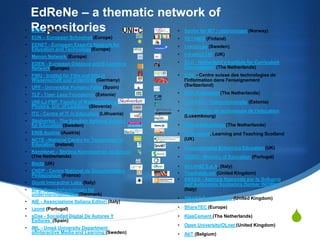
EdReNe – a thematic network of RepositoriesUNI•C (Denmark)
EUN – European Schoolnet (Europe)
EENET - European Expert's Network for Education and Technology(Europe)
Menon Network (Europe)
EDEN - European Distance and E-Learning Network(Europe)

Europe presentation

  • 1.
    Online Learning GlobalSnapshot ProjectEuropean TEAMhttp://globalsnapshot.ning.com/group/europeresearchteam/user/list
  • 2.
    A challenge forEuropeThe European Council in Lisbon 2000 decided on the objective that EU within 2010 should “…become the most competitive and dynamic knowledge-based economy in the world…” … The transformation of European education and vocational training systems involves both the development of e-learning as a means to increase quality of learning as well as a need to increase the quality of e-learning itself.Within the EHEA, all participating countries should have developed by 2010 a national framework of qualifications based on three cycles in higher education, and national quality assurance arrangements implementing an agreed set of standards and guidelines. The e-Europe and e-Learning initiatives launched by the EC have significantly contributed to the increased awareness and commitment of national and regional governments in supporting the development of a knowledge and information society in Europe.
  • 3.
    MethodologyWe decide tocollect some information, searching articles, reports, recent books looking at eLearning trends and evolution. The categories and questions that team participants decided to explore in the research:Mobile Learning, Student Populations, Course Delivery, eLearning Future (potential and growth research & projections), e-portfolios, PLE, Learning evaluation, Open Platforms, Design of competences, Surveys of activity, Open Educational Resources, Quality Assurance, Course Development, Social Media..A questionnaire/interview was built in order to ask to the different experts and actors in the e-learning field about their experiences and thougths. Available from:https://spreadsheets.google.com/viewform?formkey=dDA2Z2VJbVpEa1Z5N3pxOWFCdUxCbEE6MQ
  • 4.
    MethodologyWe tried toclassify all references collected taking in account 3 criterias (title of the publication, url, and topics or key words), but there was no enough time to do it. See an example:
  • 5.
    E-learning definitionsA fewe-learning definitions were take it in account:“The use of new multimedia technologies and the Internet to improve the quality of learning by facilitating access to resources and services as well as remote exchanges and collaboration.” This definition was originally launched in The eLearning Action Plan (European Commission 2001).The E-learning project Exemplo of the European Vocational Training Association (EVTA 2005) proposed different typologies of e-learning or different ways of exploiting the Internet for learning purposes. See the report.“-all computer and Internet-based activities that support teaching and learning – both on-campus and at a distance.” (Tony Bates)Others…
  • 6.
    Sources of papers/reportson state of online learning in EuropeJournals (European Journal of Open, Distance and eLearning, British Journal of Educational Technology,Revista de Universidad ySociedad del Conocimiento…)Conferences (EDEN, UK - ALT-C conferences, Online EducaBerlin, Learning Forum London, The European Conference on e-Learning,EARLI, Open Ed 2010, SPEDCE,EUROCALL, Mobile tech, Responsive Open Learning Environments...)Reports (Megaprovidersof e-learning in Europe, Re.Vica,...)Sites (JISC,BECTA, ElearningEuropa, EIfEL, EUCEN, Checkpoint-elearning)Blogs, Books, etc.
  • 7.
    Aspects to highlightfrom the interviews“Would be interesting to integrate web 2.0 tools in the LMS. If students work always outside the platform there is a lot of dispersion”“To teach online transformed the way I use to plan my classes… because more plannification is needed in online course… so I learnt how to prepare my classes better”“To use ICT implies to design in a different way… I recommend to try to introduce ICT in order to improve learning activities, to take profit of its potential”“The use of langblogs, wikis, e-portfolios, interactive activities, case study method and simulations are recommended...”“Technology is often a barrier because technical staff don’t develop a user-friendly tools, not intuitive, complex…”“I’m not really confident with the use of social networks because I’m not sure about its privacy”“More research and innovation is needed, but focused in pedagogy more than in technology”“…The introduction of ICT in educations helps society to be competent in its use for professional development.”“… More training for teaching staff is needed, but in terms of pedagogy… how to change educational strategies, how to improve using ICT...” “I think we are doing the same as in a traditional class but using ICT… and this need to be different”
  • 8.
    EdReNe – athematic network of RepositoriesUNI•C (Denmark)
  • 9.
    EUN – EuropeanSchoolnet (Europe)
  • 10.
    EENET - EuropeanExpert's Network for Education and Technology(Europe)
  • 11.
  • 12.
    EDEN - EuropeanDistance and E-Learning Network(Europe)