MOOC: teachers & student/learner
benefits and realities
Inge (Ignatia) de Waard
Pre-presentation
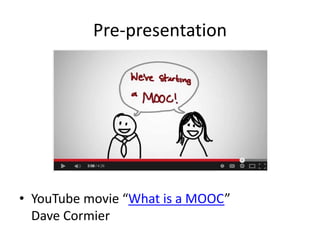
• YouTube movie “What is a MOOC”
Dave Cormier
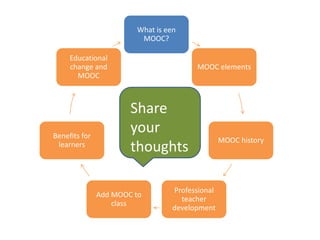
What is een
MOOC?
MOOC elements
MOOC history
Professional
teacher
development
Add MOOC to
class
Benefits for
learners
Educational
change and
MOOC
Share
your
thoughts
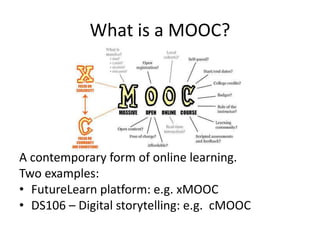
What is a MOOC?
A contemporary form of online learning.
Two examples:
• FutureLearn platform: e.g. xMOOC
• DS106 – Digital storytelling: e.g. cMOOC
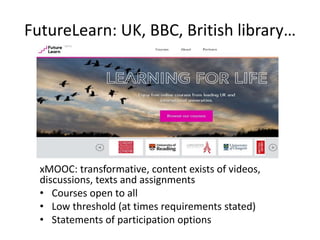
FutureLearn: UK, BBC, British library…
xMOOC: transformative, content exists of videos,
discussions, texts and assignments
• Courses open to all
• Low threshold (at times requirements stated)
• Statements of participation options
Ah, a movie!
Choice:
• Intro to Archeologie Portus, Rome (2min51)
• Video DNA from kiwi experiment – here (4min38)
• English creative writing video ordinary words for
vivid images (1min16)
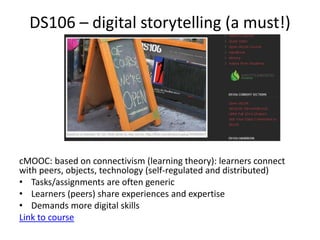
DS106 – digital storytelling (a must!)
cMOOC: based on connectivism (learning theory): learners connect
with peers, objects, technology (self-regulated and distributed)
• Tasks/assignments are often generic
• Learners (peers) share experiences and expertise
• Demands more digital skills
Link to course
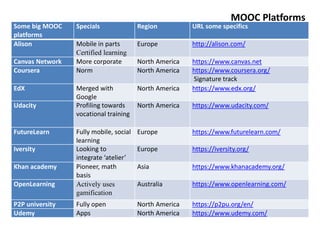
Some big MOOC
platforms
Specials Region URL some specifics
Alison Mobile in parts
Certified learning
Europe http://alison.com/
Canvas Network More corporate North America https://www.canvas.net
Coursera Norm North America https://www.coursera.org/
Signature track
EdX Merged with
Google
North America https://www.edx.org/
Udacity Profiling towards
vocational training
North America https://www.udacity.com/
FutureLearn Fully mobile, social
learning
Europe https://www.futurelearn.com/
Iversity Looking to
integrate ‘atelier’
Europe https://iversity.org/
Khan academy Pioneer, math
basis
Asia https://www.khanacademy.org/
OpenLearning Actively uses
gamification
Australia https://www.openlearning.com/
P2P university Fully open North America https://p2pu.org/en/
Udemy Apps North America https://www.udemy.com/
MOOC Platforms
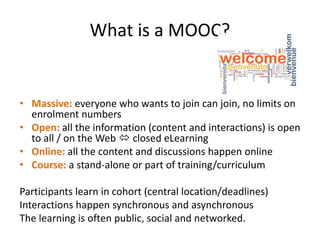
What is a MOOC?
• Massive: everyone who wants to join can join, no limits on
enrolment numbers
• Open: all the information (content and interactions) is open
to all / on the Web  closed eLearning
• Online: all the content and discussions happen online
• Course: a stand-alone or part of training/curriculum
Participants learn in cohort (central location/deadlines)
Interactions happen synchronous and asynchronous
The learning is often public, social and networked.
What distinguishes MOOC from online
and mobile learning?
• Massive group size (affects facilitator role)
• Attracts international learners
• More learner-centered (peer interactions)
• Adds to online social, networked learning
• Informal, sometimes even ‘leisure’ learning
• Use and guidance through learner analytics (due to massiveness)
• MOOC data is often publicly available
• Content: mix of Internet (OER) and self-produced content
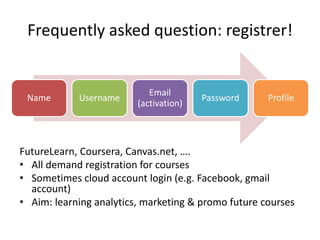
Frequently asked question: registrer!
FutureLearn, Coursera, Canvas.net, ….
• All demand registration for courses
• Sometimes cloud account login (e.g. Facebook, gmail
account)
• Aim: learning analytics, marketing & promo future courses
Name Username
Email
(activation)
Password Profile
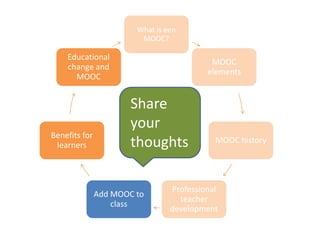
What is een
MOOC?
MOOC
elements
MOOC history
Professional
teacher
development
Add MOOC to
class
Benefits for
learners
Educational
change and
MOOC
Share
your
thoughts
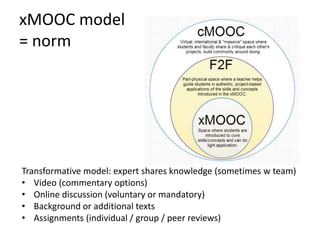
xMOOC model
= norm
Transformative model: expert shares knowledge (sometimes w team)
• Video (commentary options)
• Online discussion (voluntary or mandatory)
• Background or additional texts
• Assignments (individual / group / peer reviews)
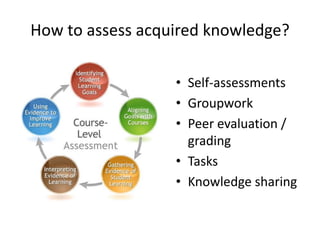
How to assess acquired knowledge?
• Self-assessments
• Groupwork
• Peer evaluation /
grading
• Tasks
• Knowledge sharing
Credits & certificaten variëren
Verschillende opties worden geëvalueerd door
onderwijsinstellingen (merendeel betalend = ROI). Enkele
voorbeelden:
• MOOC2Degree
• OpenBadges by Mozilla
• Coursera: signature track (bedrijven)
• FutureLearn (Statement of participation)
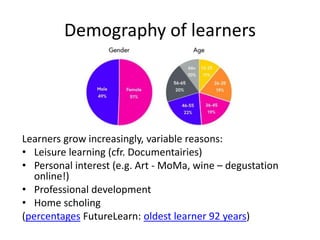
Demography of learners
Learners grow increasingly, variable reasons:
• Leisure learning (cfr. Documentairies)
• Personal interest (e.g. Art - MoMa, wine – degustation
online!)
• Professional development
• Home scholing
(percentages FutureLearn: oldest learner 92 years)
What is een
MOOC?
MOOC
elements
MOOC history
Professional
teacher
development
Add MOOC to
class
Benefits for
learners
Educational
change and
MOOC
Share
your
thoughts
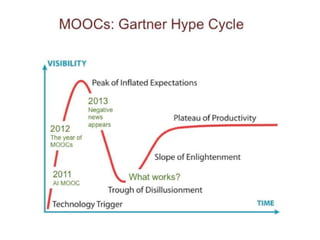
MOOC history in a nutshell
• From 2005: sharp social media increase (YouTube, wiki’s,
FB)
• CCK2008: first ‘Massive Open Online Course – over 2000
learners, internationaal) – organised by Stephen Downes &
George Siemens. Based on connectivism.
• Khan Academy: math online, gratis
• 2012: Artificial Intelligence course in Stanford University
(over 100.000 registered learners). Old pedagogy online.
• MOOC hype, worldwide press interest
2005 CCK2008
Kahn
Academy
2012
MOOC
hype
What is een
MOOC?
MOOC
elements
MOOC history
Professional
teacher
development
Add MOOC to
class
Benefits for
learners
Educational
change and
MOOC
Share
your
thoughts
Two main teacher benefits
• Professional development: teachers, learners
• MOOC as addition to class / curriculum
Professional development
• Increase specific knowledge within area of expertise
• Satisfy personal knowledge interest
• Look over the shoulder of other colleagues
• Potential for informele teacher group education
Indirect benefits
• Increase digital skills
• Explore and understand contemporary online learning
• Expand peer network (international teacher connect)
• Leisure learning
What is een
MOOC?
MOOC
elements
MOOC history
Professional
teacher
development
Add MOOC to
class
Benefits for
learners
Educational
change and
MOOC
Share
your
thoughts
MOOC adds to class / curriculum
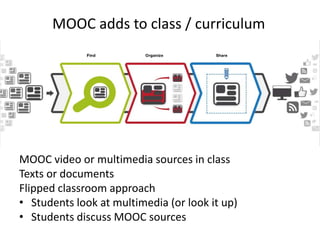
MOOC video or multimedia sources in class
Texts or documents
Flipped classroom approach
• Students look at multimedia (or look it up)
• Students discuss MOOC sources
Access to MOOC content?
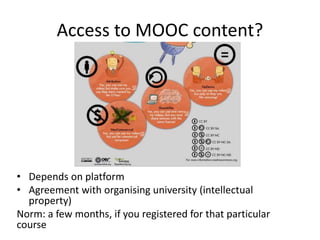
• Depends on platform
• Agreement with organising university (intellectual
property)
Norm: a few months, if you registered for that particular
course
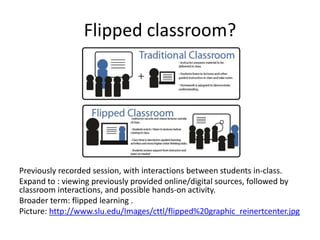
Flipped classroom?
Previously recorded session, with interactions between students in-class.
Expand to : viewing previously provided online/digital sources, followed by
classroom interactions, and possible hands-on activity.
Broader term: flipped learning .
Picture: http://www.slu.edu/Images/cttl/flipped%20graphic_reinertcenter.jpg
Overview: four big parts
• Learning goal and meaning
of the FC needs to be
shared with students for
ensured bigger
understanding.
• Online sources are shared.
To be viewed/understood
(cfr homework/reflection –
computer available?)
• In-class: groupwork, focus
on content, understanding,
difficulties, project. Peer
and teacher feedback.
• Evaluation of the process
by all.
1. Learning
goal FC
2. Pre-class:
sources
(homework)
3. Class:
groupwork &
understanding
4. Post-class:
evaluation
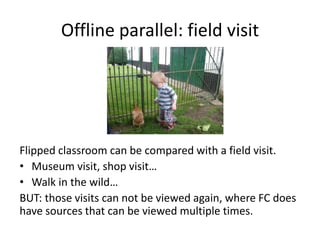
Offline parallel: field visit
Flipped classroom can be compared with a field visit.
• Museum visit, shop visit…
• Walk in the wild…
BUT: those visits can not be viewed again, where FC does
have sources that can be viewed multiple times.
How do you know the students have
actually accessed the resources?
Classical approach will do (with or without grades):
• Provide a quiz or some questions they need to answer, and
which demand reflection (intro to class discussion)
• Make sure you get the results before the class moment
Additional help for individual learning: a guiding text which
highlights the focus and concepts of the topic/reflection.
What is een
MOOC?
MOOC
elements
MOOC history
Professional
teacher
development
Add MOOC to
class
Benefits for
learners
Educational
change and
MOOC
Share
your
thoughts
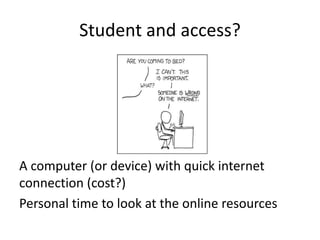
Student and access?
A computer (or device) with quick internet
connection (cost?)
Personal time to look at the online resources
Increase critical skills
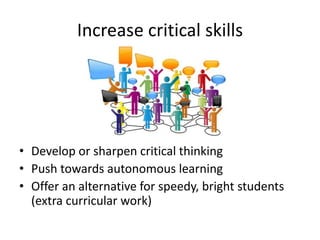
• Develop or sharpen critical thinking
• Push towards autonomous learning
• Offer an alternative for speedy, bright students
(extra curricular work)
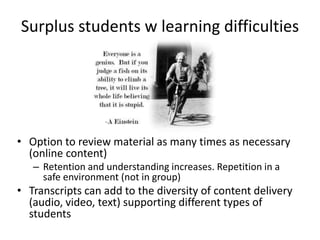
Surplus students w learning difficulties
• Option to review material as many times as necessary
(online content)
– Retention and understanding increases. Repetition in a
safe environment (not in group)
• Transcripts can add to the diversity of content delivery
(audio, video, text) supporting different types of
students
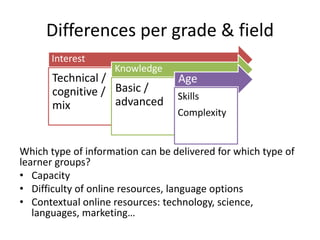
Differences per grade & field
Which type of information can be delivered for which type of
learner groups?
• Capacity
• Difficulty of online resources, language options
• Contextual online resources: technology, science,
languages, marketing…
Interest
Technical /
cognitive /
mix
Knowledge
Basic /
advanced
Age
Skills
Complexity
Transfer high school => college / Uni
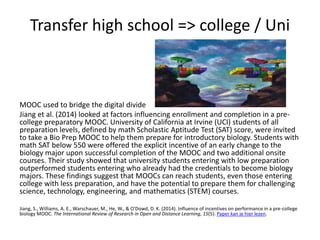
MOOC used to bridge the digital divide
Jiang et al. (2014) looked at factors influencing enrollment and completion in a pre-
college preparatory MOOC. University of California at Irvine (UCI) students of all
preparation levels, defined by math Scholastic Aptitude Test (SAT) score, were invited
to take a Bio Prep MOOC to help them prepare for introductory biology. Students with
math SAT below 550 were offered the explicit incentive of an early change to the
biology major upon successful completion of the MOOC and two additional onsite
courses. Their study showed that university students entering with low preparation
outperformed students entering who already had the credentials to become biology
majors. These findings suggest that MOOCs can reach students, even those entering
college with less preparation, and have the potential to prepare them for challenging
science, technology, engineering, and mathematics (STEM) courses.
Jiang, S., Williams, A. E., Warschauer, M., He, W., & O'Dowd, D. K. (2014). Influence of incentives on performance in a pre-college
biology MOOC. The International Review of Research in Open and Distance Learning, 15(5). Paper kan je hier lezen.
Self-directed learning
Self-directed learning (SDL) (e.g. in professionele MOOCs Milligan,
LittleJohn, 2014), self-image, motivation and ‘Big 5 traits’ paper ,
Furnham, Monsen, Ahmetaglu, 2010)
• Share SDL strategies with students
• Provide guidelines for MOOC (communication)
• Provide a clear overview of the full course, use social cognitive
constructs
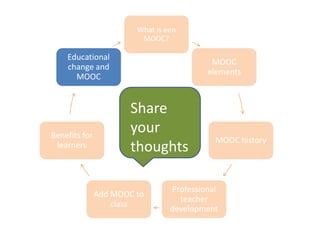
What is een
MOOC?
MOOC
elements
MOOC history
Professional
teacher
development
Add MOOC to
class
Benefits for
learners
Educational
change and
MOOC
Share
your
thoughts
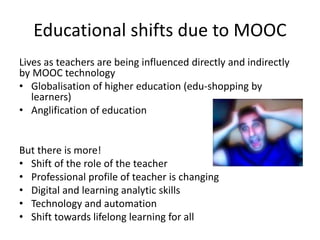
Educational shifts due to MOOC
Lives as teachers are being influenced directly and indirectly
by MOOC technology
• Globalisation of higher education (edu-shopping by
learners)
• Anglification of education
But there is more!
• Shift of the role of the teacher
• Professional profile of teacher is changing
• Digital and learning analytic skills
• Technology and automation
• Shift towards lifelong learning for all
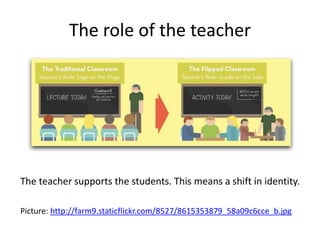
The role of the teacher
Picture: http://farm9.staticflickr.com/8527/8615353879_58a09c6cce_b.jpg
The teacher supports the students. This means a shift in identity.
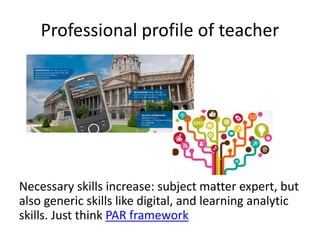
Professional profile of teacher
Necessary skills increase: subject matter expert, but
also generic skills like digital, and learning analytic
skills. Just think PAR framework
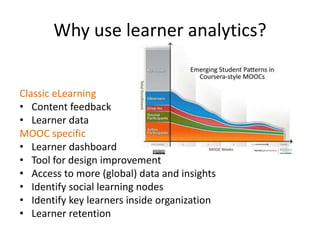
Why use learner analytics?
Classic eLearning
• Content feedback
• Learner data
MOOC specific
• Learner dashboard
• Tool for design improvement
• Access to more (global) data and insights
• Identify social learning nodes
• Identify key learners inside organization
• Learner retention
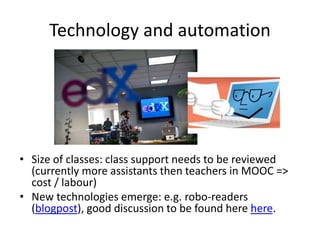
Technology and automation
• Size of classes: class support needs to be reviewed
(currently more assistants then teachers in MOOC =>
cost / labour)
• New technologies emerge: e.g. robo-readers
(blogpost), good discussion to be found here here.
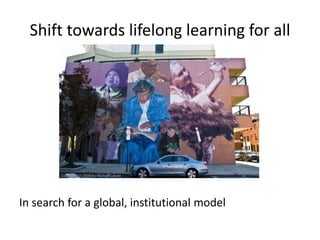
Shift towards lifelong learning for all
In search for a global, institutional model
Conclusion
• MOOC = just one type of online leren
• MOOCs cause educational disruption, possible
reform/s
• It is good to explore!
Contact me here or later
46
E-mail: ingedewaard (at) gmail.com
Blog: ignatiawebs.blogspot.com
Twitter: http://twitter.com/Ignatia
Publications:
http://www.ingedewaard.net/pubconsulpres.htm
Presentations: http://www.slideshare.net/ignatia
linkedIn: http://www.linkedin.com/in/ingedewaard

Mooc teacher and student benefits

  • 1.
    MOOC: teachers &student/learner benefits and realities Inge (Ignatia) de Waard
  • 2.
    Pre-presentation • YouTube movie“What is a MOOC” Dave Cormier
  • 3.
    What is een MOOC? MOOCelements MOOC history Professional teacher development Add MOOC to class Benefits for learners Educational change and MOOC Share your thoughts
  • 4.
    What is aMOOC? A contemporary form of online learning. Two examples: • FutureLearn platform: e.g. xMOOC • DS106 – Digital storytelling: e.g. cMOOC
  • 5.
    FutureLearn: UK, BBC,British library… xMOOC: transformative, content exists of videos, discussions, texts and assignments • Courses open to all • Low threshold (at times requirements stated) • Statements of participation options
  • 6.
    Ah, a movie! Choice: •Intro to Archeologie Portus, Rome (2min51) • Video DNA from kiwi experiment – here (4min38) • English creative writing video ordinary words for vivid images (1min16)
  • 7.
    DS106 – digitalstorytelling (a must!) cMOOC: based on connectivism (learning theory): learners connect with peers, objects, technology (self-regulated and distributed) • Tasks/assignments are often generic • Learners (peers) share experiences and expertise • Demands more digital skills Link to course
  • 8.
    Some big MOOC platforms SpecialsRegion URL some specifics Alison Mobile in parts Certified learning Europe http://alison.com/ Canvas Network More corporate North America https://www.canvas.net Coursera Norm North America https://www.coursera.org/ Signature track EdX Merged with Google North America https://www.edx.org/ Udacity Profiling towards vocational training North America https://www.udacity.com/ FutureLearn Fully mobile, social learning Europe https://www.futurelearn.com/ Iversity Looking to integrate ‘atelier’ Europe https://iversity.org/ Khan academy Pioneer, math basis Asia https://www.khanacademy.org/ OpenLearning Actively uses gamification Australia https://www.openlearning.com/ P2P university Fully open North America https://p2pu.org/en/ Udemy Apps North America https://www.udemy.com/ MOOC Platforms
  • 9.
    What is aMOOC? • Massive: everyone who wants to join can join, no limits on enrolment numbers • Open: all the information (content and interactions) is open to all / on the Web  closed eLearning • Online: all the content and discussions happen online • Course: a stand-alone or part of training/curriculum Participants learn in cohort (central location/deadlines) Interactions happen synchronous and asynchronous The learning is often public, social and networked.
  • 10.
    What distinguishes MOOCfrom online and mobile learning? • Massive group size (affects facilitator role) • Attracts international learners • More learner-centered (peer interactions) • Adds to online social, networked learning • Informal, sometimes even ‘leisure’ learning • Use and guidance through learner analytics (due to massiveness) • MOOC data is often publicly available • Content: mix of Internet (OER) and self-produced content
  • 11.
    Frequently asked question:registrer! FutureLearn, Coursera, Canvas.net, …. • All demand registration for courses • Sometimes cloud account login (e.g. Facebook, gmail account) • Aim: learning analytics, marketing & promo future courses Name Username Email (activation) Password Profile
  • 12.
    What is een MOOC? MOOC elements MOOChistory Professional teacher development Add MOOC to class Benefits for learners Educational change and MOOC Share your thoughts
  • 13.
    xMOOC model = norm Transformativemodel: expert shares knowledge (sometimes w team) • Video (commentary options) • Online discussion (voluntary or mandatory) • Background or additional texts • Assignments (individual / group / peer reviews)
  • 14.
    How to assessacquired knowledge? • Self-assessments • Groupwork • Peer evaluation / grading • Tasks • Knowledge sharing
  • 15.
    Credits & certificatenvariëren Verschillende opties worden geëvalueerd door onderwijsinstellingen (merendeel betalend = ROI). Enkele voorbeelden: • MOOC2Degree • OpenBadges by Mozilla • Coursera: signature track (bedrijven) • FutureLearn (Statement of participation)
  • 16.
    Demography of learners Learnersgrow increasingly, variable reasons: • Leisure learning (cfr. Documentairies) • Personal interest (e.g. Art - MoMa, wine – degustation online!) • Professional development • Home scholing (percentages FutureLearn: oldest learner 92 years)
  • 17.
    What is een MOOC? MOOC elements MOOChistory Professional teacher development Add MOOC to class Benefits for learners Educational change and MOOC Share your thoughts
  • 18.
    MOOC history ina nutshell • From 2005: sharp social media increase (YouTube, wiki’s, FB) • CCK2008: first ‘Massive Open Online Course – over 2000 learners, internationaal) – organised by Stephen Downes & George Siemens. Based on connectivism. • Khan Academy: math online, gratis • 2012: Artificial Intelligence course in Stanford University (over 100.000 registered learners). Old pedagogy online. • MOOC hype, worldwide press interest 2005 CCK2008 Kahn Academy 2012 MOOC hype
  • 20.
    What is een MOOC? MOOC elements MOOChistory Professional teacher development Add MOOC to class Benefits for learners Educational change and MOOC Share your thoughts
  • 21.
    Two main teacherbenefits • Professional development: teachers, learners • MOOC as addition to class / curriculum
  • 22.
    Professional development • Increasespecific knowledge within area of expertise • Satisfy personal knowledge interest • Look over the shoulder of other colleagues • Potential for informele teacher group education
  • 23.
    Indirect benefits • Increasedigital skills • Explore and understand contemporary online learning • Expand peer network (international teacher connect) • Leisure learning
  • 24.
    What is een MOOC? MOOC elements MOOChistory Professional teacher development Add MOOC to class Benefits for learners Educational change and MOOC Share your thoughts
  • 25.
    MOOC adds toclass / curriculum MOOC video or multimedia sources in class Texts or documents Flipped classroom approach • Students look at multimedia (or look it up) • Students discuss MOOC sources
  • 26.
    Access to MOOCcontent? • Depends on platform • Agreement with organising university (intellectual property) Norm: a few months, if you registered for that particular course
  • 27.
    Flipped classroom? Previously recordedsession, with interactions between students in-class. Expand to : viewing previously provided online/digital sources, followed by classroom interactions, and possible hands-on activity. Broader term: flipped learning . Picture: http://www.slu.edu/Images/cttl/flipped%20graphic_reinertcenter.jpg
  • 28.
    Overview: four bigparts • Learning goal and meaning of the FC needs to be shared with students for ensured bigger understanding. • Online sources are shared. To be viewed/understood (cfr homework/reflection – computer available?) • In-class: groupwork, focus on content, understanding, difficulties, project. Peer and teacher feedback. • Evaluation of the process by all. 1. Learning goal FC 2. Pre-class: sources (homework) 3. Class: groupwork & understanding 4. Post-class: evaluation
  • 29.
    Offline parallel: fieldvisit Flipped classroom can be compared with a field visit. • Museum visit, shop visit… • Walk in the wild… BUT: those visits can not be viewed again, where FC does have sources that can be viewed multiple times.
  • 30.
    How do youknow the students have actually accessed the resources? Classical approach will do (with or without grades): • Provide a quiz or some questions they need to answer, and which demand reflection (intro to class discussion) • Make sure you get the results before the class moment Additional help for individual learning: a guiding text which highlights the focus and concepts of the topic/reflection.
  • 31.
    What is een MOOC? MOOC elements MOOChistory Professional teacher development Add MOOC to class Benefits for learners Educational change and MOOC Share your thoughts
  • 32.
    Student and access? Acomputer (or device) with quick internet connection (cost?) Personal time to look at the online resources
  • 33.
    Increase critical skills •Develop or sharpen critical thinking • Push towards autonomous learning • Offer an alternative for speedy, bright students (extra curricular work)
  • 34.
    Surplus students wlearning difficulties • Option to review material as many times as necessary (online content) – Retention and understanding increases. Repetition in a safe environment (not in group) • Transcripts can add to the diversity of content delivery (audio, video, text) supporting different types of students
  • 35.
    Differences per grade& field Which type of information can be delivered for which type of learner groups? • Capacity • Difficulty of online resources, language options • Contextual online resources: technology, science, languages, marketing… Interest Technical / cognitive / mix Knowledge Basic / advanced Age Skills Complexity
  • 36.
    Transfer high school=> college / Uni MOOC used to bridge the digital divide Jiang et al. (2014) looked at factors influencing enrollment and completion in a pre- college preparatory MOOC. University of California at Irvine (UCI) students of all preparation levels, defined by math Scholastic Aptitude Test (SAT) score, were invited to take a Bio Prep MOOC to help them prepare for introductory biology. Students with math SAT below 550 were offered the explicit incentive of an early change to the biology major upon successful completion of the MOOC and two additional onsite courses. Their study showed that university students entering with low preparation outperformed students entering who already had the credentials to become biology majors. These findings suggest that MOOCs can reach students, even those entering college with less preparation, and have the potential to prepare them for challenging science, technology, engineering, and mathematics (STEM) courses. Jiang, S., Williams, A. E., Warschauer, M., He, W., & O'Dowd, D. K. (2014). Influence of incentives on performance in a pre-college biology MOOC. The International Review of Research in Open and Distance Learning, 15(5). Paper kan je hier lezen.
  • 37.
    Self-directed learning Self-directed learning(SDL) (e.g. in professionele MOOCs Milligan, LittleJohn, 2014), self-image, motivation and ‘Big 5 traits’ paper , Furnham, Monsen, Ahmetaglu, 2010) • Share SDL strategies with students • Provide guidelines for MOOC (communication) • Provide a clear overview of the full course, use social cognitive constructs
  • 38.
    What is een MOOC? MOOC elements MOOChistory Professional teacher development Add MOOC to class Benefits for learners Educational change and MOOC Share your thoughts
  • 39.
    Educational shifts dueto MOOC Lives as teachers are being influenced directly and indirectly by MOOC technology • Globalisation of higher education (edu-shopping by learners) • Anglification of education But there is more! • Shift of the role of the teacher • Professional profile of teacher is changing • Digital and learning analytic skills • Technology and automation • Shift towards lifelong learning for all
  • 40.
    The role ofthe teacher Picture: http://farm9.staticflickr.com/8527/8615353879_58a09c6cce_b.jpg The teacher supports the students. This means a shift in identity.
  • 41.
    Professional profile ofteacher Necessary skills increase: subject matter expert, but also generic skills like digital, and learning analytic skills. Just think PAR framework
  • 42.
    Why use learneranalytics? Classic eLearning • Content feedback • Learner data MOOC specific • Learner dashboard • Tool for design improvement • Access to more (global) data and insights • Identify social learning nodes • Identify key learners inside organization • Learner retention
  • 43.
    Technology and automation •Size of classes: class support needs to be reviewed (currently more assistants then teachers in MOOC => cost / labour) • New technologies emerge: e.g. robo-readers (blogpost), good discussion to be found here here.
  • 44.
    Shift towards lifelonglearning for all In search for a global, institutional model
  • 45.
    Conclusion • MOOC =just one type of online leren • MOOCs cause educational disruption, possible reform/s • It is good to explore!
  • 46.
    Contact me hereor later 46 E-mail: ingedewaard (at) gmail.com Blog: ignatiawebs.blogspot.com Twitter: http://twitter.com/Ignatia Publications: http://www.ingedewaard.net/pubconsulpres.htm Presentations: http://www.slideshare.net/ignatia linkedIn: http://www.linkedin.com/in/ingedewaard