


How to Improve Students’
Spelling Skill

BY
JAVED IQBAL PROFESSIONAL
DEVELOPMENT TEACHER OF PDCN FOR
EDIP PROJECT
Outline
 Session Learning Outcomes

 Why Teaching Spelling
 How do we Know and how to spell a word
 General rules
 Plural Words
 Patterns
Session Learning Outcomes
 By the end of this session C.Ps could be able to;

 1. Share the importance of spelling skills in

writing,
 2. Discuss some rules to students’ spelling skills,
 3. Devise some strategies to improve students’
spelling skills.
Question for Debate

In which language Spelling
is difficult Urdu or
English?
Why Teach Spelling
 Ensures accuracy of communication

 Boosts confidence
 Encourages writing fluency
 Helps with reading
 Rewards / exams / career plans
 Integral part of English language!
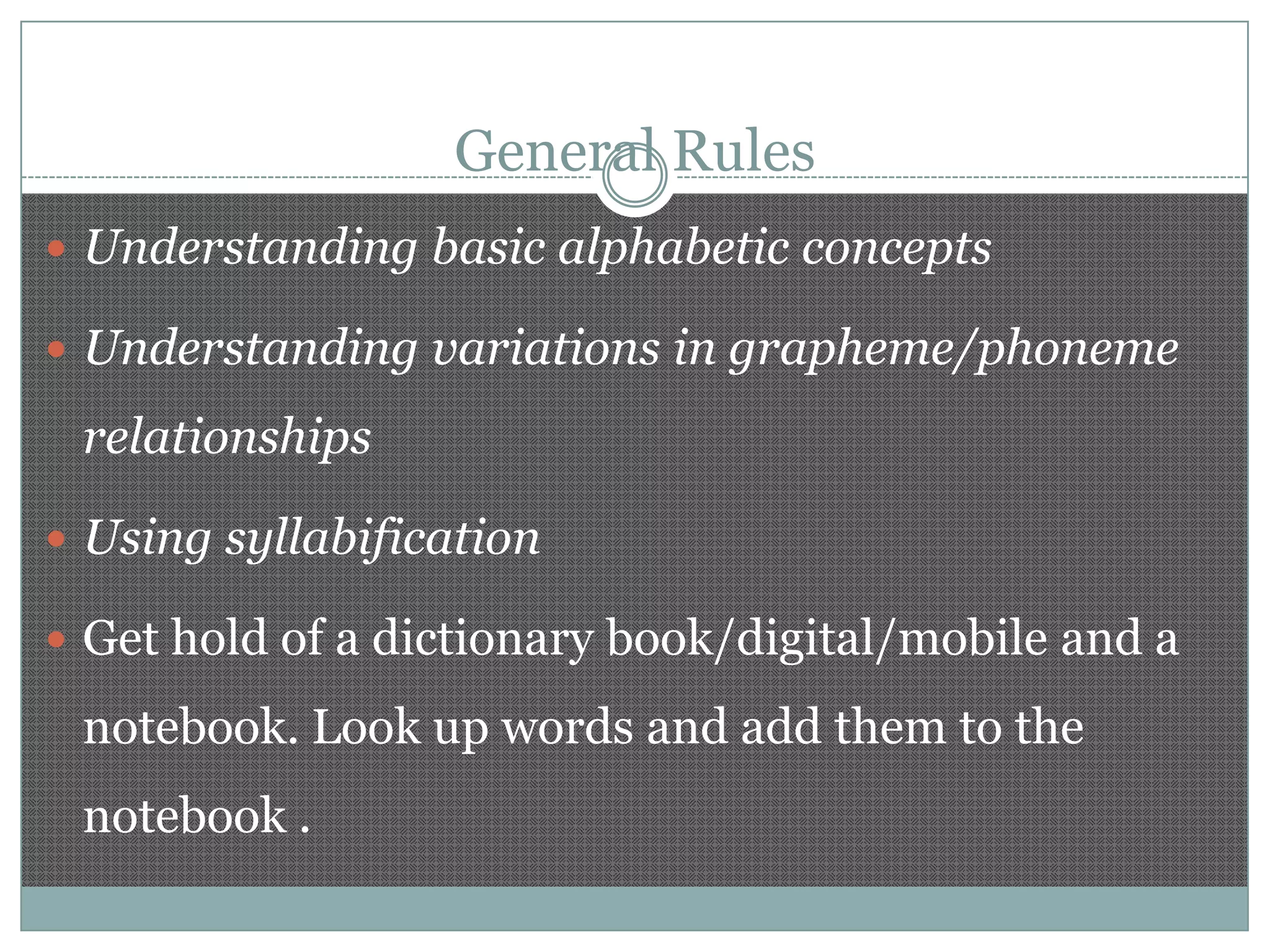
General Rules
 Understanding basic alphabetic concepts

 Understanding variations in grapheme/phoneme

relationships
 Using syllabification
 Get hold of a dictionary book/digital/mobile and a

notebook. Look up words and add them to the
notebook .
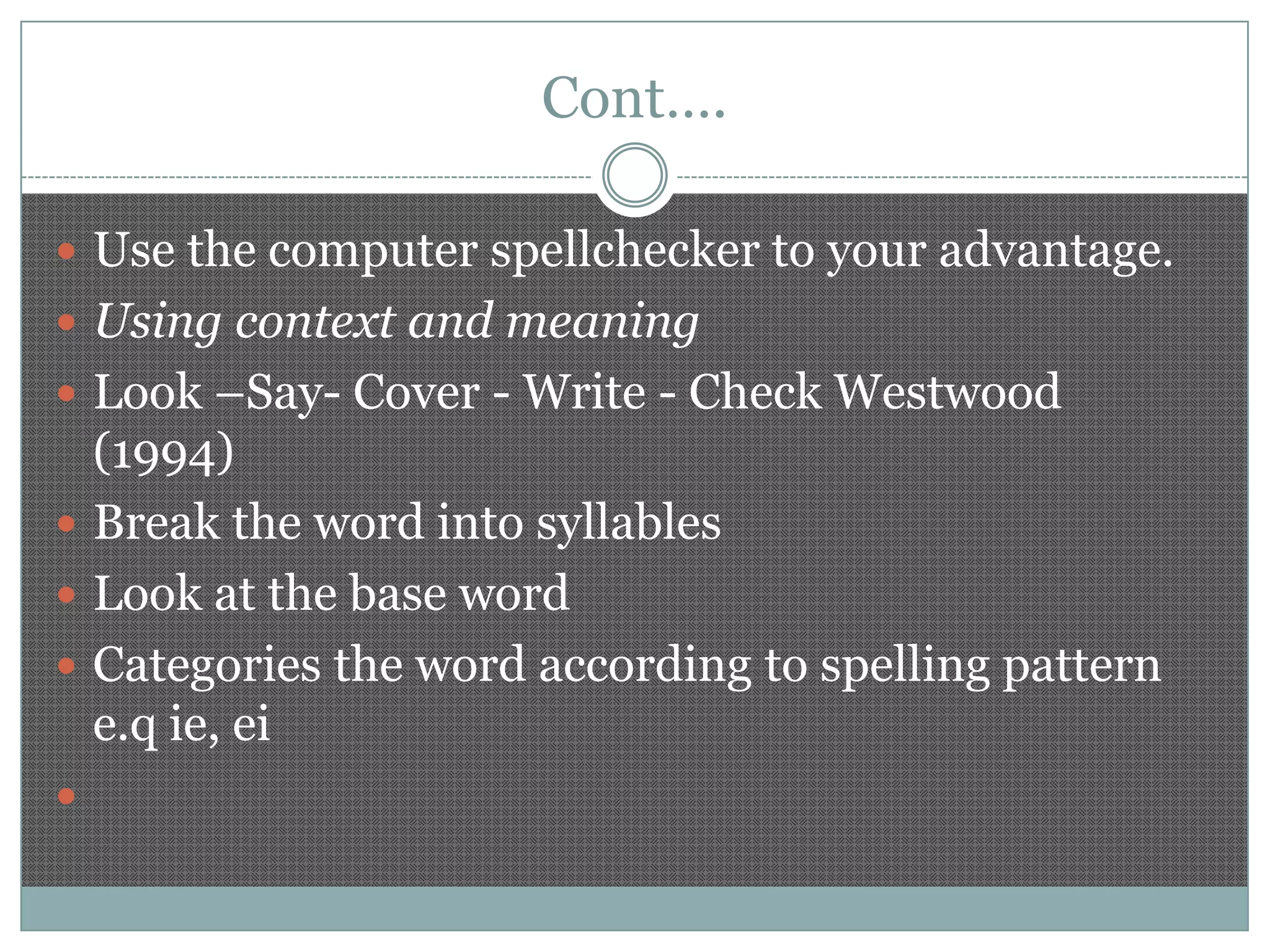
Cont….
 Use the computer spellchecker to your advantage.

 Using context and meaning
 Look –Say- Cover - Write - Check Westwood

(1994)
 Break the word into syllables
 Look at the base word
 Categories the word according to spelling pattern
e.q ie, ei

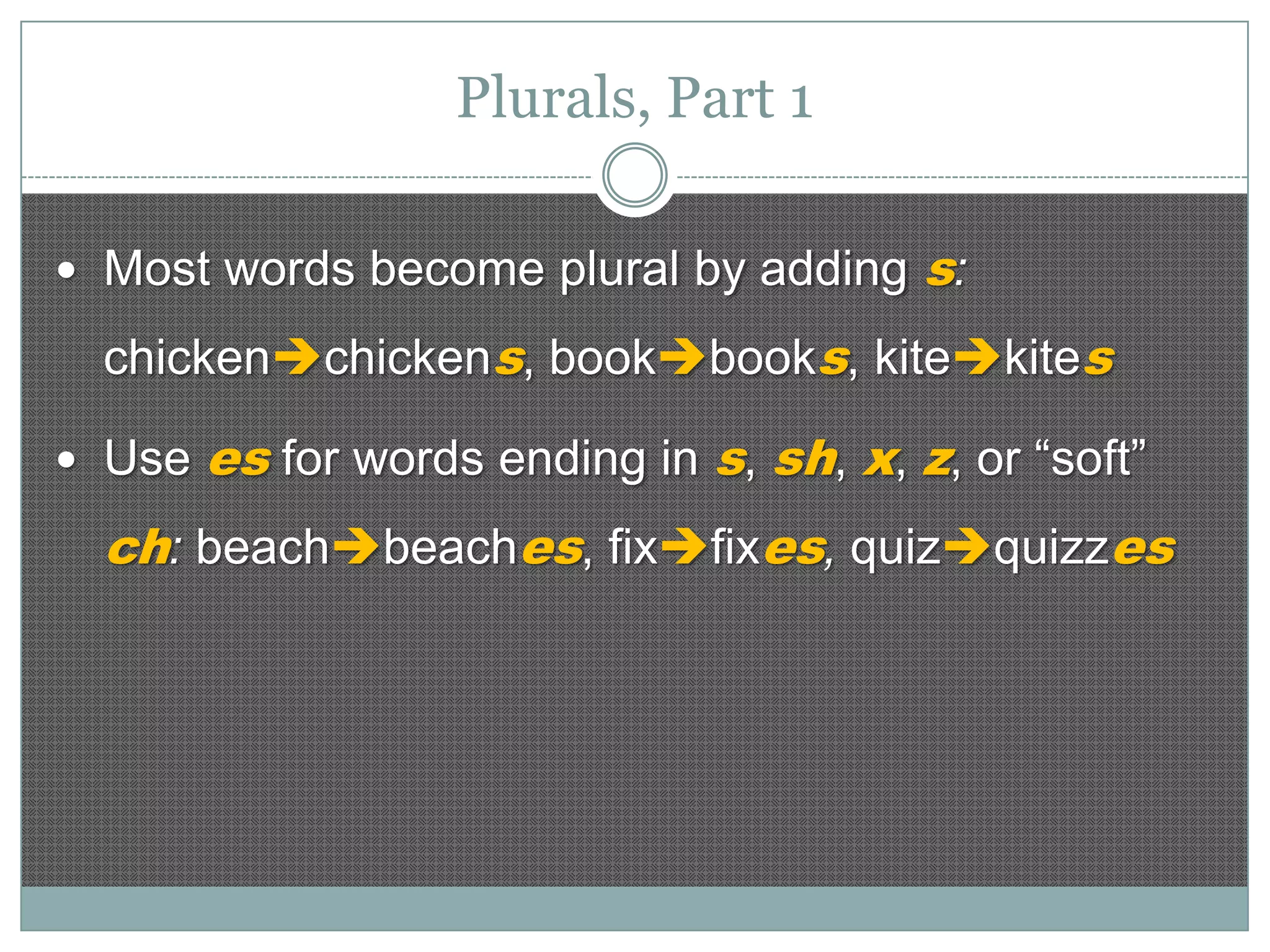
Plurals, Part 1
 Most words become plural by adding

s:

chickenchickens, bookbooks, kitekites
 Use

es for words ending in s, sh, x, z, or “soft”

ch: beachbeaches, fixfixes, quizquizzes
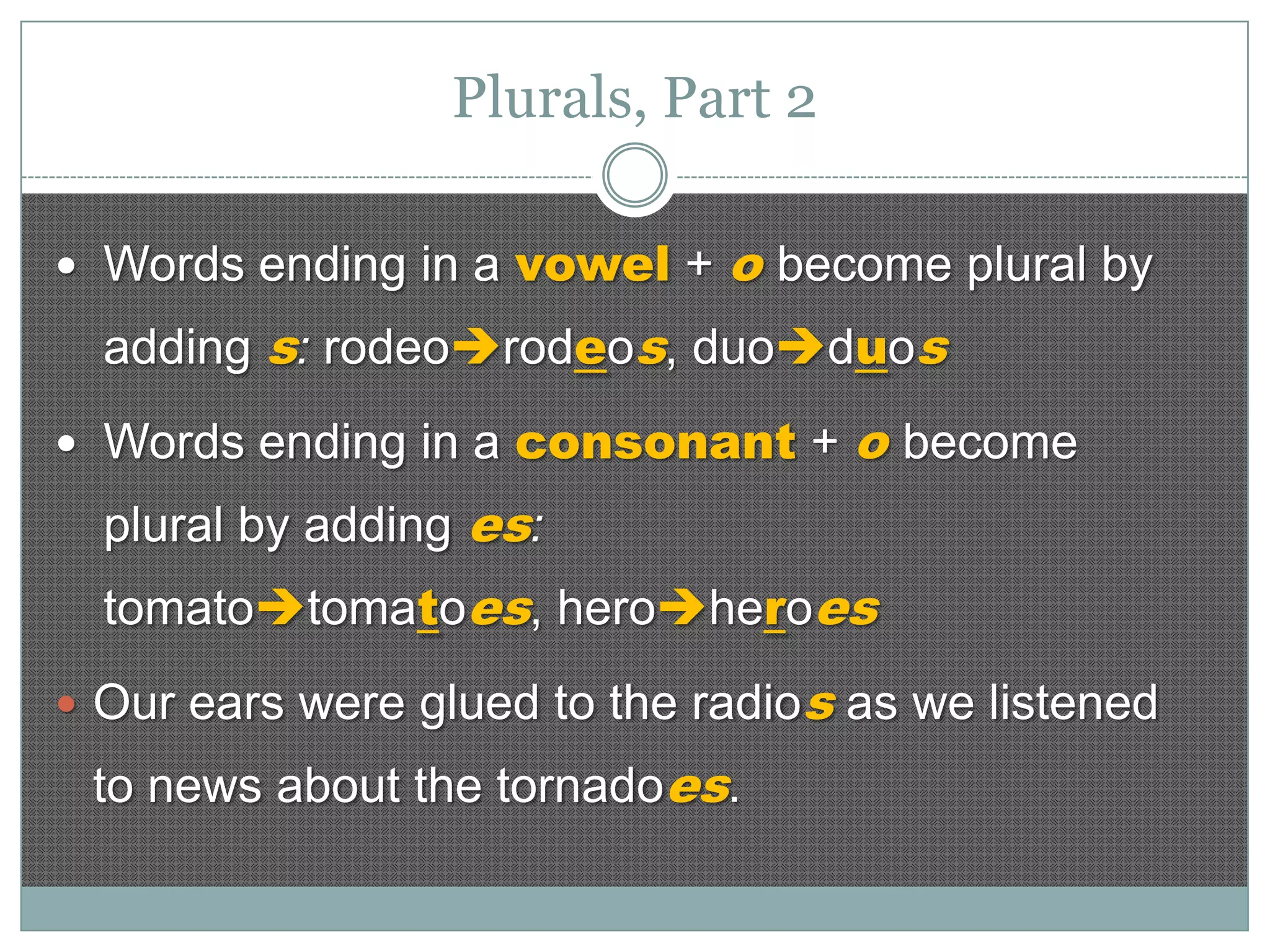
Plurals, Part 2
 Words ending in a vowel +

o become plural by

adding s: rodeorodeos, duoduos
 Words ending in a consonant +

o become

plural by adding es:
tomatotomatoes, heroheroes
 Our ears were glued to the radios as we listened

to news about the tornadoes.
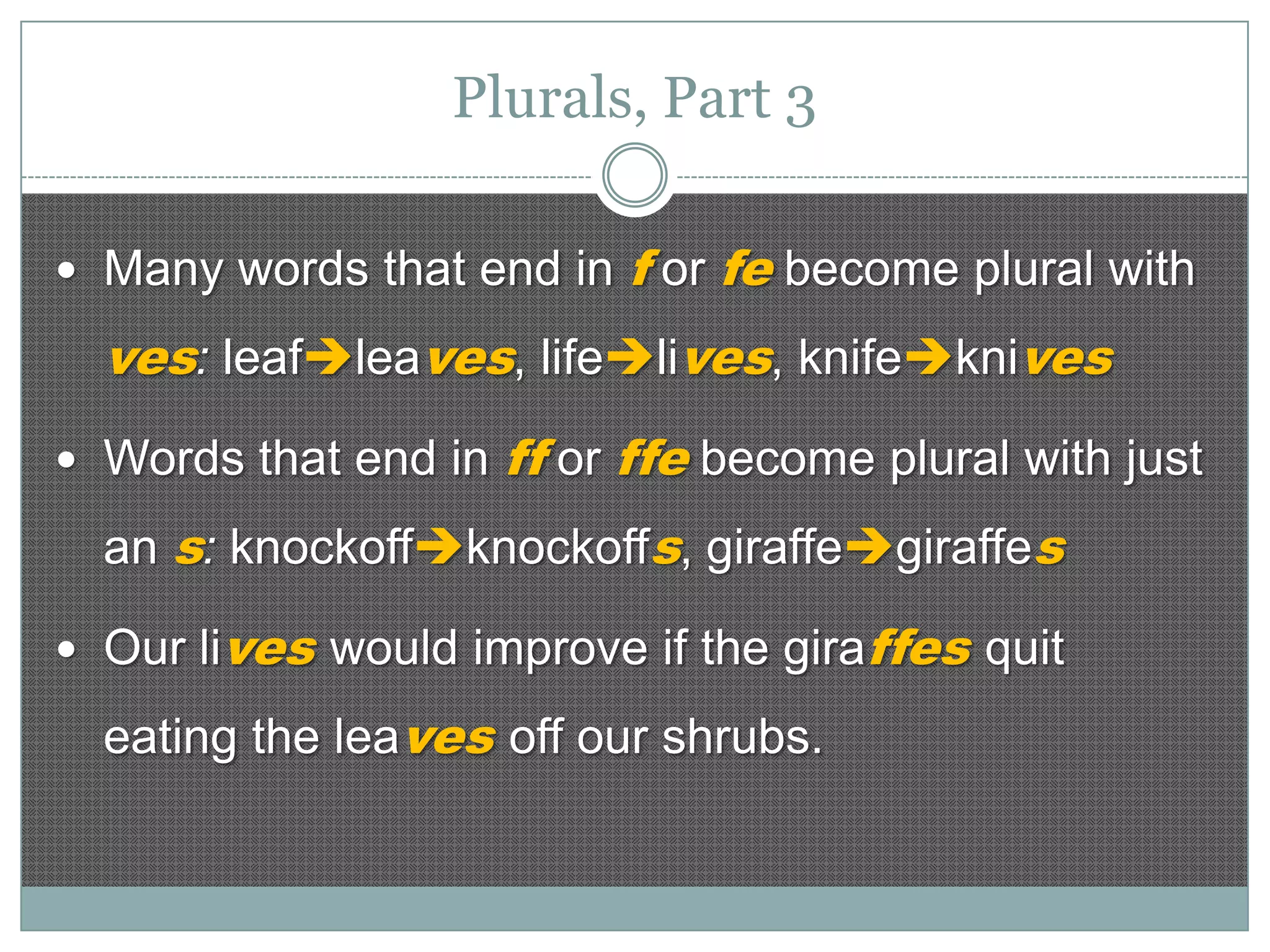
Plurals, Part 3
 Many words that end in

f or fe become plural with

ves: leafleaves, lifelives, knifeknives
 Words that end in

ff or ffe become plural with just

an s: knockoffknockoffs, giraffegiraffes
 Our lives would improve if the giraffes quit

eating the leaves off our shrubs.
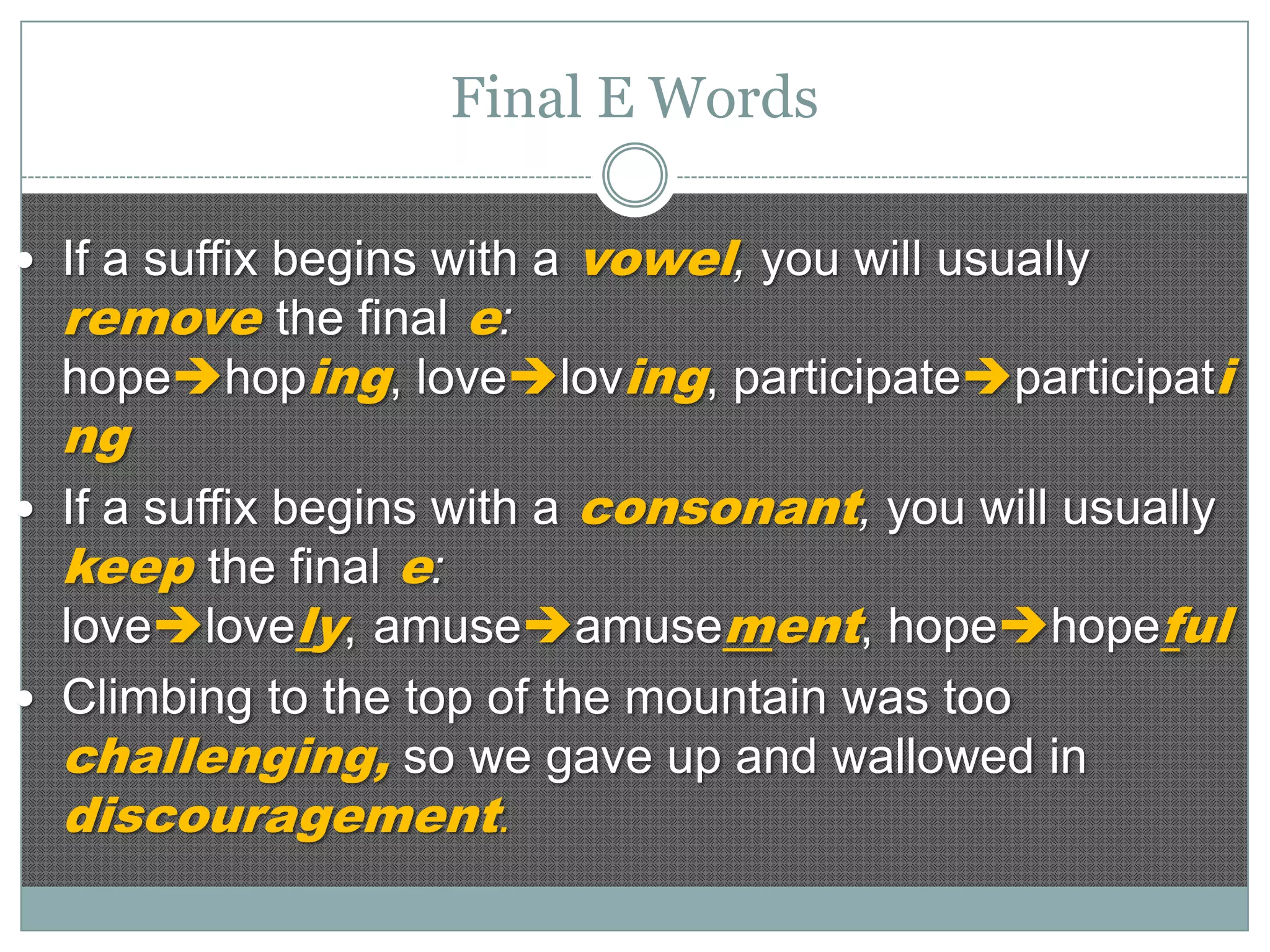
Final E Words
 If a suffix begins with a

vowel, you will usually

remove the final e:
hopehoping, loveloving, participateparticipati
ng
 If a suffix begins with a consonant, you will usually
keep the final e:
lovelovely, amuseamusement, hopehopeful
 Climbing to the top of the mountain was too

challenging, so we gave up and wallowed in
discouragement.
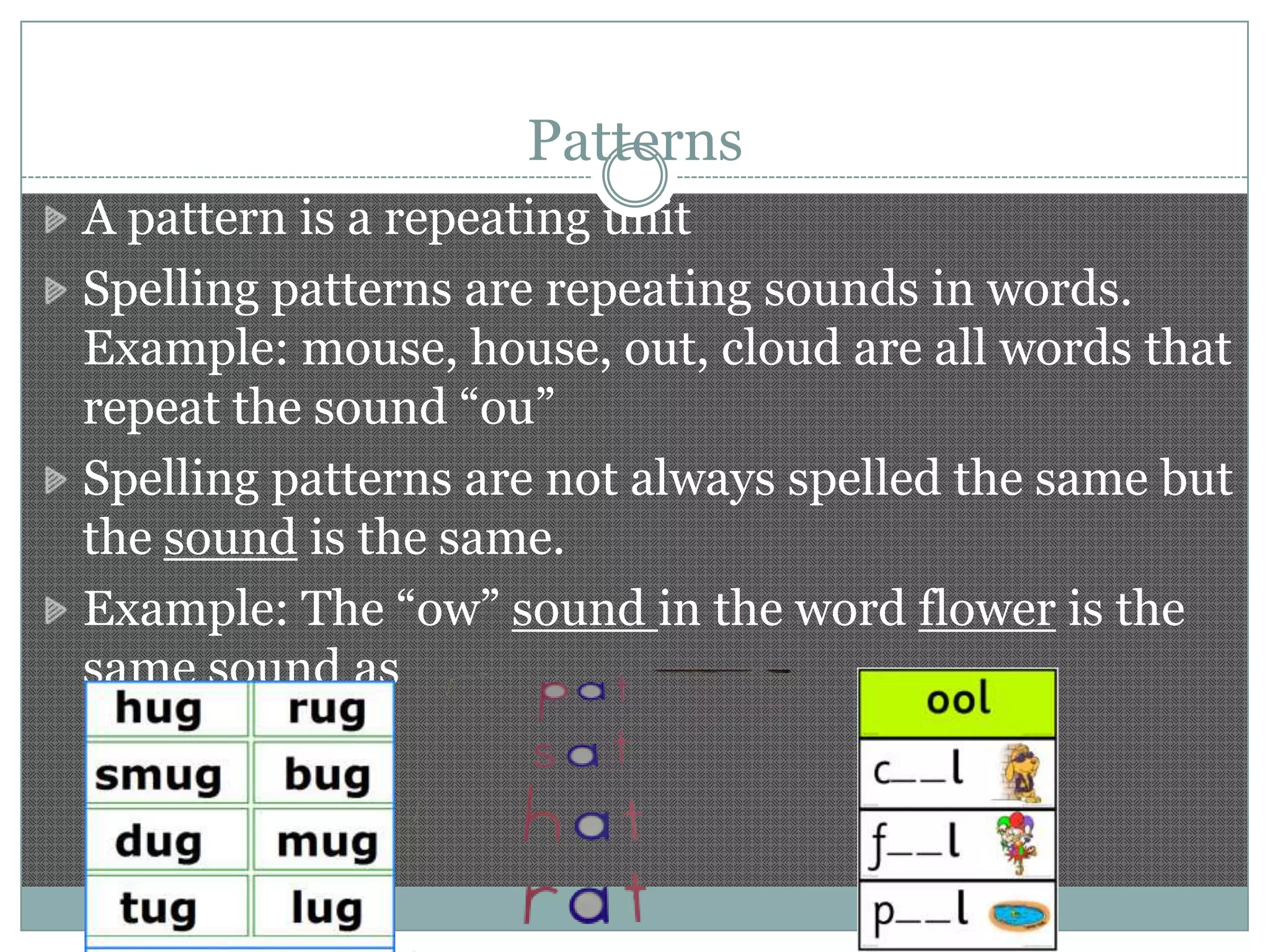
Patterns
A pattern is a repeating unit
Spelling patterns are repeating sounds in words.
Example: mouse, house, out, cloud are all words that
repeat the sound “ou”
Spelling patterns are not always spelled the same but
the sound is the same.
Example: The “ow” sound in the word flower is the
same sound as
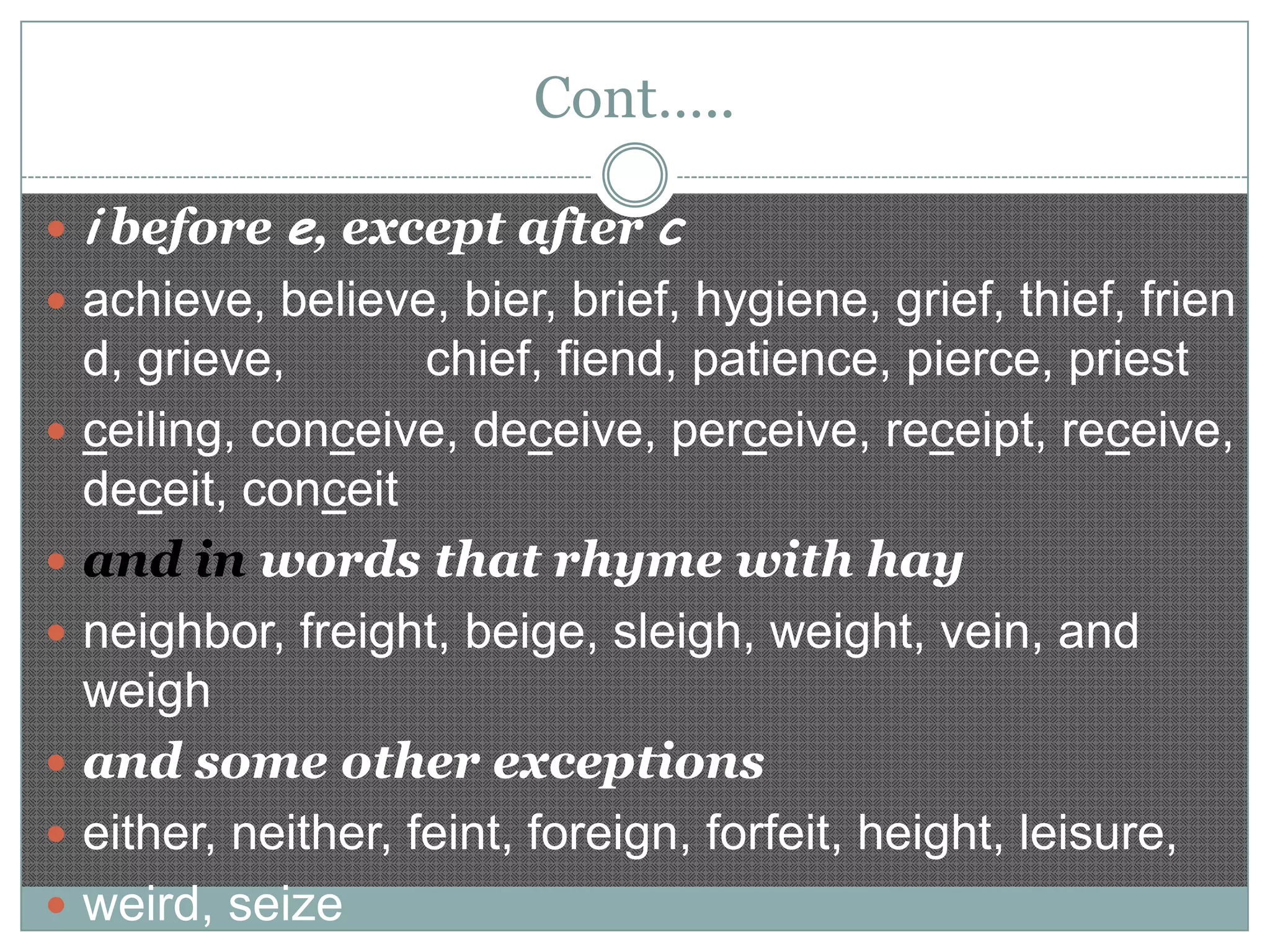
Cont…..
 i before e, except after

c

 achieve, believe, bier, brief, hygiene, grief, thief, frien









d, grieve,
chief, fiend, patience, pierce, priest
ceiling, conceive, deceive, perceive, receipt, receive,
deceit, conceit
and in words that rhyme with hay
neighbor, freight, beige, sleigh, weight, vein, and
weigh
and some other exceptions
either, neither, feint, foreign, forfeit, height, leisure,
weird, seize
Cont….
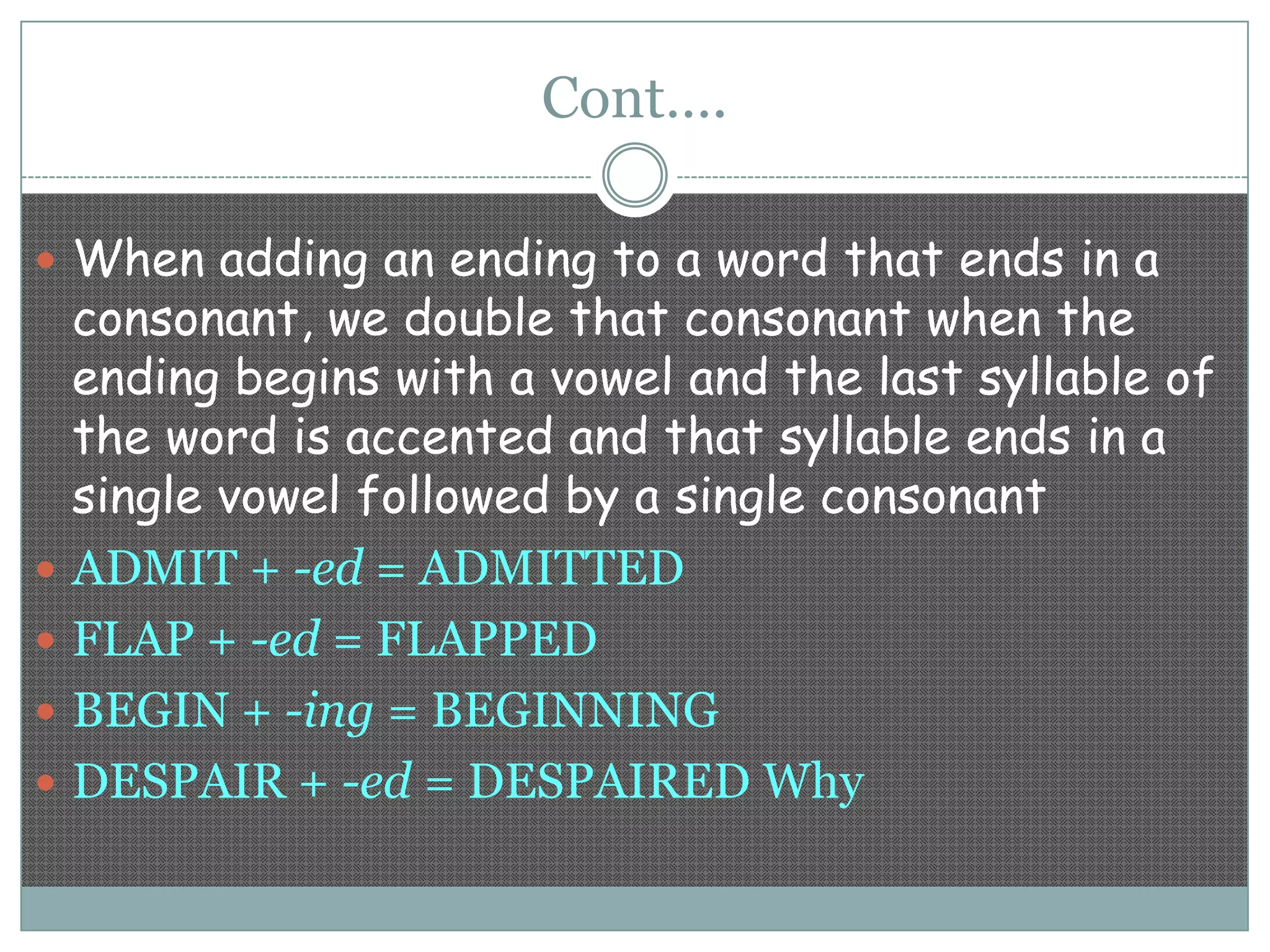
 When adding an ending to a word that ends in a







consonant, we double that consonant when the
ending begins with a vowel and the last syllable of
the word is accented and that syllable ends in a
single vowel followed by a single consonant
ADMIT + -ed = ADMITTED
FLAP + -ed = FLAPPED
BEGIN + -ing = BEGINNING
DESPAIR + -ed = DESPAIRED Why
References
 Jacari Workshop MT 2009: Teaching Spelling

 1998, NSW Department of Education and Training

Curriculum Support Directorate
 http://trevorcairney.blogspot.com/2009/09/helpi
n-children-with-spelling-skills.html
Message of the Day

Educating minds
without educating heart
is not education at all.
Aristotle
Any ?

Presentation on Improving Students Presentation Skills

  • 1.
    How to ImproveStudents’ Spelling Skill BY JAVED IQBAL PROFESSIONAL DEVELOPMENT TEACHER OF PDCN FOR EDIP PROJECT
  • 2.
    Outline  Session LearningOutcomes  Why Teaching Spelling  How do we Know and how to spell a word  General rules  Plural Words  Patterns
  • 3.
    Session Learning Outcomes By the end of this session C.Ps could be able to;  1. Share the importance of spelling skills in writing,  2. Discuss some rules to students’ spelling skills,  3. Devise some strategies to improve students’ spelling skills.
  • 4.
    Question for Debate Inwhich language Spelling is difficult Urdu or English?
  • 5.
    Why Teach Spelling Ensures accuracy of communication  Boosts confidence  Encourages writing fluency  Helps with reading  Rewards / exams / career plans  Integral part of English language!
  • 6.
    General Rules  Understandingbasic alphabetic concepts  Understanding variations in grapheme/phoneme relationships  Using syllabification  Get hold of a dictionary book/digital/mobile and a notebook. Look up words and add them to the notebook .
  • 7.
    Cont….  Use thecomputer spellchecker to your advantage.  Using context and meaning  Look –Say- Cover - Write - Check Westwood (1994)  Break the word into syllables  Look at the base word  Categories the word according to spelling pattern e.q ie, ei 
  • 8.
    Plurals, Part 1 Most words become plural by adding s: chickenchickens, bookbooks, kitekites  Use es for words ending in s, sh, x, z, or “soft” ch: beachbeaches, fixfixes, quizquizzes
  • 9.
    Plurals, Part 2 Words ending in a vowel + o become plural by adding s: rodeorodeos, duoduos  Words ending in a consonant + o become plural by adding es: tomatotomatoes, heroheroes  Our ears were glued to the radios as we listened to news about the tornadoes.
  • 10.
    Plurals, Part 3 Many words that end in f or fe become plural with ves: leafleaves, lifelives, knifeknives  Words that end in ff or ffe become plural with just an s: knockoffknockoffs, giraffegiraffes  Our lives would improve if the giraffes quit eating the leaves off our shrubs.
  • 11.
    Final E Words If a suffix begins with a vowel, you will usually remove the final e: hopehoping, loveloving, participateparticipati ng  If a suffix begins with a consonant, you will usually keep the final e: lovelovely, amuseamusement, hopehopeful  Climbing to the top of the mountain was too challenging, so we gave up and wallowed in discouragement.
  • 12.
    Patterns A pattern isa repeating unit Spelling patterns are repeating sounds in words. Example: mouse, house, out, cloud are all words that repeat the sound “ou” Spelling patterns are not always spelled the same but the sound is the same. Example: The “ow” sound in the word flower is the same sound as
  • 13.
    Cont…..  i beforee, except after c  achieve, believe, bier, brief, hygiene, grief, thief, frien       d, grieve, chief, fiend, patience, pierce, priest ceiling, conceive, deceive, perceive, receipt, receive, deceit, conceit and in words that rhyme with hay neighbor, freight, beige, sleigh, weight, vein, and weigh and some other exceptions either, neither, feint, foreign, forfeit, height, leisure, weird, seize
  • 14.
    Cont….  When addingan ending to a word that ends in a     consonant, we double that consonant when the ending begins with a vowel and the last syllable of the word is accented and that syllable ends in a single vowel followed by a single consonant ADMIT + -ed = ADMITTED FLAP + -ed = FLAPPED BEGIN + -ing = BEGINNING DESPAIR + -ed = DESPAIRED Why
  • 15.
    References  Jacari WorkshopMT 2009: Teaching Spelling  1998, NSW Department of Education and Training Curriculum Support Directorate  http://trevorcairney.blogspot.com/2009/09/helpi n-children-with-spelling-skills.html
  • 16.
    Message of theDay Educating minds without educating heart is not education at all. Aristotle
  • 17.