Understanding the Revised
Version of Bloom’s
Taxonomy
Glyn B. Vertudazo
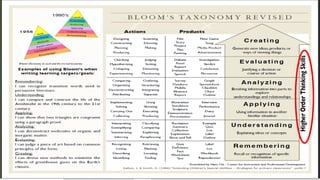
BLOOM’ S 1 9 5 6 TA XONOMY
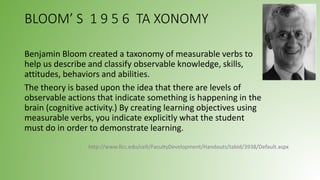
Benjamin Bloom created a taxonomy of measurable verbs to
help us describe and classify observable knowledge, skills,
attitudes, behaviors and abilities.
The theory is based upon the idea that there are levels of
observable actions that indicate something is happening in the
brain (cognitive activity.) By creating learning objectives using
measurable verbs, you indicate explicitly what the student
must do in order to demonstrate learning.
http://www.llcc.edu/celt/FacultyDevelopment/Handouts/tabid/3938/Default.aspx
Bloom’s Taxonomy
• Taxonomy of Cognitive Objectives
• Developed in 1950’s
• Means of expressing qualitatively different kinds of thinking
• Been adapted for classroom use as a planning tool
• Continues to be one of the most universally applied models
• Provides a way to organize thinking skills into six levels, from the most
basic to the more complex levels of thinking
Who are Anderson and Krathwohl?
• These gentlemen are the primary authors of the revisions to
what had become known as Bloom’s Taxonomy — an
ordering of cognitive skills.
• Both of these primary authors were in a perfect position to
orchestrate looking at the classic taxonomy critically.
• They called together a group of educational psychologists
and educators to help them with the revisions.
• Lorin Anderson was once a student of the famed Benjamin
Bloom, and
• David Krathwohl was one of Bloom’s partners as he devised
his classic cognitive taxonomy.
• Their combined efforts led to Bloom’s Taxonomy revised.
Change in Terms
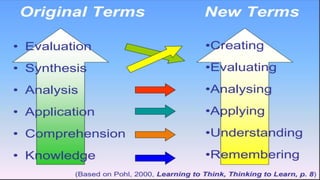
• The names of six major categories were changed from noun to verb forms.
• As the taxonomy reflects different forms of thinking and thinking is an
active process verbs were used rather than nouns.
• The subcategories of the six major categories were also replaced by verbs
and some subcategories were reorganized.
• The knowledge category was renamed. Knowledge is an outcome or
product of thinking not a form of thinking per se. Consequently, the word
knowledge was inappropriate to describe a category of thinking and was
replaced with the word remembering instead.
• Comprehension and synthesis were retitled to understanding and creating
respectively, in order to better reflect the nature of the thinking defined in
each category.
http://rite.ed.qut.edu.au/oz-teachernet/training/bloom.htm
l
Change in Emphasis
• The revision's primary focus was on the taxonomy in use. Essentially,
this means that the revised taxonomy is a more authentic tool for
curriculum planning, instructional delivery and assessment.
• The revision is aimed at a broader audience. Bloom’s Taxonomy was
traditionally viewed as a tool best applied in the earlier years of
schooling (i.e. primary and junior primary years). The revised taxonomy
is more universal and easily applicable at elementary, secondary and
even tertiary levels.
• The revision emphasizes explanation and description of
subcategories.
Why Use Bloom’s Taxonomy?
• Objectives (learning goals) are important to establish in a pedagogical
interchange so that teachers and students alike understand the
purpose of that interchange.
• Organizing objectives helps to clarify objectives for themselves and
for students.
• Having an organized set of objectives helps teachers to:
• “plan and deliver appropriate instruction”;
• “design valid assessment tasks and strategies”; and
• “ensure that instruction and assessment are aligned with the objectives.”
Educational Objectives:
A statement of a learning objective contains a verb (an action) and an
object (usually a noun).
• The verb generally refers to [actions associated with] the
intended cognitive process.
• The object generally describes the knowledge students are expected
to acquire or construct.
(Anderson and Krathwohl, 2001, pp. 4–5)
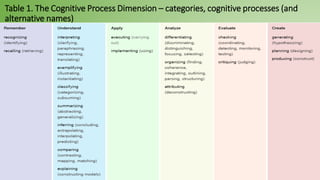
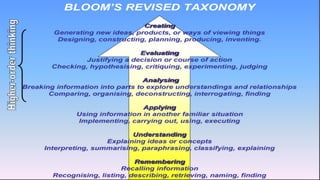
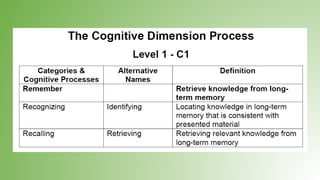
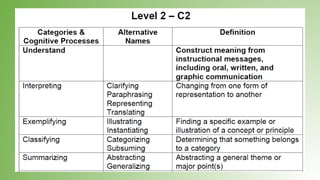
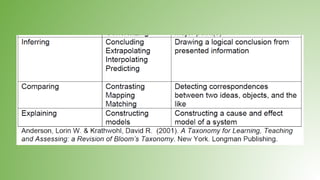
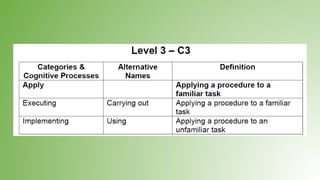
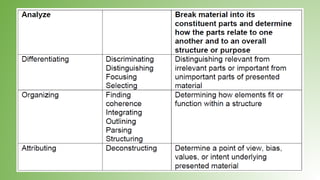
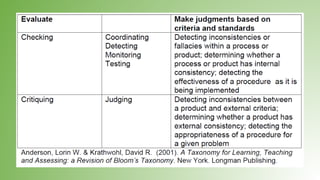
Cognitive Process Dimension
The cognitive process dimension represents a continuum of increasing
cognitive complexity—from remember to create.
Anderson and Krathwohl identify 19 specific cognitive processes that
further clarify the bounds of the six categories.
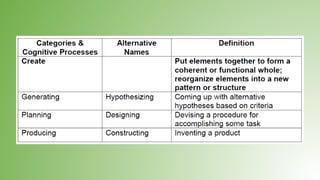
Table 1. The Cognitive Process Dimension – categories, cognitive processes (and
alternative names)
Knowledge Dimension
The knowledge dimension represents a range from concrete (factual)
to abstract (metacognitive).
Representation of the knowledge dimension as a number of discrete
steps can be a bit misleading.
For example, all procedural knowledge may not be more abstract than
all conceptual knowledge. And metacognitive knowledge is a special
case. In this model, “metacognitive knowledge is knowledge of [one’s
own] cognition and about oneself in relation to various subject matters
. . . ”
(Anderson and Krathwohl, 2001, p. 44).
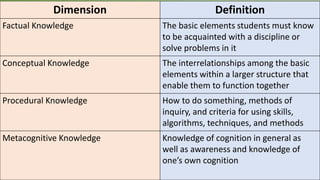
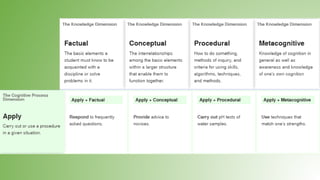
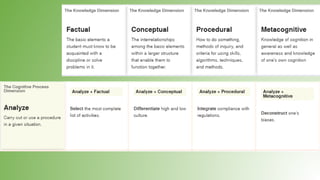
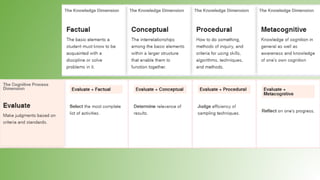
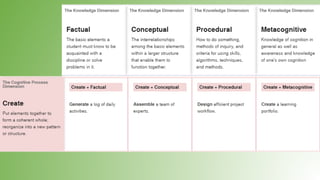
Dimension Definition
Factual Knowledge The basic elements students must know
to be acquainted with a discipline or
solve problems in it
Conceptual Knowledge The interrelationships among the basic
elements within a larger structure that
enable them to function together
Procedural Knowledge How to do something, methods of
inquiry, and criteria for using skills,
algorithms, techniques, and methods
Metacognitive Knowledge Knowledge of cognition in general as
well as awareness and knowledge of
one’s own cognition
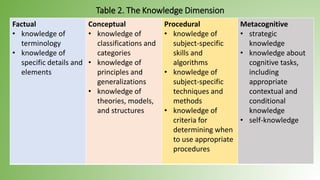
Table 2. The Knowledge Dimension
Factual
• knowledge of
terminology
• knowledge of
specific details and
elements
Conceptual
• knowledge of
classifications and
categories
• knowledge of
principles and
generalizations
• knowledge of
theories, models,
and structures
Procedural
• knowledge of
subject-specific
skills and
algorithms
• knowledge of
subject-specific
techniques and
methods
• knowledge of
criteria for
determining when
to use appropriate
procedures
Metacognitive
• strategic
knowledge
• knowledge about
cognitive tasks,
including
appropriate
contextual and
conditional
knowledge
• self-knowledge
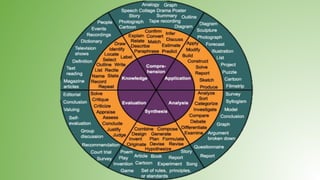
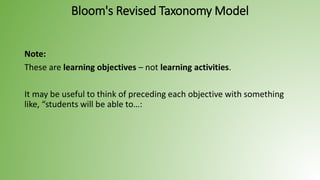
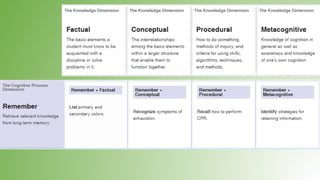
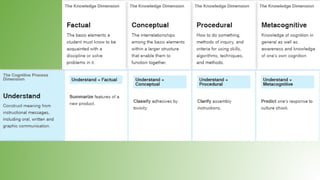
Bloom's Revised Taxonomy Model
Note:
These are learning objectives – not learning activities.
It may be useful to think of preceding each objective with something
like, “students will be able to…:
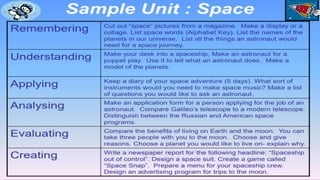
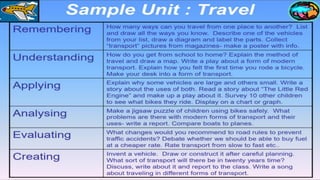
Detailed Potential Activities and
Products
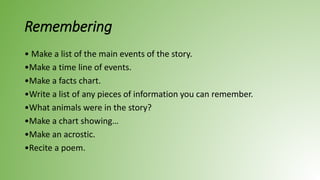
Remembering
• Make a list of the main events of the story.
•Make a time line of events.
•Make a facts chart.
•Write a list of any pieces of information you can remember.
•What animals were in the story?
•Make a chart showing…
•Make an acrostic.
•Recite a poem.
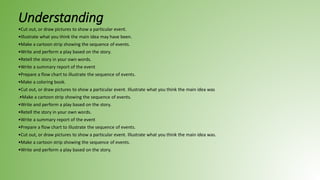
Understanding
•Cut out, or draw pictures to show a particular event.
•Illustrate what you think the main idea may have been.
•Make a cartoon strip showing the sequence of events.
•Write and perform a play based on the story.
•Retell the story in your own words.
•Write a summary report of the event
•Prepare a flow chart to illustrate the sequence of events.
•Make a coloring book.
•Cut out, or draw pictures to show a particular event. Illustrate what you think the main idea was
.•Make a cartoon strip showing the sequence of events.
•Write and perform a play based on the story.
•Retell the story in your own words.
•Write a summary report of the event
•Prepare a flow chart to illustrate the sequence of events.
•Cut out, or draw pictures to show a particular event. Illustrate what you think the main idea was.
•Make a cartoon strip showing the sequence of events.
•Write and perform a play based on the story.
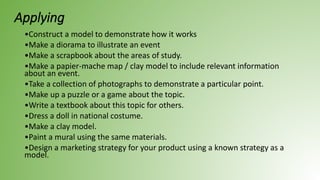
Applying
•Construct a model to demonstrate how it works
•Make a diorama to illustrate an event
•Make a scrapbook about the areas of study.
•Make a papier-mache map / clay model to include relevant information
about an event.
•Take a collection of photographs to demonstrate a particular point.
•Make up a puzzle or a game about the topic.
•Write a textbook about this topic for others.
•Dress a doll in national costume.
•Make a clay model.
•Paint a mural using the same materials.
•Design a marketing strategy for your product using a known strategy as a
model.
Analyzing
•Design a questionnaire to gather information.
•Write a commercial to sell a new product
•Make a flow chart to show the critical stages.
•Construct a graph to illustrate selected information.
•Make a family tree showing relationships.
•Devise a play about the study area.
•Write a biography of a person studied.
•Prepare a report about the area of study.
•Conduct an investigation to produce information to support a view.
•Review a work of art in terms of form, color and texture.
Evaluating
•Prepare a list of criteria to judge…
•Conduct a debate about an issue of special interest.
•Make a booklet about five rules you see as important. Convince
others.
•Form a panel to discuss views.
•Write a letter to. ..advising on changes needed.
•Write a half-yearly report.
•Prepare a case to present your view about...
Creating
•Invent a machine to do a specific task.
•Design a building to house your study.
•Create a new product. Give it a name and plan a marketing campaign.
•Write about your feelings in relation to...
•Write a TV show play, puppet show, role play, song or pantomime
about..
•Design a record, book or magazine cover for...
•Sell an idea
•Devise a way to...
•Make up a new language and use it in an example.
Assessment Questions
(Pohl, Learning to Think, Thinking to Learn, p. 12)
Remembering
•What happened after...?
•How many...?
•What is...?
•Who was it that...?
•Can you name ...?
•Find the meaning of…
•Describe what happened after…
•Who spoke to...?
•Which is true or false...?
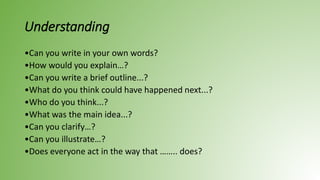
Understanding
•Can you write in your own words?
•How would you explain…?
•Can you write a brief outline...?
•What do you think could have happened next...?
•Who do you think...?
•What was the main idea...?
•Can you clarify…?
•Can you illustrate…?
•Does everyone act in the way that …….. does?
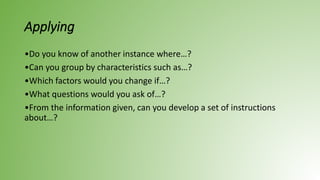
Applying
•Do you know of another instance where…?
•Can you group by characteristics such as…?
•Which factors would you change if…?
•What questions would you ask of…?
•From the information given, can you develop a set of instructions
about…?
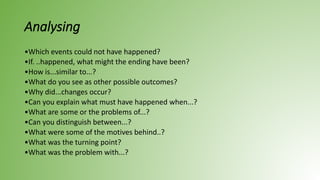
Analysing
•Which events could not have happened?
•If. ..happened, what might the ending have been?
•How is...similar to...?
•What do you see as other possible outcomes?
•Why did...changes occur?
•Can you explain what must have happened when...?
•What are some or the problems of...?
•Can you distinguish between...?
•What were some of the motives behind..?
•What was the turning point?
•What was the problem with...?
Evaluating
•Is there a better solution to...?
•Judge the value of... What do you think about...?
•Can you defend your position about...?
•Do you think...is a good or bad thing?
•How would you have handled...?
•What changes to.. would you recommend?
•Do you believe...? How would you feel if. ..?
•How effective are. ..?
•What are the consequences..?
•What influence will....have on our lives?
•What are the pros and cons of....?
•Why is ....of value?
•What are the alternatives?
•Who will gain & who will loose?
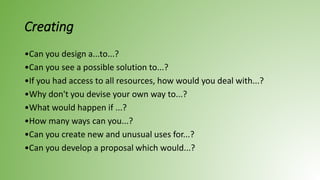
Creating
•Can you design a...to...?
•Can you see a possible solution to...?
•If you had access to all resources, how would you deal with...?
•Why don't you devise your own way to...?
•What would happen if ...?
•How many ways can you...?
•Can you create new and unusual uses for...?
•Can you develop a proposal which would...?
References:
http://www.kurwongbss.qld.edu.au/thinking/Bloom/blooms.html
http://coe.sdsu.edu/eet/articles/bloomrev/index.htm
http://rite.ed.qut.edu.au/oz-teachernet/training/bloom.html
http://www.llcc.edu/celt/FacultyDevelopment/Handouts/tabid/3938/D
efault.aspx
https://www.celt.iastate.edu/teaching/effective-teaching-
practices/revised-blooms-taxonomy/
https://thesecondprinciple.com/essential-teaching-skills/blooms-
taxonomy-revised/

Revised Bloom's Taxonomy

  • 1.
    Understanding the Revised Versionof Bloom’s Taxonomy Glyn B. Vertudazo
  • 2.
    BLOOM’ S 19 5 6 TA XONOMY Benjamin Bloom created a taxonomy of measurable verbs to help us describe and classify observable knowledge, skills, attitudes, behaviors and abilities. The theory is based upon the idea that there are levels of observable actions that indicate something is happening in the brain (cognitive activity.) By creating learning objectives using measurable verbs, you indicate explicitly what the student must do in order to demonstrate learning. http://www.llcc.edu/celt/FacultyDevelopment/Handouts/tabid/3938/Default.aspx
  • 3.
    Bloom’s Taxonomy • Taxonomyof Cognitive Objectives • Developed in 1950’s • Means of expressing qualitatively different kinds of thinking • Been adapted for classroom use as a planning tool • Continues to be one of the most universally applied models • Provides a way to organize thinking skills into six levels, from the most basic to the more complex levels of thinking
  • 5.
    Who are Andersonand Krathwohl? • These gentlemen are the primary authors of the revisions to what had become known as Bloom’s Taxonomy — an ordering of cognitive skills. • Both of these primary authors were in a perfect position to orchestrate looking at the classic taxonomy critically. • They called together a group of educational psychologists and educators to help them with the revisions. • Lorin Anderson was once a student of the famed Benjamin Bloom, and • David Krathwohl was one of Bloom’s partners as he devised his classic cognitive taxonomy. • Their combined efforts led to Bloom’s Taxonomy revised.
  • 6.
    Change in Terms •The names of six major categories were changed from noun to verb forms. • As the taxonomy reflects different forms of thinking and thinking is an active process verbs were used rather than nouns. • The subcategories of the six major categories were also replaced by verbs and some subcategories were reorganized. • The knowledge category was renamed. Knowledge is an outcome or product of thinking not a form of thinking per se. Consequently, the word knowledge was inappropriate to describe a category of thinking and was replaced with the word remembering instead. • Comprehension and synthesis were retitled to understanding and creating respectively, in order to better reflect the nature of the thinking defined in each category. http://rite.ed.qut.edu.au/oz-teachernet/training/bloom.htm l
  • 7.
    Change in Emphasis •The revision's primary focus was on the taxonomy in use. Essentially, this means that the revised taxonomy is a more authentic tool for curriculum planning, instructional delivery and assessment. • The revision is aimed at a broader audience. Bloom’s Taxonomy was traditionally viewed as a tool best applied in the earlier years of schooling (i.e. primary and junior primary years). The revised taxonomy is more universal and easily applicable at elementary, secondary and even tertiary levels. • The revision emphasizes explanation and description of subcategories.
  • 9.
    Why Use Bloom’sTaxonomy? • Objectives (learning goals) are important to establish in a pedagogical interchange so that teachers and students alike understand the purpose of that interchange. • Organizing objectives helps to clarify objectives for themselves and for students. • Having an organized set of objectives helps teachers to: • “plan and deliver appropriate instruction”; • “design valid assessment tasks and strategies”; and • “ensure that instruction and assessment are aligned with the objectives.”
  • 10.
    Educational Objectives: A statementof a learning objective contains a verb (an action) and an object (usually a noun). • The verb generally refers to [actions associated with] the intended cognitive process. • The object generally describes the knowledge students are expected to acquire or construct. (Anderson and Krathwohl, 2001, pp. 4–5)
  • 11.
    Cognitive Process Dimension Thecognitive process dimension represents a continuum of increasing cognitive complexity—from remember to create. Anderson and Krathwohl identify 19 specific cognitive processes that further clarify the bounds of the six categories.
  • 12.
    Table 1. TheCognitive Process Dimension – categories, cognitive processes (and alternative names)
  • 13.
    Knowledge Dimension The knowledgedimension represents a range from concrete (factual) to abstract (metacognitive). Representation of the knowledge dimension as a number of discrete steps can be a bit misleading. For example, all procedural knowledge may not be more abstract than all conceptual knowledge. And metacognitive knowledge is a special case. In this model, “metacognitive knowledge is knowledge of [one’s own] cognition and about oneself in relation to various subject matters . . . ” (Anderson and Krathwohl, 2001, p. 44).
  • 14.
    Dimension Definition Factual KnowledgeThe basic elements students must know to be acquainted with a discipline or solve problems in it Conceptual Knowledge The interrelationships among the basic elements within a larger structure that enable them to function together Procedural Knowledge How to do something, methods of inquiry, and criteria for using skills, algorithms, techniques, and methods Metacognitive Knowledge Knowledge of cognition in general as well as awareness and knowledge of one’s own cognition
  • 15.
    Table 2. TheKnowledge Dimension Factual • knowledge of terminology • knowledge of specific details and elements Conceptual • knowledge of classifications and categories • knowledge of principles and generalizations • knowledge of theories, models, and structures Procedural • knowledge of subject-specific skills and algorithms • knowledge of subject-specific techniques and methods • knowledge of criteria for determining when to use appropriate procedures Metacognitive • strategic knowledge • knowledge about cognitive tasks, including appropriate contextual and conditional knowledge • self-knowledge
  • 16.
    Bloom's Revised TaxonomyModel Note: These are learning objectives – not learning activities. It may be useful to think of preceding each objective with something like, “students will be able to…:
  • 32.
  • 33.
    Remembering • Make alist of the main events of the story. •Make a time line of events. •Make a facts chart. •Write a list of any pieces of information you can remember. •What animals were in the story? •Make a chart showing… •Make an acrostic. •Recite a poem.
  • 34.
    Understanding •Cut out, ordraw pictures to show a particular event. •Illustrate what you think the main idea may have been. •Make a cartoon strip showing the sequence of events. •Write and perform a play based on the story. •Retell the story in your own words. •Write a summary report of the event •Prepare a flow chart to illustrate the sequence of events. •Make a coloring book. •Cut out, or draw pictures to show a particular event. Illustrate what you think the main idea was .•Make a cartoon strip showing the sequence of events. •Write and perform a play based on the story. •Retell the story in your own words. •Write a summary report of the event •Prepare a flow chart to illustrate the sequence of events. •Cut out, or draw pictures to show a particular event. Illustrate what you think the main idea was. •Make a cartoon strip showing the sequence of events. •Write and perform a play based on the story.
  • 35.
    Applying •Construct a modelto demonstrate how it works •Make a diorama to illustrate an event •Make a scrapbook about the areas of study. •Make a papier-mache map / clay model to include relevant information about an event. •Take a collection of photographs to demonstrate a particular point. •Make up a puzzle or a game about the topic. •Write a textbook about this topic for others. •Dress a doll in national costume. •Make a clay model. •Paint a mural using the same materials. •Design a marketing strategy for your product using a known strategy as a model.
  • 36.
    Analyzing •Design a questionnaireto gather information. •Write a commercial to sell a new product •Make a flow chart to show the critical stages. •Construct a graph to illustrate selected information. •Make a family tree showing relationships. •Devise a play about the study area. •Write a biography of a person studied. •Prepare a report about the area of study. •Conduct an investigation to produce information to support a view. •Review a work of art in terms of form, color and texture.
  • 37.
    Evaluating •Prepare a listof criteria to judge… •Conduct a debate about an issue of special interest. •Make a booklet about five rules you see as important. Convince others. •Form a panel to discuss views. •Write a letter to. ..advising on changes needed. •Write a half-yearly report. •Prepare a case to present your view about...
  • 38.
    Creating •Invent a machineto do a specific task. •Design a building to house your study. •Create a new product. Give it a name and plan a marketing campaign. •Write about your feelings in relation to... •Write a TV show play, puppet show, role play, song or pantomime about.. •Design a record, book or magazine cover for... •Sell an idea •Devise a way to... •Make up a new language and use it in an example.
  • 39.
    Assessment Questions (Pohl, Learningto Think, Thinking to Learn, p. 12)
  • 40.
    Remembering •What happened after...? •Howmany...? •What is...? •Who was it that...? •Can you name ...? •Find the meaning of… •Describe what happened after… •Who spoke to...? •Which is true or false...?
  • 41.
    Understanding •Can you writein your own words? •How would you explain…? •Can you write a brief outline...? •What do you think could have happened next...? •Who do you think...? •What was the main idea...? •Can you clarify…? •Can you illustrate…? •Does everyone act in the way that …….. does?
  • 42.
    Applying •Do you knowof another instance where…? •Can you group by characteristics such as…? •Which factors would you change if…? •What questions would you ask of…? •From the information given, can you develop a set of instructions about…?
  • 43.
    Analysing •Which events couldnot have happened? •If. ..happened, what might the ending have been? •How is...similar to...? •What do you see as other possible outcomes? •Why did...changes occur? •Can you explain what must have happened when...? •What are some or the problems of...? •Can you distinguish between...? •What were some of the motives behind..? •What was the turning point? •What was the problem with...?
  • 44.
    Evaluating •Is there abetter solution to...? •Judge the value of... What do you think about...? •Can you defend your position about...? •Do you think...is a good or bad thing? •How would you have handled...? •What changes to.. would you recommend? •Do you believe...? How would you feel if. ..? •How effective are. ..? •What are the consequences..? •What influence will....have on our lives? •What are the pros and cons of....? •Why is ....of value? •What are the alternatives? •Who will gain & who will loose?
  • 45.
    Creating •Can you designa...to...? •Can you see a possible solution to...? •If you had access to all resources, how would you deal with...? •Why don't you devise your own way to...? •What would happen if ...? •How many ways can you...? •Can you create new and unusual uses for...? •Can you develop a proposal which would...?
  • 48.