Presentation on Home work
                By
Javed Iqbal PDT EDIP project funded
             by AUS aid


                                your name
Outline
•   Objectives
•   Definition of home work
•   Purpose of home work
•   Types of home work
•   Tips for assigning and checking home work
•   Benefits of home work
•   Draw backs of home work
•   Home work schedule
Objectives

• By the end of this session C.Ps could be able to:
• Reflect on their existing practice of assigning home work.
• Discuss types and purpose of home work.
• Identify different strategies for assigning and checking
  home work.
• Develop home work schedule.
Definition of home work
• Homework is the time students spend outside the classroom
   in assigned activities to practice, reinforce, or apply newly
   acquired skills and knowledge to learn necessary skills of
   independent study.
 (Jocelyn A. Butler, School Improvement Research Series
   (SIRS)).
• Home work is the out of class room task assign by the
   teacher to extend and elaborate class room task as well
   students learning.
• It is means of assessing how well students have learnt what
   you have needed to teach.
Purpose of home work
• Help students prepare for the next day.
• To review concepts to ensure that students are learning and
  extending academic performance.
• To complete the day's assignment.
• To assist and improve a student’s progress towards National
  Standards
• To extend or make more meaningful concepts introduced at
  school.
• To engage students in purposeful practice relevant to their
  learning.
Cont…..

•To reinforce lesson taught during class time..
•To teach students to manage their time.
• To help students to develop self-reliance to enable parents to
see their child’s progress and to show interest in their child’s
education.
•To strengthen the ties between home and school, particularly
when parents can help with assignments in some way.
•To develop effective study habits.
Types of home work
The five major homework types are as follows:
 Practice, which is designed to reinforce skills and
  information covered in class.
 Preparation which is given to prepare students to benefit
  from subsequent lessons.
 Extension which is provided to determine if a student can
  extend the concept or skill learned in class to a new
  situation.
• Creative which is designed to require students to integrate
  many skills and concepts in producing some project;
• Completion which is a continuation of assignments stared
  in class.
Tips for assigning home work
•   Based on clear specific goals and or purposes.
•   Do not assign as punishment.
•   Ensure that students understand the purpose .
•   Make sure that students succeed with their homework and 'new
    concepts' should not be included."
•   Regular homework can be assigned for the sake of learning.
•   Parents should be well aware of these homework expectations.
•   Quality, not quantity should be stressed.
•   Consider the students’ ability.
•   Consider the time for homework, it should be reasonable.
•   Homework assignments should always be checked.
Tips for checking home work
 Peer checking
 Involve parents in the process of assigning homework
   Prepare an answer sheet and paste it in the classroom where students
    could assess their assignments OR check a few notebooks and share
    them with other students so that students can compare and correct
    their mistakes
Develop homework timetable for your class and set specific
 time for checking homework
Check homework in your free periods
Spare extra time after school time or before school time
Benefits of home work
Immediate achievement and learning
• Better retention of factual knowledge
• Increased understanding
• Better critical thinking, concept formation, information
  processing
• Curriculum enrichment
Long – term academic benefits
• Learning during leisure time
• Improved attitude towards schools
• Better study habits and skills
Drawbacks of home work

•   Loss of interest in academic material
•   Physical and emotional fatigue
•   Denial of access to leisure time and community activities
•   Parental interference
•   Pressure to complete assignment and perform well.
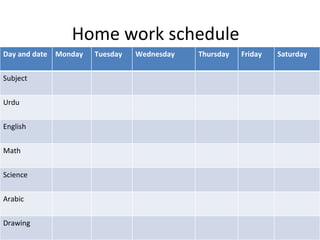
Home work schedule
Day and date   Monday   Tuesday   Wednesday   Thursday   Friday   Saturday


Subject


Urdu


English


Math


Science


Arabic


Drawing
Thank You

Floor is open for questions, suggestions and feedback.

Presentation on home work

  • 1.
    Presentation on Homework By Javed Iqbal PDT EDIP project funded by AUS aid your name
  • 2.
    Outline • Objectives • Definition of home work • Purpose of home work • Types of home work • Tips for assigning and checking home work • Benefits of home work • Draw backs of home work • Home work schedule
  • 3.
    Objectives • By theend of this session C.Ps could be able to: • Reflect on their existing practice of assigning home work. • Discuss types and purpose of home work. • Identify different strategies for assigning and checking home work. • Develop home work schedule.
  • 4.
    Definition of homework • Homework is the time students spend outside the classroom in assigned activities to practice, reinforce, or apply newly acquired skills and knowledge to learn necessary skills of independent study. (Jocelyn A. Butler, School Improvement Research Series (SIRS)). • Home work is the out of class room task assign by the teacher to extend and elaborate class room task as well students learning. • It is means of assessing how well students have learnt what you have needed to teach.
  • 5.
    Purpose of homework • Help students prepare for the next day. • To review concepts to ensure that students are learning and extending academic performance. • To complete the day's assignment. • To assist and improve a student’s progress towards National Standards • To extend or make more meaningful concepts introduced at school. • To engage students in purposeful practice relevant to their learning.
  • 6.
    Cont….. •To reinforce lessontaught during class time.. •To teach students to manage their time. • To help students to develop self-reliance to enable parents to see their child’s progress and to show interest in their child’s education. •To strengthen the ties between home and school, particularly when parents can help with assignments in some way. •To develop effective study habits.
  • 7.
    Types of homework The five major homework types are as follows:  Practice, which is designed to reinforce skills and information covered in class.  Preparation which is given to prepare students to benefit from subsequent lessons.  Extension which is provided to determine if a student can extend the concept or skill learned in class to a new situation. • Creative which is designed to require students to integrate many skills and concepts in producing some project; • Completion which is a continuation of assignments stared in class.
  • 8.
    Tips for assigninghome work • Based on clear specific goals and or purposes. • Do not assign as punishment. • Ensure that students understand the purpose . • Make sure that students succeed with their homework and 'new concepts' should not be included." • Regular homework can be assigned for the sake of learning. • Parents should be well aware of these homework expectations. • Quality, not quantity should be stressed. • Consider the students’ ability. • Consider the time for homework, it should be reasonable. • Homework assignments should always be checked.
  • 9.
    Tips for checkinghome work  Peer checking  Involve parents in the process of assigning homework  Prepare an answer sheet and paste it in the classroom where students could assess their assignments OR check a few notebooks and share them with other students so that students can compare and correct their mistakes Develop homework timetable for your class and set specific time for checking homework Check homework in your free periods Spare extra time after school time or before school time
  • 10.
    Benefits of homework Immediate achievement and learning • Better retention of factual knowledge • Increased understanding • Better critical thinking, concept formation, information processing • Curriculum enrichment Long – term academic benefits • Learning during leisure time • Improved attitude towards schools • Better study habits and skills
  • 11.
    Drawbacks of homework • Loss of interest in academic material • Physical and emotional fatigue • Denial of access to leisure time and community activities • Parental interference • Pressure to complete assignment and perform well.
  • 12.
    Home work schedule Dayand date Monday Tuesday Wednesday Thursday Friday Saturday Subject Urdu English Math Science Arabic Drawing
  • 13.
    Thank You Floor isopen for questions, suggestions and feedback.