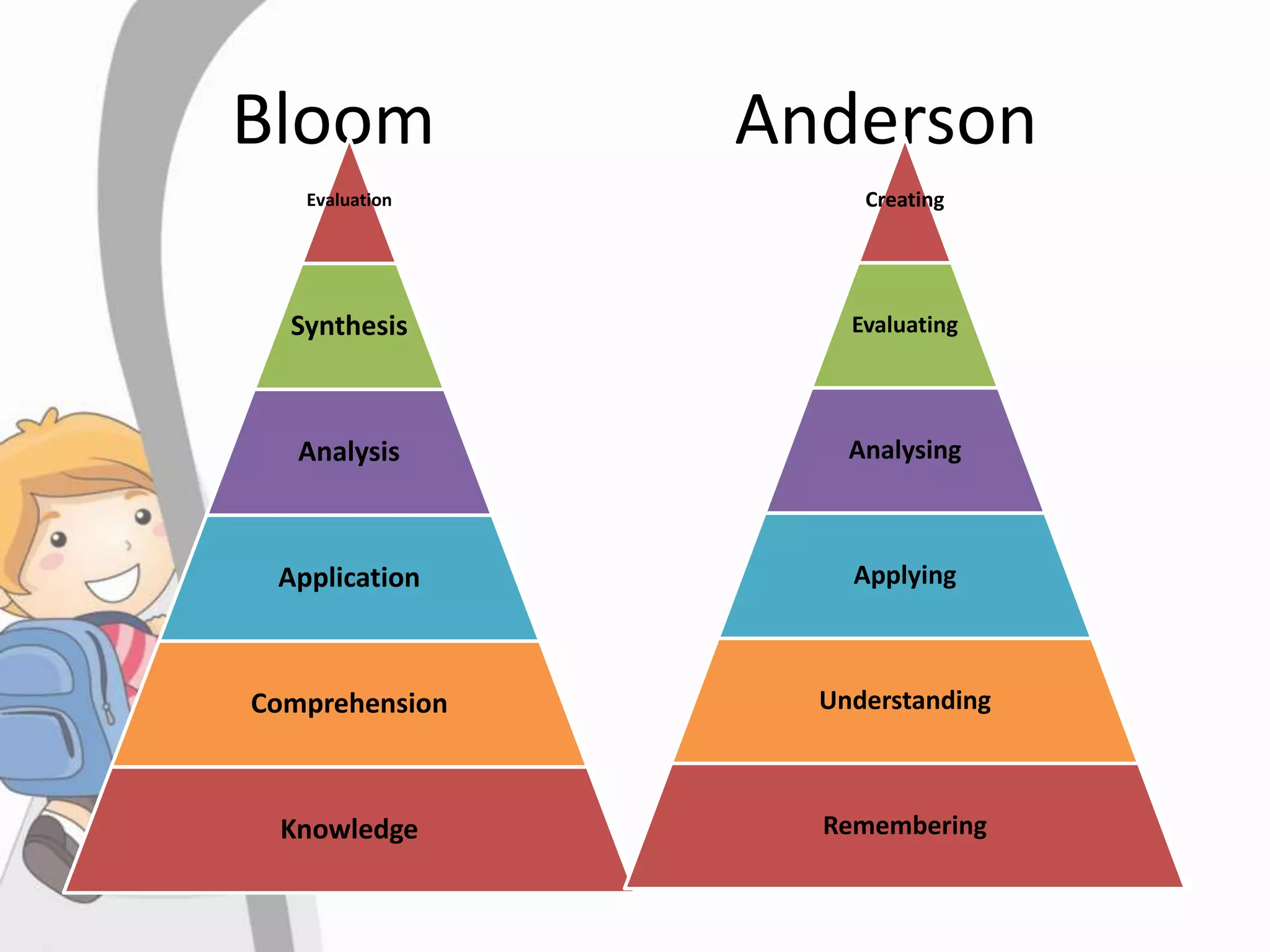
The document discusses two different educational taxonomies: Bloom's Taxonomy of Cognitive Domain from 1956 and Anderson's revision from the 1990s. Bloom's taxonomy arranged cognitive objectives from lowest to highest as knowledge, comprehension, application, analysis, synthesis, and evaluation. Anderson revised this taxonomy, changing the names to verbs and switching the order of the last two levels to be remembering, understanding, applying, analyzing, evaluating, and creating. The document provides examples of verbs associated with each level of both taxonomies.
Educational taxonomy divided into cognitive, affective, and psychomotor domains. Focus on Bloom's and Anderson's taxonomies, detailing knowledge levels and key verbs for learning objectives.
TAXONOMY OF OBJECTIVES
EducationalTaxonomy is classified into three domains
namely: (1) cognitive, (2) affective, and (3) psychomotor
or behavioral.
Bloom’s Taxonomy Of Cognitive Domain (1956)
-Benjamin Bloom led his group in coming up with
the list of instructional objectives in the cognitive domain.
Arranged from lowest to the highest level, they are as
follows:
2.
Knowledge or recall– knowledge of terminology and
conventions, trends and sequences, classifications and
categories, criteria and methodologies, principles, theories,
and structures.
Verbs: define, memorize, record, list, name, write,
identify, distinguish
Comprehension – relate to translation, interpretation, and
extrapolation.
Verbs: restate, discuss, describe, explain, express,
illustrate, report, recognize, review, locate
Application – requires the student to solve or explain a
problem or applying what he/she have learned to other
situation.
3.
Verbs: apply, demonstrate,sketch, translate,
interpret, employ, play, news, dramatize, practice,
operate
Analysis- objectives relate to breaking a whole into parts
Verbs: analyze, compare, differentiate, appraise,
distinguish, criticize, test, calculate, discriminate
Synthesis- putting parts together in a new form such as a
unique communication, a plan of operation, and a set of
abstract relations.
Verbs: create, hypothesize, invent, think of a way,
plan, formulate, construct, assemble, propose, design
4.
Evaluation- judging interms of internal evidence or logical
consistency and external evidence or consistency with
facts developed elsewhere
Verbs: judge, appraise, evaluate, measure, defend,
assess, indicate, score, select, rate
Anderson’s taxonomy of cognitive domain.
(1990’s) Lorin Anderson together with a team of
cognitive psychologists revisited Bloom’s taxonomy.
• Remembering: Learner’sability to recall information
• Understanding: Learner’s ability to understand
information
• Applying: Learner’s ability to use information in a new
way
• Analyzing: Learner’s ability to break down information
into its essential parts
• Evaluating: Learner’s ability to judge or criticize
information
• Creating: Learner’s ability to create something new
from different elements of information
7.
Anderson and KrathwohlUpdates
1. Category names were revised from nouns to verbs.
2. The last two stages of Bloom’s Taxonomy were
switched so that evaluation (evaluating) comes
before synthesis (creating).





![BLOOM'S TAXONOMY B.ed Bio [Saqlain Raza].pptx](https://cdn.slidesharecdn.com/ss_thumbnails/bloomstaxonomysaqlainraza-240331093751-6ba6c72e-thumbnail.jpg?width=640&height=640&fit=bounds)


