Classification of
educational objectives
Dr. Shilna V.
• Aims and objectives
• Blooms Taxonomy
• Revised Blooms taxonomy
• Advantages of revised Blooms taxonomy
• Higher order and lower order questions
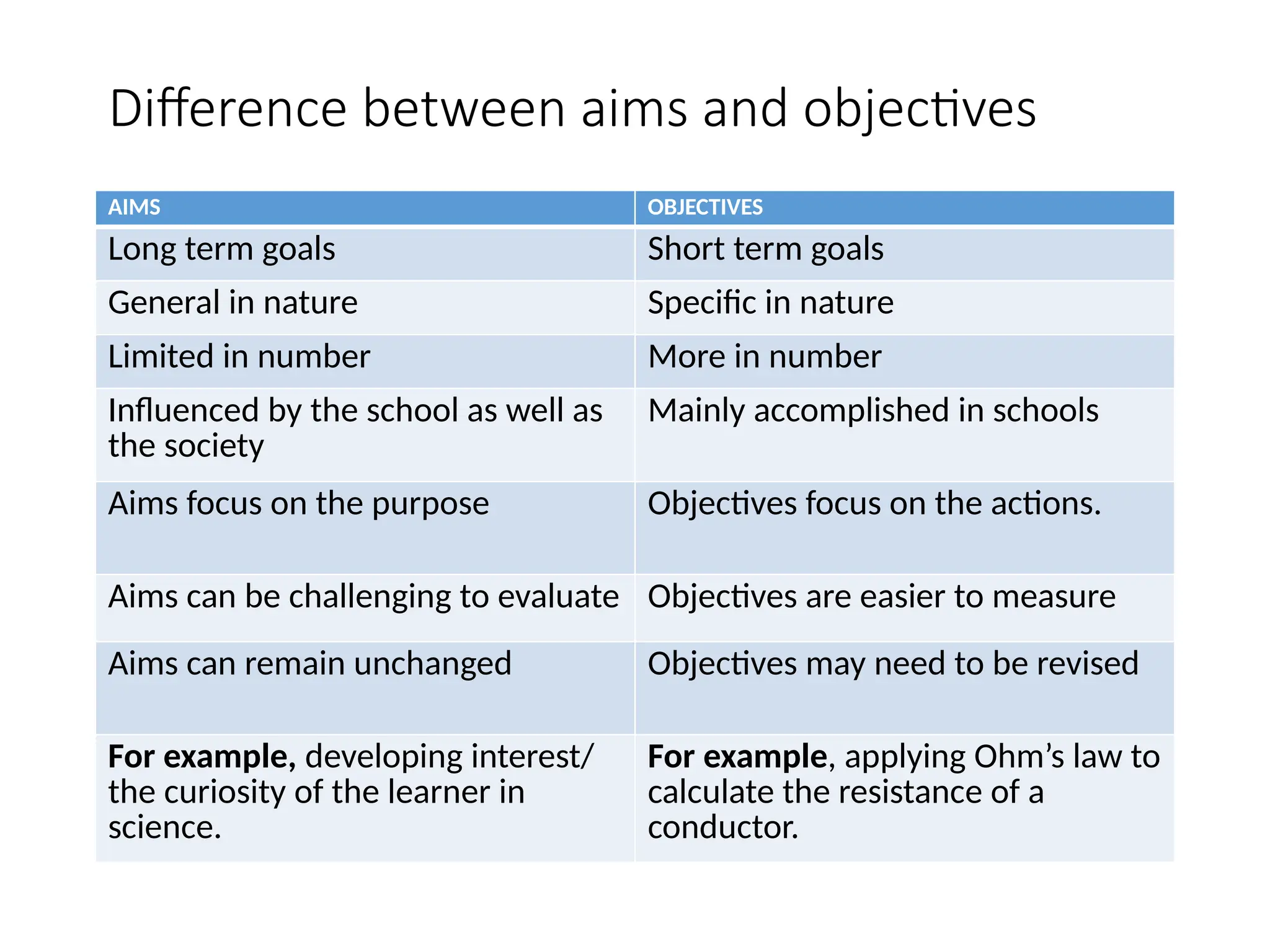
Difference between aims and objectives
AIMS OBJECTIVES
Long term goals Short term goals
General in nature Specific in nature
Limited in number More in number
Influenced by the school as well as
the society
Mainly accomplished in schools
Aims focus on the purpose Objectives focus on the actions.
Aims can be challenging to evaluate Objectives are easier to measure
Aims can remain unchanged Objectives may need to be revised
For example, developing interest/
the curiosity of the learner in
science.
For example, applying Ohm’s law to
calculate the resistance of a
conductor.
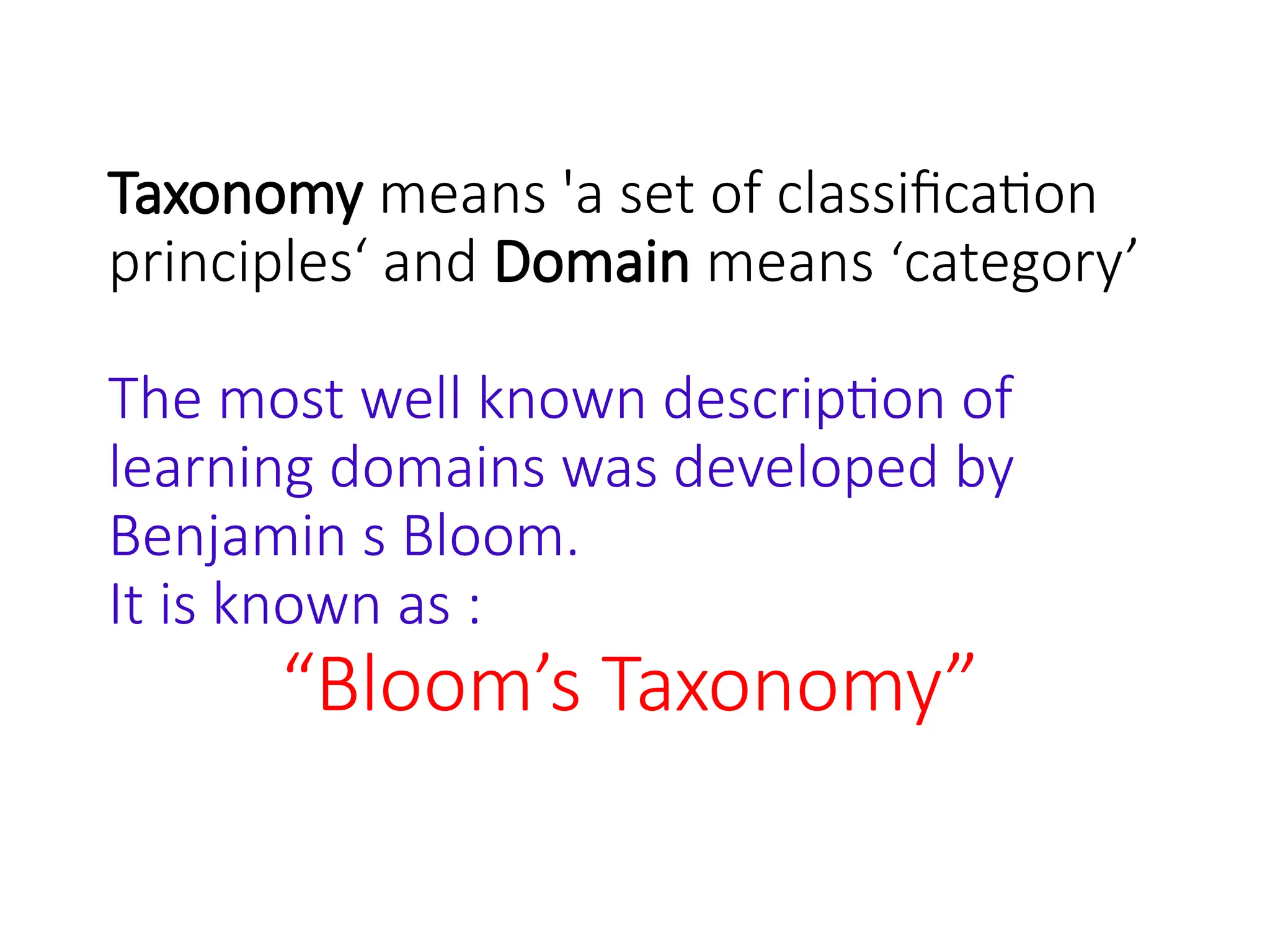
Taxonomy means 'a set of classification
principles‘ and Domain means ‘category’
The most well known description of
learning domains was developed by
Benjamin s Bloom.
It is known as :
“Bloom’s Taxonomy”
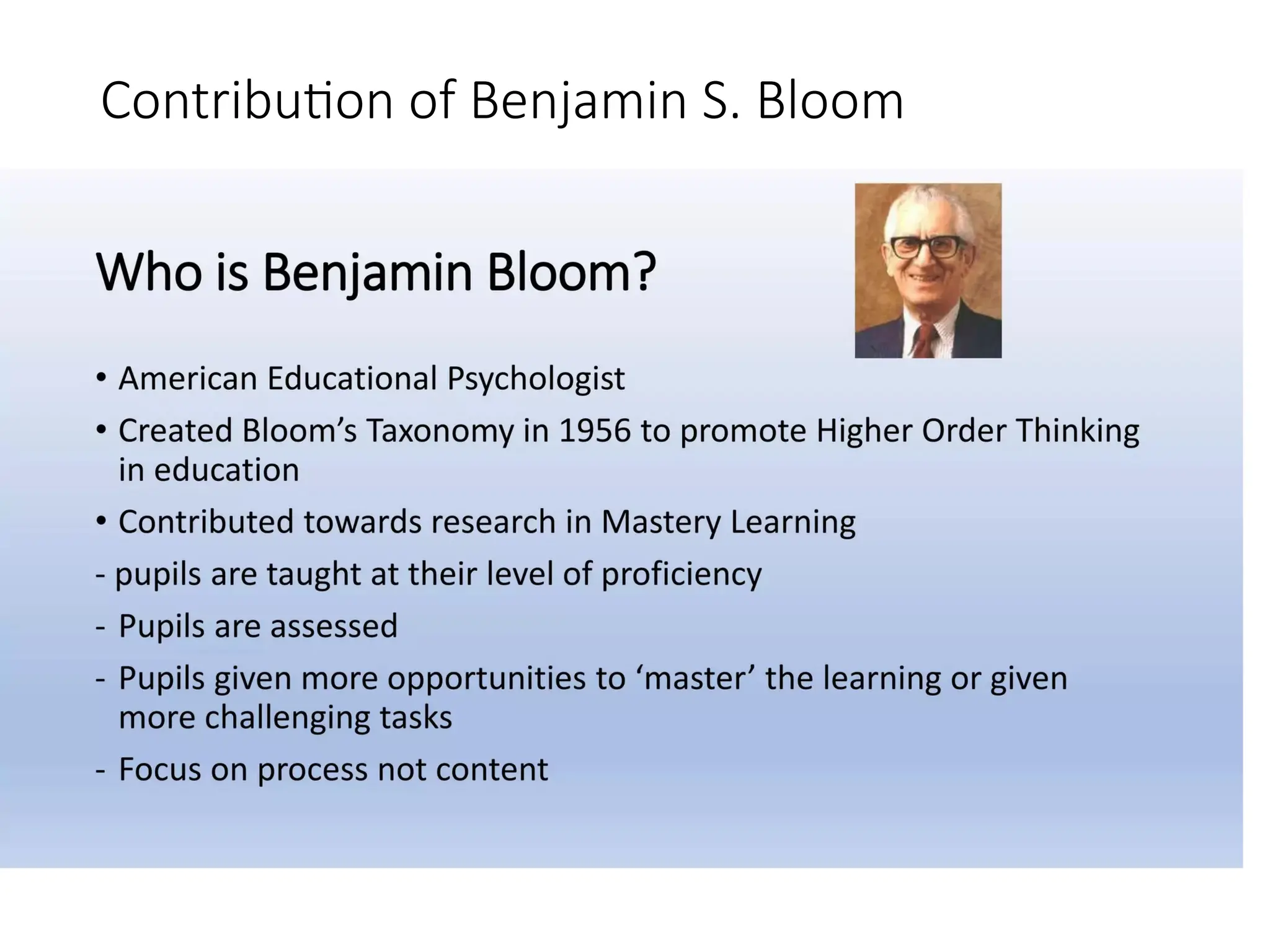
Contribution of Benjamin S. Bloom
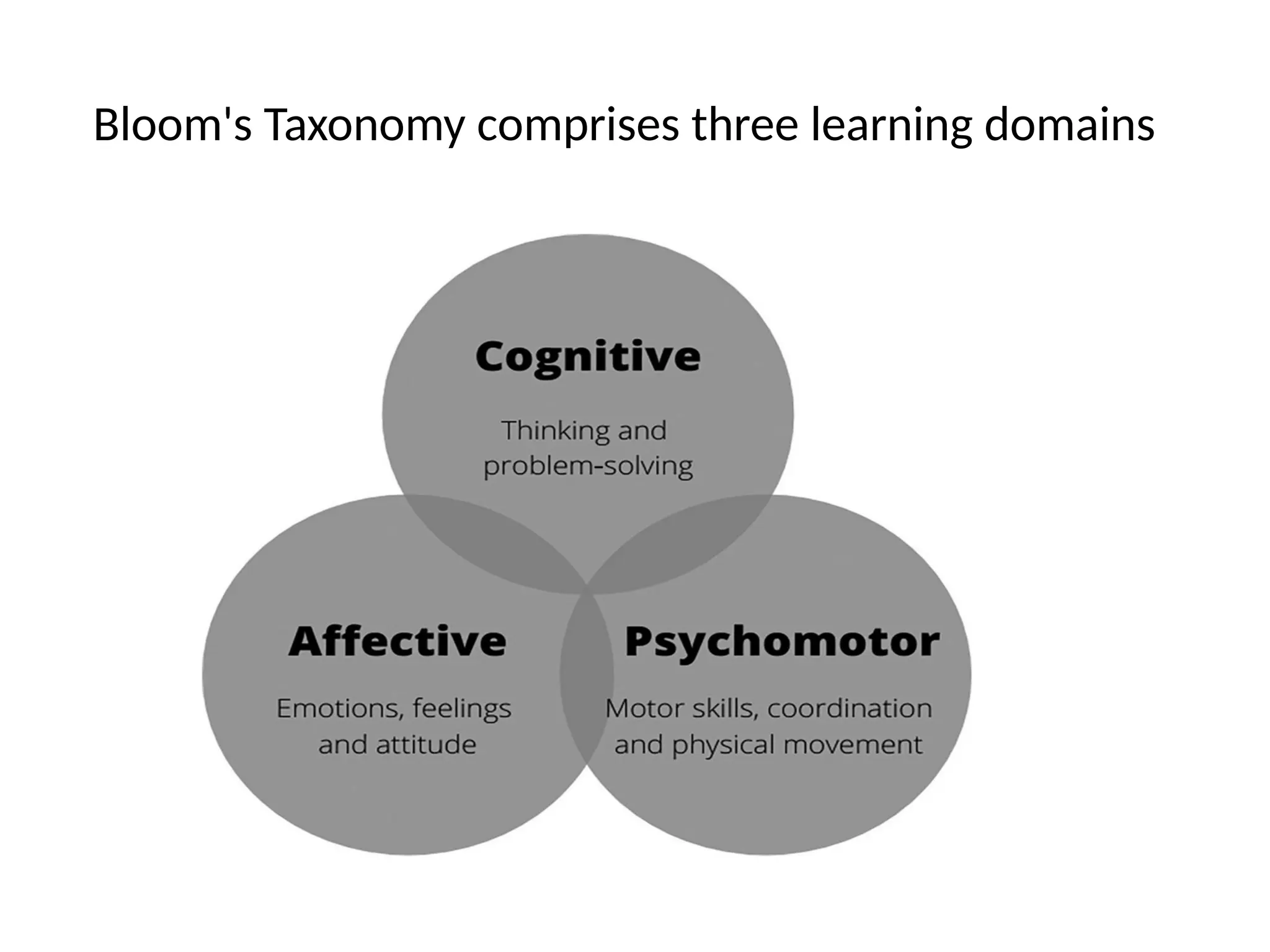
Bloom's Taxonomy comprises three learning domains
COGNITIVE DOMAIN
Involves knowledge and the development of intellectual skills
recall or recognition of specific facts, procedural patterns, and
concepts that serve in the development of intellectual abilities and
skills
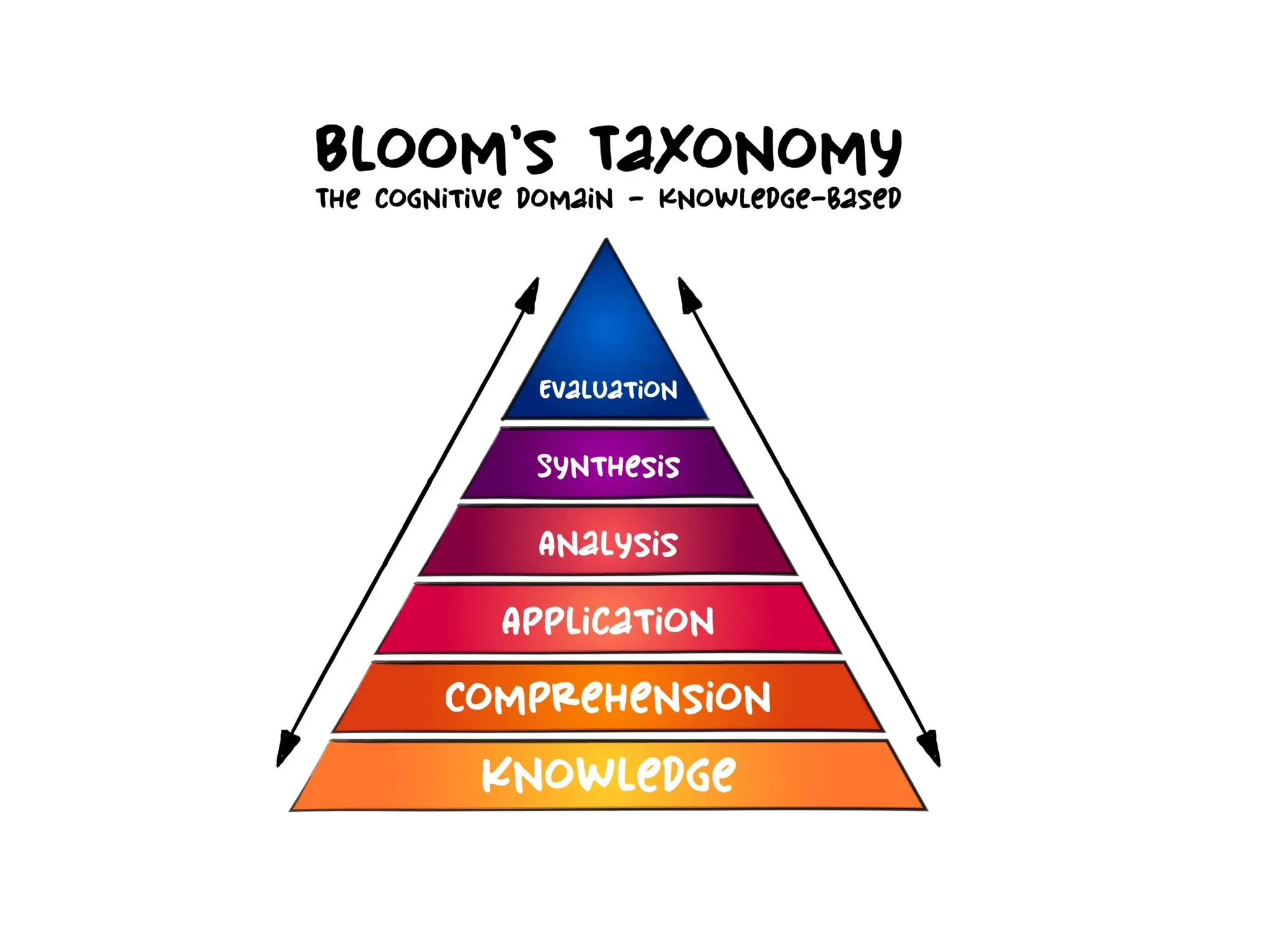
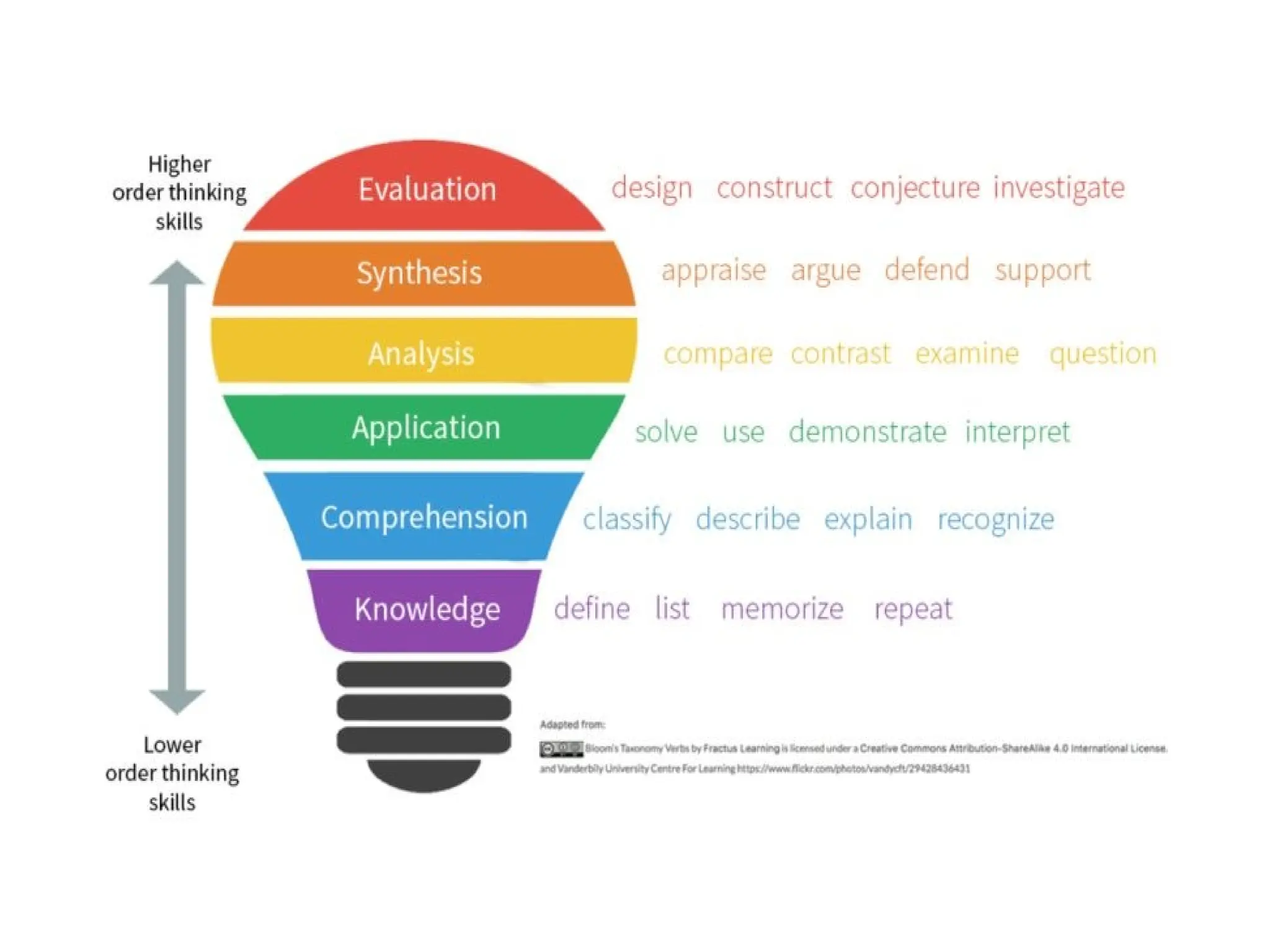
six major categories: Knowledge, Comprehension, Application,
Analysis, Synthesis, and Evaluation These categories are starting
from the simplest behavior to the most complex in hierarchical
order
The categories can be thought of as degrees of difficulties. That is,
the first ones must normally be mastered before the next ones can
take place
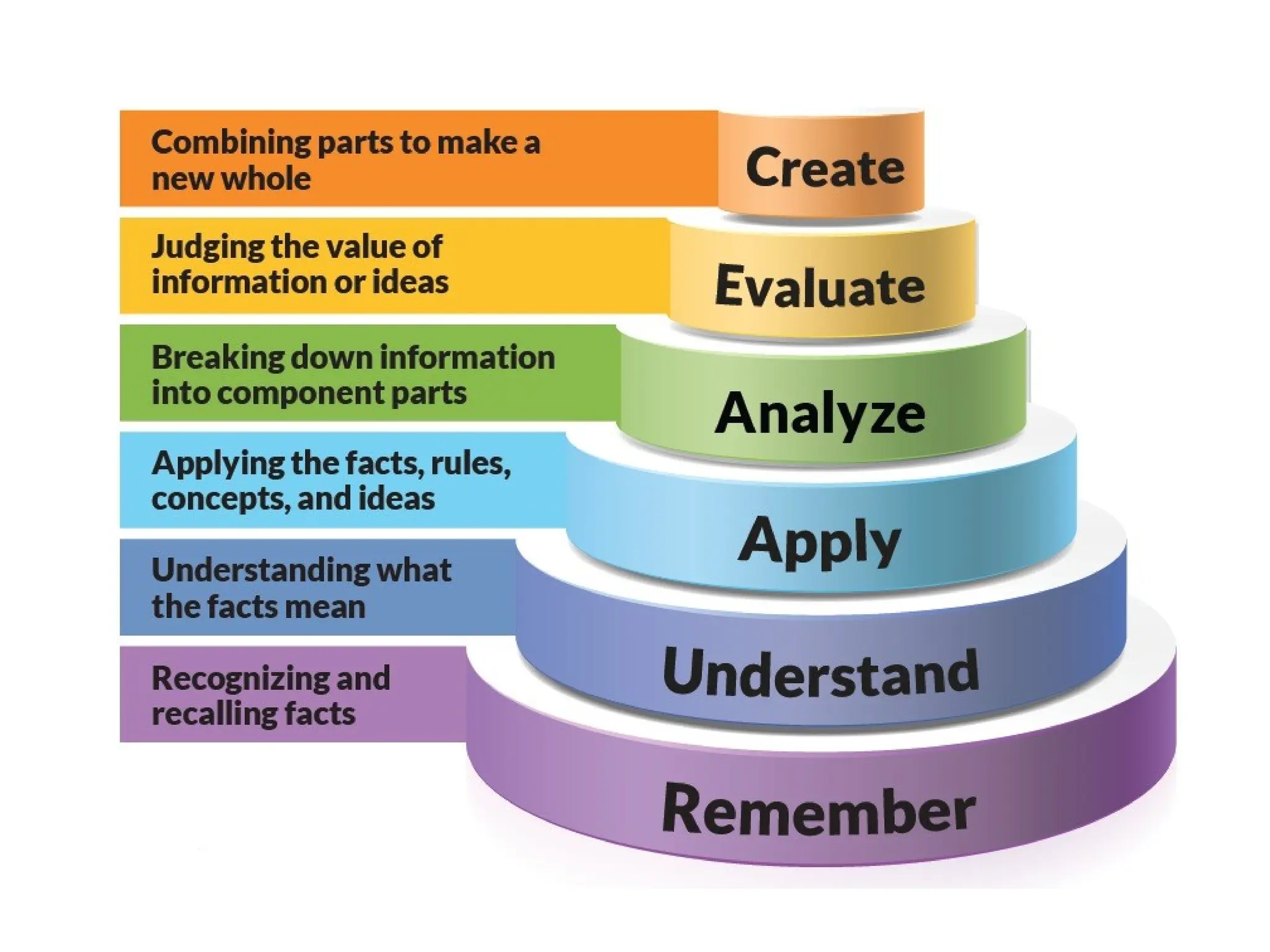
the first three elements—Knowledge, Comprehension,
and Application—represent lower-order thinking skills (LOTS),
while Analysis, Synthesis, and Evaluation are considered higher-
order thinking skills (HOTS). For this reason, the taxonomy is often
graphically represented as a pyramid with higher-order cognition at
the top.
AFFECTIVE DOMAIN
• David Krathwohl (1964)
• This domain focuses on the attitudes, values, interests, and
appreciation of learners
• It includes the manner in which individuals deal with things
emotionally, such as feelings, values, appreciation, enthusiasms,
motivations, and attitudes
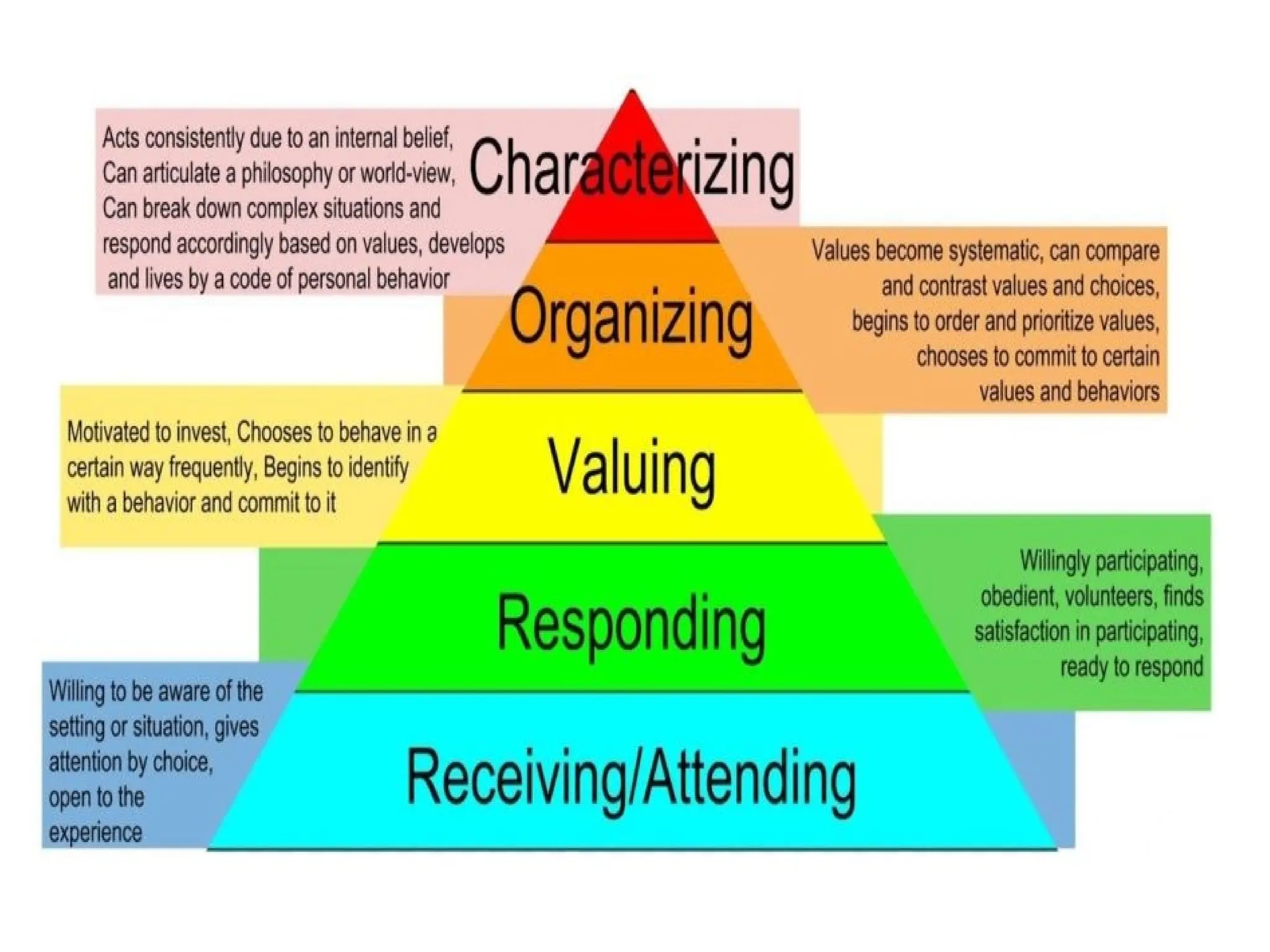
• forms a hierarchical structure and is arranged from simpler feelings
to those that are more complex
• The hierarchical structure is based on the principle of internalization.
Internalization refers to the process whereby a person’s affect toward
an object passes from a general awareness level to a point where the
affect is ‘internalized’ and consistently guides or controls the person’s
behavior
• Therefore, with the movement to more complexity, individuals
become more involved, committed, and internally motivated.
(1) Receiving :
• Awareness, willingness to hear, selected attention.
• Listen to others with respect. Listen for and remember the name of
newly introduced people.
• Key Words: acknowledge, asks, attentive, courteous, dutiful, follows,
gives, listens, understands
(2) Responding :
• Participates in class discussions. Gives a presentation. Questions new
ideals, concepts, models, etc. in order to fully understand them. Know
the safety rules and practice them
• Key Words: answers, assists, aids, complies, conforms, discusses, greets,
helps, labels, performs, presents, tells
( (3) Valuing :
Demonstrates belief in the democratic process. Is sensitive towards
individual and cultural differences (value diversity). Shows the ability to
solve problems. Proposes a plan to social improvement and follows
through with commitment. Informs management on matters that one
feels strongly about
Key Words: appreciates, cherish, treasure, demonstrates, initiates, invites,
joins, justifies, proposes, respect, shares
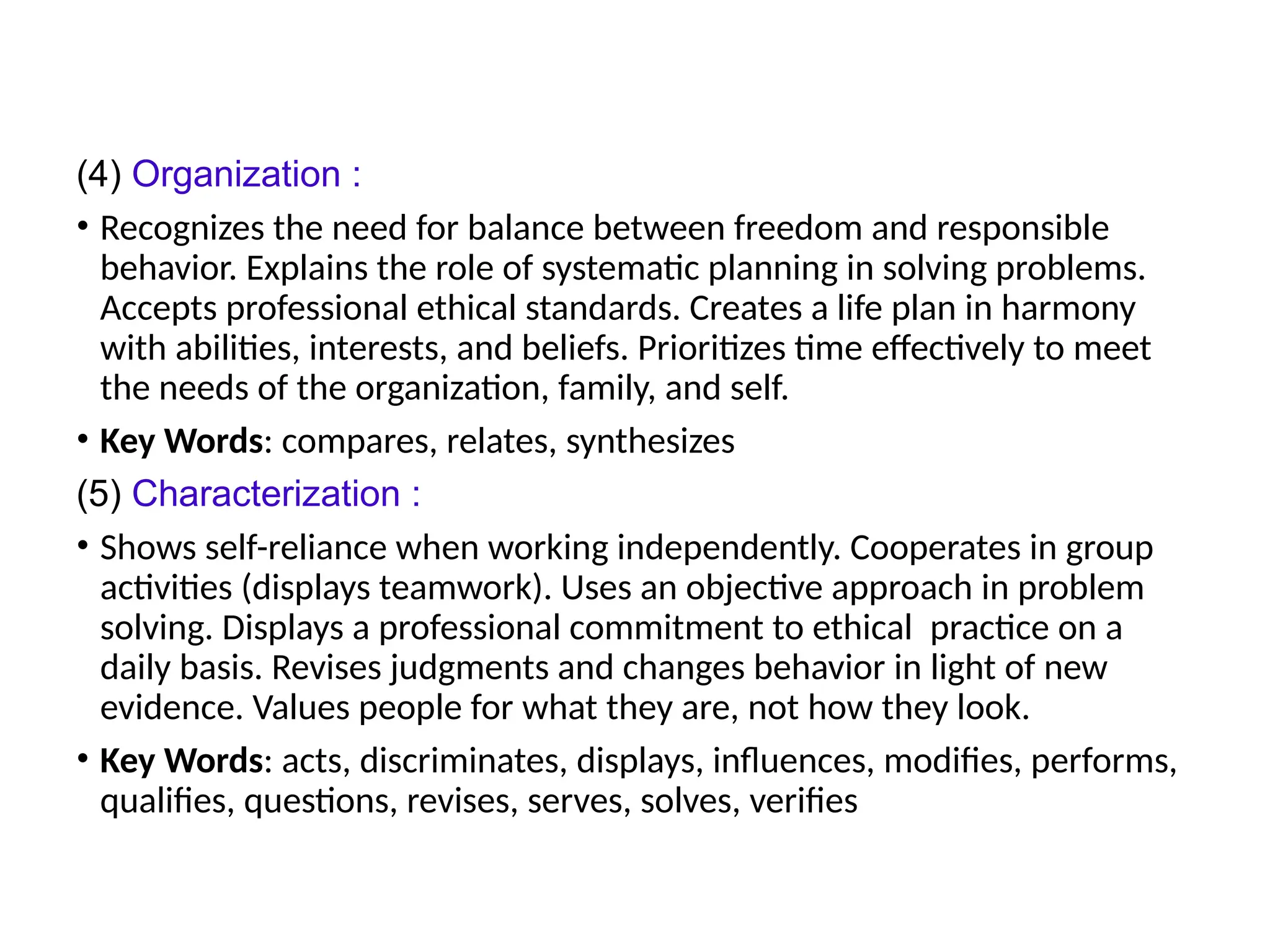
(4) Organization :
• Recognizes the need for balance between freedom and responsible
behavior. Explains the role of systematic planning in solving problems.
Accepts professional ethical standards. Creates a life plan in harmony
with abilities, interests, and beliefs. Prioritizes time effectively to meet
the needs of the organization, family, and self.
• Key Words: compares, relates, synthesizes
(5) Characterization :
• Shows self-reliance when working independently. Cooperates in group
activities (displays teamwork). Uses an objective approach in problem
solving. Displays a professional commitment to ethical practice on a
daily basis. Revises judgments and changes behavior in light of new
evidence. Values people for what they are, not how they look.
• Key Words: acts, discriminates, displays, influences, modifies, performs,
qualifies, questions, revises, serves, solves, verifies
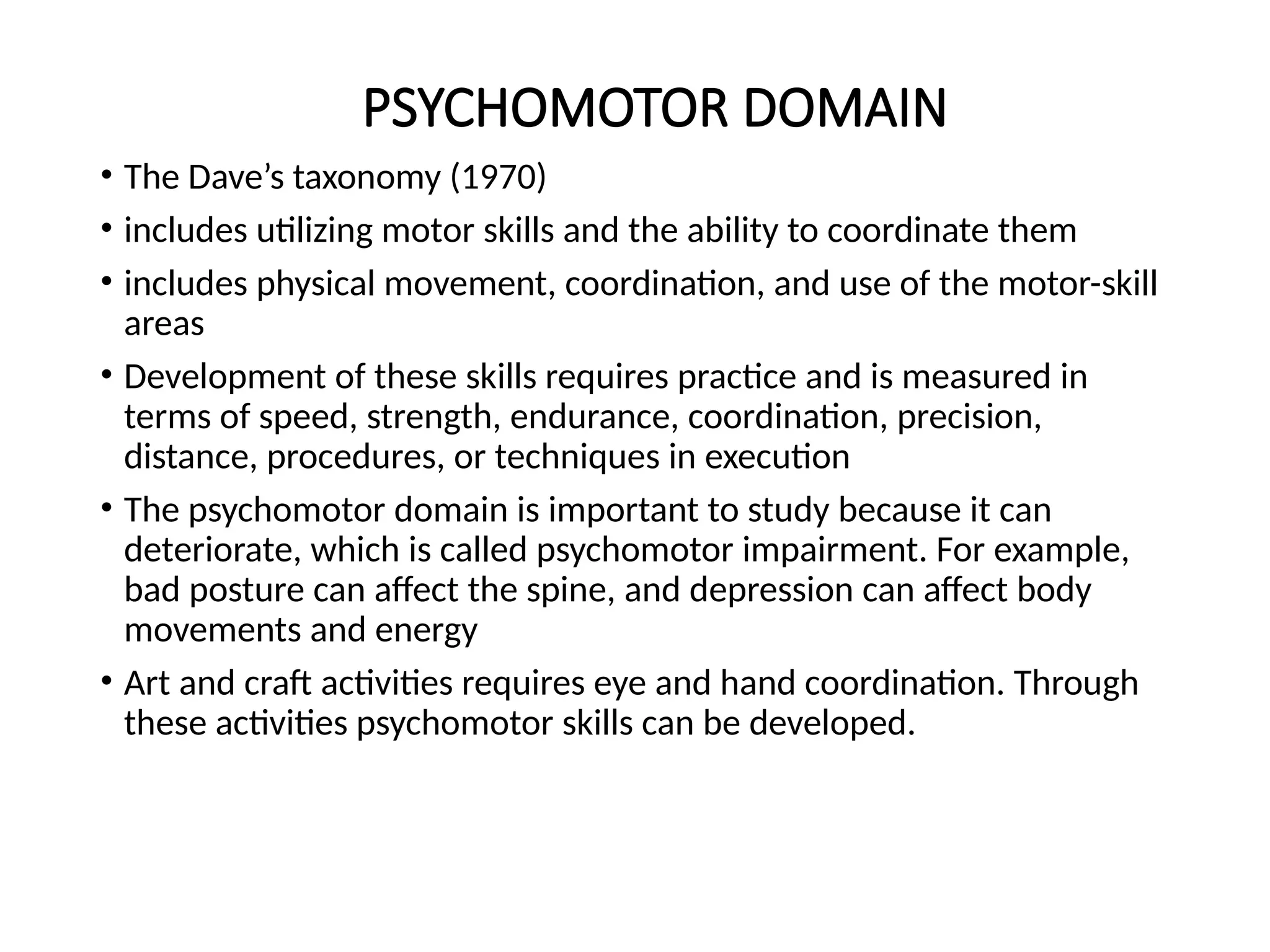
PSYCHOMOTOR DOMAIN
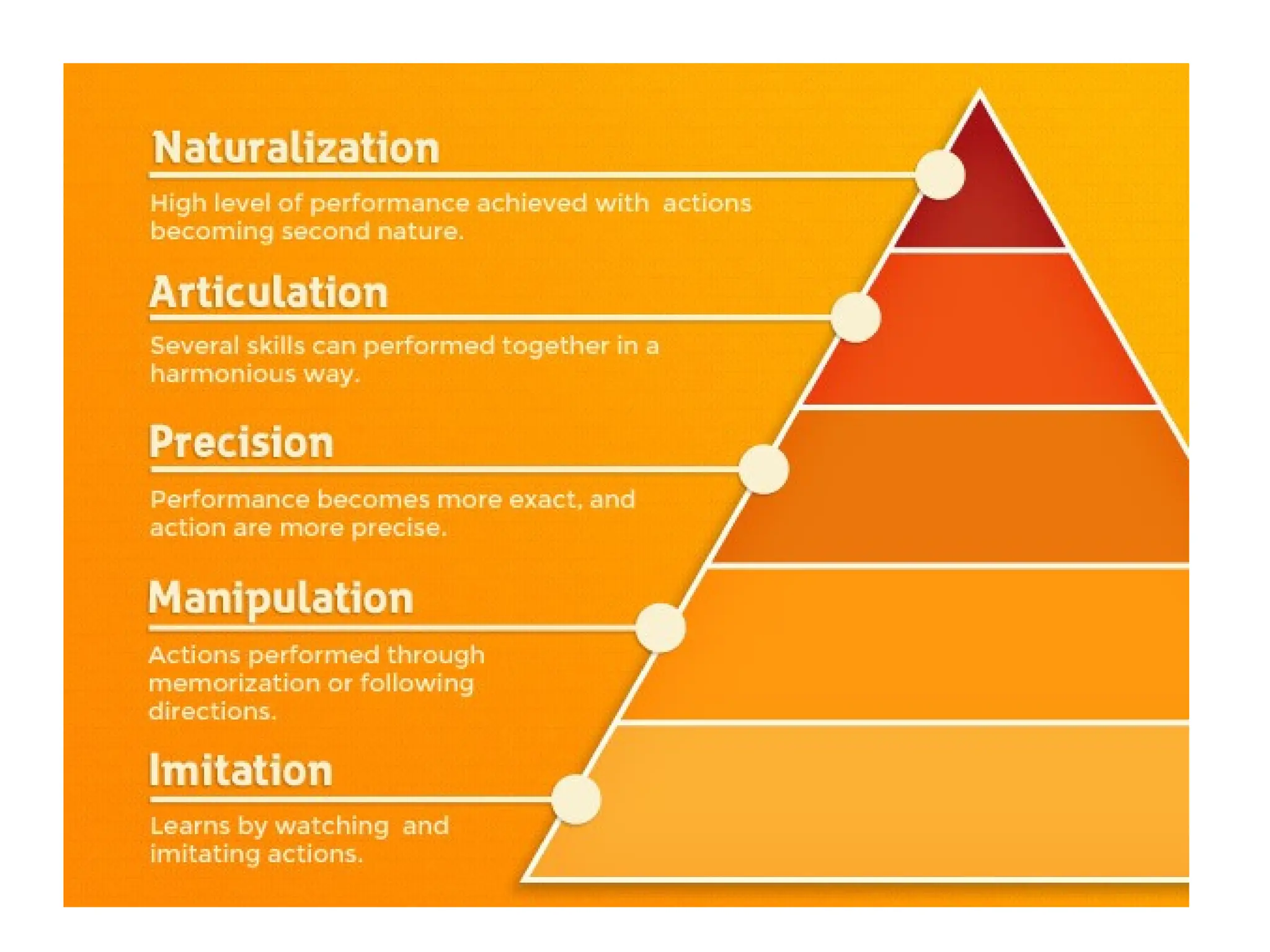
• The Dave’s taxonomy (1970)
• includes utilizing motor skills and the ability to coordinate them
• includes physical movement, coordination, and use of the motor-skill
areas
• Development of these skills requires practice and is measured in
terms of speed, strength, endurance, coordination, precision,
distance, procedures, or techniques in execution
• The psychomotor domain is important to study because it can
deteriorate, which is called psychomotor impairment. For example,
bad posture can affect the spine, and depression can affect body
movements and energy
• Art and craft activities requires eye and hand coordination. Through
these activities psychomotor skills can be developed.
Why use Bloom’s taxonomy?
•Write and revise learning
objectives
•Plan curriculum
•Identifies simple to most
difficult skills
•Effectively align objectives
to assessment techniques
and standards
•Incorporate knowledge to
be learned (knowledge
dimension) and cognitive
process to learn
•Facilitate questioning (oral
language = important role
within framework)
Revised Bloom’s
Taxonomy
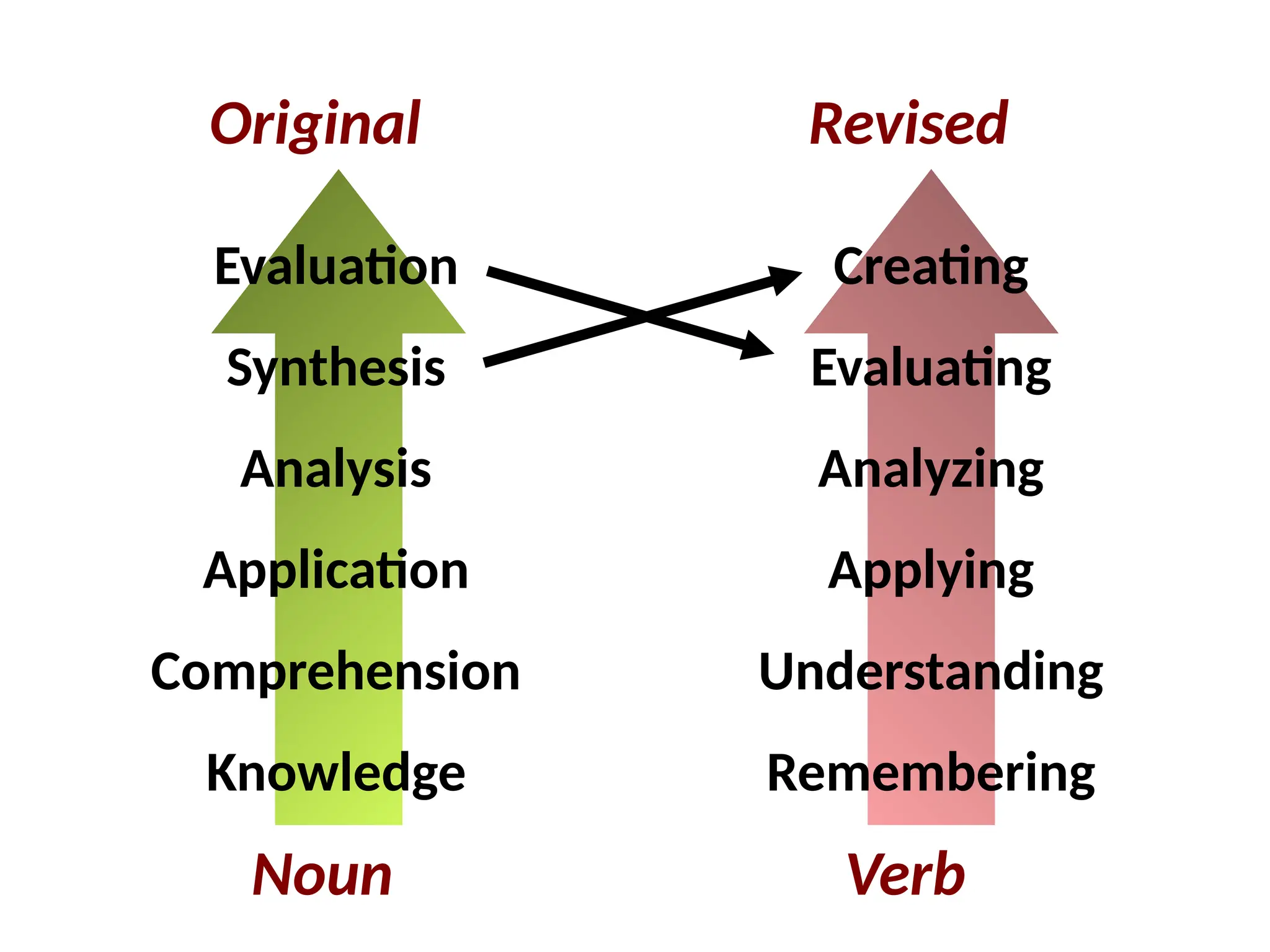
Evaluation
Synthesis
Analysis
Application
Comprehension
Knowledge
Creating
Evaluating
Analyzing
Applying
Understanding
Remembering
Original Revised
Noun Verb
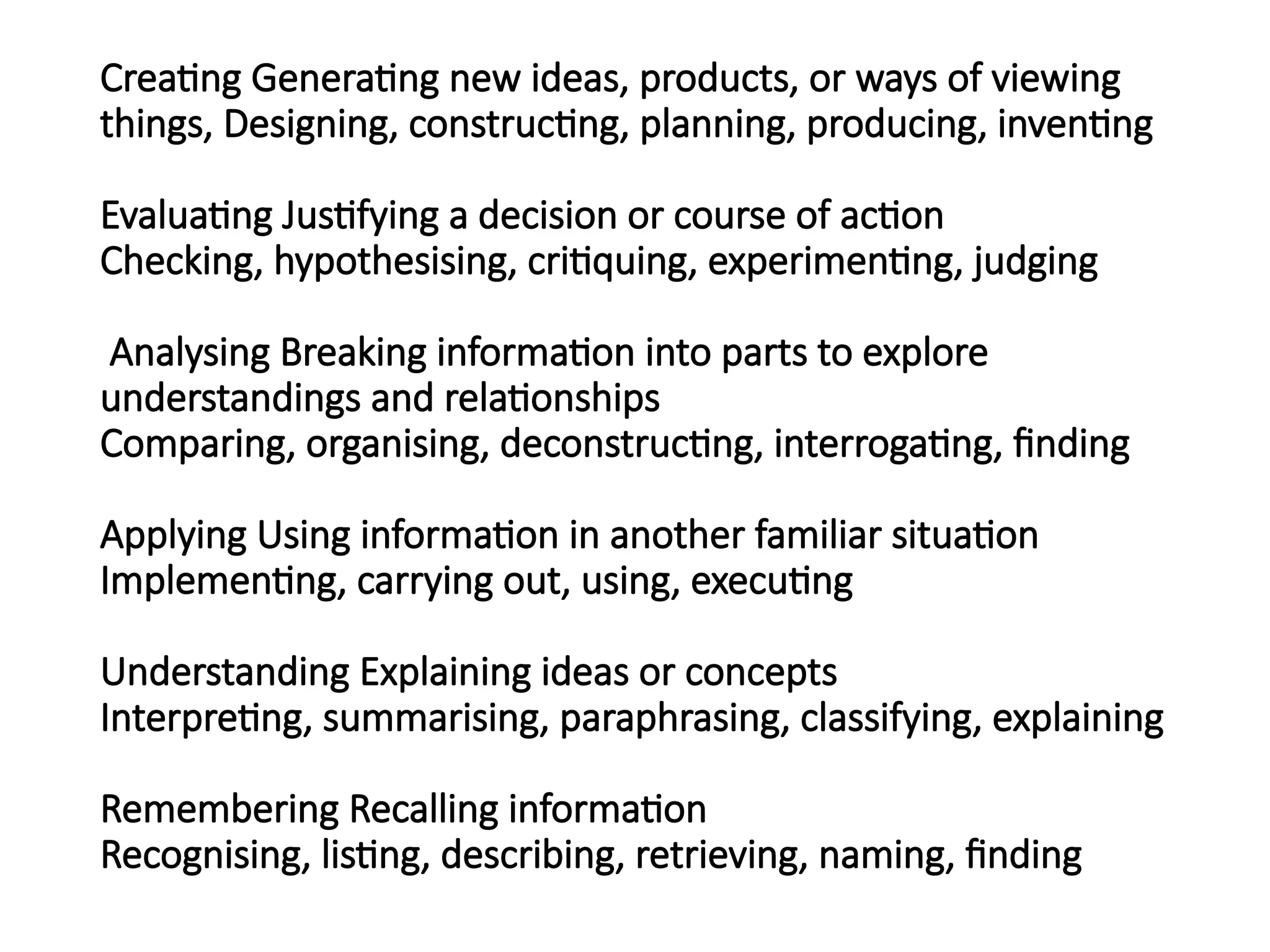
Creating Generating new ideas, products, or ways of viewing
things, Designing, constructing, planning, producing, inventing
Evaluating Justifying a decision or course of action
Checking, hypothesising, critiquing, experimenting, judging
Analysing Breaking information into parts to explore
understandings and relationships
Comparing, organising, deconstructing, interrogating, finding
Applying Using information in another familiar situation
Implementing, carrying out, using, executing
Understanding Explaining ideas or concepts
Interpreting, summarising, paraphrasing, classifying, explaining
Remembering Recalling information
Recognising, listing, describing, retrieving, naming, finding
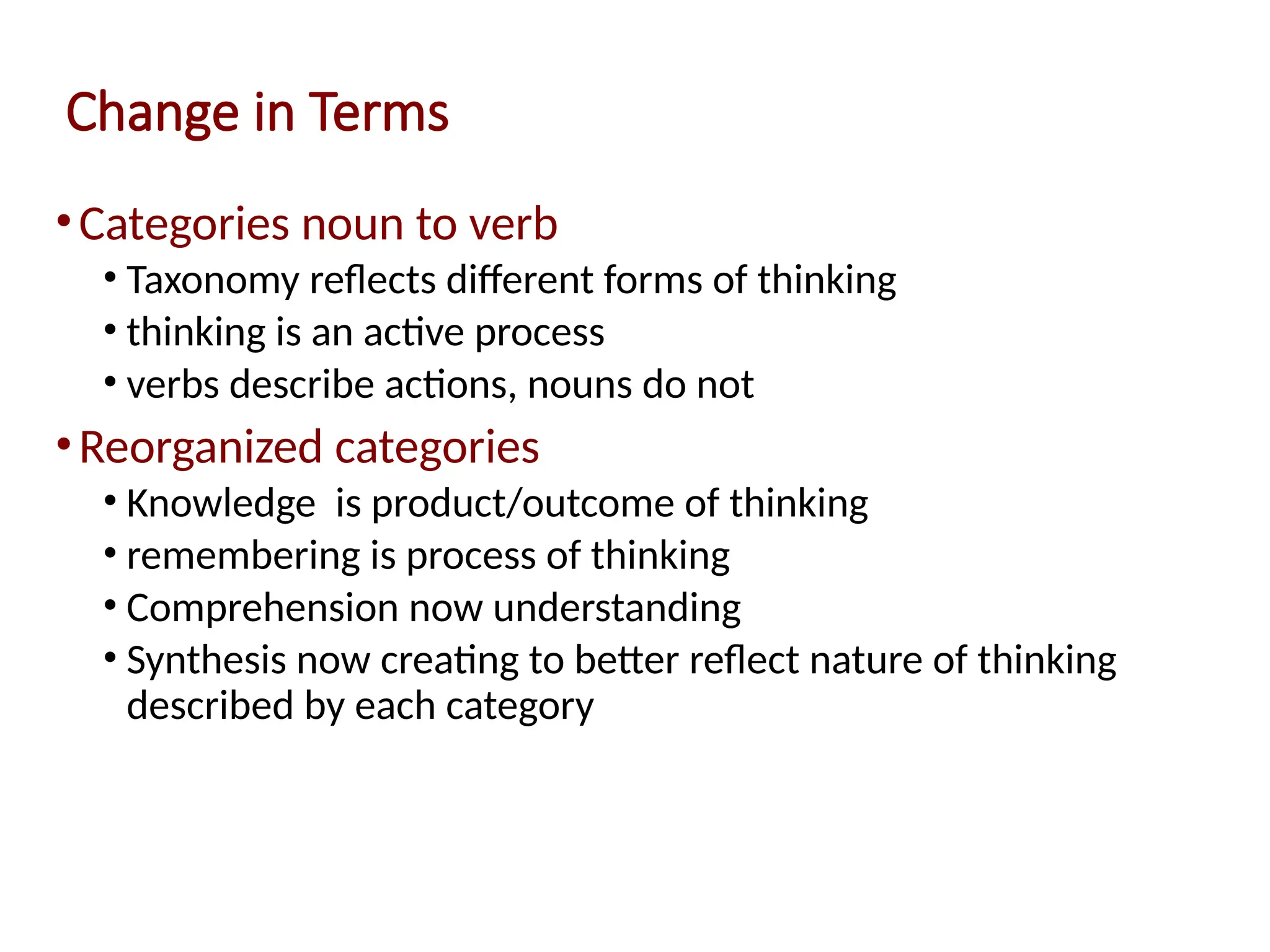
Change in Terms
•Categories noun to verb
• Taxonomy reflects different forms of thinking
• thinking is an active process
• verbs describe actions, nouns do not
•Reorganized categories
• Knowledge is product/outcome of thinking
• remembering is process of thinking
• Comprehension now understanding
• Synthesis now creating to better reflect nature of thinking
described by each category
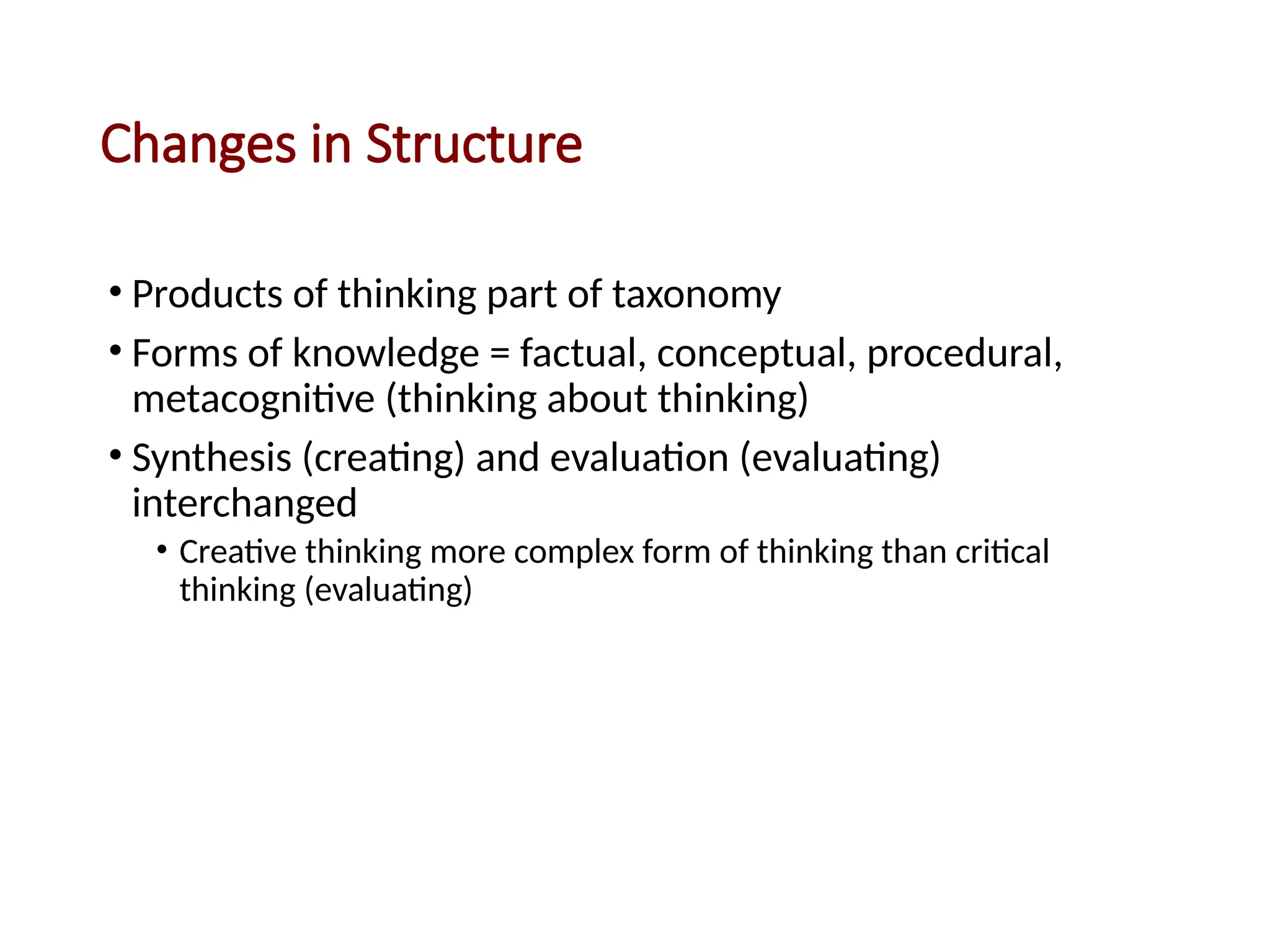
Changes in Structure
• Products of thinking part of taxonomy
• Forms of knowledge = factual, conceptual, procedural,
metacognitive (thinking about thinking)
• Synthesis (creating) and evaluation (evaluating)
interchanged
• Creative thinking more complex form of thinking than critical
thinking (evaluating)
Changes in Emphasis
• USE: More authentic tool for curriculum planning,
instructional delivery and assessment
• Aimed at broader audience
• Easily applied to all levels of education
• Revision emphasizes explanation and description of
subcategories
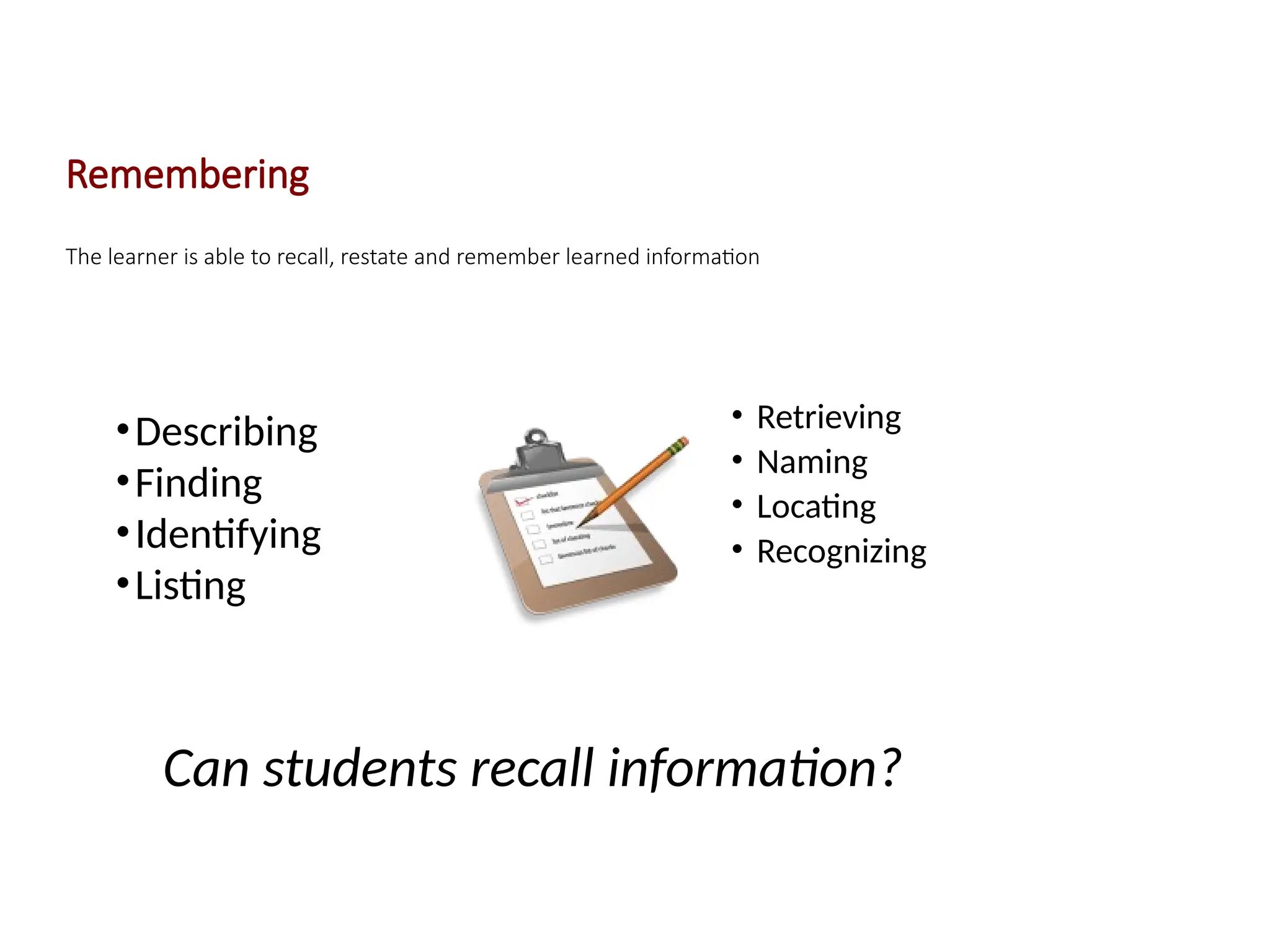
Remembering
The learner is able to recall, restate and remember learned information
•Describing
•Finding
•Identifying
•Listing
• Retrieving
• Naming
• Locating
• Recognizing
Can students recall information?
Understanding
Student grasps meaning of information
by interpreting and translating
what has been learned
• Classifying
• Comparing
• Exemplifying
• Explaining
• Inferring
• Interpreting
• Paraphrasing
• Summarizing
Can students explain ideas or concepts?
Applying
Student makes use of information in a context different from
the one in which it was learned
• Implementing
• Carrying out
• Using
• Executing
Can students use the information in
another familiar situation?
c =
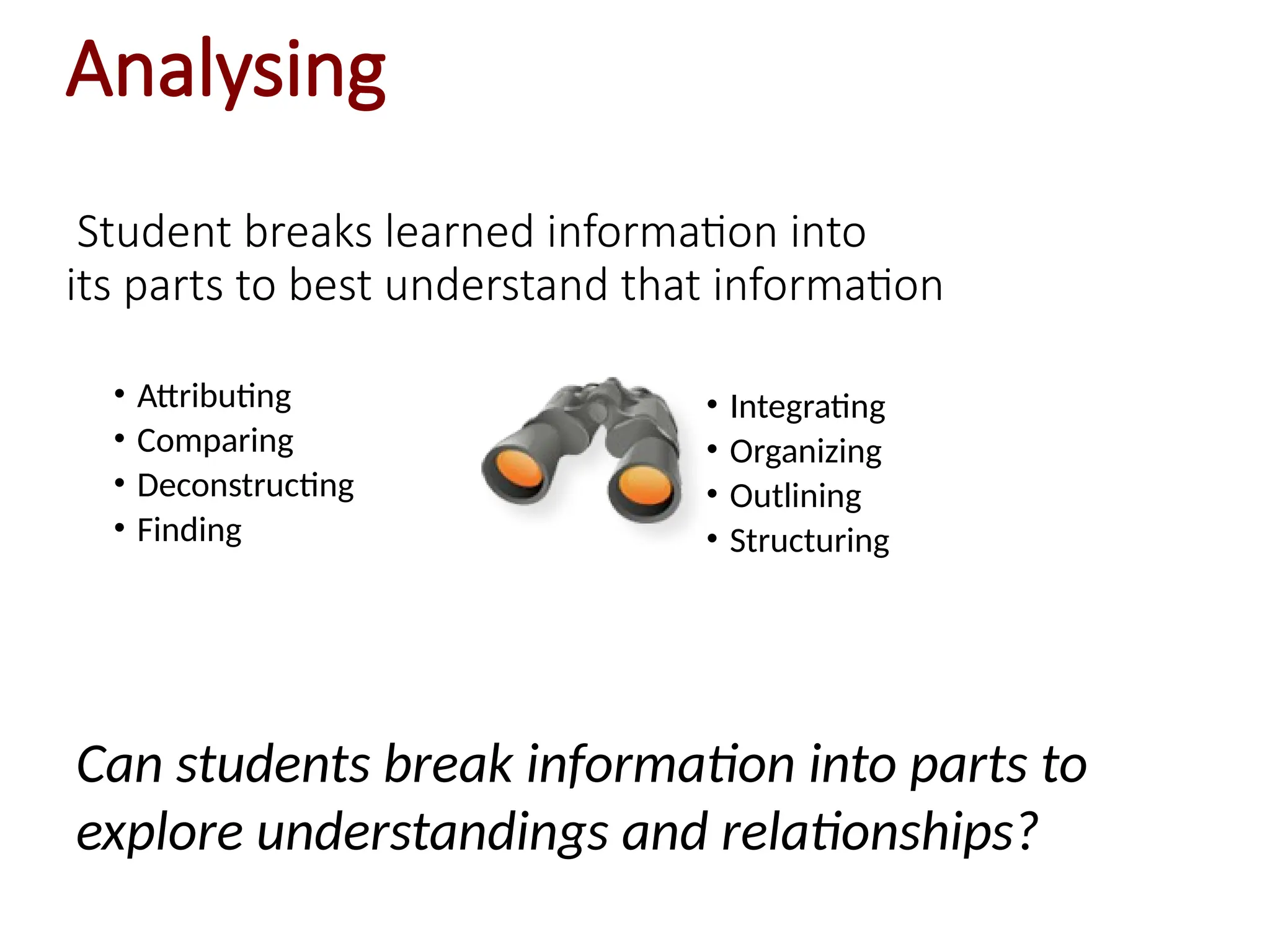
Analysing
Student breaks learned information into
its parts to best understand that information
• Attributing
• Comparing
• Deconstructing
• Finding
• Integrating
• Organizing
• Outlining
• Structuring
Can students break information into parts to
explore understandings and relationships?
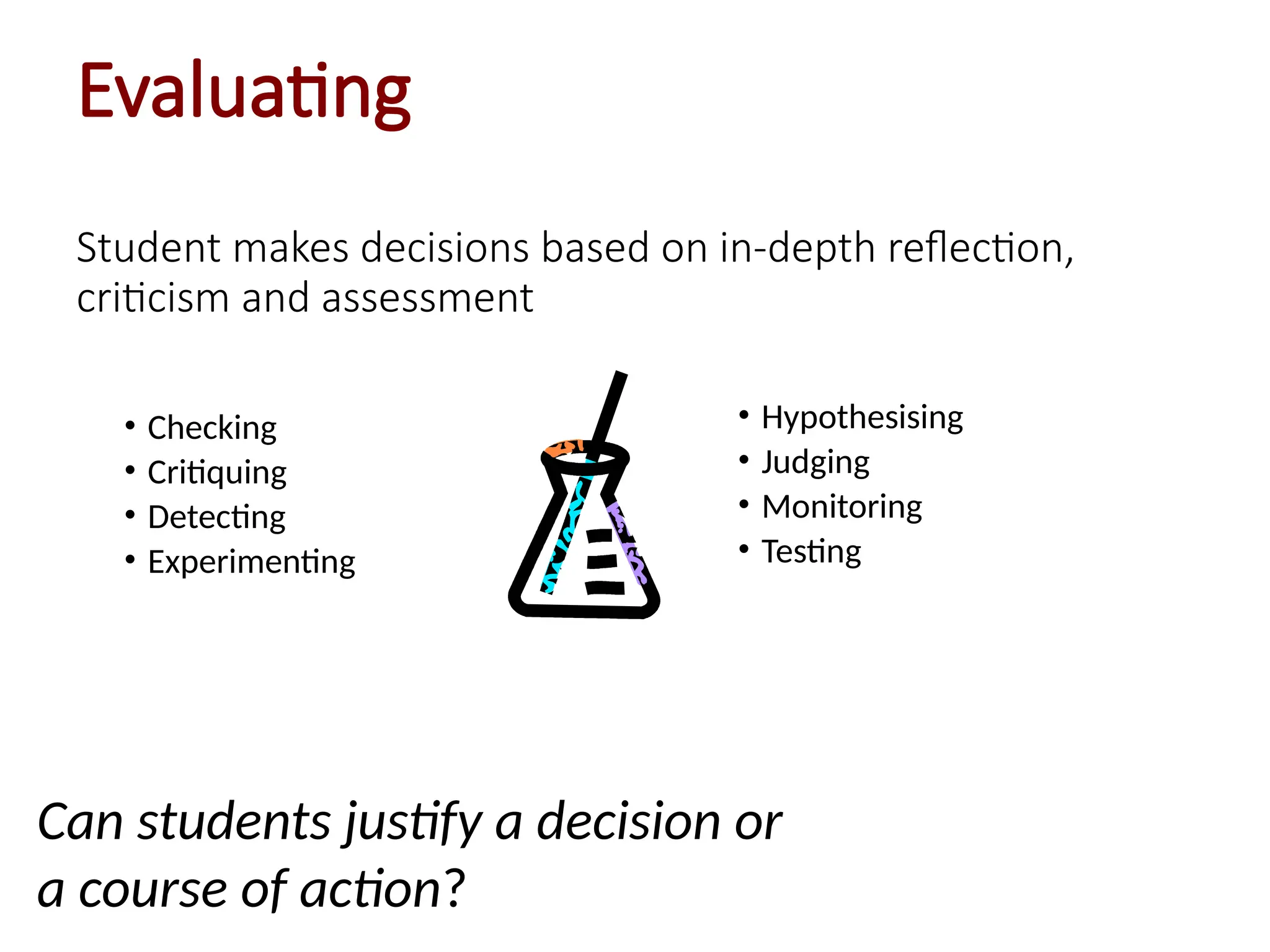
Evaluating
Student makes decisions based on in-depth reflection,
criticism and assessment
• Checking
• Critiquing
• Detecting
• Experimenting
• Hypothesising
• Judging
• Monitoring
• Testing
Can students justify a decision or
a course of action?
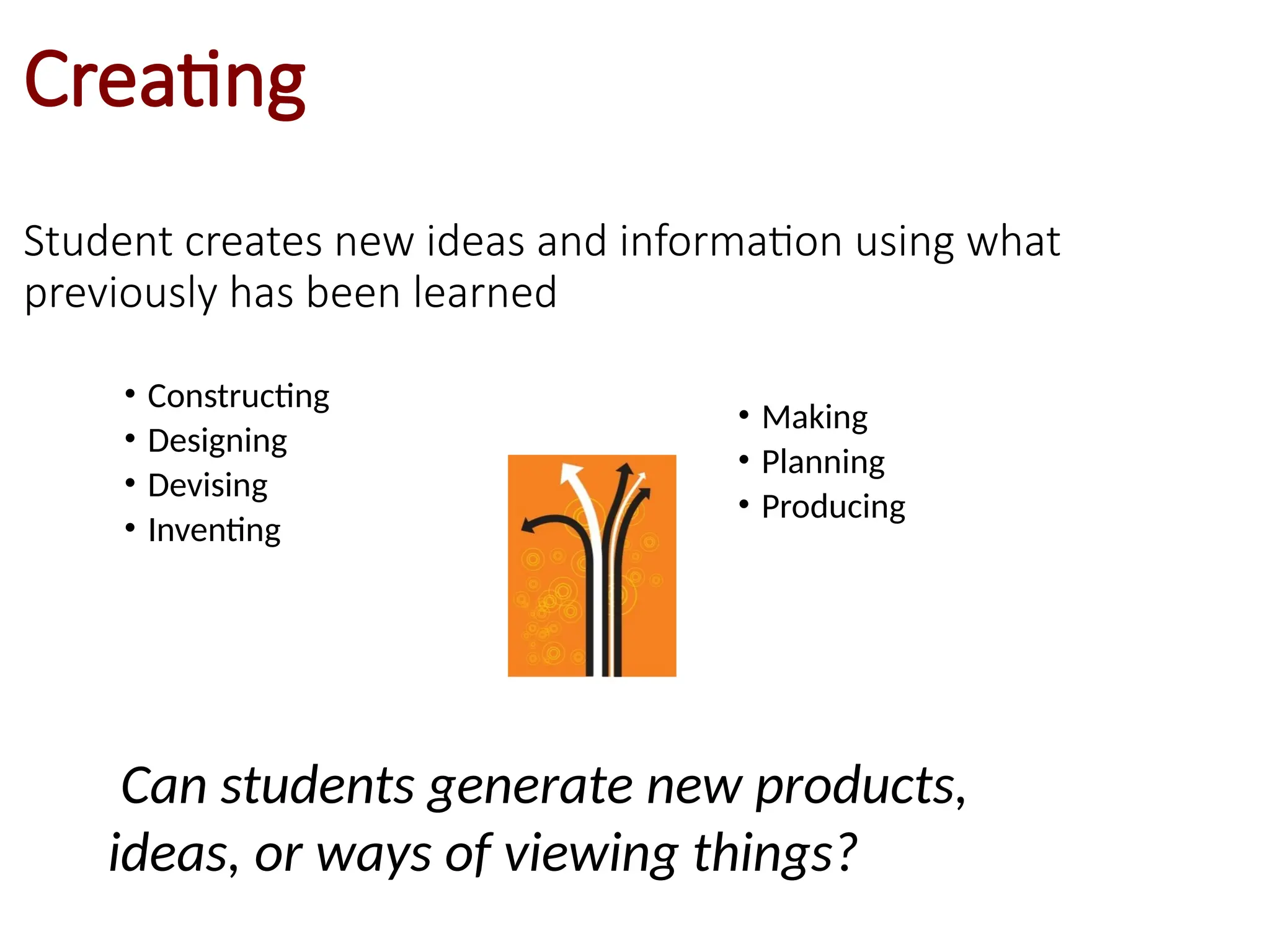
Creating
Student creates new ideas and information using what
previously has been learned
• Constructing
• Designing
• Devising
• Inventing
• Making
• Planning
• Producing
Can students generate new products,
ideas, or ways of viewing things?
Advantages of revised Blooms taxonomy
• Clear learning goals: It's easier for educators to set clear
and achievable learning goals and objectives
• Understand learning expectations: Students can more
easily understand what they need to do to be successful
• Design instructional activities: Educators can design
appropriate instructional activities and evaluation
methods
• Support neurodiverse learners: It provides a structured
framework for designing learning objectives, instructional
strategies, and assessments for diverse cognitive needs
• Promote higher level thinking: It promotes a higher level
of thinking that enables learners to apply their new skills
and knowledge
• Develop critical thinking: It helps learners analyze and
interpret information, evaluate ideas, make decisions, and
solve problems creatively
Why Blooms taxonomy revised?
Bloom's Taxonomy was revised in 2001 to better reflect the
complexity of the learning process and to align with modern
educational practices:
•Reflect the complexity of learning
The original model was linear and hierarchical, but cognitive
processes are often simultaneous and interactive. The revised model
is more dynamic and acknowledges this interconnectedness.
•Align with modern educational practices
The revised model promotes active, inquiry-based learning, student-
centered learning, and critical thinking.
•Use verbs instead of nouns
The revised model uses verbs to describe actions, which focuses on
active performance rather than acquisition.
•Swap the highest two levels
The revised model moves "create" to the highest level and drops
"synthesis".
The revised taxonomy is a useful tool for course design because it
helps move students through the learning process, from
remembering and understanding to evaluating and creating.
Lower and Higher Order Questions
• Lower level questions are those at the remembering, understanding
and lower level application levels of the taxonomy.
• Usually questions at the lower levels are appropriate for:
• Evaluating students’ preparation and comprehension
• Diagnosing students’ strengths and weaknesses
• Reviewing and/or summarizing content
Lower and Higher Order Questions
• Higher level questions are those requiring complex application,
analysis, evaluation or creation skills.
• Questions at higher levels of the taxonomy are usually most
appropriate for:
• Encouraging students to think more deeply and critically
• Problem solving
• Encouraging discussions
• Stimulating students to seek information on their own
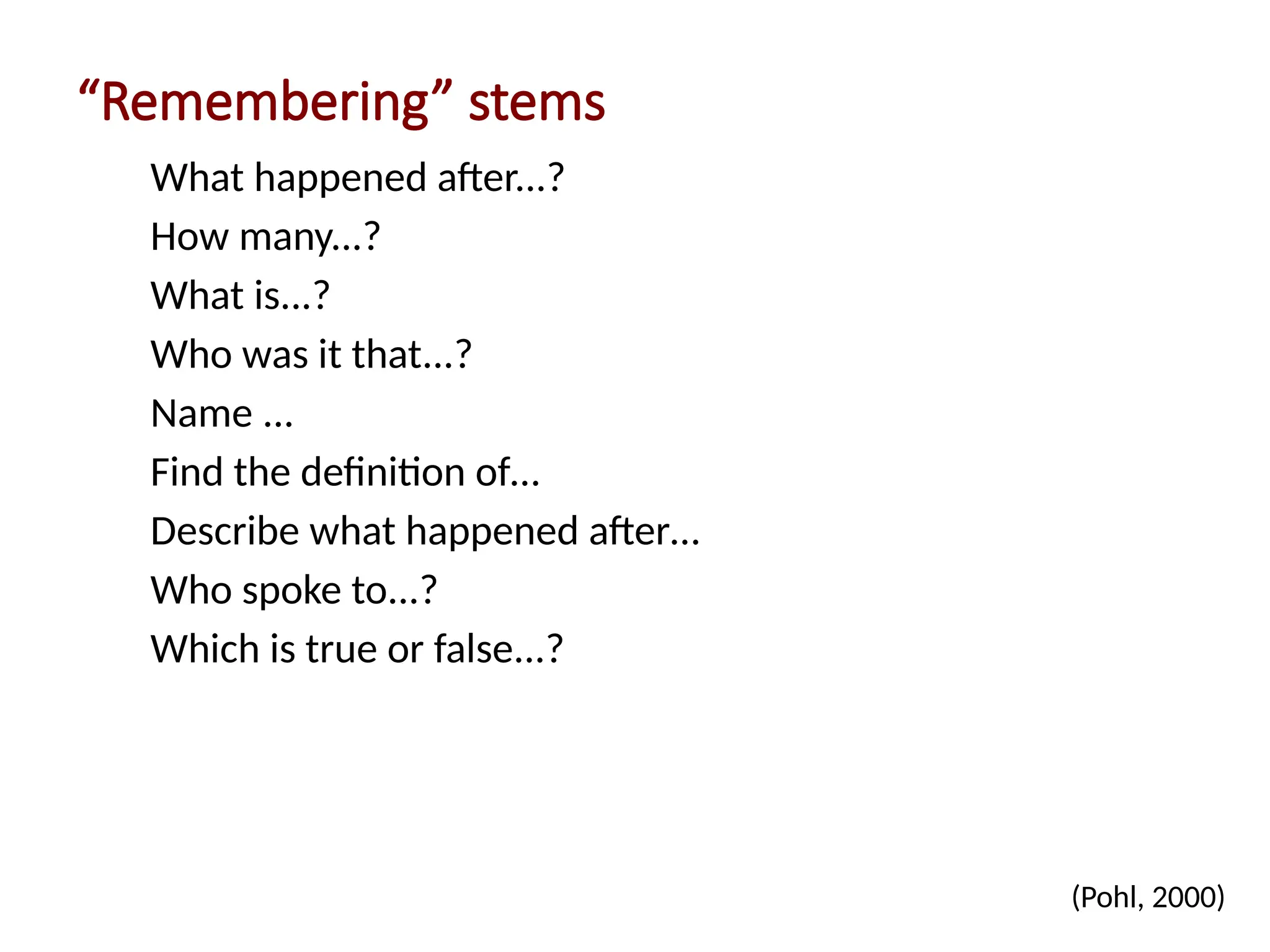
“Remembering” stems
What happened after...?
How many...?
What is...?
Who was it that...?
Name ...
Find the definition of…
Describe what happened after…
Who spoke to...?
Which is true or false...?
(Pohl, 2000)
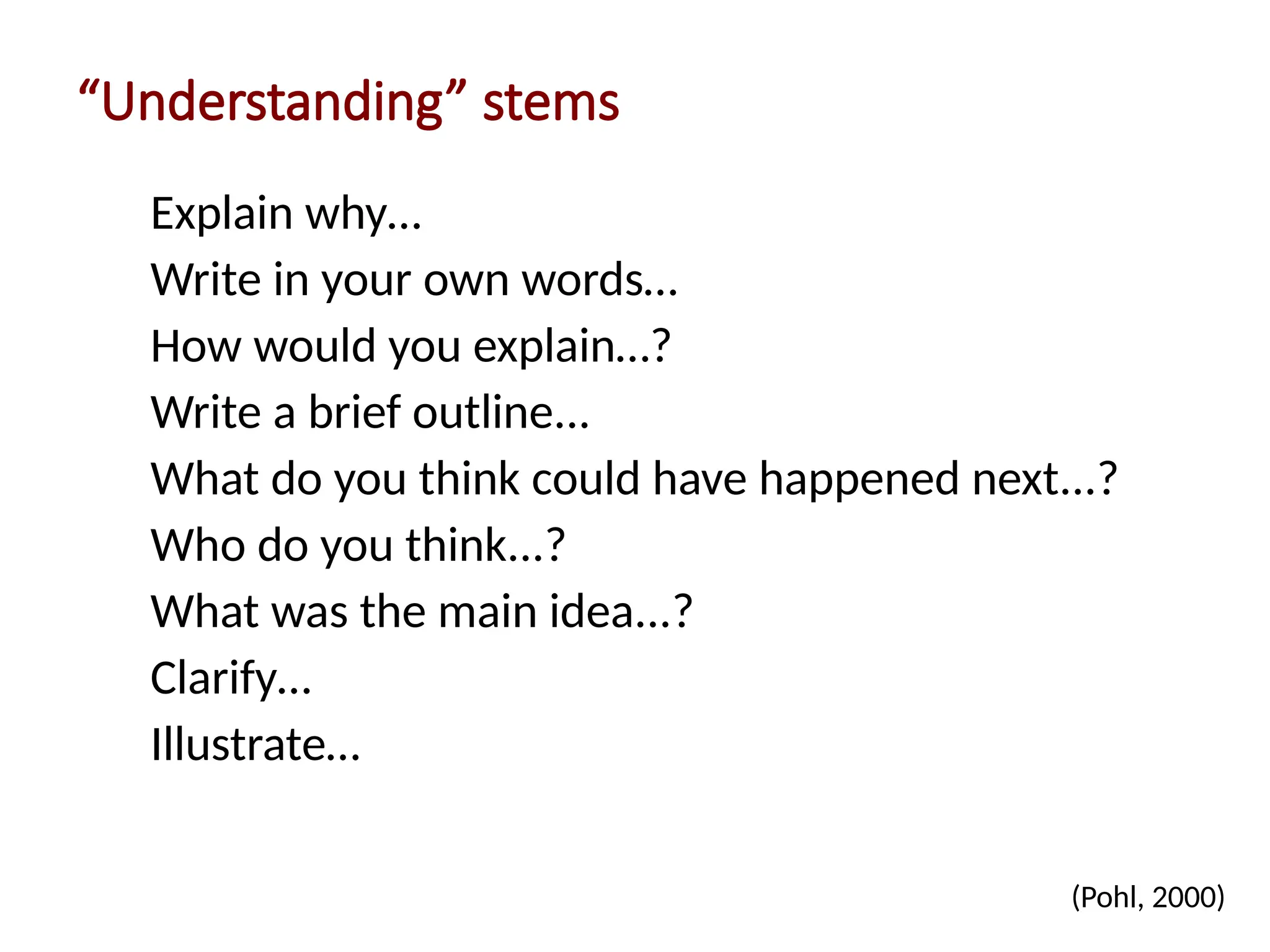
“Understanding” stems
Explain why…
Write in your own words…
How would you explain…?
Write a brief outline...
What do you think could have happened next...?
Who do you think...?
What was the main idea...?
Clarify…
Illustrate…
(Pohl, 2000)
“Applying” stems
Explain another instance where…
Group by characteristics such as…
Which factors would you change if…?
What questions would you ask of…?
From the information given, develop a set of instructions
about…
(Pohl, 2000)
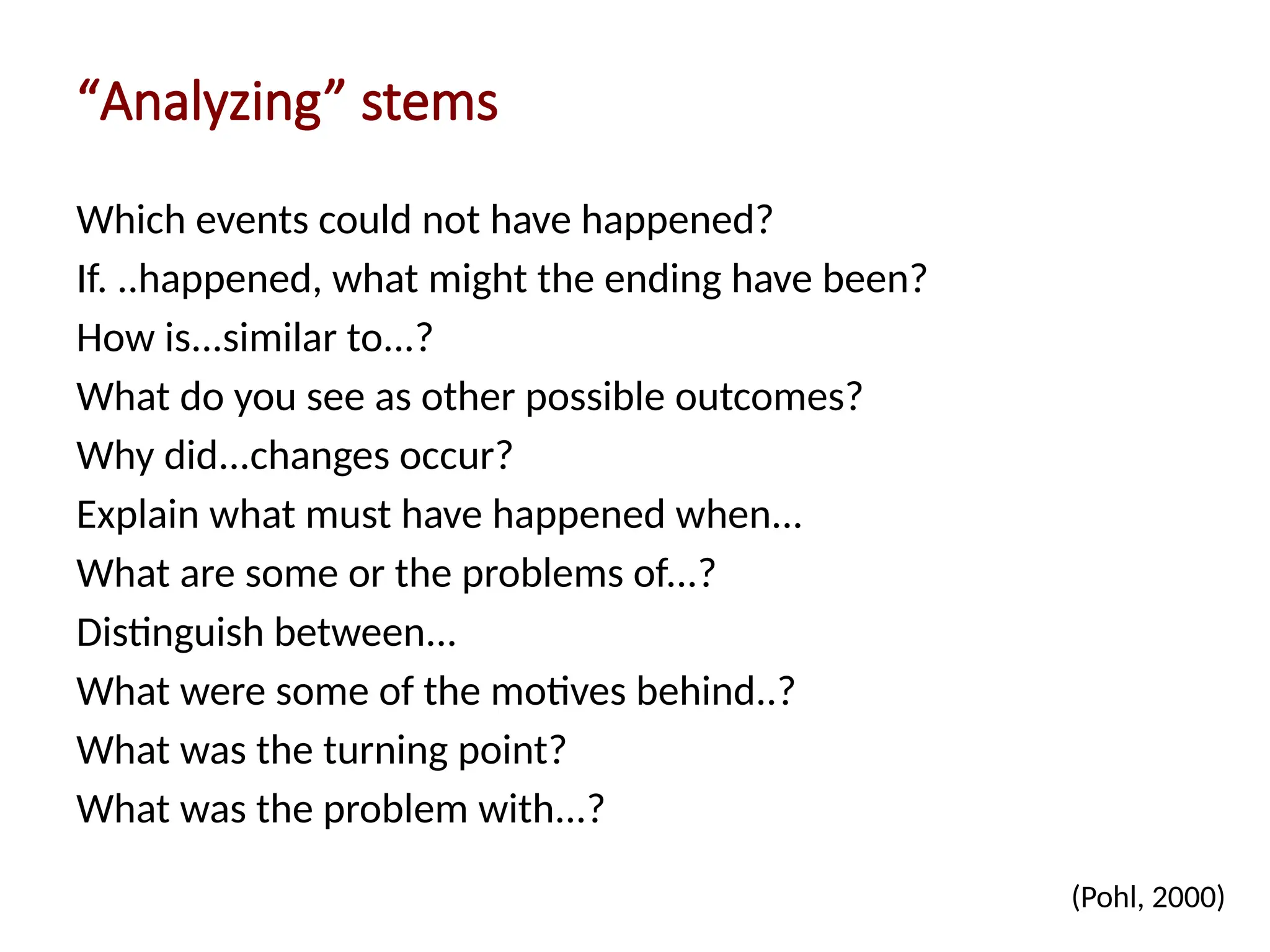
“Analyzing” stems
Which events could not have happened?
If. ..happened, what might the ending have been?
How is...similar to...?
What do you see as other possible outcomes?
Why did...changes occur?
Explain what must have happened when...
What are some or the problems of...?
Distinguish between...
What were some of the motives behind..?
What was the turning point?
What was the problem with...?
(Pohl, 2000)
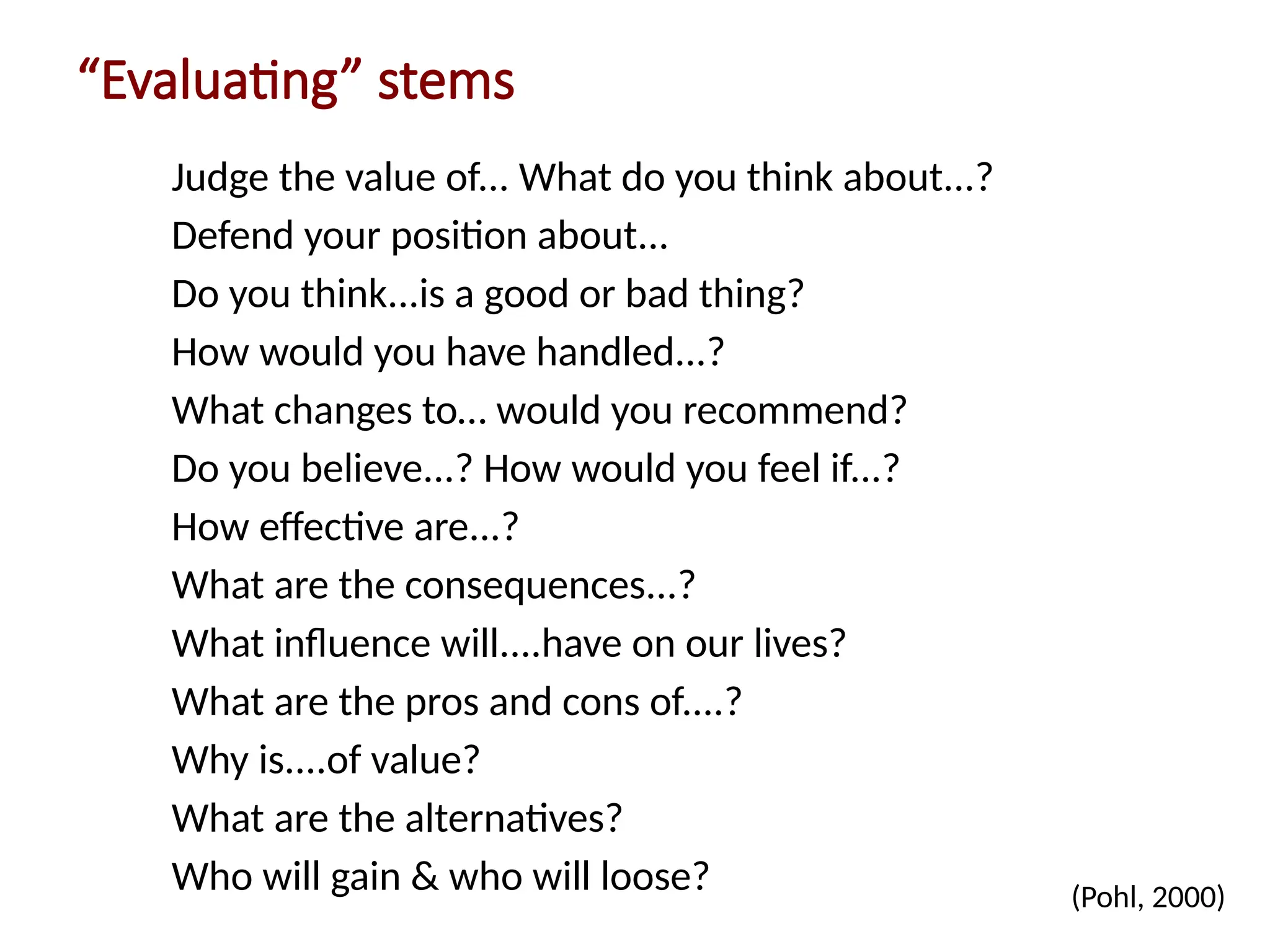
“Evaluating” stems
Judge the value of... What do you think about...?
Defend your position about...
Do you think...is a good or bad thing?
How would you have handled...?
What changes to… would you recommend?
Do you believe...? How would you feel if...?
How effective are...?
What are the consequences...?
What influence will....have on our lives?
What are the pros and cons of....?
Why is....of value?
What are the alternatives?
Who will gain & who will loose? (Pohl, 2000)
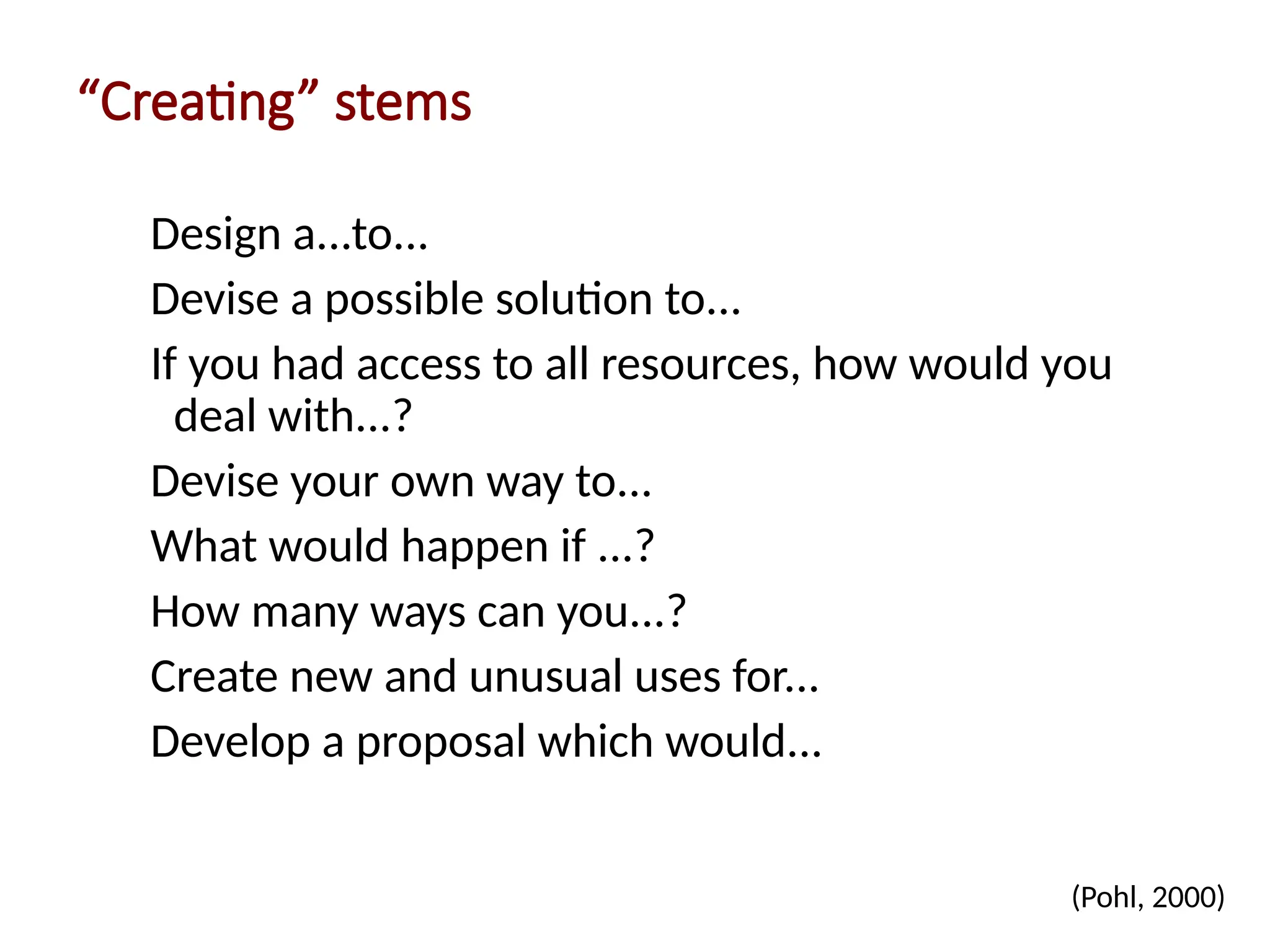
“Creating” stems
Design a...to...
Devise a possible solution to...
If you had access to all resources, how would you
deal with...?
Devise your own way to...
What would happen if ...?
How many ways can you...?
Create new and unusual uses for...
Develop a proposal which would...
(Pohl, 2000)

BLOOMS taxonomy of instructional objectives

  • 1.
    Classification of educational objectives Dr.Shilna V. • Aims and objectives • Blooms Taxonomy • Revised Blooms taxonomy • Advantages of revised Blooms taxonomy • Higher order and lower order questions
  • 2.
    Difference between aimsand objectives AIMS OBJECTIVES Long term goals Short term goals General in nature Specific in nature Limited in number More in number Influenced by the school as well as the society Mainly accomplished in schools Aims focus on the purpose Objectives focus on the actions. Aims can be challenging to evaluate Objectives are easier to measure Aims can remain unchanged Objectives may need to be revised For example, developing interest/ the curiosity of the learner in science. For example, applying Ohm’s law to calculate the resistance of a conductor.
  • 4.
    Taxonomy means 'aset of classification principles‘ and Domain means ‘category’ The most well known description of learning domains was developed by Benjamin s Bloom. It is known as : “Bloom’s Taxonomy”
  • 5.
  • 6.
    Bloom's Taxonomy comprisesthree learning domains
  • 7.
    COGNITIVE DOMAIN Involves knowledgeand the development of intellectual skills recall or recognition of specific facts, procedural patterns, and concepts that serve in the development of intellectual abilities and skills six major categories: Knowledge, Comprehension, Application, Analysis, Synthesis, and Evaluation These categories are starting from the simplest behavior to the most complex in hierarchical order The categories can be thought of as degrees of difficulties. That is, the first ones must normally be mastered before the next ones can take place the first three elements—Knowledge, Comprehension, and Application—represent lower-order thinking skills (LOTS), while Analysis, Synthesis, and Evaluation are considered higher- order thinking skills (HOTS). For this reason, the taxonomy is often graphically represented as a pyramid with higher-order cognition at the top.
  • 10.
    AFFECTIVE DOMAIN • DavidKrathwohl (1964) • This domain focuses on the attitudes, values, interests, and appreciation of learners • It includes the manner in which individuals deal with things emotionally, such as feelings, values, appreciation, enthusiasms, motivations, and attitudes • forms a hierarchical structure and is arranged from simpler feelings to those that are more complex • The hierarchical structure is based on the principle of internalization. Internalization refers to the process whereby a person’s affect toward an object passes from a general awareness level to a point where the affect is ‘internalized’ and consistently guides or controls the person’s behavior • Therefore, with the movement to more complexity, individuals become more involved, committed, and internally motivated.
  • 11.
    (1) Receiving : •Awareness, willingness to hear, selected attention. • Listen to others with respect. Listen for and remember the name of newly introduced people. • Key Words: acknowledge, asks, attentive, courteous, dutiful, follows, gives, listens, understands (2) Responding : • Participates in class discussions. Gives a presentation. Questions new ideals, concepts, models, etc. in order to fully understand them. Know the safety rules and practice them • Key Words: answers, assists, aids, complies, conforms, discusses, greets, helps, labels, performs, presents, tells
  • 12.
    ( (3) Valuing: Demonstrates belief in the democratic process. Is sensitive towards individual and cultural differences (value diversity). Shows the ability to solve problems. Proposes a plan to social improvement and follows through with commitment. Informs management on matters that one feels strongly about Key Words: appreciates, cherish, treasure, demonstrates, initiates, invites, joins, justifies, proposes, respect, shares
  • 13.
    (4) Organization : •Recognizes the need for balance between freedom and responsible behavior. Explains the role of systematic planning in solving problems. Accepts professional ethical standards. Creates a life plan in harmony with abilities, interests, and beliefs. Prioritizes time effectively to meet the needs of the organization, family, and self. • Key Words: compares, relates, synthesizes (5) Characterization : • Shows self-reliance when working independently. Cooperates in group activities (displays teamwork). Uses an objective approach in problem solving. Displays a professional commitment to ethical practice on a daily basis. Revises judgments and changes behavior in light of new evidence. Values people for what they are, not how they look. • Key Words: acts, discriminates, displays, influences, modifies, performs, qualifies, questions, revises, serves, solves, verifies
  • 15.
    PSYCHOMOTOR DOMAIN • TheDave’s taxonomy (1970) • includes utilizing motor skills and the ability to coordinate them • includes physical movement, coordination, and use of the motor-skill areas • Development of these skills requires practice and is measured in terms of speed, strength, endurance, coordination, precision, distance, procedures, or techniques in execution • The psychomotor domain is important to study because it can deteriorate, which is called psychomotor impairment. For example, bad posture can affect the spine, and depression can affect body movements and energy • Art and craft activities requires eye and hand coordination. Through these activities psychomotor skills can be developed.
  • 18.
    Why use Bloom’staxonomy? •Write and revise learning objectives •Plan curriculum •Identifies simple to most difficult skills •Effectively align objectives to assessment techniques and standards •Incorporate knowledge to be learned (knowledge dimension) and cognitive process to learn •Facilitate questioning (oral language = important role within framework)
  • 19.
  • 20.
  • 21.
    Creating Generating newideas, products, or ways of viewing things, Designing, constructing, planning, producing, inventing Evaluating Justifying a decision or course of action Checking, hypothesising, critiquing, experimenting, judging Analysing Breaking information into parts to explore understandings and relationships Comparing, organising, deconstructing, interrogating, finding Applying Using information in another familiar situation Implementing, carrying out, using, executing Understanding Explaining ideas or concepts Interpreting, summarising, paraphrasing, classifying, explaining Remembering Recalling information Recognising, listing, describing, retrieving, naming, finding
  • 23.
    Change in Terms •Categoriesnoun to verb • Taxonomy reflects different forms of thinking • thinking is an active process • verbs describe actions, nouns do not •Reorganized categories • Knowledge is product/outcome of thinking • remembering is process of thinking • Comprehension now understanding • Synthesis now creating to better reflect nature of thinking described by each category
  • 24.
    Changes in Structure •Products of thinking part of taxonomy • Forms of knowledge = factual, conceptual, procedural, metacognitive (thinking about thinking) • Synthesis (creating) and evaluation (evaluating) interchanged • Creative thinking more complex form of thinking than critical thinking (evaluating)
  • 25.
    Changes in Emphasis •USE: More authentic tool for curriculum planning, instructional delivery and assessment • Aimed at broader audience • Easily applied to all levels of education • Revision emphasizes explanation and description of subcategories
  • 26.
    Remembering The learner isable to recall, restate and remember learned information •Describing •Finding •Identifying •Listing • Retrieving • Naming • Locating • Recognizing Can students recall information?
  • 27.
    Understanding Student grasps meaningof information by interpreting and translating what has been learned • Classifying • Comparing • Exemplifying • Explaining • Inferring • Interpreting • Paraphrasing • Summarizing Can students explain ideas or concepts?
  • 28.
    Applying Student makes useof information in a context different from the one in which it was learned • Implementing • Carrying out • Using • Executing Can students use the information in another familiar situation? c =
  • 29.
    Analysing Student breaks learnedinformation into its parts to best understand that information • Attributing • Comparing • Deconstructing • Finding • Integrating • Organizing • Outlining • Structuring Can students break information into parts to explore understandings and relationships?
  • 30.
    Evaluating Student makes decisionsbased on in-depth reflection, criticism and assessment • Checking • Critiquing • Detecting • Experimenting • Hypothesising • Judging • Monitoring • Testing Can students justify a decision or a course of action?
  • 31.
    Creating Student creates newideas and information using what previously has been learned • Constructing • Designing • Devising • Inventing • Making • Planning • Producing Can students generate new products, ideas, or ways of viewing things?
  • 32.
    Advantages of revisedBlooms taxonomy • Clear learning goals: It's easier for educators to set clear and achievable learning goals and objectives • Understand learning expectations: Students can more easily understand what they need to do to be successful • Design instructional activities: Educators can design appropriate instructional activities and evaluation methods • Support neurodiverse learners: It provides a structured framework for designing learning objectives, instructional strategies, and assessments for diverse cognitive needs • Promote higher level thinking: It promotes a higher level of thinking that enables learners to apply their new skills and knowledge • Develop critical thinking: It helps learners analyze and interpret information, evaluate ideas, make decisions, and solve problems creatively
  • 33.
    Why Blooms taxonomyrevised? Bloom's Taxonomy was revised in 2001 to better reflect the complexity of the learning process and to align with modern educational practices: •Reflect the complexity of learning The original model was linear and hierarchical, but cognitive processes are often simultaneous and interactive. The revised model is more dynamic and acknowledges this interconnectedness. •Align with modern educational practices The revised model promotes active, inquiry-based learning, student- centered learning, and critical thinking. •Use verbs instead of nouns The revised model uses verbs to describe actions, which focuses on active performance rather than acquisition. •Swap the highest two levels The revised model moves "create" to the highest level and drops "synthesis". The revised taxonomy is a useful tool for course design because it helps move students through the learning process, from remembering and understanding to evaluating and creating.
  • 34.
    Lower and HigherOrder Questions • Lower level questions are those at the remembering, understanding and lower level application levels of the taxonomy. • Usually questions at the lower levels are appropriate for: • Evaluating students’ preparation and comprehension • Diagnosing students’ strengths and weaknesses • Reviewing and/or summarizing content
  • 35.
    Lower and HigherOrder Questions • Higher level questions are those requiring complex application, analysis, evaluation or creation skills. • Questions at higher levels of the taxonomy are usually most appropriate for: • Encouraging students to think more deeply and critically • Problem solving • Encouraging discussions • Stimulating students to seek information on their own
  • 36.
    “Remembering” stems What happenedafter...? How many...? What is...? Who was it that...? Name ... Find the definition of… Describe what happened after… Who spoke to...? Which is true or false...? (Pohl, 2000)
  • 37.
    “Understanding” stems Explain why… Writein your own words… How would you explain…? Write a brief outline... What do you think could have happened next...? Who do you think...? What was the main idea...? Clarify… Illustrate… (Pohl, 2000)
  • 38.
    “Applying” stems Explain anotherinstance where… Group by characteristics such as… Which factors would you change if…? What questions would you ask of…? From the information given, develop a set of instructions about… (Pohl, 2000)
  • 39.
    “Analyzing” stems Which eventscould not have happened? If. ..happened, what might the ending have been? How is...similar to...? What do you see as other possible outcomes? Why did...changes occur? Explain what must have happened when... What are some or the problems of...? Distinguish between... What were some of the motives behind..? What was the turning point? What was the problem with...? (Pohl, 2000)
  • 40.
    “Evaluating” stems Judge thevalue of... What do you think about...? Defend your position about... Do you think...is a good or bad thing? How would you have handled...? What changes to… would you recommend? Do you believe...? How would you feel if...? How effective are...? What are the consequences...? What influence will....have on our lives? What are the pros and cons of....? Why is....of value? What are the alternatives? Who will gain & who will loose? (Pohl, 2000)
  • 41.
    “Creating” stems Design a...to... Devisea possible solution to... If you had access to all resources, how would you deal with...? Devise your own way to... What would happen if ...? How many ways can you...? Create new and unusual uses for... Develop a proposal which would... (Pohl, 2000)

Editor's Notes

  • #19 BLOOM INTERESTED IN STUDENT LEARNING – CENTRAL TO HIS LIFE’S WORK WROTE OR CO-AUTHORED 18 BOOKS IN LOVE WITH PROCESS OF “FINDING OUT” ONE OF MOST WIDELY APPLIED AND MOST OFTEN CITED REFERENCES IN EDUCATION TRANSLATED INTO 22 LANGUAGES B. 1913 D. 1999
  • #20 Remembering = Rote memorization Classifying cognitive thinking into different levels, each building on the previous level, from the most simple to the most abstract ORIGINAL = 8 years REVISED = 6 years Application (noun) to knowledge (verb)
  • #24 ONE CAN BE CRITICAL WITHOUT BEING CREATIVE (i.e., JUDGE AN IDEA AND JUSTIFY CHOICES) BUT CREATIVE PRODUCTION OFTEN REQUIRES CRITICAL THINKING (1.E., ACCEPTING AND REJECTING IDEAS ON THE PATH TO CREATING A NEW IDEA, PRODUCT, OR WAY OF LOOKING AT THINGS (POHL, 2000). ONE DIMENTIONAL TO TWO-DIMENTIONAL FORM (SEE HANDOUT WITH VERBS AND OUTCOMES/PRODUCTS) KNOWLEDGE DIMENSION – KIND OF KNOWLEDGE TO BE LEARNED (FACTUAL, CONCEPTUAL, PROCEDURAL, META-COGNITIVE) COGNITIVE PROCESS DIMENSION – PROCESS USED TO LEARN (REMEMBER, UNDERSTAND, APPLY, ANALYZE, EVALUATE, CREATE) (SOURCE: MARY FOREHAND, 2008)
  • #25 Bloom’s taxonomy was traditionally viewed as a tool best applied in the earlier years of schooling (i.e., primary and junior primary years). The revised taxonomy is more universal and easily applicable at elementary, secondary, and higher education levels. Revision emphasizes explanation and description of subcategories. See handout.
  • #26 Make a story map showing the main events of the story. Make a time line of your typical day. Make a concept map of the topic. Write a list of keywords you know about…. What characters were in the story? Make a chart showing… Make an acrostic poem about… Recite a poem you have learned.
  • #27 Write in your own words… Cut out, or draw pictures to illustrate a particular event in the story. Report to the class… Illustrate what you think the main idea may have been. Make a cartoon strip showing the sequence of events in the story. Write and perform a play based on the story. Write a brief outline to explain this story to someone else Explain why the character solved the problem in this particular way Write a summary report of the event. Prepare a flow chart to illustrate the sequence of events. Make a coloring book. Paraphrase this chapter in the book. Retell in your own words. Outline the main points.
  • #28 Construct a model to demonstrate how it looks or works Practice a play and perform it for the class Make a diorama to illustrate an event Write a diary entry Make a scrapbook about the area of study. Prepare invitations for a character’s birthday party Make a topographic map Take and display a collection of photographs on a particular topic. Make up a puzzle or a game about the topic. Write an explanation about this topic for others. Dress a doll in national costume. Make a clay model… Paint a mural using the same materials. Continue the story…
  • #29 Use a Venn Diagram to show how two topics are the same and different Design a questionnaire to gather information. Survey classmates to find out what they think about a particular topic. Analyse the results. Make a flow chart to show the critical stages. Classify the actions of the characters in the book Create a sociogram from the narrative Construct a graph to illustrate selected information. Make a family tree showing relationships. Devise a roleplay about the study area. Write a biography of a person studied. Prepare a report about the area of study. Conduct an investigation to produce information to support a view. Review a work of art in terms of form, color and texture. Draw a graph Complete a Decision Making Matrix to help you decide which breakfast cereal to purchase
  • #30 Write a letter to the editor Prepare and conduct a debate Prepare a list of criteria to judge… Write a persuasive speech arguing for/against… Make a booklet about five rules you see as important. Convince others. Form a panel to discuss viewpoints on…. Write a letter to. ..advising on changes needed. Write a half-yearly report. Prepare a case to present your view about... Complete a PMI on… Evaluate the character’s actions in the story
  • #31 Use the . . . strategy to invent a new type of sports shoe. Invent a machine to do a specific task. Design a robot to do your homework. Create a new product. Give it a name and plan a marketing campaign. Write about your feelings in relation to... Write a TV show play, puppet show, role play, song or pantomime about.. Design a new monetary system Develop a menu for a new restaurant using a variety of healthy foods Design a CD, book or magazine cover for... Sell an idea Devise a way to... Make up a new language and use it in an example Write a jingle to advertise a new product. (Adapted from Dalton, 1986)