Learning Strategies Done by/ Ahmed Al-Ajmi
Points to highlight Defining learning strategies. Types of learning strategies. Successful learner strategies. The link between learning strategies and learning styles. Usefulness of learning strategies. Are learning strategies changeable? Studies.
 
A sad story A student was excellent at school. He got 93.9% at the end of grade 12 and the least mark was 93 !!! He joined Sultan Qaboos University and was interested in learning English and becoming a teacher. After he finished the 4 th  year, he graduated with grade C !!! From your point of view, why couldn’t he get high marks ?!!!
Defining learning strategies “ Learning strategies are specific actions taken by the learner to make learning easier, faster, more enjoyable, more self-directed, more effective, more transferable to new situations”. Source (Oxford, 1990) “ Operations …to aid the: acquisition, storage, retrieval, and use of information…”  source   (Oxford, 1990)
Definitions (cont.) Language learning strategies are the purposeful steps used by language learners to: comprehend and process new information more deeply, to help to recall old information, and apply knowledge and skills to facilitate problem-solving. Source (Nyikos, 1991)
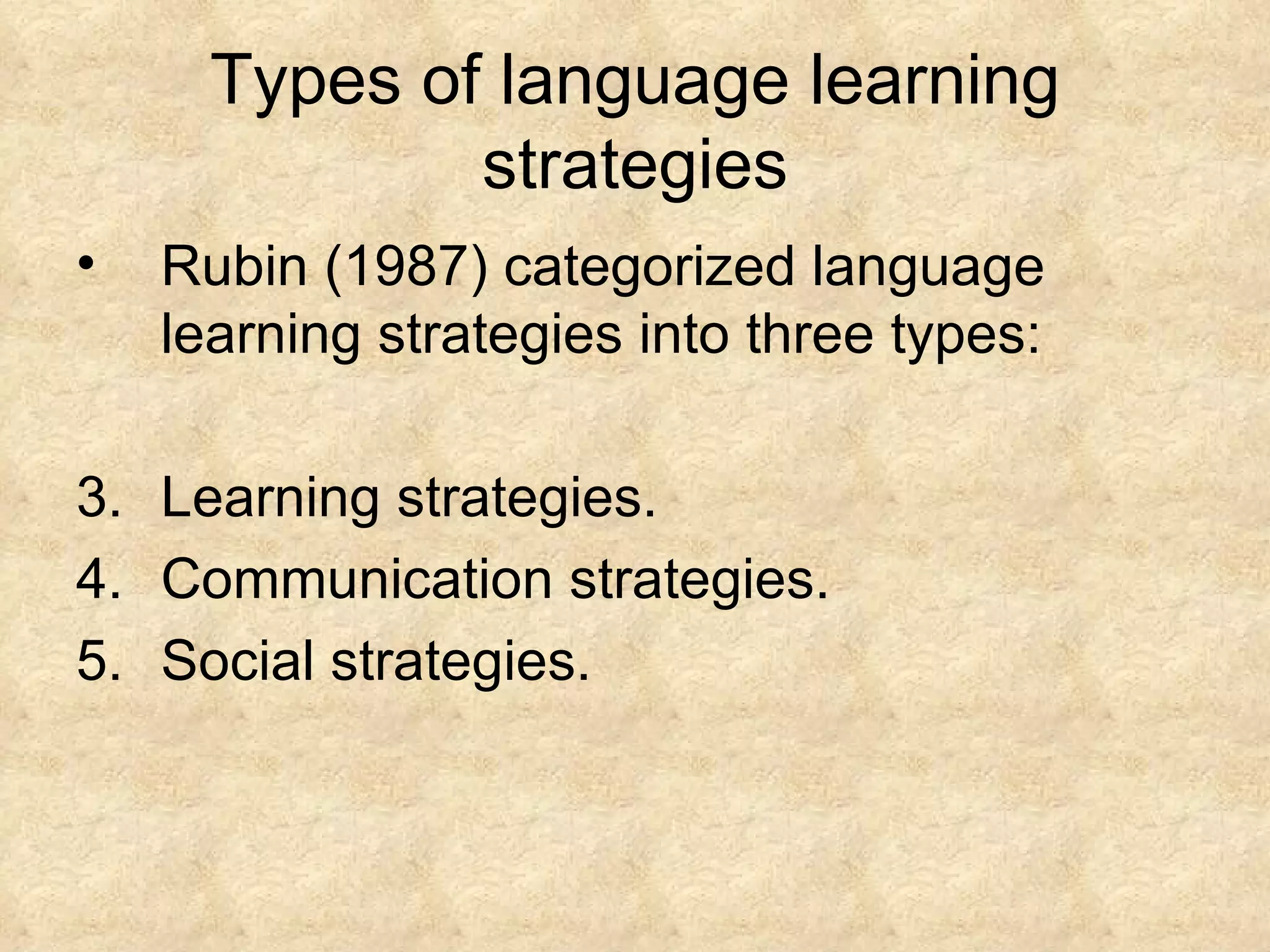
Types of language learning strategies Rubin (1987) categorized language learning strategies into three types: Learning strategies. Communication strategies. Social strategies.
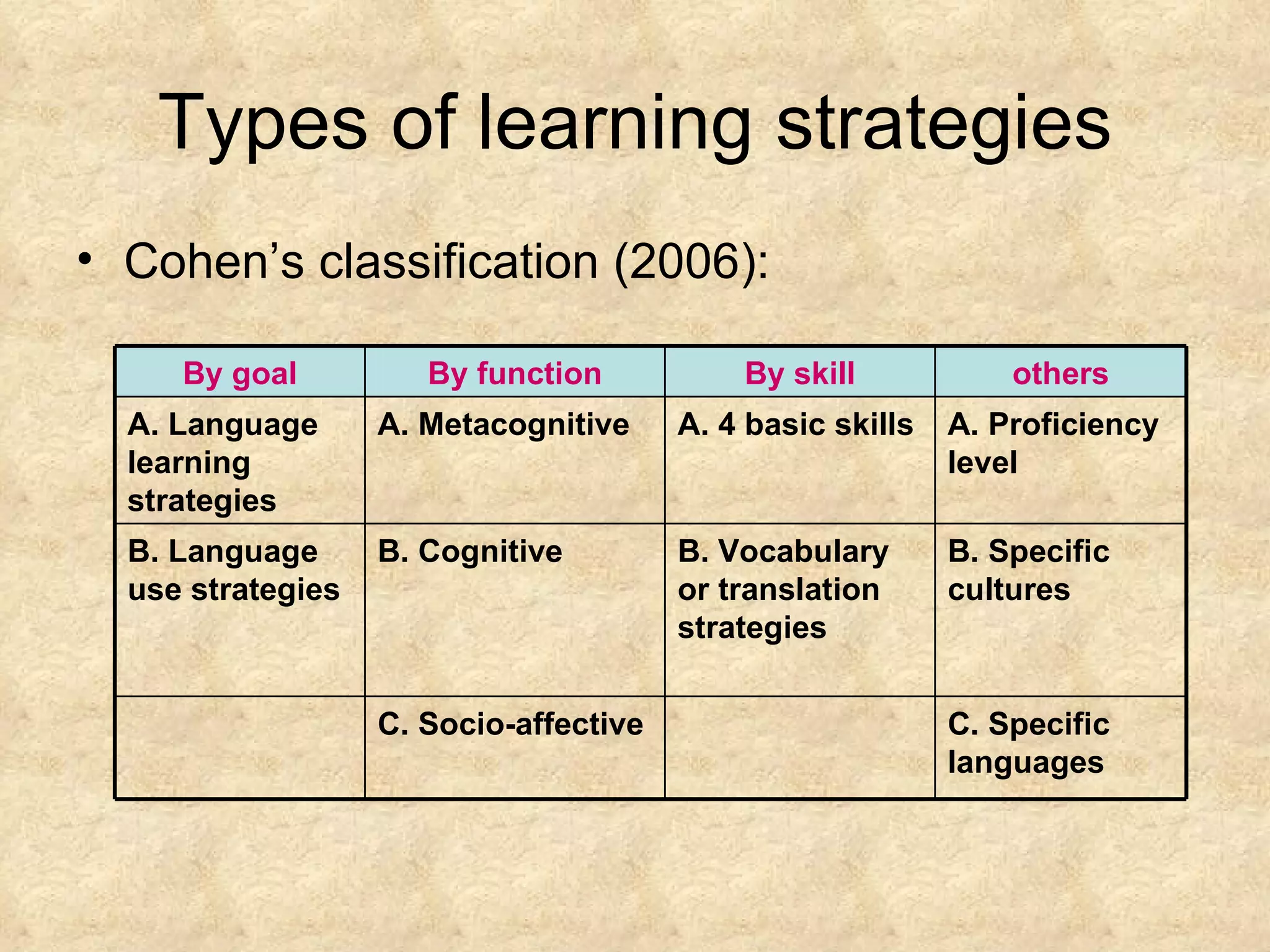
Types of learning strategies Cohen’s classification (2006): C. Specific languages C. Socio-affective B. Specific cultures B. Vocabulary or translation strategies B. Cognitive B. Language use strategies A. Proficiency level A. 4 basic skills  A. Metacognitive A. Language learning strategies others By skill By function By goal
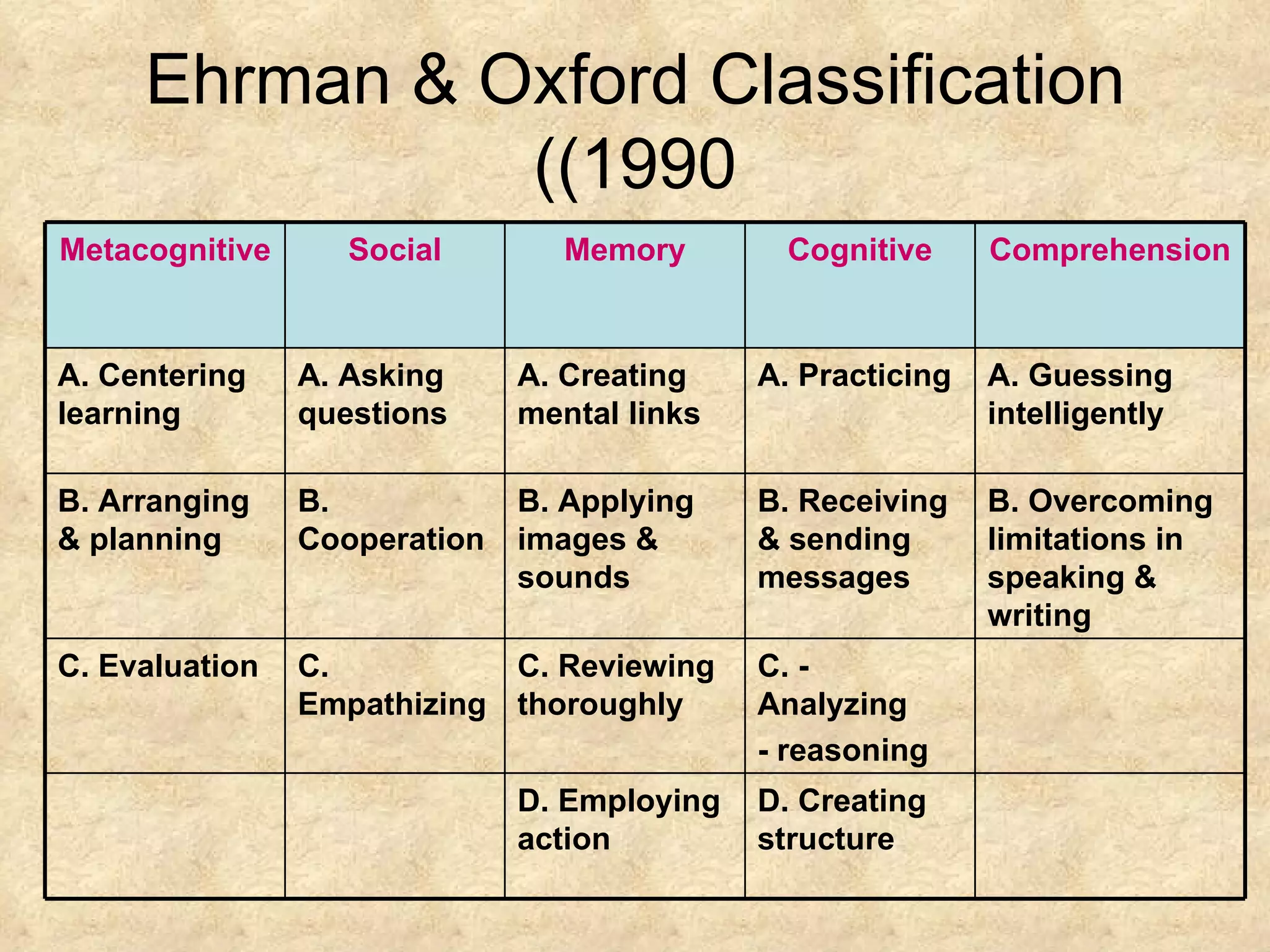
Ehrman & Oxford Classification (1990) D. Creating structure D. Employing action C. - Analyzing - reasoning C. Reviewing thoroughly C. Empathizing C. Evaluation B. Overcoming limitations in speaking & writing B. Receiving & sending messages B. Applying images & sounds B. Cooperation B. Arranging & planning A. Guessing intelligently A. Practicing A. Creating mental links A. Asking questions A. Centering learning Comprehension Cognitive Memory Social Metacognitive
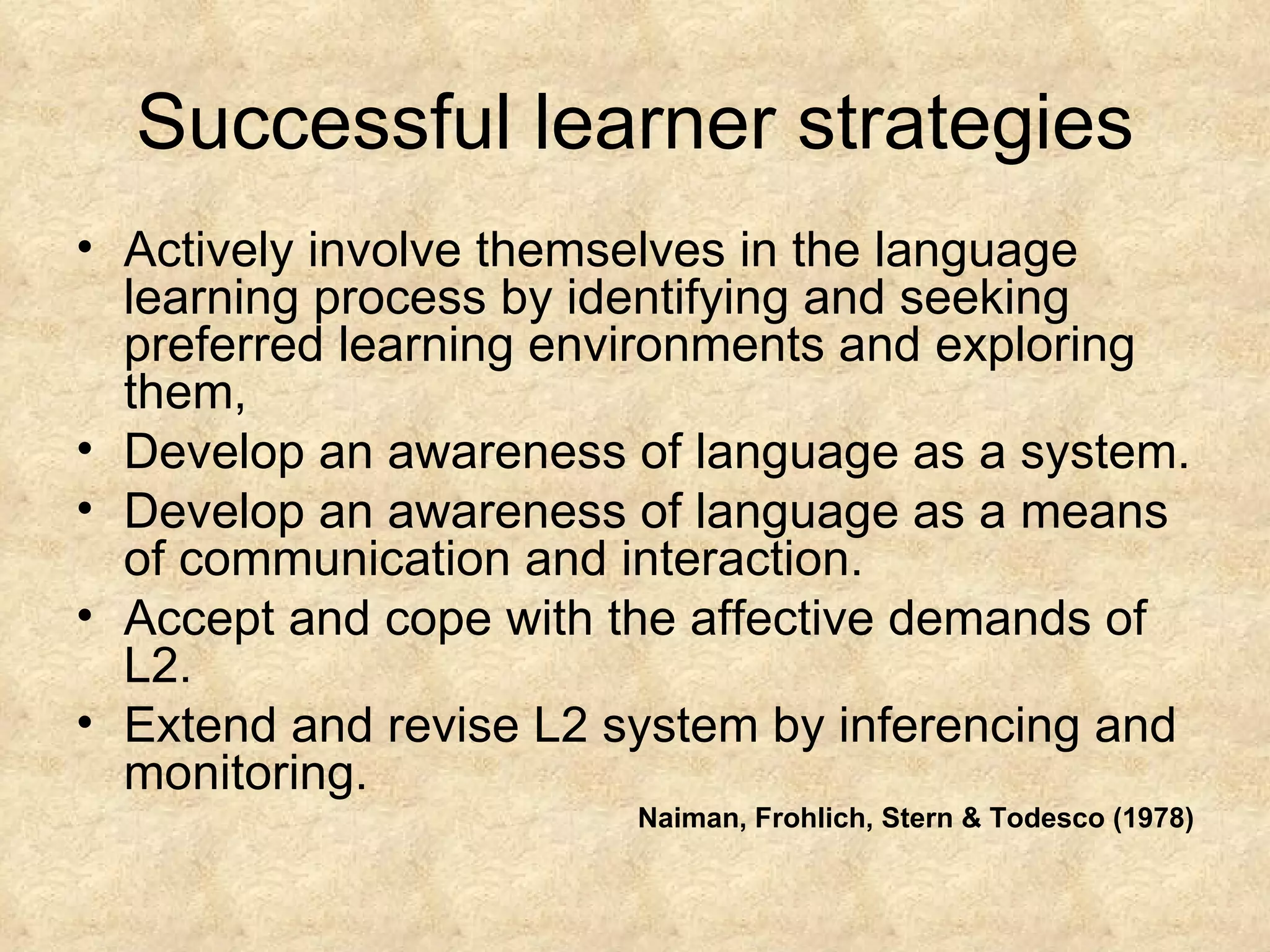
Successful learner strategies Actively involve themselves in the language learning process by identifying and seeking preferred learning environments and exploring them, Develop an awareness of language as a system. Develop an awareness of language as a means of communication and interaction. Accept and cope with the affective demands of L2. Extend and revise L2 system by inferencing and monitoring. Naiman, Frohlich, Stern & Todesco (1978)
The learning strategies and learning style link A learning style is a predisposition on the part of some students to adopt a particular learning strategy regardless of the specific demands of the learning task.  (Schmeck in Schulz-Wender, 2001)
Are learning strategies useful? “ With some exceptions, strategies themselves are not inherently good or bad, but have the potential to be used effectively”. (Cohen, 1998). The total number or variety of strategies employed and the frequency with which any given strategy is used are not necessarily indicators of how successful they will be on a language task”. (Cohen, 1998)
Are learning strategies useful? (cont.) Strategies can be more or less person-related, task-related, or learning context related. A strategy suitable for one particular person, task, or learning context may not be suitable for another. (Gu, 2003).
Strategies promote: Language competence. Risk-taking & confidence. Memory & retention. Self-monitoring. Good study habits. Awareness of strengths and individual differences.
Are learning strategies changeable? Some strategies are relatively stable and others are relatively changeable. Person-related strategies tend to be more stable while task-dependent strategies tend to be more changeable.  (Gu, 2003)
Studies of language learner strategy use One important goal is to understand the cognitive, social and affective processes involved in language learning in order to help the less successful language learners overcome learning difficulties. (Chamot, 2001)
Studies (cont.) Oxford and Nyikos (1989) studied 1200 university students and found that  females used language learning strategies  more than their male counterparts. Peacock (2001) found that students  majoring in physics  used far  less cognitive strategies  than the math and engineering students, while math students used fewer metacognitive strategies. (Eslami & Al-Buainain, 2008)
Studies (cont.) Eslami & Al-Buainain (2008), Title: Language learning strategy use by Arabic speaking pre-service teachers learning Eglish through content area. Participants: 27 female Arab students, from two universities in Qatar. Finished BA and were going through intensive one year teacher education program.
Studies (cont.) Some results were:  Students reported using  metacognitive strategies  more frequently. Students with higher levels of English proficiency reported that they would  use gestures when they cannot thik of a word  and would  use a word or phrase that has equivalent meaning as an English word  that they cannot think of. Those students were also found to be  more likely to notice their English mistakes  and use that information to help them do better.
Thanks for listening & time for asking questions

Learning Strategies

  • 1.
    Learning Strategies Doneby/ Ahmed Al-Ajmi
  • 2.
    Points to highlightDefining learning strategies. Types of learning strategies. Successful learner strategies. The link between learning strategies and learning styles. Usefulness of learning strategies. Are learning strategies changeable? Studies.
  • 3.
  • 4.
    A sad storyA student was excellent at school. He got 93.9% at the end of grade 12 and the least mark was 93 !!! He joined Sultan Qaboos University and was interested in learning English and becoming a teacher. After he finished the 4 th year, he graduated with grade C !!! From your point of view, why couldn’t he get high marks ?!!!
  • 5.
    Defining learning strategies“ Learning strategies are specific actions taken by the learner to make learning easier, faster, more enjoyable, more self-directed, more effective, more transferable to new situations”. Source (Oxford, 1990) “ Operations …to aid the: acquisition, storage, retrieval, and use of information…” source (Oxford, 1990)
  • 6.
    Definitions (cont.) Languagelearning strategies are the purposeful steps used by language learners to: comprehend and process new information more deeply, to help to recall old information, and apply knowledge and skills to facilitate problem-solving. Source (Nyikos, 1991)
  • 7.
    Types of languagelearning strategies Rubin (1987) categorized language learning strategies into three types: Learning strategies. Communication strategies. Social strategies.
  • 8.
    Types of learningstrategies Cohen’s classification (2006): C. Specific languages C. Socio-affective B. Specific cultures B. Vocabulary or translation strategies B. Cognitive B. Language use strategies A. Proficiency level A. 4 basic skills A. Metacognitive A. Language learning strategies others By skill By function By goal
  • 9.
    Ehrman & OxfordClassification (1990) D. Creating structure D. Employing action C. - Analyzing - reasoning C. Reviewing thoroughly C. Empathizing C. Evaluation B. Overcoming limitations in speaking & writing B. Receiving & sending messages B. Applying images & sounds B. Cooperation B. Arranging & planning A. Guessing intelligently A. Practicing A. Creating mental links A. Asking questions A. Centering learning Comprehension Cognitive Memory Social Metacognitive
  • 10.
    Successful learner strategiesActively involve themselves in the language learning process by identifying and seeking preferred learning environments and exploring them, Develop an awareness of language as a system. Develop an awareness of language as a means of communication and interaction. Accept and cope with the affective demands of L2. Extend and revise L2 system by inferencing and monitoring. Naiman, Frohlich, Stern & Todesco (1978)
  • 11.
    The learning strategiesand learning style link A learning style is a predisposition on the part of some students to adopt a particular learning strategy regardless of the specific demands of the learning task. (Schmeck in Schulz-Wender, 2001)
  • 12.
    Are learning strategiesuseful? “ With some exceptions, strategies themselves are not inherently good or bad, but have the potential to be used effectively”. (Cohen, 1998). The total number or variety of strategies employed and the frequency with which any given strategy is used are not necessarily indicators of how successful they will be on a language task”. (Cohen, 1998)
  • 13.
    Are learning strategiesuseful? (cont.) Strategies can be more or less person-related, task-related, or learning context related. A strategy suitable for one particular person, task, or learning context may not be suitable for another. (Gu, 2003).
  • 14.
    Strategies promote: Languagecompetence. Risk-taking & confidence. Memory & retention. Self-monitoring. Good study habits. Awareness of strengths and individual differences.
  • 15.
    Are learning strategieschangeable? Some strategies are relatively stable and others are relatively changeable. Person-related strategies tend to be more stable while task-dependent strategies tend to be more changeable. (Gu, 2003)
  • 16.
    Studies of languagelearner strategy use One important goal is to understand the cognitive, social and affective processes involved in language learning in order to help the less successful language learners overcome learning difficulties. (Chamot, 2001)
  • 17.
    Studies (cont.) Oxfordand Nyikos (1989) studied 1200 university students and found that females used language learning strategies more than their male counterparts. Peacock (2001) found that students majoring in physics used far less cognitive strategies than the math and engineering students, while math students used fewer metacognitive strategies. (Eslami & Al-Buainain, 2008)
  • 18.
    Studies (cont.) Eslami& Al-Buainain (2008), Title: Language learning strategy use by Arabic speaking pre-service teachers learning Eglish through content area. Participants: 27 female Arab students, from two universities in Qatar. Finished BA and were going through intensive one year teacher education program.
  • 19.
    Studies (cont.) Someresults were: Students reported using metacognitive strategies more frequently. Students with higher levels of English proficiency reported that they would use gestures when they cannot thik of a word and would use a word or phrase that has equivalent meaning as an English word that they cannot think of. Those students were also found to be more likely to notice their English mistakes and use that information to help them do better.
  • 20.
    Thanks for listening& time for asking questions