Objectives	
s  Definitions:
s  Types:
s  Causes of H.F.
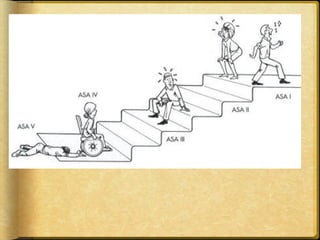
s  ASA Physical Status Classification
s  Clinical Manifestations of H.F.
s  Management:
Definition:
s heart failure

means inability of the heart
to supply sufficient oxygenated blood for the
body needs.
Types:
	
  
Left ventricle failure:
Failure occurs solely in the left ventricle ---s/s are
related to congestion of lung.
Right ventricle failure:
Failure occurs solely in the right ventricle – s/s are
related to systemic congestion.
Combination of both left and right ventricles failure =
congestive heart failure
there are both pulmonary &systemic congestion.
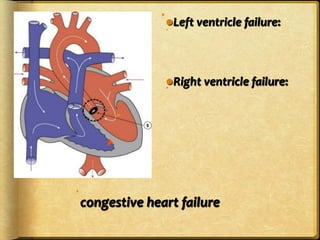
l Left	
  ventricle	
  failure:	
  

l Right	
  ventricle	
  failure:	


congestive	
  heart	
  failure
Heart	
  Physiology	
  
Causes of H.F.
Congenital heart disease
s  coarcatation of aorta.
s  pulmonary stenosis.
s  Cardiomyopathy
s  Bacterial endo carditis
s  Rheumatic carditis.
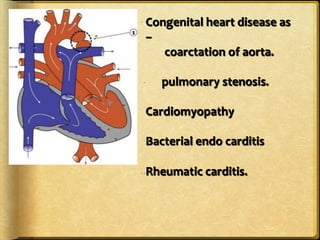
Congenital	
  heart	
  disease	
  as	
  
–	


  coarctation	
  of	
  aorta.	


pulmonary	
  stenosis.	


Cardiomyopathy	


Bacterial	
  endo	
  carditis	


Rheumatic	
  carditis.	
  
ASA Physical Status Classification
for CHF.	
s  ASA-I: No dyspnea, no fatigue with normal
exertion.
s  ASA-II: Mild dyspnea, or fatigue during
exertion.
s  ASA-III:
activity.

Dyspnea or fatigue with normal

s  ASA-IV: Dyspnea, orthopnea and undue
fatigue at all times.
s  ASA-I:
No special modification in
dental ttt.
s  ASA-II:

Can be managed normally
Can use stress reduction prot.

s  ASA-III:

there is ^^^Risk in dental ttt.

so Before any dental management :
ask for medical consultation
apply stress reduction protocol.
s 

ASA-IV:

s  Dental treatment should be withheld for all elective
procedures until the cardiovascular disorder is
controlled.
s  Dental emergencies as pain or infections should be
managed with medication
s  If intervention is necessary the patient should be
hospitalized under a physician care before , during and
after dental treatment.
Clinical	
  Manifestations	
  
Clinical Manifestations
of H.F.	
s 

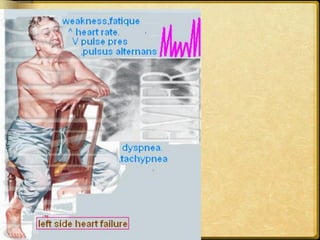
Left ventricular failure:
s 
s 

Weakness and undue fatigue.
Dyspnea:……..degrees of dyspnea
s 

Dyspnea on exertion accompanied by:
s 
s 

s 
s 
s 

Tachypnea.
Cough and expectoration.

Increased urination at night (nocturia).
Orthopnea.
Paroxysmal nocturnal dyspnea (exaggerated form
of orthopnea).
s  NB,
s  The patient awakens from sleep acutely, having
shortening of breath and gasping for air with
respiratory difficulty.
s  There may be inspiratory and expiratory wheeze
……>> cardiac asthma.
s 
s 

Pale, sweaty, cool …skin.
Vital Signs: blood pre……pulse pre…..

s 

Usually increased blood pressure more in diastolic
pr.

s 

Pulse pressure narrow.

s 

H.R. increased.

s 

Pulses alternans (alternating strong and weak heart
beats).

s 

Tachypnea, hyperventilation.
Right Ventricular H.F:
s/s of systemic venous congestion:
s  Peripheral edema:
s  Swelling of feet and ankles: more in day and in
night. Dependent or pitting edema in bedridden -in sacral region.

s  Weakness and fatigue.
s  Cyanosis: especially in mucous membrane.
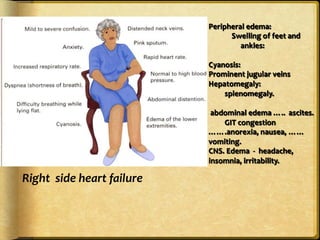
Right	
  	
  side	
  heart	
  failure	

Peripheral	
  edema:	


  Swelling	
  of	
  feet	
  and	


  ankles:	


Cyanosis:	


Prominent	
  jugular	
  veins	


Hepatomegaly:	


  splenomegaly.	


  abdominal	
  edema	
  …..	
  	
  ascites.	
  
	
  GIT	
  congestion	
  
…….anorexia,	
  nausea,	
  	
  ……
vomiting.	
  
CNS.	
  Edema	
  	
  -­‐	
  	
  headache,	


insomnia,	
  irritability.	


s 

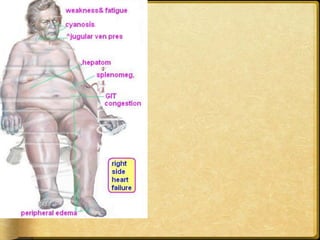
Prominent jugular veins in nect.

s 

Hepatomegaly: splenomegaly.

s 

With progress of edema – abdominal edema
known as ascites.

s 

GIT congestion - anorexia, nausea, vomiting.

s 

CNS. Edema - headache, insomnia,
irritability.
s  3)

Combined left and right vent. V.

s  All previous s/s are present.
s  In addition:
s  Hyperventilation – respiratory alkalosis:
s  Cold hands.
s  Tingling fingers..
s  Anxiety.
Management	
s  R.

Recognize H.F.:
Left ventricular f.
Right ventricular f.
Congestive H.F.

s  T.

Terminate dental procedure:
- Remove dental materials.
s  P.
s 

Position Care:
Should be in comfortable

in most cases – upright position is good
s 

this allows sitting of fluid down in base of lung and
good ventilation for the rest of lung tissue.

s  N.B. If patient looses consc. >>>> place him in supine
position.
s  ABCD (basic life support) as needed
s  M:

Call for medical emergency.

s 

…..

send to hospital…

for other medial treatment as
phlebotomy, O2, drugs, as digitalis,
s 

Calm the patient.

diuretics.
s  Definitive Care:
s 

Give O2.

s 

Monitor vital signs.

s 

Alleviate symptoms.

s  Eg:

*****

^ blood pres………. By :

- phlebotomy (by tourniquets).
- Vasodilators: as
- Nitroglycerin:
s 

Dose : 8 – 1.2 mg/every 5 mint.

s  NB: Blood pressure should be above 100 mg to
give nitroglycerin.
s 

*****of apprehension[…fear..] e.g. by opioid
like drugs as meperidine I.M. 25 mg.

s  Subsequent dental ttt…
s  Episodes of H.F. should be considered.
Dental	
  considerations	
  
s  Patient	
  position	
  (partially	
  recline	
  or	
  erect	
  position).	
  
s  Dental	
  treatment	
  may	
  precipitate	
  dysrhythmias,	
  
angina,	
  or	
  heart	
  failure.	
  
s  For	
  patient	
  with	
  mild	
  controlled	
  cardiac	
  failure,	
  
routine	
  dental	
  care	
  can	
  usually	
  be	
  provided	
  with	
  little	
  
modification.	
  Anxiety	
  must	
  be	
  minimized	
  and	
  pain	
  
control	
  must	
  be	
  fully	
  effective.	
  
s  For	
  patient	
  with	
  poorly	
  controlled	
  or	
  uncontrolled	
  
cardiac	
  failure,	
  medical	
  attention	
  should	
  be	
  obtained	
  
before	
  any	
  dental	
  treatment.	
  	
  
Dental	
  considerations	
  
s  Elective	
  dental	
  treatment	
  should	
  be	
  delayed	
  until	
  the	
  
condition	
  has	
  been	
  stabilized	
  medically.	
  
s  Emergency	
  dental	
  care	
  should	
  be	
  conservative,	
  
principally	
  with	
  analgesics,	
  and	
  antibiotics.	
  
s  Appointments	
  should	
  be	
  short.	
  
s  Patients	
  are	
  best	
  treated	
  in	
  the	
  late	
  morning.	
  
s  An	
  aspirating	
  syringe	
  should	
  be	
  used	
  to	
  give	
  LA.	
  
Epinephrine	
  may	
  increase	
  hypertension	
  and	
  
precipitate	
  dysrhythmias.	
  	
  
Dental	
  considerations	
  
s  Effective	
  analgesia	
  must	
  be	
  provided.	
  
s  Patient	
  on	
  medication	
  such	
  as	
  diuretics	
  may	
  cause	
  
orthostatic	
  hypotension,	
  and	
  therefore	
  patients	
  
should	
  be	
  raised	
  slowly	
  to	
  upright	
  position.	


Congestive heart failure

Congestive heart failure

  • 2.
    Objectives s  Definitions: s  Types: s Causes of H.F. s  ASA Physical Status Classification s  Clinical Manifestations of H.F. s  Management:
  • 3.
    Definition: s heart failure means inabilityof the heart to supply sufficient oxygenated blood for the body needs.
  • 4.
    Types:   Left ventriclefailure: Failure occurs solely in the left ventricle ---s/s are related to congestion of lung. Right ventricle failure: Failure occurs solely in the right ventricle – s/s are related to systemic congestion. Combination of both left and right ventricles failure = congestive heart failure there are both pulmonary &systemic congestion.
  • 5.
    l Left  ventricle  failure:   l Right  ventricle  failure:   congestive  heart  failure
  • 6.
  • 7.
    Causes of H.F. Congenitalheart disease s  coarcatation of aorta. s  pulmonary stenosis. s  Cardiomyopathy s  Bacterial endo carditis s  Rheumatic carditis.
  • 8.
    Congenital  heart  disease  as   –                coarctation  of  aorta.     pulmonary  stenosis.     Cardiomyopathy     Bacterial  endo  carditis     Rheumatic  carditis.  
  • 9.
    ASA Physical StatusClassification for CHF. s  ASA-I: No dyspnea, no fatigue with normal exertion. s  ASA-II: Mild dyspnea, or fatigue during exertion. s  ASA-III: activity. Dyspnea or fatigue with normal s  ASA-IV: Dyspnea, orthopnea and undue fatigue at all times.
  • 11.
    s  ASA-I: No specialmodification in dental ttt. s  ASA-II: Can be managed normally Can use stress reduction prot. s  ASA-III: there is ^^^Risk in dental ttt. so Before any dental management : ask for medical consultation apply stress reduction protocol.
  • 12.
    s  ASA-IV: s  Dental treatmentshould be withheld for all elective procedures until the cardiovascular disorder is controlled. s  Dental emergencies as pain or infections should be managed with medication s  If intervention is necessary the patient should be hospitalized under a physician care before , during and after dental treatment.
  • 13.
  • 14.
    Clinical Manifestations of H.F. s  Leftventricular failure: s  s  Weakness and undue fatigue. Dyspnea:……..degrees of dyspnea s  Dyspnea on exertion accompanied by: s  s  s  s  s  Tachypnea. Cough and expectoration. Increased urination at night (nocturia). Orthopnea. Paroxysmal nocturnal dyspnea (exaggerated form of orthopnea).
  • 15.
    s  NB, s  Thepatient awakens from sleep acutely, having shortening of breath and gasping for air with respiratory difficulty. s  There may be inspiratory and expiratory wheeze ……>> cardiac asthma.
  • 16.
    s  s  Pale, sweaty, cool…skin. Vital Signs: blood pre……pulse pre….. s  Usually increased blood pressure more in diastolic pr. s  Pulse pressure narrow. s  H.R. increased. s  Pulses alternans (alternating strong and weak heart beats). s  Tachypnea, hyperventilation.
  • 18.
    Right Ventricular H.F: s/sof systemic venous congestion: s  Peripheral edema: s  Swelling of feet and ankles: more in day and in night. Dependent or pitting edema in bedridden -in sacral region. s  Weakness and fatigue. s  Cyanosis: especially in mucous membrane.
  • 19.
    Right    side  heart  failure Peripheral  edema:          Swelling  of  feet  and        ankles:                 Cyanosis:       Prominent  jugular  veins       Hepatomegaly:        splenomegaly.      abdominal  edema  …..    ascites.    GIT  congestion   …….anorexia,  nausea,    …… vomiting.   CNS.  Edema    -­‐    headache,       insomnia,  irritability.    
  • 21.
    s  Prominent jugular veinsin nect. s  Hepatomegaly: splenomegaly. s  With progress of edema – abdominal edema known as ascites. s  GIT congestion - anorexia, nausea, vomiting. s  CNS. Edema - headache, insomnia, irritability.
  • 22.
    s  3) Combined leftand right vent. V. s  All previous s/s are present. s  In addition: s  Hyperventilation – respiratory alkalosis: s  Cold hands. s  Tingling fingers.. s  Anxiety.
  • 23.
    Management s  R. Recognize H.F.: Leftventricular f. Right ventricular f. Congestive H.F. s  T. Terminate dental procedure: - Remove dental materials.
  • 24.
    s  P. s  Position Care: Shouldbe in comfortable in most cases – upright position is good s  this allows sitting of fluid down in base of lung and good ventilation for the rest of lung tissue. s  N.B. If patient looses consc. >>>> place him in supine position.
  • 25.
    s  ABCD (basiclife support) as needed s  M: Call for medical emergency. s  ….. send to hospital… for other medial treatment as phlebotomy, O2, drugs, as digitalis, s  Calm the patient. diuretics.
  • 26.
    s  Definitive Care: s  GiveO2. s  Monitor vital signs. s  Alleviate symptoms. s  Eg: ***** ^ blood pres………. By : - phlebotomy (by tourniquets). - Vasodilators: as
  • 27.
    - Nitroglycerin: s  Dose :8 – 1.2 mg/every 5 mint. s  NB: Blood pressure should be above 100 mg to give nitroglycerin.
  • 28.
    s  *****of apprehension[…fear..] e.g.by opioid like drugs as meperidine I.M. 25 mg. s  Subsequent dental ttt… s  Episodes of H.F. should be considered.
  • 29.
    Dental  considerations   s Patient  position  (partially  recline  or  erect  position).   s  Dental  treatment  may  precipitate  dysrhythmias,   angina,  or  heart  failure.   s  For  patient  with  mild  controlled  cardiac  failure,   routine  dental  care  can  usually  be  provided  with  little   modification.  Anxiety  must  be  minimized  and  pain   control  must  be  fully  effective.   s  For  patient  with  poorly  controlled  or  uncontrolled   cardiac  failure,  medical  attention  should  be  obtained   before  any  dental  treatment.    
  • 30.
    Dental  considerations   s Elective  dental  treatment  should  be  delayed  until  the   condition  has  been  stabilized  medically.   s  Emergency  dental  care  should  be  conservative,   principally  with  analgesics,  and  antibiotics.   s  Appointments  should  be  short.   s  Patients  are  best  treated  in  the  late  morning.   s  An  aspirating  syringe  should  be  used  to  give  LA.   Epinephrine  may  increase  hypertension  and   precipitate  dysrhythmias.    
  • 31.
    Dental  considerations   s Effective  analgesia  must  be  provided.   s  Patient  on  medication  such  as  diuretics  may  cause   orthostatic  hypotension,  and  therefore  patients   should  be  raised  slowly  to  upright  position.