FACIAL PALSY
INTRODUCTIONFacial nerve is the VII CN.Facial muscles develop from the mesoderm of second branchial arch.Facial muscles are remnants of panniculuscarnosus ,the subcutaneous muscle of animals.
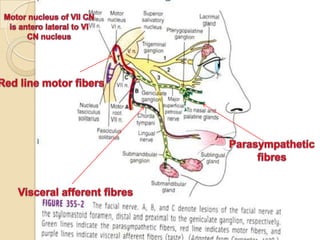
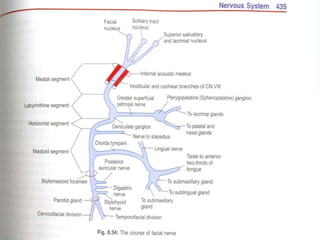
Motor nucleus of VII CN is antero lateral to VI CN nucleus Red line motor fibersParasympathetic fibresVisceral afferent fibres
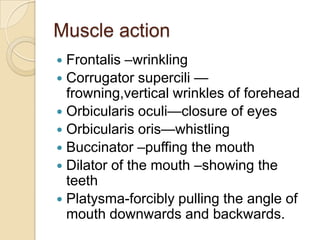
Muscle actionFrontalis –wrinklingCorrugatorsupercili — frowning,vertical wrinkles of foreheadOrbicularisoculi—closure of eyesOrbicularisoris—whistlingBuccinator –puffing the mouthDilator of the mouth –showing the teethPlatysma-forcibly pulling the angle of mouth downwards and backwards.
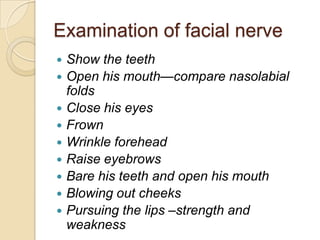
Examination of facial nerveShow the teethOpen his mouth—compare nasolabial foldsClose his eyesFrownWrinkle foreheadRaise eyebrowsBare his teeth and open his mouthBlowing out cheeksPursuing the lips –strength and weakness
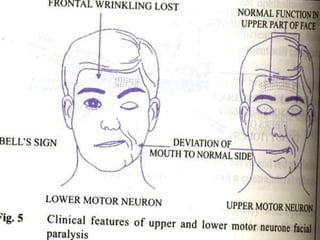
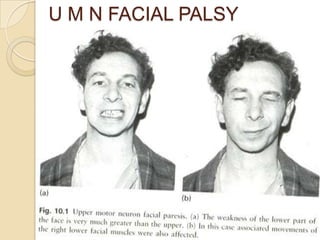
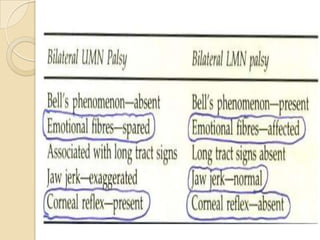
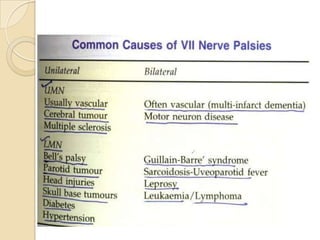
U M N FACIAL PALSY
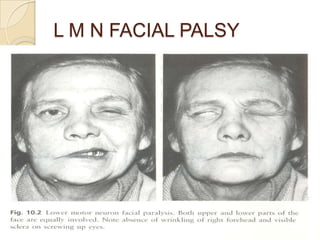
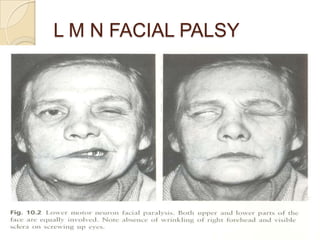
L M N FACIAL PALSY
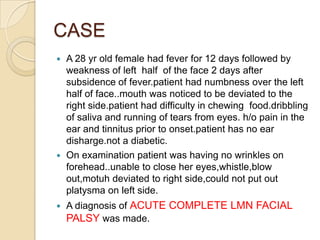
CASEA 28 yr old female had fever for 12 days followed by weakness of left  half  of the face 2 days after subsidence of fever.patient had numbness over the left half of face..mouth was noticed to be deviated to the right side.patient had difficulty in chewing  food.dribbling of saliva and running of tears from eyes. h/o pain in the ear and tinnitus prior to onset.patient has no ear disharge.not a diabetic.On examination patient was having no wrinkles on forehead..unable to close her eyes,whistle,blowout,motuh deviated to right side,could not put out platysma on left side. A diagnosis of ACUTE COMPLETE LMN FACIAL PALSY was made.
Bell’s palsy
DEFINITIONAcute onset of non suppurative  inflammation of the facial nerve above the stylomastoidforamen,producing a unilateral LMN FACIAL PALSY.
BELL’S PALSYIDIOPATHIC  L. M.N FACIAL PALSYHERPES SIMPLEX FACIAL PARALYSIS(ADAM AND VICTOR’S)HERPETIC FACIAL PARALYSIS—(ADAM AND VICTOR’S)Most common form of lower motor neuron facial palsy. Sudden onset of LMN facial palsy.No other neurologic abnormalities.
BELL’S PALSYcont…Incidence is 23/1,00,000Affects men and women equally , all ages ,all times of the year.Increased occurrence in the elderly diabetics, hypertensives than in the common people.Increased incidence in women during the third trimester of pregnancy 2 weeks preceding delivery ,first two weeks postpartum.1 in 6o life time occurrence of single episodeFacial palsy reccurs with each pregnancy .
Etiology:Idiopathic Reactivation of the herpes simplex virus in the geniculate ganglion.Viral agent has long been suspected –(BARINGER)
Patho physiologyHSV I DNA in the endoneural fluid .,post auricular muscle---due to reactivation of the virus in the geniuclate ganglion.Inactivated intra nasal influenza vaccine can cause bells palsy.No adequate  data to support the above relation.
Onset of bell’s palsy is acute.½ of the cases attain maximum paralysis in 48 hours.All cases are clinically prominent by 5 days.
Pain behind the ear may precede the paralysis by a day or two .Impairement of taste is present to some degree in all cases –rarely beyond second week of paralysis.Hyperacusis or distortion of sound in ipsilateral ear ---paralysis of stapedius muscle.
Patient feels stiffness of face pulled to one side.Ipsilateral restriction of eye closure, difficulty with eating ,fine facial movements.Disturbance of taste –chorda tympani fibresHyperacusis—fibers to stapedius
Paralysis is partial in 30%,complete in 70%cases.Emotional fibres are affectedJaw jerk is normalCorneal reflex is absentThese differentiate it from UMN  palsy
BELL’S PHENOMENONNormally on closing the eye ,the eyeball moves upwards and inwards.This is obvious on the affected side due to ineffective closure of the eyelids.
ClinicallyCorner of mouth droopsCrease and skin folds effacesForehead is unfurrowedEyelids will not closeEye on the paralysed side rolls upward –BELL’S PHENOMENONLower lid sags and falls away from conjunctivaTears spill over cheekFood collects between the teeth and lipsSaliva may dribble from the corner of the mouthHeaviness or numbeness of the faceSensory loss rarely demonstratble
Enhancement of the facial nerve on gadolinium enhanced MRIIncreased lymphocytes ,mononuclear cells in CSF.Other testsTensilon testShirmer testESRBlood glucose levels
Prognosis80% patients recover within a few weeks.2-12 weeks.10%--permanent disfigurement.long term sequelae.8%--recurrenceBest clinical guide to progress is the severity of the palsy during the first few days after presentation.Recovery of taste precedes motor function.
Clinically complete palsy when first seen are less likely to make a full recovery—than incomplete oneAdvanced ageHyperacusis—persistentSevere initial pain.
If recovery of taste occurs in first week –good prognostic sign.Early recovery of motor function in the first 5-7 days— most favourable prognosis.Recurrence is due to reactivation of virus,pregnancy.Interval between periods is not predictable.
TreatmentControversialSymptomaticProtection of eye during the sleep   patchMassage of the weakened muscles   Lubricating eye dropsPrednisolone 60-80 mg/day in divided doses intial 4-5 days,then taper over next 7-10 days.Decreases the possibility of permanent paralysisFrom swelling of facial nerve in facial canal.Decreases the severe pain.
Acyclovir alone is not useful.No evidence that surgical decompression of facial nerve is effective ---may be harmfulAcyclovir 400mg 5 times a day –10 days is not recommendedValacyclovir 1000mg /day 5-7 days-not recommended.
ComplicationsContracture develops in the paralysed muscles—normal appearance---evident when patient smiles.
Denervation after ten days---axonal degeneration.Electromyography Nerve excitability Nerve conduction studies are useful for prognosis.
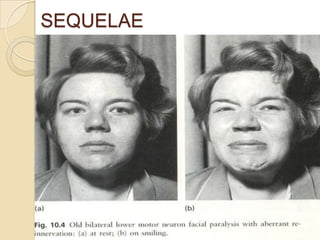
Long delay in the onset of recovery—3monthsRegeneration of nerve –2 yearsIncompleteCrocodile tearsJaw winkingSynkinesisFacial spasmsSequelae
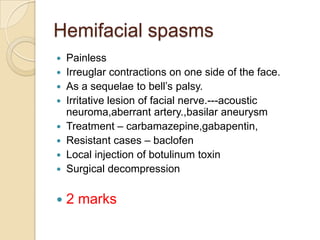
Hemifacial spasmsPainless Irreuglar contractions on one side of the face.As a sequelae to bell’s palsy.Irritative lesion of facial nerve.---acoustic neuroma,aberrantartery.,basilar aneurysmTreatment – carbamazepine,gabapentin,Resistant cases – baclofenLocal injection of botulinum toxin Surgical decompression2 marks
SEQUELAE
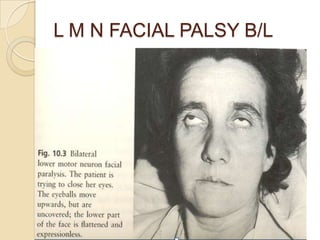
Facial diplegiab/l LMN facial palsySeen in Guillainbarre syndromeMiller fischer variantSarcoidosisLyme diseaseMobius syndromeMelkersonrosenthal  syndrome
L M N FACIAL PALSY
L M N FACIAL PALSY B/L
MELKERSSEN ROSENTHAL SYNDROMERECURRENT FACIAL PARLAYSISLABIAL EDEMAPLICATION OF TONGUE2 MARKS
D.DIAGNOSISLyme diseaseRamsay hunt syndromeSarcoidosisGuillainbarre syndromeLeprosyDiabetesSjogrensAmyloidosisMelkersonrosenthal syndromeAcoustic neuromaMutiple sclerosisMiddle ear infectionsCarotid body tumorsCholesteatoma
summaryIdiopathic LMN  FACIAL palsy is bells’; palsyRecovery is the rulePrednisolone 60- 80 mg for five days .
Thank you

Bell’s palsy

  • 1.
  • 2.
    INTRODUCTIONFacial nerve isthe VII CN.Facial muscles develop from the mesoderm of second branchial arch.Facial muscles are remnants of panniculuscarnosus ,the subcutaneous muscle of animals.
  • 3.
    Motor nucleus ofVII CN is antero lateral to VI CN nucleus Red line motor fibersParasympathetic fibresVisceral afferent fibres
  • 5.
    Muscle actionFrontalis –wrinklingCorrugatorsupercili— frowning,vertical wrinkles of foreheadOrbicularisoculi—closure of eyesOrbicularisoris—whistlingBuccinator –puffing the mouthDilator of the mouth –showing the teethPlatysma-forcibly pulling the angle of mouth downwards and backwards.
  • 6.
    Examination of facialnerveShow the teethOpen his mouth—compare nasolabial foldsClose his eyesFrownWrinkle foreheadRaise eyebrowsBare his teeth and open his mouthBlowing out cheeksPursuing the lips –strength and weakness
  • 8.
    U M NFACIAL PALSY
  • 9.
    L M NFACIAL PALSY
  • 10.
    CASEA 28 yrold female had fever for 12 days followed by weakness of left half of the face 2 days after subsidence of fever.patient had numbness over the left half of face..mouth was noticed to be deviated to the right side.patient had difficulty in chewing food.dribbling of saliva and running of tears from eyes. h/o pain in the ear and tinnitus prior to onset.patient has no ear disharge.not a diabetic.On examination patient was having no wrinkles on forehead..unable to close her eyes,whistle,blowout,motuh deviated to right side,could not put out platysma on left side. A diagnosis of ACUTE COMPLETE LMN FACIAL PALSY was made.
  • 11.
  • 12.
    DEFINITIONAcute onset ofnon suppurative inflammation of the facial nerve above the stylomastoidforamen,producing a unilateral LMN FACIAL PALSY.
  • 13.
    BELL’S PALSYIDIOPATHIC L. M.N FACIAL PALSYHERPES SIMPLEX FACIAL PARALYSIS(ADAM AND VICTOR’S)HERPETIC FACIAL PARALYSIS—(ADAM AND VICTOR’S)Most common form of lower motor neuron facial palsy. Sudden onset of LMN facial palsy.No other neurologic abnormalities.
  • 14.
    BELL’S PALSYcont…Incidence is23/1,00,000Affects men and women equally , all ages ,all times of the year.Increased occurrence in the elderly diabetics, hypertensives than in the common people.Increased incidence in women during the third trimester of pregnancy 2 weeks preceding delivery ,first two weeks postpartum.1 in 6o life time occurrence of single episodeFacial palsy reccurs with each pregnancy .
  • 15.
    Etiology:Idiopathic Reactivation ofthe herpes simplex virus in the geniculate ganglion.Viral agent has long been suspected –(BARINGER)
  • 16.
    Patho physiologyHSV IDNA in the endoneural fluid .,post auricular muscle---due to reactivation of the virus in the geniuclate ganglion.Inactivated intra nasal influenza vaccine can cause bells palsy.No adequate data to support the above relation.
  • 17.
    Onset of bell’spalsy is acute.½ of the cases attain maximum paralysis in 48 hours.All cases are clinically prominent by 5 days.
  • 18.
    Pain behind theear may precede the paralysis by a day or two .Impairement of taste is present to some degree in all cases –rarely beyond second week of paralysis.Hyperacusis or distortion of sound in ipsilateral ear ---paralysis of stapedius muscle.
  • 19.
    Patient feels stiffnessof face pulled to one side.Ipsilateral restriction of eye closure, difficulty with eating ,fine facial movements.Disturbance of taste –chorda tympani fibresHyperacusis—fibers to stapedius
  • 20.
    Paralysis is partialin 30%,complete in 70%cases.Emotional fibres are affectedJaw jerk is normalCorneal reflex is absentThese differentiate it from UMN palsy
  • 21.
    BELL’S PHENOMENONNormally onclosing the eye ,the eyeball moves upwards and inwards.This is obvious on the affected side due to ineffective closure of the eyelids.
  • 22.
    ClinicallyCorner of mouthdroopsCrease and skin folds effacesForehead is unfurrowedEyelids will not closeEye on the paralysed side rolls upward –BELL’S PHENOMENONLower lid sags and falls away from conjunctivaTears spill over cheekFood collects between the teeth and lipsSaliva may dribble from the corner of the mouthHeaviness or numbeness of the faceSensory loss rarely demonstratble
  • 23.
    Enhancement of thefacial nerve on gadolinium enhanced MRIIncreased lymphocytes ,mononuclear cells in CSF.Other testsTensilon testShirmer testESRBlood glucose levels
  • 24.
    Prognosis80% patients recoverwithin a few weeks.2-12 weeks.10%--permanent disfigurement.long term sequelae.8%--recurrenceBest clinical guide to progress is the severity of the palsy during the first few days after presentation.Recovery of taste precedes motor function.
  • 25.
    Clinically complete palsywhen first seen are less likely to make a full recovery—than incomplete oneAdvanced ageHyperacusis—persistentSevere initial pain.
  • 26.
    If recovery oftaste occurs in first week –good prognostic sign.Early recovery of motor function in the first 5-7 days— most favourable prognosis.Recurrence is due to reactivation of virus,pregnancy.Interval between periods is not predictable.
  • 27.
    TreatmentControversialSymptomaticProtection of eyeduring the sleep patchMassage of the weakened muscles Lubricating eye dropsPrednisolone 60-80 mg/day in divided doses intial 4-5 days,then taper over next 7-10 days.Decreases the possibility of permanent paralysisFrom swelling of facial nerve in facial canal.Decreases the severe pain.
  • 28.
    Acyclovir alone isnot useful.No evidence that surgical decompression of facial nerve is effective ---may be harmfulAcyclovir 400mg 5 times a day –10 days is not recommendedValacyclovir 1000mg /day 5-7 days-not recommended.
  • 29.
    ComplicationsContracture develops inthe paralysed muscles—normal appearance---evident when patient smiles.
  • 30.
    Denervation after tendays---axonal degeneration.Electromyography Nerve excitability Nerve conduction studies are useful for prognosis.
  • 31.
    Long delay inthe onset of recovery—3monthsRegeneration of nerve –2 yearsIncompleteCrocodile tearsJaw winkingSynkinesisFacial spasmsSequelae
  • 32.
    Hemifacial spasmsPainless Irreuglarcontractions on one side of the face.As a sequelae to bell’s palsy.Irritative lesion of facial nerve.---acoustic neuroma,aberrantartery.,basilar aneurysmTreatment – carbamazepine,gabapentin,Resistant cases – baclofenLocal injection of botulinum toxin Surgical decompression2 marks
  • 33.
  • 36.
    Facial diplegiab/l LMNfacial palsySeen in Guillainbarre syndromeMiller fischer variantSarcoidosisLyme diseaseMobius syndromeMelkersonrosenthal syndrome
  • 37.
    L M NFACIAL PALSY
  • 38.
    L M NFACIAL PALSY B/L
  • 39.
    MELKERSSEN ROSENTHAL SYNDROMERECURRENTFACIAL PARLAYSISLABIAL EDEMAPLICATION OF TONGUE2 MARKS
  • 40.
    D.DIAGNOSISLyme diseaseRamsay huntsyndromeSarcoidosisGuillainbarre syndromeLeprosyDiabetesSjogrensAmyloidosisMelkersonrosenthal syndromeAcoustic neuromaMutiple sclerosisMiddle ear infectionsCarotid body tumorsCholesteatoma
  • 41.
    summaryIdiopathic LMN FACIAL palsy is bells’; palsyRecovery is the rulePrednisolone 60- 80 mg for five days .
  • 42.