
Mr Veerabhadra.B.Badiger
Asst Professor
Dept of Medical Surgical Nsg. 1
v4veeru25@gmail.com
2
v4veeru25@gmail.com
Myocarditis
Myocarditis is an inflammation of the heart
muscle (myocardium).
Myocarditis can affect heart muscle and
heart's electrical conduction system, reducing
heart's ability to pump and causing rapid or
abnormal heart rhythms (arrhythmias)
3
v4veeru25@gmail.com
The incidence of myocarditis is estimated
to be 1 to 10 cases per 100,000 persons
Patients may develop dilated
cardiomyopathy and heart failure.
4
v4veeru25@gmail.com
Causes for myocarditis
Infection viral adenovirus ,COVID-19,
hepatitis B and C; parvovirus,
 Bacterial (staphylococcus, streptococcus)
Mycotic,
Parasitic Trypanosoma cruzi and toxoplasma,
protozoal, or spirochetal infection.
5
v4veeru25@gmail.com
Fungal Yeast infections, candida ,
aspergillus; histoplasma
Systemic infections such as rheumatic fever
Immunosuppressive therapy.
Auto immune disorder.
 Infective endocarditis.
Allergic drug reaction ex:-penicillin and
sulfonamide drugs
6
v4veeru25@gmail.com
Clinical features
Chest pain
Rapid or abnormal heart rhythms (arrhythmias)
Shortness of breath
Edema in legs, ankles and feet
Fatigue
Other signs and symptoms such as a
Headache, body aches, joint pain, fever, a sore
throat diarrhea
7
v4veeru25@gmail.com
Diagnostic studies
History collection
Physical examination.
Blood testing: CBC , RFT, LFT, CRP , cardiac
enzymes
Chest x-ray : to show chest anatomy and potential
signs of heart failure
Electrocardiogram (ECG): to detect abnormal heart
rates and rhythms
8
v4veeru25@gmail.com
Echocardiogram (ultrasound imaging of the
heart): to help detect structural or functional
issues in the heart and adjacent vessels
Myocardial biopsy (sampling of heart muscle
tissue): may be performed during a cardiac
catheterization to allow the doctor to examine a
small piece of muscular tissue from the heart
9
v4veeru25@gmail.com
Management
Treatment for myocarditis may include:
Corticosteroidtherapy (to help reduce inflammation)
Cardiac medications, such as a beta-blocker, ACE
inhibitor,
Rest, fluid restriction, and a low-salt diet
Diuretictherapy to treat fluid overload
Antibiotic therapy
10
v4veeru25@gmail.com
Treating severe cases
In some severe cases of myocarditis, aggressive treatment
might include:
Ventricular assist devices. Ventricular assist devices
(VADs) are mechanical pumps that help pump blood
from the lower chambers of heart (the ventricles) to the
rest of body.
VADs are used in people who have weakened hearts or
heart failure. This treatment may be used to allow the
heart to recover or while waiting for other treatments,
such as a heart transplant.
11
v4veeru25@gmail.com
Intra-aortic balloon pump. Doctors insert a catheter in a
blood vessel in leg and guide it to heart using X-ray
imaging. Doctors place a balloon attached to the end of the
catheter in the main artery leading out to aorta. As the
balloon inflates and deflates, it helps to increase blood flow
and decrease the workload on the heart.
12
v4veeru25@gmail.com
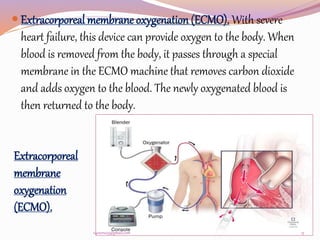
 Extracorporeal membrane oxygenation (ECMO). With severe
heart failure, this device can provide oxygen to the body. When
blood is removed from the body, it passes through a special
membrane in the ECMO machine that removes carbon dioxide
and adds oxygen to the blood. The newly oxygenated blood is
then returned to the body.
13
v4veeru25@gmail.com
Extracorporeal
membrane
oxygenation
(ECMO).
Nursing diagnosis
Acute Pain related to infection & inflammation.
Risk for Decreased Cardiac Output related to myocardial
infection.
Risk for Ineffective Tissue Perfusion reduced blood pressure.
Deficient Knowledge
Activcity Intolerance related to imbalance between oxygen
supply (delivery) and demand
Fear/Anxiety
14
v4veeru25@gmail.com
v4veeru25@gmail.com 15

Myocarditis

  • 1.
    Mr Veerabhadra.B.Badiger Asst Professor Deptof Medical Surgical Nsg. 1 v4veeru25@gmail.com
  • 2.
  • 3.
    Myocarditis Myocarditis is aninflammation of the heart muscle (myocardium). Myocarditis can affect heart muscle and heart's electrical conduction system, reducing heart's ability to pump and causing rapid or abnormal heart rhythms (arrhythmias) 3 v4veeru25@gmail.com
  • 4.
    The incidence ofmyocarditis is estimated to be 1 to 10 cases per 100,000 persons Patients may develop dilated cardiomyopathy and heart failure. 4 v4veeru25@gmail.com
  • 5.
    Causes for myocarditis Infectionviral adenovirus ,COVID-19, hepatitis B and C; parvovirus,  Bacterial (staphylococcus, streptococcus) Mycotic, Parasitic Trypanosoma cruzi and toxoplasma, protozoal, or spirochetal infection. 5 v4veeru25@gmail.com
  • 6.
    Fungal Yeast infections,candida , aspergillus; histoplasma Systemic infections such as rheumatic fever Immunosuppressive therapy. Auto immune disorder.  Infective endocarditis. Allergic drug reaction ex:-penicillin and sulfonamide drugs 6 v4veeru25@gmail.com
  • 7.
    Clinical features Chest pain Rapidor abnormal heart rhythms (arrhythmias) Shortness of breath Edema in legs, ankles and feet Fatigue Other signs and symptoms such as a Headache, body aches, joint pain, fever, a sore throat diarrhea 7 v4veeru25@gmail.com
  • 8.
    Diagnostic studies History collection Physicalexamination. Blood testing: CBC , RFT, LFT, CRP , cardiac enzymes Chest x-ray : to show chest anatomy and potential signs of heart failure Electrocardiogram (ECG): to detect abnormal heart rates and rhythms 8 v4veeru25@gmail.com
  • 9.
    Echocardiogram (ultrasound imagingof the heart): to help detect structural or functional issues in the heart and adjacent vessels Myocardial biopsy (sampling of heart muscle tissue): may be performed during a cardiac catheterization to allow the doctor to examine a small piece of muscular tissue from the heart 9 v4veeru25@gmail.com
  • 10.
    Management Treatment for myocarditismay include: Corticosteroidtherapy (to help reduce inflammation) Cardiac medications, such as a beta-blocker, ACE inhibitor, Rest, fluid restriction, and a low-salt diet Diuretictherapy to treat fluid overload Antibiotic therapy 10 v4veeru25@gmail.com
  • 11.
    Treating severe cases Insome severe cases of myocarditis, aggressive treatment might include: Ventricular assist devices. Ventricular assist devices (VADs) are mechanical pumps that help pump blood from the lower chambers of heart (the ventricles) to the rest of body. VADs are used in people who have weakened hearts or heart failure. This treatment may be used to allow the heart to recover or while waiting for other treatments, such as a heart transplant. 11 v4veeru25@gmail.com
  • 12.
    Intra-aortic balloon pump.Doctors insert a catheter in a blood vessel in leg and guide it to heart using X-ray imaging. Doctors place a balloon attached to the end of the catheter in the main artery leading out to aorta. As the balloon inflates and deflates, it helps to increase blood flow and decrease the workload on the heart. 12 v4veeru25@gmail.com
  • 13.
     Extracorporeal membraneoxygenation (ECMO). With severe heart failure, this device can provide oxygen to the body. When blood is removed from the body, it passes through a special membrane in the ECMO machine that removes carbon dioxide and adds oxygen to the blood. The newly oxygenated blood is then returned to the body. 13 v4veeru25@gmail.com Extracorporeal membrane oxygenation (ECMO).
  • 14.
    Nursing diagnosis Acute Painrelated to infection & inflammation. Risk for Decreased Cardiac Output related to myocardial infection. Risk for Ineffective Tissue Perfusion reduced blood pressure. Deficient Knowledge Activcity Intolerance related to imbalance between oxygen supply (delivery) and demand Fear/Anxiety 14 v4veeru25@gmail.com
  • 15.