Chapter 4 B.M.H The Central Process Unit
Learning Objectives List the measures of computer processing speed and explain the approaches that increase speed. Microprocessor speed Memory cache Flash memory RISC computers Parallel processing MIU P4-116
What makes a computer fast? Factors Microprocessor speed Bus line size Availability of cache ( More sophisticated ones ) Flash memory RISC computers Parallel processing MIU
Computer processing speeds The execution of an instruction  may be measured in Millisecond : 1/10 3  of a second very slow (old) computer Microsecond : 1/10 6  of a second Nanosecond : 1/10 9  of a second modern computer Picosecond : 1/10 12  of a second MIU
Computer processing speeds Microprocessor speeds are determined by  Microprocessor ’ s clock speed MIPS Megaflop MIU
Microprocessor ’ s clock speed Usually expressed in  megahertz (MHz)  10 6  of machine cycles per second gigahertz (GHz)  10 9  of machine cycles per second Ex. a PC listed at 500MHz : capable of handling 500*10 6  machine cycles/s    Direct comparison of clock speeds Meaningful only between identical microprocessors MIU
MIPS One  m illion  i nstructions  p er  s econd Ex. A computer with speed of 0.5MIPS : execute 500,000 instructions per second High-speed personal computer  : perform at 100 MIPS and higher. A more accurate measure than clock speed MIU
Megaflop One  m illion  flo ating- p oint operation per second The ability of the computer to perform complex mathematical operation. MIU
Cache Temporary storage area Designed to speed up data transfer within the computer Types  Memory cache Disk cache ; chapter 6 MIU
Memory cache A relatively small block of very fast memory Designed for the specific purpose of  speeding up  the internal transfer of data and software instructions. The data and instructions stored in cache  : are  most recently or most frequently used. Types  Internal cache External cache MIU
Memory cache MIU
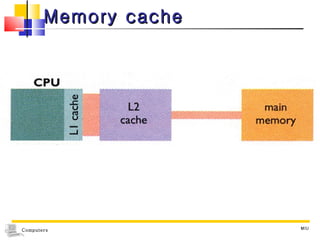
Memory cache Internal cache, Level 1 (L1) cache In the processor The fastest sort Takes up precious space and increase the cost of the microprocessor No more than 128KB  External cache, Level 2 (L2) cache On separate chips Probably 256KB or 512KB SRAM technology Cheaper and slower than L1 cache much faster (and more expensive) than memory MIU
Flash Memory    Memory : volatile    Secondary storage : slow rate Flash memory nonvolatile RAM Faster than secondary storage Used in cellular phones, digital cameras, and digital music recorders Replacing disks in some handheld computers Being produced in credit card Smaller than a disk drive  Require only half the power MIU
RISC Technology Instruction set a specific group of instructions  that each type of CPU is designed to understand  such as ADD or MOVE A single program instruction May be made up of a substantial number of subinstructions, each of which must take at least one machine cycle Instructions set computing types CISC ( Complex instruction set computing ) RISC ( Reduced instruction set computing ) MIU
RISC Technology CISC ( Complex instruction set computing) Many of the most complex instructions in the instruction set are rarely used A problem to speedy performance Intel ’ s Pentium family RISC ( Reduced instruction set computing) Small subset of instructions Increase the speed Programs in graphics and engineering areas A significant performance advantage PowerPCs and Alphas MIU
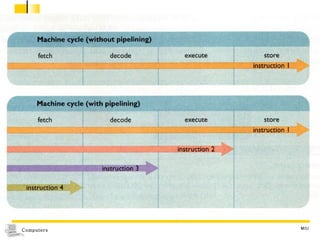
Parallel Processing Serial processing The execution of one instruction at a time Pipelining  An instruction action doesn ’ t need to be completed before the next instruction action is begun. An instruction : One fetch is complete for it and it moves to decode. the next instruction : Fetch is begun for the next.    Problem : a single electronic pathway (bus line) acts like a bottle neck. MIU
MIU
Parallel Processing A method of using multiple processors at the same time Many processor, each with its own memory unit, working at the same time Ultimate speed solution Capable of operating in term of teraflops Trillions of floating-point instruction per second Network server : with 4 to 16 processors Supercomputer : with 100 or 1000 processors MIU

Computers8 Ch4 3

  • 1.
    Chapter 4 B.M.HThe Central Process Unit
  • 2.
    Learning Objectives Listthe measures of computer processing speed and explain the approaches that increase speed. Microprocessor speed Memory cache Flash memory RISC computers Parallel processing MIU P4-116
  • 3.
    What makes acomputer fast? Factors Microprocessor speed Bus line size Availability of cache ( More sophisticated ones ) Flash memory RISC computers Parallel processing MIU
  • 4.
    Computer processing speedsThe execution of an instruction may be measured in Millisecond : 1/10 3 of a second very slow (old) computer Microsecond : 1/10 6 of a second Nanosecond : 1/10 9 of a second modern computer Picosecond : 1/10 12 of a second MIU
  • 5.
    Computer processing speedsMicroprocessor speeds are determined by Microprocessor ’ s clock speed MIPS Megaflop MIU
  • 6.
    Microprocessor ’ sclock speed Usually expressed in megahertz (MHz) 10 6 of machine cycles per second gigahertz (GHz) 10 9 of machine cycles per second Ex. a PC listed at 500MHz : capable of handling 500*10 6 machine cycles/s  Direct comparison of clock speeds Meaningful only between identical microprocessors MIU
  • 7.
    MIPS One m illion i nstructions p er s econd Ex. A computer with speed of 0.5MIPS : execute 500,000 instructions per second High-speed personal computer : perform at 100 MIPS and higher. A more accurate measure than clock speed MIU
  • 8.
    Megaflop One m illion flo ating- p oint operation per second The ability of the computer to perform complex mathematical operation. MIU
  • 9.
    Cache Temporary storagearea Designed to speed up data transfer within the computer Types Memory cache Disk cache ; chapter 6 MIU
  • 10.
    Memory cache Arelatively small block of very fast memory Designed for the specific purpose of speeding up the internal transfer of data and software instructions. The data and instructions stored in cache : are most recently or most frequently used. Types Internal cache External cache MIU
  • 11.
  • 12.
    Memory cache Internalcache, Level 1 (L1) cache In the processor The fastest sort Takes up precious space and increase the cost of the microprocessor No more than 128KB External cache, Level 2 (L2) cache On separate chips Probably 256KB or 512KB SRAM technology Cheaper and slower than L1 cache much faster (and more expensive) than memory MIU
  • 13.
    Flash Memory  Memory : volatile  Secondary storage : slow rate Flash memory nonvolatile RAM Faster than secondary storage Used in cellular phones, digital cameras, and digital music recorders Replacing disks in some handheld computers Being produced in credit card Smaller than a disk drive Require only half the power MIU
  • 14.
    RISC Technology Instructionset a specific group of instructions that each type of CPU is designed to understand such as ADD or MOVE A single program instruction May be made up of a substantial number of subinstructions, each of which must take at least one machine cycle Instructions set computing types CISC ( Complex instruction set computing ) RISC ( Reduced instruction set computing ) MIU
  • 15.
    RISC Technology CISC( Complex instruction set computing) Many of the most complex instructions in the instruction set are rarely used A problem to speedy performance Intel ’ s Pentium family RISC ( Reduced instruction set computing) Small subset of instructions Increase the speed Programs in graphics and engineering areas A significant performance advantage PowerPCs and Alphas MIU
  • 16.
    Parallel Processing Serialprocessing The execution of one instruction at a time Pipelining An instruction action doesn ’ t need to be completed before the next instruction action is begun. An instruction : One fetch is complete for it and it moves to decode. the next instruction : Fetch is begun for the next.  Problem : a single electronic pathway (bus line) acts like a bottle neck. MIU
  • 17.
  • 18.
    Parallel Processing Amethod of using multiple processors at the same time Many processor, each with its own memory unit, working at the same time Ultimate speed solution Capable of operating in term of teraflops Trillions of floating-point instruction per second Network server : with 4 to 16 processors Supercomputer : with 100 or 1000 processors MIU