Computer Evolution and Performance
ENIAC - BACKGROUND
 Electronic Numerical Integrator And Computer
 Eckert and Mauchly
 University of Pennsylvania
 Trajectory tables for weapons
 Started 1943
 Finished 1946
 Too late for war effort
 Used until 1955
ENIAC - DETAILS
 Decimal (not binary)
 20 accumulators of 10 digits
 Programmed manually by switches
 18,000 vacuum tubes
 30 tons
 15,000 square feet
 140 kW power consumption
 5,000 additions per second
VON NEUMANN/TURING
 Stored Program concept
 Main memory storing programs and data
 ALU operating on binary data
 Control unit interpreting instructions from memory
and executing
 Input and output equipment operated by control unit
 Princeton Institute for Advanced Studies
 IAS
 Completed 1952
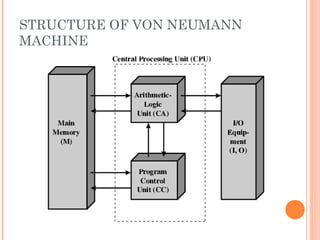
STRUCTURE OF VON NEUMANN
MACHINE
IAS - DETAILS
 1000 x 40 bit words
 Binary number
 2 x 20 bit instructions
 Set of registers (storage in CPU)
 Memory Buffer Register
 Memory Address Register
 Instruction Register
 Instruction Buffer Register
 Program Counter
 Accumulator
 Multiplier Quotient
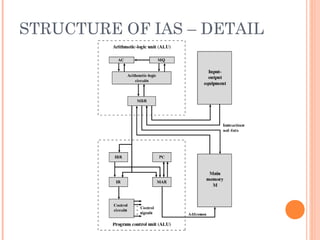
STRUCTURE OF IAS – DETAIL
CONT..
MBR – contains a word to be stored in memory or
sent to the I/O unit, or is used to receive a word
from memory or from the I/O unit.
MAR – specifies the address in memory of the word
to be written from or read into MBR.
IR – contains 8-bit opcode instruction being
executed.
PC – contains the address of the next instruction
AC and MQ – hold temporarily operands.
COMMERCIAL COMPUTERS
 1947 - Eckert-Mauchly Computer Corporation
 UNIVAC I (Universal Automatic Computer)
 US Bureau of Census 1950 calculations
 Became part of Sperry-Rand Corporation
 Late 1950s - UNIVAC II
 Faster
 More memory
IBM
 Punched-card processing equipment
 1953 - the 701
 IBM’s first stored program computer
 Scientific calculations
 1955 - the 702
 Business applications
 Lead to 700/7000 series
TRANSISTORS
 Replaced vacuum tubes
 Smaller
 Cheaper
 Less heat dissipation
 Solid State device
 Made from Silicon (Sand)
 Invented 1947 at Bell Labs
 William Shockley et al.
TRANSISTOR BASED COMPUTERS
 Second generation machines
 NCR & RCA produced small transistor machines
 IBM 7000
 DEC - 1957
 Produced PDP-1
MICROELECTRONICS
 Literally - “small electronics”
 A computer is made up of gates, memory cells
and interconnections
 These can be manufactured on a semiconductor
 e.g. silicon wafer
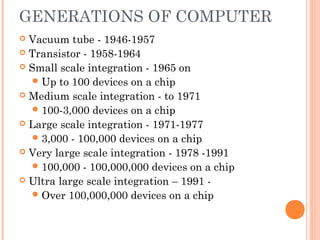
GENERATIONS OF COMPUTER
 Vacuum tube - 1946-1957
 Transistor - 1958-1964
 Small scale integration - 1965 on
Up to 100 devices on a chip
 Medium scale integration - to 1971
100-3,000 devices on a chip
 Large scale integration - 1971-1977
3,000 - 100,000 devices on a chip
 Very large scale integration - 1978 -1991
100,000 - 100,000,000 devices on a chip
 Ultra large scale integration – 1991 -
Over 100,000,000 devices on a chip
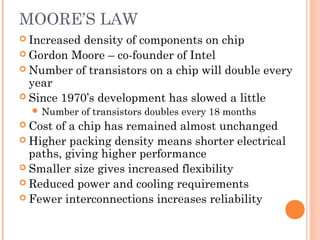
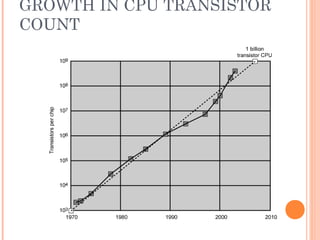
MOORE’S LAW
 Increased density of components on chip
 Gordon Moore – co-founder of Intel
 Number of transistors on a chip will double every
year
 Since 1970’s development has slowed a little
 Number of transistors doubles every 18 months
 Cost of a chip has remained almost unchanged
 Higher packing density means shorter electrical
paths, giving higher performance
 Smaller size gives increased flexibility
 Reduced power and cooling requirements
 Fewer interconnections increases reliability
GROWTH IN CPU TRANSISTOR
COUNT
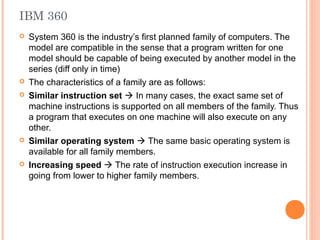
IBM 360
 System 360 is the industry’s first planned family of computers. The
model are compatible in the sense that a program written for one
model should be capable of being executed by another model in the
series (diff only in time)
 The characteristics of a family are as follows:
 Similar instruction set  In many cases, the exact same set of
machine instructions is supported on all members of the family. Thus
a program that executes on one machine will also execute on any
other.
 Similar operating system  The same basic operating system is
available for all family members.
 Increasing speed  The rate of instruction execution increase in
going from lower to higher family members.
CONT..
 Increasing I/O port In going from lower
to higher family members.
 Increasing memory  In going from lower
to higher family members.
 Increasing cost  In going from lower to
higher family members.
DEC PDP-8
 1964
 First minicomputer.
 Did not need air conditioned room
 Small enough to sit on a lab bench
 Cheap $16,000, IBM360 $100k.
 Embedded applications & OEM
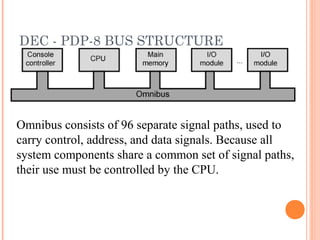
 Use BUS STRUCTURE- Omnibus
DEC - PDP-8 BUS STRUCTURE
Omnibus consists of 96 separate signal paths, used to
carry control, address, and data signals. Because all
system components share a common set of signal paths,
their use must be controlled by the CPU.
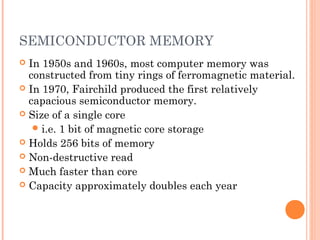
SEMICONDUCTOR MEMORY
 In 1950s and 1960s, most computer memory was
constructed from tiny rings of ferromagnetic material.
 In 1970, Fairchild produced the first relatively
capacious semiconductor memory.
 Size of a single core
i.e. 1 bit of magnetic core storage
 Holds 256 bits of memory
 Non-destructive read
 Much faster than core
 Capacity approximately doubles each year
INTEL
 1971 – Intel developed 4004
 First microprocessor
 Contain all CPU components on a single chip
 4 bit
 Followed in 1972 by 8008
 8 bit
 4004, 8008 designed for specific applications
 1974 - 8080
 Intel’s first general purpose microprocessor
SPEEDING IT UP
 Pipelining
 On board cache
 On board L1 & L2 cache
 Branch prediction – the processor looks ahead in the
instruction code fetched from memory and predicts which
branches, or group of instructions to be process next.
 Data flow analysis – the processor analyzes which
instructions are dependent on each other’s result, or data,
to create an optimized schedule of instructions.
 Speculative execution – using branch prediction and
data flow analysis, some processor speculatively execute
instructions ahead of their actual appearance in the
program execution, holding the results in temporary
locations. This enables the processor to keep its execution
engines as busy as possible by executing instruction that
are likely to be needed.
PERFORMANCE BALANCE
 Processor speed increased
 Memory capacity increased
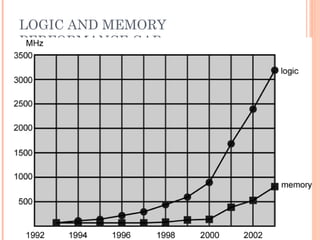
 Memory speed lags behind processor speed
LOGIC AND MEMORY
PERFORMANCE GAP
SOLUTIONS
 Increase the number of bits that are retrieved at one
time by making DRAMs “wider” rather than “deeper”
and by using wide bus data paths.
 Change the DRAM interface to make it more efficient
by including a cache or other buffering scheme on the
DRAM.
 Reduce the frequency of memory access by
incorporating increasingly complex and efficient
cache structures between the processor and main
memory. Incorporation of one or more caches on the
processor chip.
 Increase the interconnect bandwidth between
processors and memory by using higher-speed buses
and using hierarchy of buses to buffer and structure
data flow.
I/O DEVICES
 Peripherals with intensive I/O demands
 Large data throughput demands
 Processors can handle this
 Problem moving data
 Solutions:
 Caching
 Buffering
 Higher-speed interconnection buses
 More elaborate bus structures
 Multiple-processor configurations
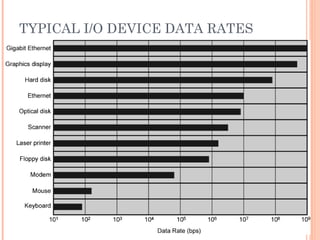
TYPICAL I/O DEVICE DATA RATES
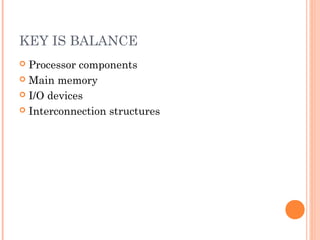
KEY IS BALANCE
 Processor components
 Main memory
 I/O devices
 Interconnection structures
IMPROVEMENTS IN CHIP
ORGANIZATION AND
ARCHITECTURE
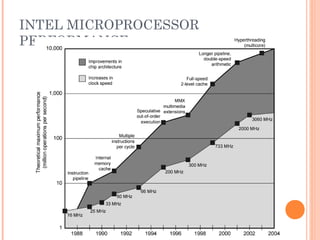
 Increase hardware speed of processor
 Fundamentally due to shrinking logic gate size
 More gates, packed more tightly, increasing clock rate
 Propagation time for signals reduced
 Increase size and speed of caches
 Dedicating part of processor chip
 Cache access times drop significantly
 Change processor organization and architecture
 Increase effective speed of execution
 Parallelism
DENSITY
 Power
 Power density increases with density of logic and clock
speed
 Dissipating heat
 RC delay
 Speed at which electrons flow limited by resistance and
capacitance of metal wires connecting them
 Delay increases as RC product increases
 Wire interconnects thinner, increasing resistance
 Wires closer together, increasing capacitance
 Memory latency
 Memory speeds lag processor speeds
 Solution:
 More emphasis on organizational and architectural
approaches
INTEL MICROPROCESSOR
PERFORMANCE
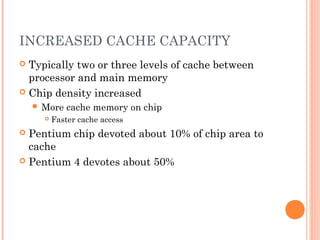
INCREASED CACHE CAPACITY
 Typically two or three levels of cache between
processor and main memory
 Chip density increased
 More cache memory on chip
 Faster cache access
 Pentium chip devoted about 10% of chip area to
cache
 Pentium 4 devotes about 50%
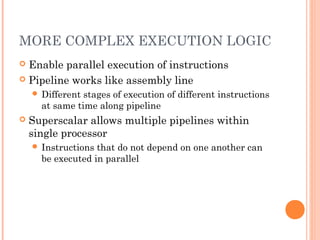
MORE COMPLEX EXECUTION LOGIC
 Enable parallel execution of instructions
 Pipeline works like assembly line
 Different stages of execution of different instructions
at same time along pipeline
 Superscalar allows multiple pipelines within
single processor
 Instructions that do not depend on one another can
be executed in parallel
DIMINISHING RETURNS
 Internal organization of processors complex
 Can get a great deal of parallelism
 Further significant increases likely to be relatively
modest
 Benefits from cache are reaching limit
 Increasing clock rate runs into power dissipation
problem
 Some fundamental physical limits are being reached
NEW APPROACH – MULTIPLE
CORES
 Multiple processors on single chip
 Large shared cache
 Within a processor, increase in performance
proportional to square root of increase in
complexity
 If software can use multiple processors, doubling
number of processors almost doubles performance
 So, use two simpler processors on the chip rather
than one more complex processor
 With two processors, larger caches are justified
 Power consumption of memory logic less than processing
logic
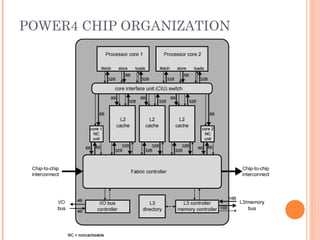
 Example: IBM POWER4
 Two cores based on PowerPC
POWER4 CHIP ORGANIZATION
PENTIUM EVOLUTION (1)
 8080
 first general purpose microprocessor
 8 bit data path
 Used in first personal computer – Altair
 8086
 much more powerful
 16 bit
 instruction cache, prefetch few instructions
 8088 (8 bit external bus) used in first IBM PC
 80286
 16 Mbyte memory addressable
 up from 1Mb
 80386
 32 bit
 Support for multitasking
PENTIUM EVOLUTION (2)
 80486
 sophisticated powerful cache and instruction pipelining
 built in maths co-processor
 Pentium
 Superscalar
 Multiple instructions executed in parallel
 Pentium Pro
 Increased superscalar organization
 Aggressive register renaming
 branch prediction
 data flow analysis
 speculative execution
PENTIUM EVOLUTION (3)
 Pentium II
 MMX technology
 graphics, video & audio processing
 Pentium III
 Additional floating point instructions for 3D graphics
 Pentium 4
 Note Arabic rather than Roman numerals
 Further floating point and multimedia enhancements
 Itanium
 64 bit
 see chapter 15
 Itanium 2
 Hardware enhancements to increase speed
POWERPC
 1975, 801 minicomputer project (IBM) RISC
 Berkeley RISC I processor
 1986, IBM commercial RISC workstation product, RT PC.
 Not commercial success
 Many rivals with comparable or better performance
 1990, IBM RISC System/6000
 RISC-like superscalar machine
 POWER architecture
 IBM alliance with Motorola (68000 microprocessors), and
Apple, (used 68000 in Macintosh)
 Result is PowerPC architecture
 Derived from the POWER architecture
 Superscalar RISC
 Apple Macintosh
 Embedded chip applications
POWERPC FAMILY (1)
 601:
 Quickly to market. 32-bit machine
 603:
 Low-end desktop and portable
 32-bit
 Comparable performance with 601
 Lower cost and more efficient implementation
 604:
 Desktop and low-end servers
 32-bit machine
 Much more advanced superscalar design
 Greater performance
 620:
 High-end servers
 64-bit architecture
POWERPC FAMILY (2)
 740/750:
 Also known as G3
 Two levels of cache on chip
 G4:
 Increases parallelism and internal speed
 G5:
 Improvements in parallelism and internal speed
 64-bit organization

Lecture 2 computer evolution and performance

  • 1.
  • 2.
    ENIAC - BACKGROUND Electronic Numerical Integrator And Computer  Eckert and Mauchly  University of Pennsylvania  Trajectory tables for weapons  Started 1943  Finished 1946  Too late for war effort  Used until 1955
  • 3.
    ENIAC - DETAILS Decimal (not binary)  20 accumulators of 10 digits  Programmed manually by switches  18,000 vacuum tubes  30 tons  15,000 square feet  140 kW power consumption  5,000 additions per second
  • 4.
    VON NEUMANN/TURING  StoredProgram concept  Main memory storing programs and data  ALU operating on binary data  Control unit interpreting instructions from memory and executing  Input and output equipment operated by control unit  Princeton Institute for Advanced Studies  IAS  Completed 1952
  • 5.
    STRUCTURE OF VONNEUMANN MACHINE
  • 6.
    IAS - DETAILS 1000 x 40 bit words  Binary number  2 x 20 bit instructions  Set of registers (storage in CPU)  Memory Buffer Register  Memory Address Register  Instruction Register  Instruction Buffer Register  Program Counter  Accumulator  Multiplier Quotient
  • 7.
    STRUCTURE OF IAS– DETAIL
  • 8.
    CONT.. MBR – containsa word to be stored in memory or sent to the I/O unit, or is used to receive a word from memory or from the I/O unit. MAR – specifies the address in memory of the word to be written from or read into MBR. IR – contains 8-bit opcode instruction being executed. PC – contains the address of the next instruction AC and MQ – hold temporarily operands.
  • 9.
    COMMERCIAL COMPUTERS  1947- Eckert-Mauchly Computer Corporation  UNIVAC I (Universal Automatic Computer)  US Bureau of Census 1950 calculations  Became part of Sperry-Rand Corporation  Late 1950s - UNIVAC II  Faster  More memory
  • 10.
    IBM  Punched-card processingequipment  1953 - the 701  IBM’s first stored program computer  Scientific calculations  1955 - the 702  Business applications  Lead to 700/7000 series
  • 11.
    TRANSISTORS  Replaced vacuumtubes  Smaller  Cheaper  Less heat dissipation  Solid State device  Made from Silicon (Sand)  Invented 1947 at Bell Labs  William Shockley et al.
  • 12.
    TRANSISTOR BASED COMPUTERS Second generation machines  NCR & RCA produced small transistor machines  IBM 7000  DEC - 1957  Produced PDP-1
  • 13.
    MICROELECTRONICS  Literally -“small electronics”  A computer is made up of gates, memory cells and interconnections  These can be manufactured on a semiconductor  e.g. silicon wafer
  • 14.
    GENERATIONS OF COMPUTER Vacuum tube - 1946-1957  Transistor - 1958-1964  Small scale integration - 1965 on Up to 100 devices on a chip  Medium scale integration - to 1971 100-3,000 devices on a chip  Large scale integration - 1971-1977 3,000 - 100,000 devices on a chip  Very large scale integration - 1978 -1991 100,000 - 100,000,000 devices on a chip  Ultra large scale integration – 1991 - Over 100,000,000 devices on a chip
  • 15.
    MOORE’S LAW  Increaseddensity of components on chip  Gordon Moore – co-founder of Intel  Number of transistors on a chip will double every year  Since 1970’s development has slowed a little  Number of transistors doubles every 18 months  Cost of a chip has remained almost unchanged  Higher packing density means shorter electrical paths, giving higher performance  Smaller size gives increased flexibility  Reduced power and cooling requirements  Fewer interconnections increases reliability
  • 16.
    GROWTH IN CPUTRANSISTOR COUNT
  • 17.
    IBM 360  System360 is the industry’s first planned family of computers. The model are compatible in the sense that a program written for one model should be capable of being executed by another model in the series (diff only in time)  The characteristics of a family are as follows:  Similar instruction set  In many cases, the exact same set of machine instructions is supported on all members of the family. Thus a program that executes on one machine will also execute on any other.  Similar operating system  The same basic operating system is available for all family members.  Increasing speed  The rate of instruction execution increase in going from lower to higher family members.
  • 18.
    CONT..  Increasing I/Oport In going from lower to higher family members.  Increasing memory  In going from lower to higher family members.  Increasing cost  In going from lower to higher family members.
  • 19.
    DEC PDP-8  1964 First minicomputer.  Did not need air conditioned room  Small enough to sit on a lab bench  Cheap $16,000, IBM360 $100k.  Embedded applications & OEM  Use BUS STRUCTURE- Omnibus
  • 20.
    DEC - PDP-8BUS STRUCTURE Omnibus consists of 96 separate signal paths, used to carry control, address, and data signals. Because all system components share a common set of signal paths, their use must be controlled by the CPU.
  • 21.
    SEMICONDUCTOR MEMORY  In1950s and 1960s, most computer memory was constructed from tiny rings of ferromagnetic material.  In 1970, Fairchild produced the first relatively capacious semiconductor memory.  Size of a single core i.e. 1 bit of magnetic core storage  Holds 256 bits of memory  Non-destructive read  Much faster than core  Capacity approximately doubles each year
  • 22.
    INTEL  1971 –Intel developed 4004  First microprocessor  Contain all CPU components on a single chip  4 bit  Followed in 1972 by 8008  8 bit  4004, 8008 designed for specific applications  1974 - 8080  Intel’s first general purpose microprocessor
  • 23.
    SPEEDING IT UP Pipelining  On board cache  On board L1 & L2 cache  Branch prediction – the processor looks ahead in the instruction code fetched from memory and predicts which branches, or group of instructions to be process next.  Data flow analysis – the processor analyzes which instructions are dependent on each other’s result, or data, to create an optimized schedule of instructions.  Speculative execution – using branch prediction and data flow analysis, some processor speculatively execute instructions ahead of their actual appearance in the program execution, holding the results in temporary locations. This enables the processor to keep its execution engines as busy as possible by executing instruction that are likely to be needed.
  • 24.
    PERFORMANCE BALANCE  Processorspeed increased  Memory capacity increased  Memory speed lags behind processor speed
  • 25.
  • 26.
    SOLUTIONS  Increase thenumber of bits that are retrieved at one time by making DRAMs “wider” rather than “deeper” and by using wide bus data paths.  Change the DRAM interface to make it more efficient by including a cache or other buffering scheme on the DRAM.  Reduce the frequency of memory access by incorporating increasingly complex and efficient cache structures between the processor and main memory. Incorporation of one or more caches on the processor chip.  Increase the interconnect bandwidth between processors and memory by using higher-speed buses and using hierarchy of buses to buffer and structure data flow.
  • 27.
    I/O DEVICES  Peripheralswith intensive I/O demands  Large data throughput demands  Processors can handle this  Problem moving data  Solutions:  Caching  Buffering  Higher-speed interconnection buses  More elaborate bus structures  Multiple-processor configurations
  • 28.
  • 29.
    KEY IS BALANCE Processor components  Main memory  I/O devices  Interconnection structures
  • 30.
    IMPROVEMENTS IN CHIP ORGANIZATIONAND ARCHITECTURE  Increase hardware speed of processor  Fundamentally due to shrinking logic gate size  More gates, packed more tightly, increasing clock rate  Propagation time for signals reduced  Increase size and speed of caches  Dedicating part of processor chip  Cache access times drop significantly  Change processor organization and architecture  Increase effective speed of execution  Parallelism
  • 31.
    DENSITY  Power  Powerdensity increases with density of logic and clock speed  Dissipating heat  RC delay  Speed at which electrons flow limited by resistance and capacitance of metal wires connecting them  Delay increases as RC product increases  Wire interconnects thinner, increasing resistance  Wires closer together, increasing capacitance  Memory latency  Memory speeds lag processor speeds  Solution:  More emphasis on organizational and architectural approaches
  • 32.
  • 33.
    INCREASED CACHE CAPACITY Typically two or three levels of cache between processor and main memory  Chip density increased  More cache memory on chip  Faster cache access  Pentium chip devoted about 10% of chip area to cache  Pentium 4 devotes about 50%
  • 34.
    MORE COMPLEX EXECUTIONLOGIC  Enable parallel execution of instructions  Pipeline works like assembly line  Different stages of execution of different instructions at same time along pipeline  Superscalar allows multiple pipelines within single processor  Instructions that do not depend on one another can be executed in parallel
  • 35.
    DIMINISHING RETURNS  Internalorganization of processors complex  Can get a great deal of parallelism  Further significant increases likely to be relatively modest  Benefits from cache are reaching limit  Increasing clock rate runs into power dissipation problem  Some fundamental physical limits are being reached
  • 36.
    NEW APPROACH –MULTIPLE CORES  Multiple processors on single chip  Large shared cache  Within a processor, increase in performance proportional to square root of increase in complexity  If software can use multiple processors, doubling number of processors almost doubles performance  So, use two simpler processors on the chip rather than one more complex processor  With two processors, larger caches are justified  Power consumption of memory logic less than processing logic  Example: IBM POWER4  Two cores based on PowerPC
  • 37.
  • 38.
    PENTIUM EVOLUTION (1) 8080  first general purpose microprocessor  8 bit data path  Used in first personal computer – Altair  8086  much more powerful  16 bit  instruction cache, prefetch few instructions  8088 (8 bit external bus) used in first IBM PC  80286  16 Mbyte memory addressable  up from 1Mb  80386  32 bit  Support for multitasking
  • 39.
    PENTIUM EVOLUTION (2) 80486  sophisticated powerful cache and instruction pipelining  built in maths co-processor  Pentium  Superscalar  Multiple instructions executed in parallel  Pentium Pro  Increased superscalar organization  Aggressive register renaming  branch prediction  data flow analysis  speculative execution
  • 40.
    PENTIUM EVOLUTION (3) Pentium II  MMX technology  graphics, video & audio processing  Pentium III  Additional floating point instructions for 3D graphics  Pentium 4  Note Arabic rather than Roman numerals  Further floating point and multimedia enhancements  Itanium  64 bit  see chapter 15  Itanium 2  Hardware enhancements to increase speed
  • 41.
    POWERPC  1975, 801minicomputer project (IBM) RISC  Berkeley RISC I processor  1986, IBM commercial RISC workstation product, RT PC.  Not commercial success  Many rivals with comparable or better performance  1990, IBM RISC System/6000  RISC-like superscalar machine  POWER architecture  IBM alliance with Motorola (68000 microprocessors), and Apple, (used 68000 in Macintosh)  Result is PowerPC architecture  Derived from the POWER architecture  Superscalar RISC  Apple Macintosh  Embedded chip applications
  • 42.
    POWERPC FAMILY (1) 601:  Quickly to market. 32-bit machine  603:  Low-end desktop and portable  32-bit  Comparable performance with 601  Lower cost and more efficient implementation  604:  Desktop and low-end servers  32-bit machine  Much more advanced superscalar design  Greater performance  620:  High-end servers  64-bit architecture
  • 43.
    POWERPC FAMILY (2) 740/750:  Also known as G3  Two levels of cache on chip  G4:  Increases parallelism and internal speed  G5:  Improvements in parallelism and internal speed  64-bit organization