Introduction to 
CMOS VLSI 
Design 
Elementary Logic Design 
and 
Fabrication 
by 
SUVAYAN SAMANTA 
STREAM-ECE-2 
ROLL-111 
14/02/2014 slide- 1
INTRODUCTION 
 Very-large-scale integration (VLSI) is the process of creating 
integrated circuits by combining thousands of transistors into a 
single chip. 
 VLSI began in the 1970s 
 Integrated circuits: many transistors on one chip. 
 Metal Oxide Semiconductor (MOS) transistor 
 Fast, cheap, low-power transistors 
 Complementary: mixture of n- and p-type leads to less power 
14/02/2014 slide- 2
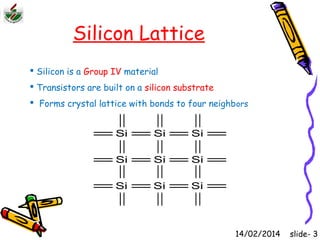
Silicon Lattice 
 Silicon is a Group IV material 
 Transistors are built on a silicon substrate 
 Forms crystal lattice with bonds to four neighbors 
Si Si Si 
Si Si Si 
Si Si Si 
14/02/2014 slide- 3
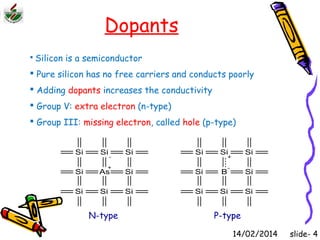
Dopants 
 Silicon is a semiconductor 
 Pure silicon has no free carriers and conducts poorly 
 Adding dopants increases the conductivity 
 Group V: extra electron (n-type) 
 Group III: missing electron, called hole (p-type) 
Si Si Si 
Si As Si 
Si Si Si 
Si Si Si 
Si B Si 
Si Si Si 
- 
+ 
+ 
- 
N-type P-type 
14/02/2014 
slide- 4
p-n Junctions 
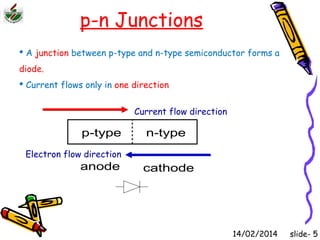
 A junction between p-type and n-type semiconductor forms a 
diode. 
 Current flows only in one direction 
p-type n-type 
anode cathode 
14/02/2014 
Current flow direction 
Electron flow direction 
slide- 5
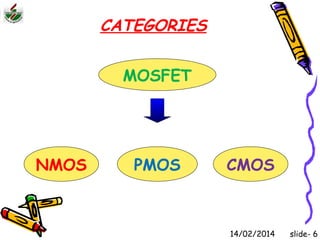
CATEGORIES 
MOSFET 
NMOS PMOS CMOS 
14/02/2014 slide- 6
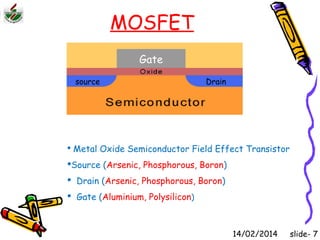
MOSFET 
Gate 
source Drain 
 Metal Oxide Semiconductor Field Effect Transistor 
Source (Arsenic, Phosphorous, Boron) 
 Drain (Arsenic, Phosphorous, Boron) 
 Gate (Aluminium, Polysilicon) 
14/02/2014 slide- 7
nMOS Transistor 
 Four terminals: gate, source, drain, body 
 Gate – oxide – body stack looks like a capacitor 
 Gate and body are conductors 
 SiO2 (oxide) is a very good insulator 
 Called metal – oxide – semiconductor (MOS) capacitor 
 Even though gate is no longer made of metal 
14/02/2014 slide- 8
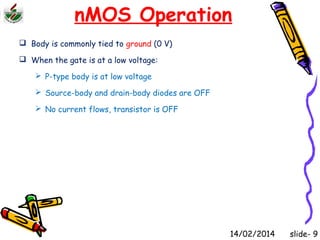
nMOS Operation 
 Body is commonly tied to ground (0 V) 
 When the gate is at a low voltage: 
 P-type body is at low voltage 
 Source-body and drain-body diodes are OFF 
 No current flows, transistor is OFF 
14/02/2014 slide- 9
nMOS Operation 
 When the gate is at a high voltage. 
 Positive charge on gate of MOS capacitor 
 Negative charge attracted to body 
 Inverts a channel under gate to n-type 
 Now current can flow through n-type silicon from source 
through channel to drain, transistor is ON 
14/02/2014 slide- 10
pMOS Transistor 
Similar, but doping and voltages reversed 
Body tied to high voltage (VDD) 
Gate low: transistor ON 
Gate high: transistor OFF 
 indicates inverted behavior 
14/02/2014 
Bubble 
slide- 11
Power Supply Voltage 
 GND = 0 V 
 In 1980’s, VDD = 5V 
 VDD has decreased in modern processes 
High VDD would damage modern tiny transistors 
 Lower VDD saves power 
 VDD = 3.3, 2.5, 1.8, 1.5, 1.2, 1.0, … 
14/02/2014 slide- 12
Transistors as Switches 
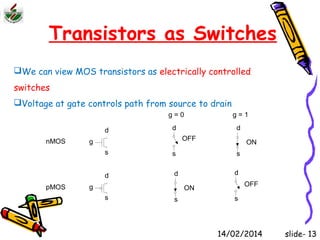
We can view MOS transistors as electrically controlled 
switches 
Voltage at gate controls path from source to drain 
g 
d 
s 
g = 0 
d 
s 
g = 1 
d 
s 
g 
d 
s 
d 
s 
d 
s 
nMOS 
pMOS 
OFF ON 
ON OFF 
14/02/2014 slide- 13
What is CMOS? 
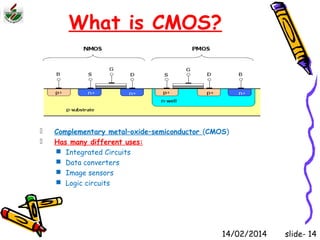
 Complementary metal–oxide–semiconductor (CMOS) 
 Has many different uses: 
 Integrated Circuits 
 Data converters 
 Image sensors 
 Logic circuits 
14/02/2014 slide- 14
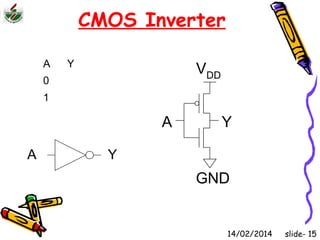
CMOS Inverter 
A Y 
0 
1 
A Y 
VDD 
A Y 
GND 
14/02/2014 slide- 15
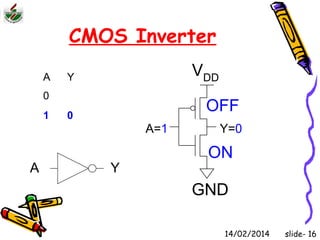
CMOS Inverter 
A Y 
0 
1 0 
VDD 
OFF 
A=1 Y=0 
ON 
GND 
A Y 
14/02/2014 slide- 16
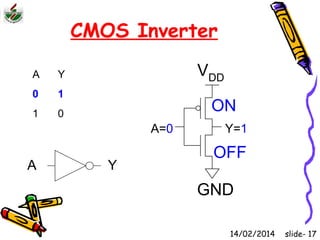
CMOS Inverter 
A Y 
0 1 
1 0 
VDD 
ON 
A=0 Y=1 
OFF 
GND 
A Y 
14/02/2014 slide- 17
CMOS Fabrication 
 CMOS transistors are fabricated on silicon wafer 
 Lithography process similar to printing press 
 On each step, different materials are deposited or 
etched 
 Easiest to understand by viewing both top and cross-section 
of wafer in a simplified manufacturing 
process 
14/02/2014 slide- 18
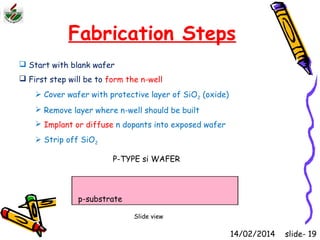
Fabrication Steps 
 Start with blank wafer 
 First step will be to form the n-well 
 Cover wafer with protective layer of SiO2 (oxide) 
 Remove layer where n-well should be built 
 Implant or diffuse n dopants into exposed wafer 
 Strip off SiO2 
P-TYPE si WAFER 
p-substrate 
Slide view 
14/02/2014 slide- 19
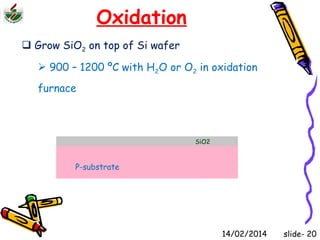
Oxidation 
 Grow SiO2 on top of Si wafer 
 900 – 1200 ºC with H2O or O2 in oxidation 
furnace 
SiO2 
P-substrate 
14/02/2014 slide- 20
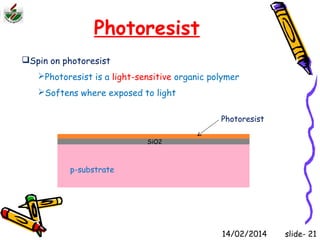
Photoresist 
Spin on photoresist 
Photoresist is a light-sensitive organic polymer 
Softens where exposed to light 
p-substrate 
SiO2 
Photoresist 
14/02/2014 slide- 21
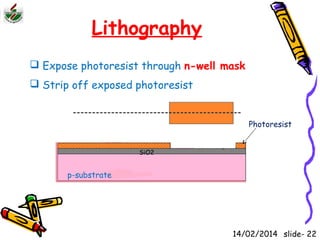
Lithography 
 Expose photoresist through n-well mask 
 Strip off exposed photoresist 
p-substrate 
SiO2 
Photoresist 
14/02/2014 slide- 22
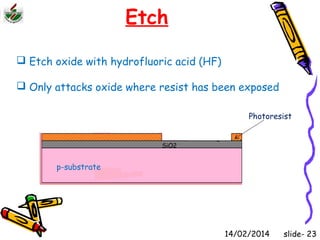
Etch 
 Etch oxide with hydrofluoric acid (HF) 
 Only attacks oxide where resist has been exposed 
p-substrate 
SiO2 
Photoresist 
14/02/2014 slide- 23
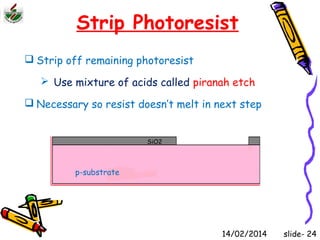
Strip Photoresist 
Strip off remaining photoresist 
 Use mixture of acids called piranah etch 
Necessary so resist doesn’t melt in next step 
p-substrate 
SiO2 
14/02/2014 slide- 24
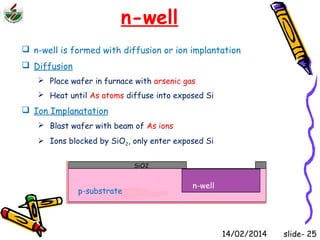
n-well 
 n-well is formed with diffusion or ion implantation 
 Diffusion 
 Place wafer in furnace with arsenic gas 
 Heat until As atoms diffuse into exposed Si 
 Ion Implanatation 
 Blast wafer with beam of As ions 
 Ions blocked by SiO2, only enter exposed Si 
SiO2 
p-substrate n-well 
14/02/2014 slide- 25
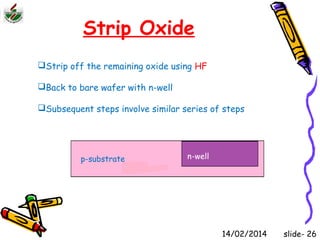
Strip Oxide 
Strip off the remaining oxide using HF 
Back to bare wafer with n-well 
Subsequent steps involve similar series of steps 
p-substrate n-well 
14/02/2014 slide- 26
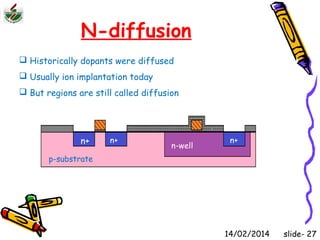
N-diffusion 
 Historically dopants were diffused 
 Usually ion implantation today 
 But regions are still called diffusion 
n+ n+ n-well n+ 
p-substrate 
14/02/2014 slide- 27
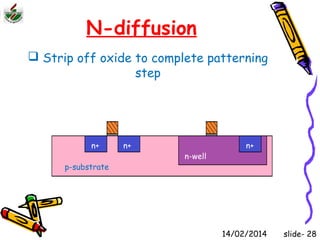
N-diffusion 
 Strip off oxide to complete patterning 
step 
n+ n+ n+ 
n-well 
p-substrate 
14/02/2014 slide- 28
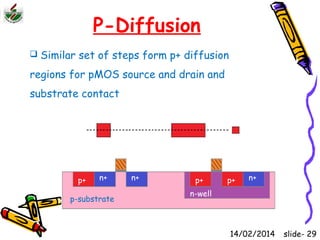
P-Diffusion 
 Similar set of steps form p+ diffusion 
regions for pMOS source and drain and 
substrate contact 
n+ n+ n+ 
p+ p+ p+ 
p-substrate n-well 
14/02/2014 slide- 29
Summary 
 MOS Transistors are stack of gate, oxide, silicon 
 Can be viewed as electrically controlled switches 
 Build logic gates out of switches 
 We became familier with the fabrication process 
of CMOS 
14/02/2014 slide- 30
BiBliography 
web.ewu.edu/groups/technology/Claudio/ee430/Lecture 
s/L1-print.pdf 
 users.ece.utexas.edu/~adnan/vlsi-05- 
backup/lec23Concl.ppt 
14/02/2014 slide- 31 
en.wikipedia.org/wiki/CMOS 
www.cmosvlsi.com/
14/02/2014 slide- 32
14/02/2014 slide- 33

Cmos fabrication by suvayan samanta

  • 1.
    Introduction to CMOSVLSI Design Elementary Logic Design and Fabrication by SUVAYAN SAMANTA STREAM-ECE-2 ROLL-111 14/02/2014 slide- 1
  • 2.
    INTRODUCTION  Very-large-scaleintegration (VLSI) is the process of creating integrated circuits by combining thousands of transistors into a single chip.  VLSI began in the 1970s  Integrated circuits: many transistors on one chip.  Metal Oxide Semiconductor (MOS) transistor  Fast, cheap, low-power transistors  Complementary: mixture of n- and p-type leads to less power 14/02/2014 slide- 2
  • 3.
    Silicon Lattice Silicon is a Group IV material  Transistors are built on a silicon substrate  Forms crystal lattice with bonds to four neighbors Si Si Si Si Si Si Si Si Si 14/02/2014 slide- 3
  • 4.
    Dopants  Siliconis a semiconductor  Pure silicon has no free carriers and conducts poorly  Adding dopants increases the conductivity  Group V: extra electron (n-type)  Group III: missing electron, called hole (p-type) Si Si Si Si As Si Si Si Si Si Si Si Si B Si Si Si Si - + + - N-type P-type 14/02/2014 slide- 4
  • 5.
    p-n Junctions A junction between p-type and n-type semiconductor forms a diode.  Current flows only in one direction p-type n-type anode cathode 14/02/2014 Current flow direction Electron flow direction slide- 5
  • 6.
    CATEGORIES MOSFET NMOSPMOS CMOS 14/02/2014 slide- 6
  • 7.
    MOSFET Gate sourceDrain  Metal Oxide Semiconductor Field Effect Transistor Source (Arsenic, Phosphorous, Boron)  Drain (Arsenic, Phosphorous, Boron)  Gate (Aluminium, Polysilicon) 14/02/2014 slide- 7
  • 8.
    nMOS Transistor Four terminals: gate, source, drain, body  Gate – oxide – body stack looks like a capacitor  Gate and body are conductors  SiO2 (oxide) is a very good insulator  Called metal – oxide – semiconductor (MOS) capacitor  Even though gate is no longer made of metal 14/02/2014 slide- 8
  • 9.
    nMOS Operation Body is commonly tied to ground (0 V)  When the gate is at a low voltage:  P-type body is at low voltage  Source-body and drain-body diodes are OFF  No current flows, transistor is OFF 14/02/2014 slide- 9
  • 10.
    nMOS Operation When the gate is at a high voltage.  Positive charge on gate of MOS capacitor  Negative charge attracted to body  Inverts a channel under gate to n-type  Now current can flow through n-type silicon from source through channel to drain, transistor is ON 14/02/2014 slide- 10
  • 11.
    pMOS Transistor Similar,but doping and voltages reversed Body tied to high voltage (VDD) Gate low: transistor ON Gate high: transistor OFF  indicates inverted behavior 14/02/2014 Bubble slide- 11
  • 12.
    Power Supply Voltage  GND = 0 V  In 1980’s, VDD = 5V  VDD has decreased in modern processes High VDD would damage modern tiny transistors  Lower VDD saves power  VDD = 3.3, 2.5, 1.8, 1.5, 1.2, 1.0, … 14/02/2014 slide- 12
  • 13.
    Transistors as Switches We can view MOS transistors as electrically controlled switches Voltage at gate controls path from source to drain g d s g = 0 d s g = 1 d s g d s d s d s nMOS pMOS OFF ON ON OFF 14/02/2014 slide- 13
  • 14.
    What is CMOS?  Complementary metal–oxide–semiconductor (CMOS)  Has many different uses:  Integrated Circuits  Data converters  Image sensors  Logic circuits 14/02/2014 slide- 14
  • 15.
    CMOS Inverter AY 0 1 A Y VDD A Y GND 14/02/2014 slide- 15
  • 16.
    CMOS Inverter AY 0 1 0 VDD OFF A=1 Y=0 ON GND A Y 14/02/2014 slide- 16
  • 17.
    CMOS Inverter AY 0 1 1 0 VDD ON A=0 Y=1 OFF GND A Y 14/02/2014 slide- 17
  • 18.
    CMOS Fabrication CMOS transistors are fabricated on silicon wafer  Lithography process similar to printing press  On each step, different materials are deposited or etched  Easiest to understand by viewing both top and cross-section of wafer in a simplified manufacturing process 14/02/2014 slide- 18
  • 19.
    Fabrication Steps Start with blank wafer  First step will be to form the n-well  Cover wafer with protective layer of SiO2 (oxide)  Remove layer where n-well should be built  Implant or diffuse n dopants into exposed wafer  Strip off SiO2 P-TYPE si WAFER p-substrate Slide view 14/02/2014 slide- 19
  • 20.
    Oxidation  GrowSiO2 on top of Si wafer  900 – 1200 ºC with H2O or O2 in oxidation furnace SiO2 P-substrate 14/02/2014 slide- 20
  • 21.
    Photoresist Spin onphotoresist Photoresist is a light-sensitive organic polymer Softens where exposed to light p-substrate SiO2 Photoresist 14/02/2014 slide- 21
  • 22.
    Lithography  Exposephotoresist through n-well mask  Strip off exposed photoresist p-substrate SiO2 Photoresist 14/02/2014 slide- 22
  • 23.
    Etch  Etchoxide with hydrofluoric acid (HF)  Only attacks oxide where resist has been exposed p-substrate SiO2 Photoresist 14/02/2014 slide- 23
  • 24.
    Strip Photoresist Stripoff remaining photoresist  Use mixture of acids called piranah etch Necessary so resist doesn’t melt in next step p-substrate SiO2 14/02/2014 slide- 24
  • 25.
    n-well  n-wellis formed with diffusion or ion implantation  Diffusion  Place wafer in furnace with arsenic gas  Heat until As atoms diffuse into exposed Si  Ion Implanatation  Blast wafer with beam of As ions  Ions blocked by SiO2, only enter exposed Si SiO2 p-substrate n-well 14/02/2014 slide- 25
  • 26.
    Strip Oxide Stripoff the remaining oxide using HF Back to bare wafer with n-well Subsequent steps involve similar series of steps p-substrate n-well 14/02/2014 slide- 26
  • 27.
    N-diffusion  Historicallydopants were diffused  Usually ion implantation today  But regions are still called diffusion n+ n+ n-well n+ p-substrate 14/02/2014 slide- 27
  • 28.
    N-diffusion  Stripoff oxide to complete patterning step n+ n+ n+ n-well p-substrate 14/02/2014 slide- 28
  • 29.
    P-Diffusion  Similarset of steps form p+ diffusion regions for pMOS source and drain and substrate contact n+ n+ n+ p+ p+ p+ p-substrate n-well 14/02/2014 slide- 29
  • 30.
    Summary  MOSTransistors are stack of gate, oxide, silicon  Can be viewed as electrically controlled switches  Build logic gates out of switches  We became familier with the fabrication process of CMOS 14/02/2014 slide- 30
  • 31.
    BiBliography web.ewu.edu/groups/technology/Claudio/ee430/Lecture s/L1-print.pdf  users.ece.utexas.edu/~adnan/vlsi-05- backup/lec23Concl.ppt 14/02/2014 slide- 31 en.wikipedia.org/wiki/CMOS www.cmosvlsi.com/
  • 32.
  • 33.