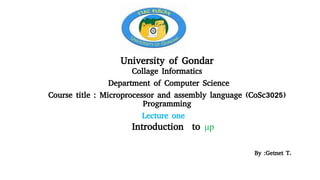
University of Gondar
Collage Informatics
Department of Computer Science
Course title : Microprocessor and assembly language (CoSc3025)
Programming
Lecture one
Introduction to μp
By :Getnet T.
Outline
Introduction
How does it work
Evolution
Future Evolution
Types of Microprocessor based on instruction set
Introduction to μp
A μp is a digital electronic component with transistors on a single semiconductor integrated
circuit (IC).
Is a computer processor where the data processing logic and control is included on a single
integrated circuit, or a small number of integrated circuits.
It is also multipurpose, programmable and register based electronic device that read binary
instruction from memory accept binary data as input and process the data according to the input
and provide the result as result.
It is programmable electronic chips that has computing and decision making capability similar to
CPU.
Integrated circuit (IC) that contains the entire central processing unit of a computer on a single
chip and It function as amplifier, oscillator, timer counter, logic gate memory and microcontroller
Cont..
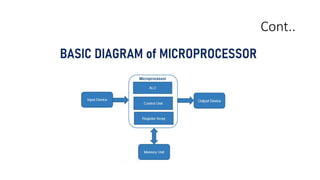
The microprocessor contains the arithmetic, logic, and control circuitry required to
perform the functions of a computer's central processing unit.
A microprocessor is a controlling unit of a micro-computer, fabricated on a small
chip capable of performing Arithmetic Logical Unit (ALU) operations and
communicating with the other devices connected to it.
Cont.…
It is set of switches.
A bit refers to one binary digit; a zero or one
In computer memory and processing bit refers to the state of one switch.
Cont..
CPU (central processing unit).
The controlling element in a computer system.
Memory and I/O controlled via instructions stored in memory, executed by
the microprocessor
An instruction is a single operation of a processor defined by
processor instruction set.
Cont..
Microprocessor is a device which is capable of:
Receive input
Performing computation
Store data and instructions
Display the results
Control the devices that perform all the above 4 functions
Power of the microprocessor is capability to execute billions of instructions per
second from a program or software (group of instructions) stored in the memory
system.
stored programs make the microprocessor and computer system very powerful
devices.
Cont..
Cont.…
The Microprocessor Age
Each microprocessor age differ form another depends on the following:-
The number of instruction
The clock speed
Bandwidth
By word size of the data.
Cont..
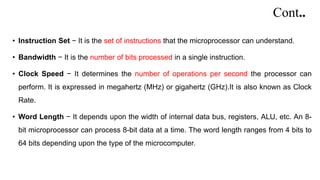
• Instruction Set − It is the set of instructions that the microprocessor can understand.
• Bandwidth − It is the number of bits processed in a single instruction.
• Clock Speed − It determines the number of operations per second the processor can
perform. It is expressed in megahertz (MHz) or gigahertz (GHz).It is also known as Clock
Rate.
• Word Length − It depends upon the width of internal data bus, registers, ALU, etc. An 8-
bit microprocessor can process 8-bit data at a time. The word length ranges from 4 bits to
64 bits depending upon the type of the microcomputer.
Cont.…
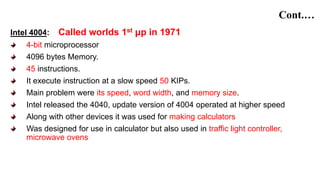
Intel 4004: Called worlds 1st μp in 1971
4-bit microprocessor
4096 bytes Memory.
45 instructions.
It execute instruction at a slow speed 50 KIPs.
Main problem were its speed, word width, and memory size.
Intel released the 4040, update version of 4004 operated at higher speed
Along with other devices it was used for making calculators
Was designed for use in calculator but also used in traffic light controller,
microwave ovens
Cont.…
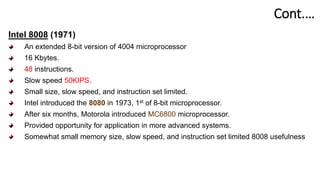
Intel 8008 (1971)
An extended 8-bit version of 4004 microprocessor
16 Kbytes.
48 instructions.
Slow speed 50KIPS.
Small size, slow speed, and instruction set limited.
Intel introduced the 8080 in 1973, 1st of 8-bit microprocessor.
After six months, Motorola introduced MC6800 microprocessor.
Provided opportunity for application in more advanced systems.
Somewhat small memory size, slow speed, and instruction set limited 8008 usefulness
Cont.…
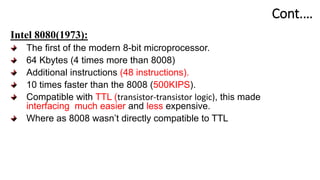
Intel 8080(1973):
The first of the modern 8-bit microprocessor.
64 Kbytes (4 times more than 8008)
Additional instructions (48 instructions).
10 times faster than the 8008 (500KIPS).
Compatible with TTL (transistor-transistor logic), this made
interfacing much easier and less expensive.
Where as 8008 wasn’t directly compatible to TTL
Cont.…
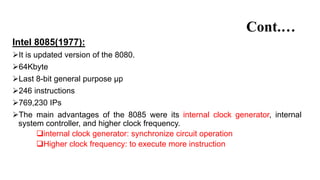
Intel 8085(1977):
It is updated version of the 8080.
64Kbyte
Last 8-bit general purpose µp
246 instructions
769,230 IPs
The main advantages of the 8085 were its internal clock generator, internal
system controller, and higher clock frequency.
internal clock generator: synchronize circuit operation
Higher clock frequency: to execute more instruction
The Modern Microprocessor
Intel 8086 /8088 (1978):
16-bit.
1Mbytes (16 times more than 8085).
Executed 2.5 MIPs.
4 or 6-byte instruction cache or queue that prefetched a few instructions before
they were executed.
Over 20,000 instructions.
Include multiplication and division instructions missed in earlier µP
These microprocessors are called CISC because of the number and complexity
of instructions. 8086 8088
16 bit internal bus 8 bit internal bus
Cont.…
Intel 80286 (1983):
Updated versions of 8086/8088
Almost identical to the 8086/8088
16-bit.
16 Mbytes.
Few additional instructions that manage the extra 15M byte of memory.
Execute instruction 4 MIPs: Increased Clock Speed
Cont.…
Intel 80386 (1986) first practical 32 bit Microprocessor
Represents a meager overhaul of 8086-80286 Architecture.
32-bit.
32-bit memory address (4 G bytes).
80386SX /16-bit data bus / 16 M byte memory (24-bit
address bus).
80386SL /80386SLC /16-bit data bus /32 M byte memory (25-
bit address bus).
80386SLC contained an internal cache memory.
Cont.…
In 1995 Intel released 80386EX. That called embedded PC
b/c it contain all the components of PC on a single IC.
80386EX /16-bit data /26-bit address /24-line in/out data
/DRAM refresh controller/ programmable chip selection
logic.
Transfer Single precision floating –point require 32-bit wide
memory.
80386 include a memory management unit (Hardware)
earlier µP left for software.
Cont.…
Intel 80486 (1989)
Incorporated an 80386, an 80387 coprocessor, and 8k byte cache
memory system in to one integrated package.
Execute 50 MIPs.
80486DX2 (Double –Clocked Version). With 66 MHz / memory transfer
executing at the rate of 33MHz.
80486DX4 (Triple –Clocked Version). With 100MHz / memory transfer
at 33MHz.
80486DX4 executed instructions at about the same speed as the 60
MHz Pentium and it contain 16k byte cache.
The Pentium Microprocessor
Introduced 1993, Pentium was similar to 80386 and 80486
microprocessors.
Originally labeled the P5 or 80586.
It operated with high speed(110 MIPS)
Memory system up to 4G bytes
It was 32 bit microprocessor.
Dual integer processor and can execute two instruction
simultaneously because it contain two internal integer processor
Cont.…
Pentium pro processor (P6).
Contains 21 million transistors.
Three integer units, floating – point unit to increase the performance.
150 MHz /166 MHz in 1995.
16k byte cache (L1) (8k byte instruction, 8k byte data).
256k byte (L2) cache.
Three execution engines (can execute up to 3 instruction at a time).
Execute 32-bit code (useful with windows NT).
For server market.
4G byte memory or 64G byte memory (36-bit) if configured
Cont.…
Pentium II (1997).
Placed the Pentium II on small circuit board
Use a 100MHz bus speed
Allow for easy processor installation and removal
Cont.…
Pentium III
Uses faster core than Pentium II, but still a P6
Slot 1 version contain 512K cache.
flip-chip version contain 256K cache.
Both use bus speed of 100 MHz
Cont.…
Pentium 4 and core II microprocessor
released in late 2000.
Speeds to 3.2 GHz and faster.
Uses RAMBUS or DDR (double data rate) memory technology.
DDR allow to synchronize dynamic random access memory
Cache size from 32K to 8KByte and most recently to 64K
Shift from aluminum to copper interconnections inside the microprocessor.
Cont.…
Pentium 4 and core II, 64-bit and multiple core microprocessor
64-bit modification allow the microprocessor to address 4GB of memory
through a wider 64-bit address
Each core execute separate task in a program (multithread application)
The main problem faced by Intel is that the clock speed can’t be increased
to a much higher rate.
Multiple cores are the current solution to providing faster microprocessor
Cont.…
In 2002, Itanium.
64 bit processor
64GB of memory
Greater parallelism.
128 general –purpose integer registers.
128 floating – point registers.
64 predicate registers.
Many execution units.
Designed for the server market.
Conceptual views of the microprocessors
CPU Coprocessor
8K
L1 cache
80486DX
CPU 1 CPU 2 Copro
16K L1 Cache
Pentium
CPU 1 CPU 2 CPU 3 Copro
16K L1 Cache
256K L2 Cache
Pentium Pro
CPU 1 CPU 2 CPU 3 Copro
32K L1 Cache
512K L2 Cache
Or
256K L2 Cache
Pentium II, Pentium III,
or Pentium 4
The Future of Microprocessors evolution
 No one can make accurate predictions.
The process speed will get more faster
The memory will get more large
Architecture will get more efficient
Types of Microprocessor
Based on the instruction set microprocessors are classified into:
I. RISC — Reduced Instruction Set Computing.
 These types of processors are commonly used in air conditioners.
 Executes one instruction per clock.
II. CISC — Complex Instruction Set Computing.
The types of processors are used in desktops, laptops and servers.
Refers to number and complexity of instructions
Improvements was: Multiply and Divide
The number of instruction increased from 45 to more than 20,000
chapter  1-part 1 introduction o microprocessor.pdf

chapter 1-part 1 introduction o microprocessor.pdf

  • 1.
    University of Gondar CollageInformatics Department of Computer Science Course title : Microprocessor and assembly language (CoSc3025) Programming Lecture one Introduction to μp By :Getnet T.
  • 2.
    Outline Introduction How does itwork Evolution Future Evolution Types of Microprocessor based on instruction set
  • 3.
    Introduction to μp Aμp is a digital electronic component with transistors on a single semiconductor integrated circuit (IC). Is a computer processor where the data processing logic and control is included on a single integrated circuit, or a small number of integrated circuits. It is also multipurpose, programmable and register based electronic device that read binary instruction from memory accept binary data as input and process the data according to the input and provide the result as result. It is programmable electronic chips that has computing and decision making capability similar to CPU. Integrated circuit (IC) that contains the entire central processing unit of a computer on a single chip and It function as amplifier, oscillator, timer counter, logic gate memory and microcontroller
  • 4.
    Cont.. The microprocessor containsthe arithmetic, logic, and control circuitry required to perform the functions of a computer's central processing unit. A microprocessor is a controlling unit of a micro-computer, fabricated on a small chip capable of performing Arithmetic Logical Unit (ALU) operations and communicating with the other devices connected to it.
  • 5.
    Cont.… It is setof switches. A bit refers to one binary digit; a zero or one In computer memory and processing bit refers to the state of one switch.
  • 6.
    Cont.. CPU (central processingunit). The controlling element in a computer system. Memory and I/O controlled via instructions stored in memory, executed by the microprocessor An instruction is a single operation of a processor defined by processor instruction set.
  • 7.
    Cont.. Microprocessor is adevice which is capable of: Receive input Performing computation Store data and instructions Display the results Control the devices that perform all the above 4 functions Power of the microprocessor is capability to execute billions of instructions per second from a program or software (group of instructions) stored in the memory system. stored programs make the microprocessor and computer system very powerful devices.
  • 8.
  • 9.
  • 10.
    The Microprocessor Age Eachmicroprocessor age differ form another depends on the following:- The number of instruction The clock speed Bandwidth By word size of the data.
  • 11.
    Cont.. • Instruction Set− It is the set of instructions that the microprocessor can understand. • Bandwidth − It is the number of bits processed in a single instruction. • Clock Speed − It determines the number of operations per second the processor can perform. It is expressed in megahertz (MHz) or gigahertz (GHz).It is also known as Clock Rate. • Word Length − It depends upon the width of internal data bus, registers, ALU, etc. An 8- bit microprocessor can process 8-bit data at a time. The word length ranges from 4 bits to 64 bits depending upon the type of the microcomputer.
  • 12.
    Cont.… Intel 4004: Calledworlds 1st μp in 1971 4-bit microprocessor 4096 bytes Memory. 45 instructions. It execute instruction at a slow speed 50 KIPs. Main problem were its speed, word width, and memory size. Intel released the 4040, update version of 4004 operated at higher speed Along with other devices it was used for making calculators Was designed for use in calculator but also used in traffic light controller, microwave ovens
  • 13.
    Cont.… Intel 8008 (1971) Anextended 8-bit version of 4004 microprocessor 16 Kbytes. 48 instructions. Slow speed 50KIPS. Small size, slow speed, and instruction set limited. Intel introduced the 8080 in 1973, 1st of 8-bit microprocessor. After six months, Motorola introduced MC6800 microprocessor. Provided opportunity for application in more advanced systems. Somewhat small memory size, slow speed, and instruction set limited 8008 usefulness
  • 14.
    Cont.… Intel 8080(1973): The firstof the modern 8-bit microprocessor. 64 Kbytes (4 times more than 8008) Additional instructions (48 instructions). 10 times faster than the 8008 (500KIPS). Compatible with TTL (transistor-transistor logic), this made interfacing much easier and less expensive. Where as 8008 wasn’t directly compatible to TTL
  • 15.
    Cont.… Intel 8085(1977): It isupdated version of the 8080. 64Kbyte Last 8-bit general purpose µp 246 instructions 769,230 IPs The main advantages of the 8085 were its internal clock generator, internal system controller, and higher clock frequency. internal clock generator: synchronize circuit operation Higher clock frequency: to execute more instruction
  • 16.
    The Modern Microprocessor Intel8086 /8088 (1978): 16-bit. 1Mbytes (16 times more than 8085). Executed 2.5 MIPs. 4 or 6-byte instruction cache or queue that prefetched a few instructions before they were executed. Over 20,000 instructions. Include multiplication and division instructions missed in earlier µP These microprocessors are called CISC because of the number and complexity of instructions. 8086 8088 16 bit internal bus 8 bit internal bus
  • 17.
    Cont.… Intel 80286 (1983): Updatedversions of 8086/8088 Almost identical to the 8086/8088 16-bit. 16 Mbytes. Few additional instructions that manage the extra 15M byte of memory. Execute instruction 4 MIPs: Increased Clock Speed
  • 18.
    Cont.… Intel 80386 (1986)first practical 32 bit Microprocessor Represents a meager overhaul of 8086-80286 Architecture. 32-bit. 32-bit memory address (4 G bytes). 80386SX /16-bit data bus / 16 M byte memory (24-bit address bus). 80386SL /80386SLC /16-bit data bus /32 M byte memory (25- bit address bus). 80386SLC contained an internal cache memory.
  • 19.
    Cont.… In 1995 Intelreleased 80386EX. That called embedded PC b/c it contain all the components of PC on a single IC. 80386EX /16-bit data /26-bit address /24-line in/out data /DRAM refresh controller/ programmable chip selection logic. Transfer Single precision floating –point require 32-bit wide memory. 80386 include a memory management unit (Hardware) earlier µP left for software.
  • 20.
    Cont.… Intel 80486 (1989) Incorporatedan 80386, an 80387 coprocessor, and 8k byte cache memory system in to one integrated package. Execute 50 MIPs. 80486DX2 (Double –Clocked Version). With 66 MHz / memory transfer executing at the rate of 33MHz. 80486DX4 (Triple –Clocked Version). With 100MHz / memory transfer at 33MHz. 80486DX4 executed instructions at about the same speed as the 60 MHz Pentium and it contain 16k byte cache.
  • 21.
    The Pentium Microprocessor ThePentium Microprocessor Introduced 1993, Pentium was similar to 80386 and 80486 microprocessors. Originally labeled the P5 or 80586. It operated with high speed(110 MIPS) Memory system up to 4G bytes It was 32 bit microprocessor. Dual integer processor and can execute two instruction simultaneously because it contain two internal integer processor
  • 22.
    Cont.… Pentium pro processor(P6). Contains 21 million transistors. Three integer units, floating – point unit to increase the performance. 150 MHz /166 MHz in 1995. 16k byte cache (L1) (8k byte instruction, 8k byte data). 256k byte (L2) cache. Three execution engines (can execute up to 3 instruction at a time). Execute 32-bit code (useful with windows NT). For server market. 4G byte memory or 64G byte memory (36-bit) if configured
  • 23.
    Cont.… Pentium II (1997). Placedthe Pentium II on small circuit board Use a 100MHz bus speed Allow for easy processor installation and removal
  • 24.
    Cont.… Pentium III Uses fastercore than Pentium II, but still a P6 Slot 1 version contain 512K cache. flip-chip version contain 256K cache. Both use bus speed of 100 MHz
  • 25.
    Cont.… Pentium 4 andcore II microprocessor released in late 2000. Speeds to 3.2 GHz and faster. Uses RAMBUS or DDR (double data rate) memory technology. DDR allow to synchronize dynamic random access memory Cache size from 32K to 8KByte and most recently to 64K Shift from aluminum to copper interconnections inside the microprocessor.
  • 26.
    Cont.… Pentium 4 andcore II, 64-bit and multiple core microprocessor 64-bit modification allow the microprocessor to address 4GB of memory through a wider 64-bit address Each core execute separate task in a program (multithread application) The main problem faced by Intel is that the clock speed can’t be increased to a much higher rate. Multiple cores are the current solution to providing faster microprocessor
  • 27.
    Cont.… In 2002, Itanium. 64bit processor 64GB of memory Greater parallelism. 128 general –purpose integer registers. 128 floating – point registers. 64 predicate registers. Many execution units. Designed for the server market.
  • 28.
    Conceptual views ofthe microprocessors CPU Coprocessor 8K L1 cache 80486DX CPU 1 CPU 2 Copro 16K L1 Cache Pentium
  • 29.
    CPU 1 CPU2 CPU 3 Copro 16K L1 Cache 256K L2 Cache Pentium Pro CPU 1 CPU 2 CPU 3 Copro 32K L1 Cache 512K L2 Cache Or 256K L2 Cache Pentium II, Pentium III, or Pentium 4
  • 30.
    The Future ofMicroprocessors evolution  No one can make accurate predictions. The process speed will get more faster The memory will get more large Architecture will get more efficient
  • 31.
    Types of Microprocessor Basedon the instruction set microprocessors are classified into: I. RISC — Reduced Instruction Set Computing.  These types of processors are commonly used in air conditioners.  Executes one instruction per clock. II. CISC — Complex Instruction Set Computing. The types of processors are used in desktops, laptops and servers. Refers to number and complexity of instructions Improvements was: Multiply and Divide The number of instruction increased from 45 to more than 20,000