The Central Process Unit  Chapter 4 B.M.H
Learning Objectives System Unit Microprocessor  Memory RAM ROM Bus line  System bus Expansion buses Expansion slot  Expansion cards MIU
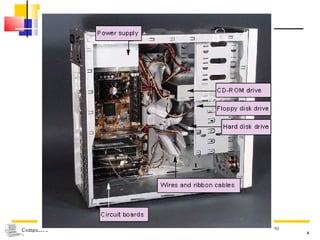
The System Unit ; The case that houses the electronic components of the computer system Components  Motherboard The main system unit component Storage Devices Hard drive, floppy drive, CD/DVD-ROM drive Power Supply Wires and Ribbon Cables MIU
MIU
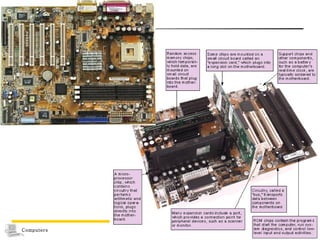
Motherboard Called the  main circuit board The flat circuit board  within the personal computer housing that hold the computer circuitry A mass of chips and connections  that organize the computer ’ s activities MIU
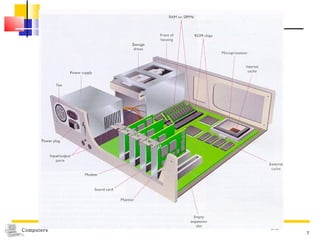
Motherboard Components Microprocessor ; the most important component Memory chips RAM ROM Bus line  System bus Expansion buses Expansion slots  Expansion cards MIU
MIU
MIU
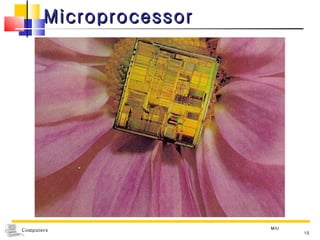
Microprocessor Central processing unit on a chip Called Logic chip  when it is used to control specialized devices. key components Control unit Arithmetic/logic unit Register System clock MIU
Microprocessor MIU
Microprocessor Contain tiny transistors The basic building block of the microprocessor Today, millions of  transistors Electronic switches  that may or may not allow current to pass through If current passes through, the switch is (  ), representing a (  ) bit If current does not pass through, the switch is (  ), representing a (  ) bit The combination of transistors  Stand for combination of (  ) Represent digits, letter, and special characters MIU Refer to Computers7_ch4_2_1  Computers7_ch4_2_2
Microprocessor Pentium chip By Intel The current workhorse in the PC market  Includes multimedia instructions PowerPC family of chips  -- non-Intel By Apple, IBM, and Motorola Manufactured by both IBM and Motorola primary use : Apple Macintosh family of PCs Alpha  -- non-Intel Produced by Compaq Used in high-end servers and workstations MIU
Memory Component Evolved from primitive vacuum tubes  Today ’ s modern memory ;  Semiconductor Advantage reliability compactness low cost lower power usage Volatile  Require continuous electric current to represent data Monolithic  all the circuits on single chip together constitute an inseparable unit of storage MIU
Semiconductor Memory Thousand of very small circuits-pathways for electric currents-on a silicon chip Each circuit on a chip be in one of two states, on or off  two states : represent the binary digits 1 and 0 these digits : combined to represent ( c~  ) thus makes the memory chip a storage bin for data and instructions MIU
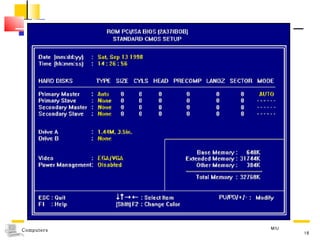
Semiconductor Memory CMOS one important type of semiconductor design C omplementary  M etal  O xide  S emiconductor the design is noted for using  relatively little electricity CMOS RAM : In PC, one use for CMOS a small amount of memory  that, thanks to battery power,  retains data when the computer is shut off to store information your computer needs  when it boots up, such as time, date, and hardware configuration data when the computer is running, it can be updated MIU
MIU
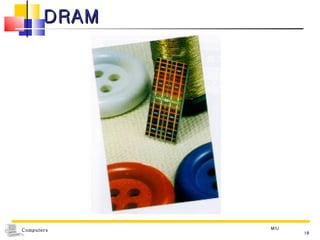
RAM  (Random Access Memory) volatile  its contents are lost once the power is shut off Static RAM(SRAM) will retain its contents  without intervention from the CPU  as long a power is maintained much faster than DRAM Dynamic RAM(DRAM) must be constantly refreshed (recharged) by the CPU   or it will lose its contents used for most PC memory because of its  size and cost advantages Synchronous DRAM (SDRAM) a faster type of DRAM,  used in most PCs today Rambus DRAM(RDRAM) faster than SDRAM MIU
DRAM MIU
RAM RAM packaged on circuit boards  SIMMs  (single in-line memory modules) memory chips are installed on  one side of the board DIMMs  (dual in-line memory modules) memory chips are installed on  both sides of the board    Motherboard design determines the maximum amount of memory    For increasing the PC's RAM buy extra memory modules and plug into your computer's motherboard MIU
ROM (Read-only memory ) Contain programs and data that are  permanently recorded  into this type of memory at the factory Nonvolatile  ex) the boot routine is stored in ROM PROM (programmable read-only memory) By ROM burners  the instructions within it can be changed MIU
Bus Line (Bus) A set of parallel electrical paths  that transport electrical signals copper tracing on the surface of the motherboard Types System bus transports data between  the CPU and memory Expansion buses Connect to expansion slots, and ports on the motherboard MIU P4-113
Bus Bus width the number of bits of data that  can be carried at one time indicates the number of electrical paths the greater the width,  the more data can be carried at a time . the width of system bus depend on the CPU design,  normally,  the same as the CPU's word size Bus speed  Measured in  megahertz (MHz) The faster the bus speed, the faster data travels through the system MIU
Expansion Boards interface cards  or  adapter cards Connect various peripheral devices to a computer  by plugging them into  expansion slots  on the motherboard Provide external connectors, called  ports To plug in peripherals such as a printer, a mouse, and a keyboard MIU
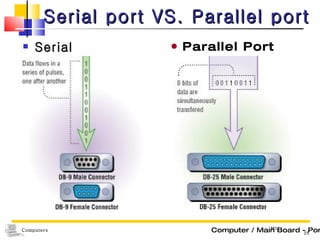
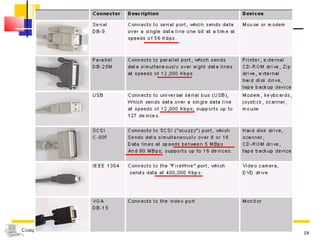
Port Serial ports Transmit data one bit at a time, similar to cars on a one-lane road Are typically used for slow-speed devices such as  the mouse and keyboard Parallel ports Transmit groups of bits together Are used for faster devices such as  printers and scanners  MIU
Serial port VS. Parallel port Serial Port MIU Parallel Port Computer / Main Board - Port                        
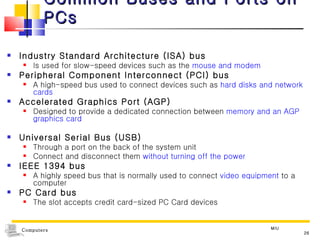
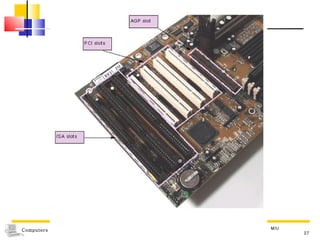
Common Buses and Ports on PCs Industry Standard Architecture (ISA) bus Is used for slow-speed devices such as the  mouse and modem Peripheral Component Interconnect (PCI) bus A high-speed bus used to connect devices such as  hard disks and network cards Accelerated Graphics Port (AGP) Designed to provide a dedicated connection between  memory and an AGP graphics card Universal Serial Bus (USB) Through a port on the back of the system unit Connect and disconnect them  without turning off the power IEEE 1394 bus A highly speed bus that is normally used to connect  video equipment  to a computer PC Card bus The slot accepts credit card-sized PC Card devices MIU
MIU
MIU

Computers7 Ch4 2

  • 1.
    The Central ProcessUnit Chapter 4 B.M.H
  • 2.
    Learning Objectives SystemUnit Microprocessor Memory RAM ROM Bus line System bus Expansion buses Expansion slot Expansion cards MIU
  • 3.
    The System Unit; The case that houses the electronic components of the computer system Components Motherboard The main system unit component Storage Devices Hard drive, floppy drive, CD/DVD-ROM drive Power Supply Wires and Ribbon Cables MIU
  • 4.
  • 5.
    Motherboard Called the main circuit board The flat circuit board within the personal computer housing that hold the computer circuitry A mass of chips and connections that organize the computer ’ s activities MIU
  • 6.
    Motherboard Components Microprocessor; the most important component Memory chips RAM ROM Bus line System bus Expansion buses Expansion slots Expansion cards MIU
  • 7.
  • 8.
  • 9.
    Microprocessor Central processingunit on a chip Called Logic chip when it is used to control specialized devices. key components Control unit Arithmetic/logic unit Register System clock MIU
  • 10.
  • 11.
    Microprocessor Contain tinytransistors The basic building block of the microprocessor Today, millions of transistors Electronic switches that may or may not allow current to pass through If current passes through, the switch is ( ), representing a ( ) bit If current does not pass through, the switch is ( ), representing a ( ) bit The combination of transistors Stand for combination of ( ) Represent digits, letter, and special characters MIU Refer to Computers7_ch4_2_1 Computers7_ch4_2_2
  • 12.
    Microprocessor Pentium chipBy Intel The current workhorse in the PC market Includes multimedia instructions PowerPC family of chips -- non-Intel By Apple, IBM, and Motorola Manufactured by both IBM and Motorola primary use : Apple Macintosh family of PCs Alpha -- non-Intel Produced by Compaq Used in high-end servers and workstations MIU
  • 13.
    Memory Component Evolvedfrom primitive vacuum tubes Today ’ s modern memory ; Semiconductor Advantage reliability compactness low cost lower power usage Volatile Require continuous electric current to represent data Monolithic all the circuits on single chip together constitute an inseparable unit of storage MIU
  • 14.
    Semiconductor Memory Thousandof very small circuits-pathways for electric currents-on a silicon chip Each circuit on a chip be in one of two states, on or off two states : represent the binary digits 1 and 0 these digits : combined to represent ( c~ ) thus makes the memory chip a storage bin for data and instructions MIU
  • 15.
    Semiconductor Memory CMOSone important type of semiconductor design C omplementary M etal O xide S emiconductor the design is noted for using relatively little electricity CMOS RAM : In PC, one use for CMOS a small amount of memory that, thanks to battery power, retains data when the computer is shut off to store information your computer needs when it boots up, such as time, date, and hardware configuration data when the computer is running, it can be updated MIU
  • 16.
  • 17.
    RAM (RandomAccess Memory) volatile its contents are lost once the power is shut off Static RAM(SRAM) will retain its contents without intervention from the CPU as long a power is maintained much faster than DRAM Dynamic RAM(DRAM) must be constantly refreshed (recharged) by the CPU or it will lose its contents used for most PC memory because of its size and cost advantages Synchronous DRAM (SDRAM) a faster type of DRAM, used in most PCs today Rambus DRAM(RDRAM) faster than SDRAM MIU
  • 18.
  • 19.
    RAM RAM packagedon circuit boards SIMMs (single in-line memory modules) memory chips are installed on one side of the board DIMMs (dual in-line memory modules) memory chips are installed on both sides of the board  Motherboard design determines the maximum amount of memory  For increasing the PC's RAM buy extra memory modules and plug into your computer's motherboard MIU
  • 20.
    ROM (Read-only memory) Contain programs and data that are permanently recorded into this type of memory at the factory Nonvolatile ex) the boot routine is stored in ROM PROM (programmable read-only memory) By ROM burners the instructions within it can be changed MIU
  • 21.
    Bus Line (Bus)A set of parallel electrical paths that transport electrical signals copper tracing on the surface of the motherboard Types System bus transports data between the CPU and memory Expansion buses Connect to expansion slots, and ports on the motherboard MIU P4-113
  • 22.
    Bus Bus widththe number of bits of data that can be carried at one time indicates the number of electrical paths the greater the width, the more data can be carried at a time . the width of system bus depend on the CPU design, normally, the same as the CPU's word size Bus speed Measured in megahertz (MHz) The faster the bus speed, the faster data travels through the system MIU
  • 23.
    Expansion Boards interfacecards or adapter cards Connect various peripheral devices to a computer by plugging them into expansion slots on the motherboard Provide external connectors, called ports To plug in peripherals such as a printer, a mouse, and a keyboard MIU
  • 24.
    Port Serial portsTransmit data one bit at a time, similar to cars on a one-lane road Are typically used for slow-speed devices such as the mouse and keyboard Parallel ports Transmit groups of bits together Are used for faster devices such as printers and scanners MIU
  • 25.
    Serial port VS.Parallel port Serial Port MIU Parallel Port Computer / Main Board - Port                        
  • 26.
    Common Buses andPorts on PCs Industry Standard Architecture (ISA) bus Is used for slow-speed devices such as the mouse and modem Peripheral Component Interconnect (PCI) bus A high-speed bus used to connect devices such as hard disks and network cards Accelerated Graphics Port (AGP) Designed to provide a dedicated connection between memory and an AGP graphics card Universal Serial Bus (USB) Through a port on the back of the system unit Connect and disconnect them without turning off the power IEEE 1394 bus A highly speed bus that is normally used to connect video equipment to a computer PC Card bus The slot accepts credit card-sized PC Card devices MIU
  • 27.
  • 28.