COMPUTER
GENERATION
Computer Generation
•A step in Technology
•Changes in Hardware &
Software
Computer Generations
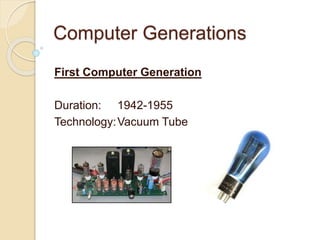
First Computer Generation
Duration: 1942-1955
Technology:Vacuum Tube
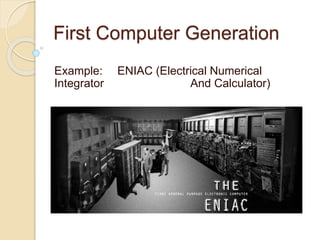
First Computer Generation
Example: ENIAC (Electrical Numerical
Integrator And Calculator)
First Computer Generation
Advantages:
•Vacuum tubes were the only electronic
components available during those days.
•Those computers were the fastest calculating
device of their time.
•They could perform computations in
milliseconds.
First Computer Generation
Disadvantages:
•Too bulky in size
•Unreliable
•Large amount of heat generated
•Heavy air-conditioning required
•Prone to frequent hardware failures
•Constant maintenance required
•Non-portable
•Commercial production was difficult and costly
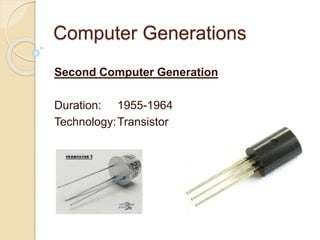
Computer Generations
Second Computer Generation
Duration: 1955-1964
Technology:Transistor
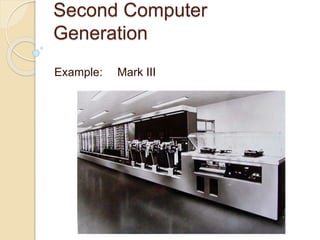
Second Computer
Generation
Example: Mark III
Second Computer
Generation
Advantages:
•Smaller in size as compared to first generation
computers.
•More reliable.
•Less heat generated.
•Computation time was reduced to
microseconds.
•Less prone to hardware failure
•Better portability
•Wider commercial use
Second Computer
Generation
Disadvantages:
•Air-conditioning required.
•Frequent hardware maintenance.
•Manual assembly of individual components into
functioning unit was required.
•Commercial production was difficult.
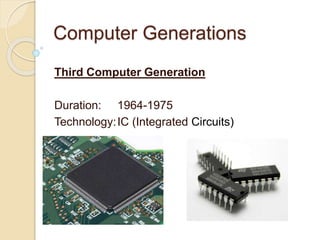
Computer Generations
Third Computer Generation
Duration: 1964-1975
Technology:IC (Integrated Circuits)
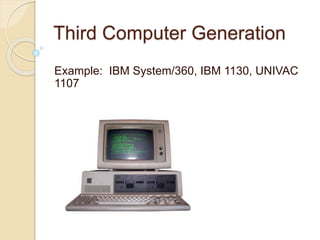
Third Computer Generation
Example: IBM System/360, IBM 1130, UNIVAC
1107
Third Computer Generation
Advantages:
•Smaller in size as compared to previous generations
•Even more reliable than second generation
computers.
•Lower heat generated than second generation
computers.
•Computation time was reduced to nanoseconds.
•Hardware failure was rare.
•Easily portable.
•General purpose computers.
•Less power requirement than previous generation
computers.
•Commercial production was easier and cheaper.
Third Computer Generation
Disadvantages:
•Air-conditioning required in many cases.
•Highly sophisticated technology required for the
manufacture of IC chips
Computer Generations
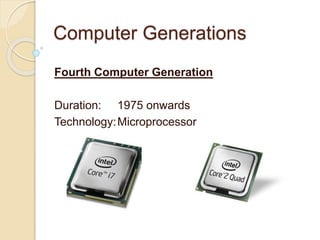
Fourth Computer Generation
Duration: 1975 onwards
Technology:Microprocessor
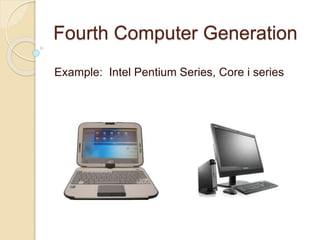
Fourth Computer Generation
Example: Intel Pentium Series, Core i series
Fourth Computer Generation
Advantages:
•Smallest in size because of high component
density.
•Very reliable
•Heat generated is negligible
•No air conditioning required in most cases.
•Much faster in computation than previous
generation.
•Hardware failure is negligible and hence
minimal maintenance is required.
•Totally general purpose.
Fourth Computer Generation
Disadvantages:
•Highly sophisticated technology required for the
manufacture of VLSI chips.
Computer Generations
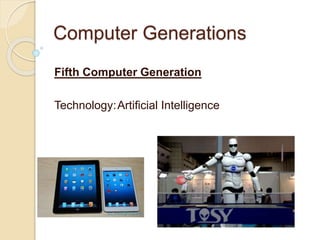
Fifth Computer Generation
Technology:Artificial Intelligence

Computer generations