PRESENTATION BY:-
1.TafshIrul Alam Mahi
2.Adnan Ahmed
3. JakIr HossaIn
4.Fardin Farhan SaklaIn
1
GENERATION OF COMPUTERS
DEPARTMENT
OF
ARCHITECTURE
INDEX:
• INTRODUCTION
• FIRST GENERATION OF COMPUTER
• SECOND GENERATION OF COMPUTER
• THIRD GENERATION OF COMPUTER
• FOURTH GENERATION OF COMPUTER
• FIFTH GENERATION OF COMPUTER
INTRODUCTION
• The history of computer development is
often referred to in reference to the different
generations of computing devices. Each generation
of computer is characterized by a major
technological development that fundamentally
changed the way computers operate,resulting in
increasingly smaller, cheaper, more powerful and
more efficient and reliable devices.
First Generation of Computers
(1945-1956)
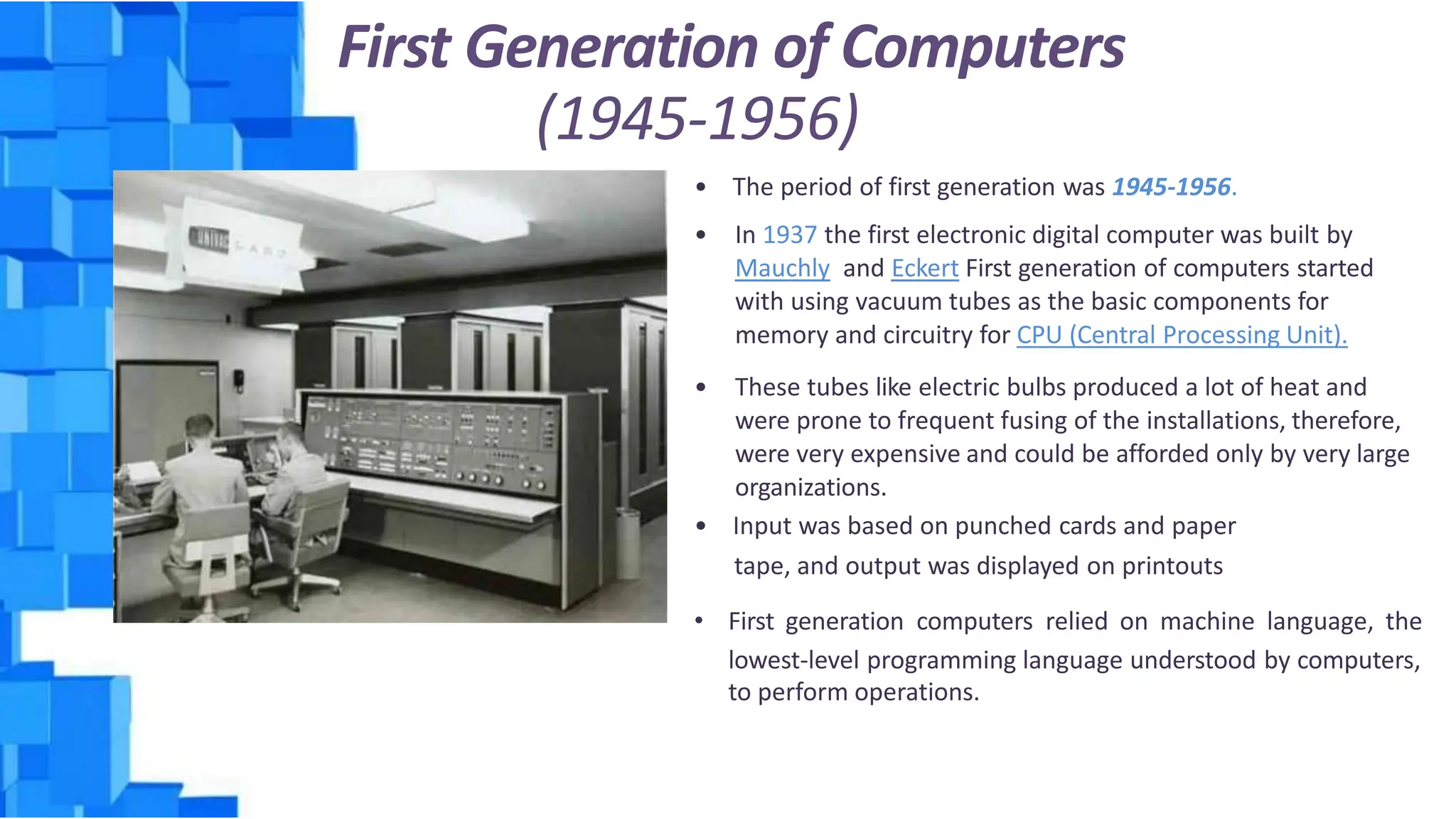
• The period of first generation was 1945-1956.
• In 1937 the first electronic digital computer was built by
Mauchly and Eckert First generation of computers started
with using vacuum tubes as the basic components for
memory and circuitry for CPU (Central Processing Unit).
• These tubes like electric bulbs produced a lot of heat and
were prone to frequent fusing of the installations, therefore,
were very expensive and could be afforded only by very large
organizations.
• Input was based on punched cards and paper
tape, and output was displayed on printouts
• First generation computers relied on machine language, the
lowest-level programming language understood by computers,
to perform operations.
The main features of First Generation are:
• Vacuum tube technology
• Unreliable
• Very costly
• Generate lot of heat
• Slow Input/output device
• Huge size
• Need of A.C.
• Non-portable
Advantages:-
• Vacuum tubes were the only electronic component
available during those days.
• Vacuum tube technology made possible to
make electronic digital computers.
• These computers could calculate data in millisecond
Disadvantages:-
• The computers were large in size.
• They consumed a large amount of
energy.
• They heated very soon due to
thousands of vacuum tubes.
• They were not very reliable.
• Air conditioning was required.
• Constant maintenance was required.
• Non-portable.
• Costly commercial production.
• Limited commercial use.
• Very slow speed.
• Limited programming capabilities.
• Used machine language only.
• Used magnetic drums which
provide very less data storage.
• Used punch cards for input.
• Not versatile and very faulty.
Some computers of this
generation were:-
•ENIAC
•EDVAC
•UNIVAC
•IBM-701
•IBM-650
Second Generation Computers
(1959-1965)
• The second generation computers used
transistors.
• The scientists at Bell laboratories developed
transistor in 1947.
• These scientists include John Bardeen,
William Brattain and William Shockley.
• The size of the computers was decreased
by replacing vacuum tubes with transistors.
• In this generation,magnetic cores were used
as primary memory and magnetic tape
and magnetic disks as secondary storage
devices.
Advantages:-
•Smaller in size as compared to the first generation computers.
•The 2nd generation Computers were more reliable
•Used less energy and were not heated.
•Wider commercial use
•Better portability as compared to the first generation computers.
•Better speed and could calculate data in microseconds
•Used faster peripherals like tape drives, magnetic disks, printer etc.
• Used Assembly language instead of Machine language.
•Accuracy improved.
Disadvantages:-
•Cooling system was required
•Constant maintenance was required
•Commercial production was difficult
•Only used for specific purposes
•Costly and not versatile
•Punch cards were used for input
The main features of second generation are:-
• Use of transistors
• Reliable in comparison to first generation computers
• Smaller size as compared to first generation computers
• Generated less heat as compared to first generation computers
• Consumed less electricity as compared to first generation computers
• Faster than first generation computers
• Still very costly
Some computers of this generation were:-
• IBM 1620 - for scientific purpose
• IBM 1401 - for business application
• CDC 3600 - for medical purpose
Third Generation Computers
(1965-1971)
• The Third generation computers used
the integrated circuits (IC).
• Jack Kilby developed the concept of integrated
circuit in 1958. It was an important invention in
the computer field.
• The first IC was invented and used in 1961. The
size of an IC is about ¼ square inch.
• A single IC chip may contain thousands of
transistors.The computer became smaller in
size,faster,more reliable and less expensive.
The main features of third generation are:-
• IC used
• More reliable in comparison to previous two generations
• Smaller size
• Generated less heat
• Faster
• Lesser maintenance
• Still costly
• A.C needed
• Consumed lesser electricity
• Supported high-level language
Advantages:-
•Smaller in size as compared to previous generations.
•More reliable.
•Used less energy
•Produced less heat as compared to the previous two generations of computers.
•Better speed and could calculate data in nanoseconds.
•Used fan for heat discharge to prevent damage.
•Maintenance cost was low because hardware failure is rear.
•Totally general purpose
•Could be used for high-level languages.
•Good storage
•Versatile to an extent
•Less expensive
•Better accuracy
•Commercial production increased.
•Used mouse and keyboard for input.
Disadvantages
Air conditioning was required.
Highly sophisticated
technology required for the
manufacturing of IC chips.
The examples of third generation computers are:-
• IBM-360 series
• Honeywell-6000 series
• PDP(Personal Data Processor)
• IBM-370/168
• TDC-316
Fourth Generation Computers
(1975-Present)
• The fourth generation computers started with the invention
of Microprocessor.
• The Microprocessor contains thousands of ICs. Ted
Hoff produced the first microprocessor in 1971 for Intel.
• It was known as Intel 4004. The technology of integrated
circuits improved rapidly.
• The LSI (Large Scale Integration) circuit and VLSI (Very Large
Scale Integration) circuit was designed.
• It greatly reduced the size of computer. The size of modern
Microprocessors is usually one square inch.
• It can contain millions of electronic circuits.
The main features of fourth generation are:-
• VLSI technology used
• Very cheap
• Portable and reliable
• Use of PC's
• Very small size
• Pipeline processing
• No A.C. needed
• Concept of internet was introduced
• Great developments in the fields of networks
• Computers became easily available
Advantages:-
• More powerful and reliable than previous
generations.
• Small in size
• Fast processing power with less power
consumption.
• Fan for heat discharging and thus to keep cold.
• No air conditioning required.
• Totally general purpose
• Commercial production
• Less need of repair.
• Cheapest among all generations
• All types of High level languages can be used in this
type of computers.
Disadvantages:-
• The latest technology is required for
manufacturing of Microprocessors.
• Very advance technology was required
to make the ICs.
• Highly skilled staff was required for
manufacturing.
Some computers of this generation were:-
• IBM-360 series
• Honeywell-6000 series
• PDP(Personal Data Processor)
• IBM-370/168
• TDC-316
• Apple Macintosh
Fifth Generation Computers
(Present & Beyond)
Fifth generation computing devices,based on artificial intelligence,are still
in development,though there are some applications,such as voice
recognition,that are being used today.
The use of parallel processing and superconductors is
helping to make artificial intelligence a reality.
Quantum computation and molecular and nanotechnology will radically
change the face of computers in years to come.
The goal of fifth-generation computing is to develop devices that
respond to natural language input and are capable of learning and self-
organization.
The main features of fifth generation are:-
• ULSI technology.
• Development of true artificial intelligence.
• Development of Natural language processing.
• Advancement in Parallel Processing.
• Advancement in Superconductor technology.
• More user friendly interfaces with multimedia features.
• Availability of very powerful and compact computers at cheaper rates.
Some computer types of this generation are:-
• Desktop
• Laptop
• NoteBook
• UltraBook
• ChromeBook
Advantages:-
•This type of computer is versatile device by which we can perform
various types of programme.
• Low cost than first,second and third generation Computer.
• High speed than first,second and third generation Computer.
• This computer have artificial intelligence.
Disadvantages:-
•Technology is still under process and research on its viability is going
on.
•The speed, this technology is claiming seems difficult to achieve (in
future, it might be) because of the incompetent technological support
in most parts of the world.
•Many of the old devices would not be competent to 5G, hence, all of
them need to be replaced with new one — expensive deal.
•Developing infrastructure needs high cost.
•Security and privacy issue yet to be solved.
THANK YOU EVERYONE
IF YOU HAVE ANY QUESTIONS
FEEL FREE TO ASK US    
…THE END…

Understanding Computer Generations-MaHi.pptx

  • 1.
    PRESENTATION BY:- 1.TafshIrul AlamMahi 2.Adnan Ahmed 3. JakIr HossaIn 4.Fardin Farhan SaklaIn 1 GENERATION OF COMPUTERS DEPARTMENT OF ARCHITECTURE
  • 2.
    INDEX: • INTRODUCTION • FIRSTGENERATION OF COMPUTER • SECOND GENERATION OF COMPUTER • THIRD GENERATION OF COMPUTER • FOURTH GENERATION OF COMPUTER • FIFTH GENERATION OF COMPUTER
  • 3.
    INTRODUCTION • The historyof computer development is often referred to in reference to the different generations of computing devices. Each generation of computer is characterized by a major technological development that fundamentally changed the way computers operate,resulting in increasingly smaller, cheaper, more powerful and more efficient and reliable devices.
  • 4.
    First Generation ofComputers (1945-1956) • The period of first generation was 1945-1956. • In 1937 the first electronic digital computer was built by Mauchly and Eckert First generation of computers started with using vacuum tubes as the basic components for memory and circuitry for CPU (Central Processing Unit). • These tubes like electric bulbs produced a lot of heat and were prone to frequent fusing of the installations, therefore, were very expensive and could be afforded only by very large organizations. • Input was based on punched cards and paper tape, and output was displayed on printouts • First generation computers relied on machine language, the lowest-level programming language understood by computers, to perform operations.
  • 5.
    The main featuresof First Generation are: • Vacuum tube technology • Unreliable • Very costly • Generate lot of heat • Slow Input/output device • Huge size • Need of A.C. • Non-portable
  • 6.
    Advantages:- • Vacuum tubeswere the only electronic component available during those days. • Vacuum tube technology made possible to make electronic digital computers. • These computers could calculate data in millisecond
  • 7.
    Disadvantages:- • The computerswere large in size. • They consumed a large amount of energy. • They heated very soon due to thousands of vacuum tubes. • They were not very reliable. • Air conditioning was required. • Constant maintenance was required. • Non-portable. • Costly commercial production. • Limited commercial use. • Very slow speed. • Limited programming capabilities. • Used machine language only. • Used magnetic drums which provide very less data storage. • Used punch cards for input. • Not versatile and very faulty.
  • 8.
    Some computers ofthis generation were:- •ENIAC •EDVAC •UNIVAC •IBM-701 •IBM-650
  • 9.
    Second Generation Computers (1959-1965) •The second generation computers used transistors. • The scientists at Bell laboratories developed transistor in 1947. • These scientists include John Bardeen, William Brattain and William Shockley. • The size of the computers was decreased by replacing vacuum tubes with transistors. • In this generation,magnetic cores were used as primary memory and magnetic tape and magnetic disks as secondary storage devices.
  • 10.
    Advantages:- •Smaller in sizeas compared to the first generation computers. •The 2nd generation Computers were more reliable •Used less energy and were not heated. •Wider commercial use •Better portability as compared to the first generation computers. •Better speed and could calculate data in microseconds •Used faster peripherals like tape drives, magnetic disks, printer etc. • Used Assembly language instead of Machine language. •Accuracy improved.
  • 11.
    Disadvantages:- •Cooling system wasrequired •Constant maintenance was required •Commercial production was difficult •Only used for specific purposes •Costly and not versatile •Punch cards were used for input
  • 12.
    The main featuresof second generation are:- • Use of transistors • Reliable in comparison to first generation computers • Smaller size as compared to first generation computers • Generated less heat as compared to first generation computers • Consumed less electricity as compared to first generation computers • Faster than first generation computers • Still very costly
  • 13.
    Some computers ofthis generation were:- • IBM 1620 - for scientific purpose • IBM 1401 - for business application • CDC 3600 - for medical purpose
  • 14.
    Third Generation Computers (1965-1971) •The Third generation computers used the integrated circuits (IC). • Jack Kilby developed the concept of integrated circuit in 1958. It was an important invention in the computer field. • The first IC was invented and used in 1961. The size of an IC is about ¼ square inch. • A single IC chip may contain thousands of transistors.The computer became smaller in size,faster,more reliable and less expensive.
  • 15.
    The main featuresof third generation are:- • IC used • More reliable in comparison to previous two generations • Smaller size • Generated less heat • Faster • Lesser maintenance • Still costly • A.C needed • Consumed lesser electricity • Supported high-level language
  • 16.
    Advantages:- •Smaller in sizeas compared to previous generations. •More reliable. •Used less energy •Produced less heat as compared to the previous two generations of computers. •Better speed and could calculate data in nanoseconds. •Used fan for heat discharge to prevent damage. •Maintenance cost was low because hardware failure is rear. •Totally general purpose •Could be used for high-level languages. •Good storage •Versatile to an extent •Less expensive •Better accuracy •Commercial production increased. •Used mouse and keyboard for input. Disadvantages Air conditioning was required. Highly sophisticated technology required for the manufacturing of IC chips.
  • 17.
    The examples ofthird generation computers are:- • IBM-360 series • Honeywell-6000 series • PDP(Personal Data Processor) • IBM-370/168 • TDC-316
  • 18.
    Fourth Generation Computers (1975-Present) •The fourth generation computers started with the invention of Microprocessor. • The Microprocessor contains thousands of ICs. Ted Hoff produced the first microprocessor in 1971 for Intel. • It was known as Intel 4004. The technology of integrated circuits improved rapidly. • The LSI (Large Scale Integration) circuit and VLSI (Very Large Scale Integration) circuit was designed. • It greatly reduced the size of computer. The size of modern Microprocessors is usually one square inch. • It can contain millions of electronic circuits.
  • 19.
    The main featuresof fourth generation are:- • VLSI technology used • Very cheap • Portable and reliable • Use of PC's • Very small size • Pipeline processing • No A.C. needed • Concept of internet was introduced • Great developments in the fields of networks • Computers became easily available
  • 20.
    Advantages:- • More powerfuland reliable than previous generations. • Small in size • Fast processing power with less power consumption. • Fan for heat discharging and thus to keep cold. • No air conditioning required. • Totally general purpose • Commercial production • Less need of repair. • Cheapest among all generations • All types of High level languages can be used in this type of computers. Disadvantages:- • The latest technology is required for manufacturing of Microprocessors. • Very advance technology was required to make the ICs. • Highly skilled staff was required for manufacturing.
  • 21.
    Some computers ofthis generation were:- • IBM-360 series • Honeywell-6000 series • PDP(Personal Data Processor) • IBM-370/168 • TDC-316 • Apple Macintosh
  • 22.
    Fifth Generation Computers (Present& Beyond) Fifth generation computing devices,based on artificial intelligence,are still in development,though there are some applications,such as voice recognition,that are being used today. The use of parallel processing and superconductors is helping to make artificial intelligence a reality. Quantum computation and molecular and nanotechnology will radically change the face of computers in years to come. The goal of fifth-generation computing is to develop devices that respond to natural language input and are capable of learning and self- organization.
  • 23.
    The main featuresof fifth generation are:- • ULSI technology. • Development of true artificial intelligence. • Development of Natural language processing. • Advancement in Parallel Processing. • Advancement in Superconductor technology. • More user friendly interfaces with multimedia features. • Availability of very powerful and compact computers at cheaper rates.
  • 24.
    Some computer typesof this generation are:- • Desktop • Laptop • NoteBook • UltraBook • ChromeBook
  • 25.
    Advantages:- •This type ofcomputer is versatile device by which we can perform various types of programme. • Low cost than first,second and third generation Computer. • High speed than first,second and third generation Computer. • This computer have artificial intelligence.
  • 26.
    Disadvantages:- •Technology is stillunder process and research on its viability is going on. •The speed, this technology is claiming seems difficult to achieve (in future, it might be) because of the incompetent technological support in most parts of the world. •Many of the old devices would not be competent to 5G, hence, all of them need to be replaced with new one — expensive deal. •Developing infrastructure needs high cost. •Security and privacy issue yet to be solved.
  • 27.
    THANK YOU EVERYONE IFYOU HAVE ANY QUESTIONS FEEL FREE TO ASK US     …THE END…