Md. Raseduzzaman
Md. Monirll Awal
Golam Mostofa
Rifat Hasan Hridoy
Foysal Ahmed
Md. Raseduzzaman

 Generation in computer terminology is a change in
technology a computer is/was being used. Initially,
the generation term was used to distinguish between
varying hardware technologies.
What is computer generation?

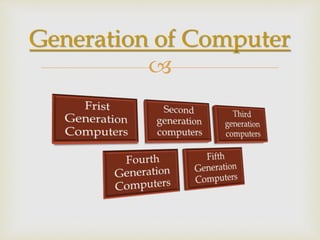
Generation of Computer

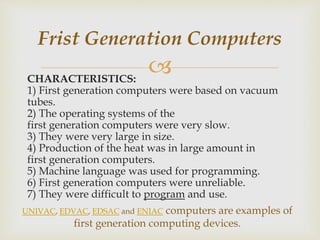
Frist Generation Computers
UNIVAC, EDVAC, EDSAC and ENIAC computers are examples of
first generation computing devices.
CHARACTERISTICS:
1) First generation computers were based on vacuum
tubes.
2) The operating systems of the
first generation computers were very slow.
3) They were very large in size.
4) Production of the heat was in large amount in
first generation computers.
5) Machine language was used for programming.
6) First generation computers were unreliable.
7) They were difficult to program and use.

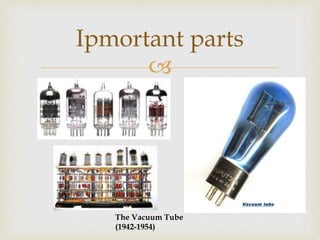
Ipmortant parts
The Vacuum Tube
(1942-1954)
Md: Foysal Ahmed
ID : 161-15-7492
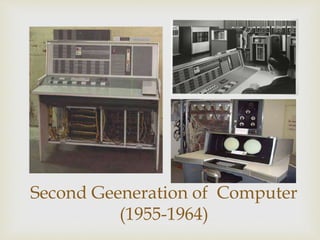
Second Geeneration of Computer
(1955-1964)
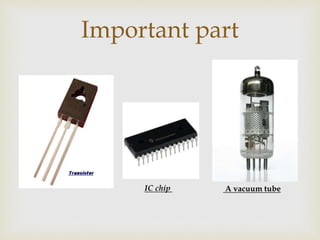
Important part
A vacuum tubeIC chip
Md. Monirll Awal

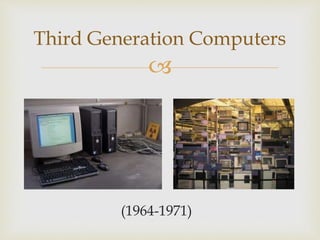
Third Generation Computers
(1964-1971)

Third Generation
Computers
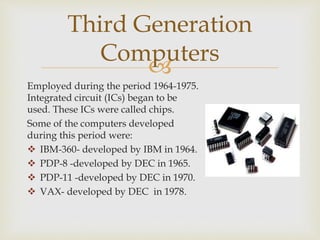
Employed during the period 1964-1975.
Integrated circuit (ICs) began to be
used. These ICs were called chips.
Some of the computers developed
during this period were:
 IBM-360- developed by IBM in 1964.
 PDP-8 -developed by DEC in 1965.
 PDP-11 -developed by DEC in 1970.
 VAX- developed by DEC in 1978.

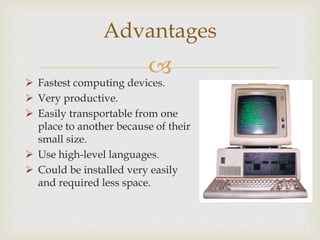
Advantages
 Fastest computing devices.
 Very productive.
 Easily transportable from one
place to another because of their
small size.
 Use high-level languages.
 Could be installed very easily
and required less space.
Md. Refat Hassan Hredoy

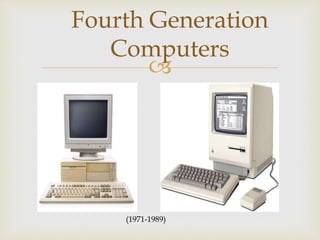
Fourth Generation
Computers
(1971-1989)

Computer-Fourth
Generation
 The period of fourth generation was 1971-
1989. The computers of fourth generation
used Very Large Scale Integrated (VLSI)
circuits. VLSI circuits having about 5000
transistors and other circuit elements and
their associated circuits on a single chip made
it possible to have microcomputers of fourth
generation. Fourth generation computers
became more powerful, compact, reliable, and
affordable. As a result, it gave rise to personal
computer (PC) revolution.

The main features of
fourth generation are:-
 VLSI technology used
 Very cheap
 Portable and reliable
 Use of PC's
 Very small size
 Pipeline processing
 No A.C. needed
 Concept of internet was introduced
 Great developments in the fields of networks
 Computers became easily available

Advantages of Fourth
Generation
1. Smaller in size and much reliable.
2. No cooling system required in many cases.
3. Much faster computation.
4. Portable and cheap.
5. The heat generated was negligible.
6. Totally general purpose computer.

Disadvantages of Fourth
Generation
1. Latest technology was required for manufacturing of
microprocessors.

Some computers of this
generation were:
1. DEC 10
2. STAR 1000
3. PDP 11
4. CRAY-1(Super Computer)
5. CRAY-X-MP(Super Computer)
Golam Mostofa Imran

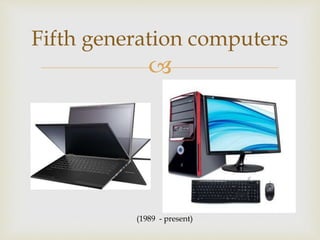
Fifth generation computers
(1989 - present)

ICs with ULSI technology
Larger capacity main memory hard disks with
RAID support
Optical disks as portable read-only storage
media
Notebooks powerful desktop PCs and
workstations
Powerful servers supercomputers
Internet
Cluster computing
Key hardware technologies

Micro-kernel based multithreading
distributed OS
Parallel programming libraries like MPI &
PVM
JAVA
World Wide Web
Multimedia Internet applications
More complex supercomputing
applications
Key software technologies

Portable computers
Powerful, cheaper reliable, and easier to use
desktop machines
Powerful supercomputers
High uptime due to hot-pluggable components
Totally general purpose machines
Easier to produce commercially easier to
upgrade
Rapid software development possible
Key characteristics

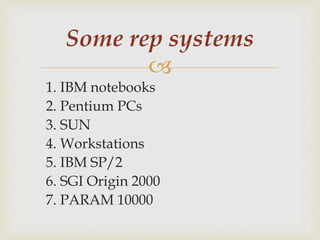
1. IBM notebooks
2. Pentium PCs
3. SUN
4. Workstations
5. IBM SP/2
6. SGI Origin 2000
7. PARAM 10000
Some rep systems
Computer generations powerpoint slide

Computer generations powerpoint slide

  • 1.
    Md. Raseduzzaman Md. MonirllAwal Golam Mostofa Rifat Hasan Hridoy Foysal Ahmed
  • 2.
  • 3.
      Generation incomputer terminology is a change in technology a computer is/was being used. Initially, the generation term was used to distinguish between varying hardware technologies. What is computer generation?
  • 4.
  • 5.
     Frist Generation Computers UNIVAC,EDVAC, EDSAC and ENIAC computers are examples of first generation computing devices. CHARACTERISTICS: 1) First generation computers were based on vacuum tubes. 2) The operating systems of the first generation computers were very slow. 3) They were very large in size. 4) Production of the heat was in large amount in first generation computers. 5) Machine language was used for programming. 6) First generation computers were unreliable. 7) They were difficult to program and use.
  • 6.
  • 7.
    Md: Foysal Ahmed ID: 161-15-7492
  • 8.
    Second Geeneration ofComputer (1955-1964)
  • 9.
  • 10.
  • 11.
  • 12.
     Third Generation Computers Employed duringthe period 1964-1975. Integrated circuit (ICs) began to be used. These ICs were called chips. Some of the computers developed during this period were:  IBM-360- developed by IBM in 1964.  PDP-8 -developed by DEC in 1965.  PDP-11 -developed by DEC in 1970.  VAX- developed by DEC in 1978.
  • 13.
     Advantages  Fastest computingdevices.  Very productive.  Easily transportable from one place to another because of their small size.  Use high-level languages.  Could be installed very easily and required less space.
  • 14.
  • 15.
  • 16.
     Computer-Fourth Generation  The periodof fourth generation was 1971- 1989. The computers of fourth generation used Very Large Scale Integrated (VLSI) circuits. VLSI circuits having about 5000 transistors and other circuit elements and their associated circuits on a single chip made it possible to have microcomputers of fourth generation. Fourth generation computers became more powerful, compact, reliable, and affordable. As a result, it gave rise to personal computer (PC) revolution.
  • 17.
     The main featuresof fourth generation are:-  VLSI technology used  Very cheap  Portable and reliable  Use of PC's  Very small size  Pipeline processing  No A.C. needed  Concept of internet was introduced  Great developments in the fields of networks  Computers became easily available
  • 18.
     Advantages of Fourth Generation 1.Smaller in size and much reliable. 2. No cooling system required in many cases. 3. Much faster computation. 4. Portable and cheap. 5. The heat generated was negligible. 6. Totally general purpose computer.
  • 19.
     Disadvantages of Fourth Generation 1.Latest technology was required for manufacturing of microprocessors.
  • 20.
     Some computers ofthis generation were: 1. DEC 10 2. STAR 1000 3. PDP 11 4. CRAY-1(Super Computer) 5. CRAY-X-MP(Super Computer)
  • 21.
  • 22.
  • 23.
     ICs with ULSItechnology Larger capacity main memory hard disks with RAID support Optical disks as portable read-only storage media Notebooks powerful desktop PCs and workstations Powerful servers supercomputers Internet Cluster computing Key hardware technologies
  • 24.
     Micro-kernel based multithreading distributedOS Parallel programming libraries like MPI & PVM JAVA World Wide Web Multimedia Internet applications More complex supercomputing applications Key software technologies
  • 25.
     Portable computers Powerful, cheaperreliable, and easier to use desktop machines Powerful supercomputers High uptime due to hot-pluggable components Totally general purpose machines Easier to produce commercially easier to upgrade Rapid software development possible Key characteristics
  • 26.
     1. IBM notebooks 2.Pentium PCs 3. SUN 4. Workstations 5. IBM SP/2 6. SGI Origin 2000 7. PARAM 10000 Some rep systems