GROUP- 1
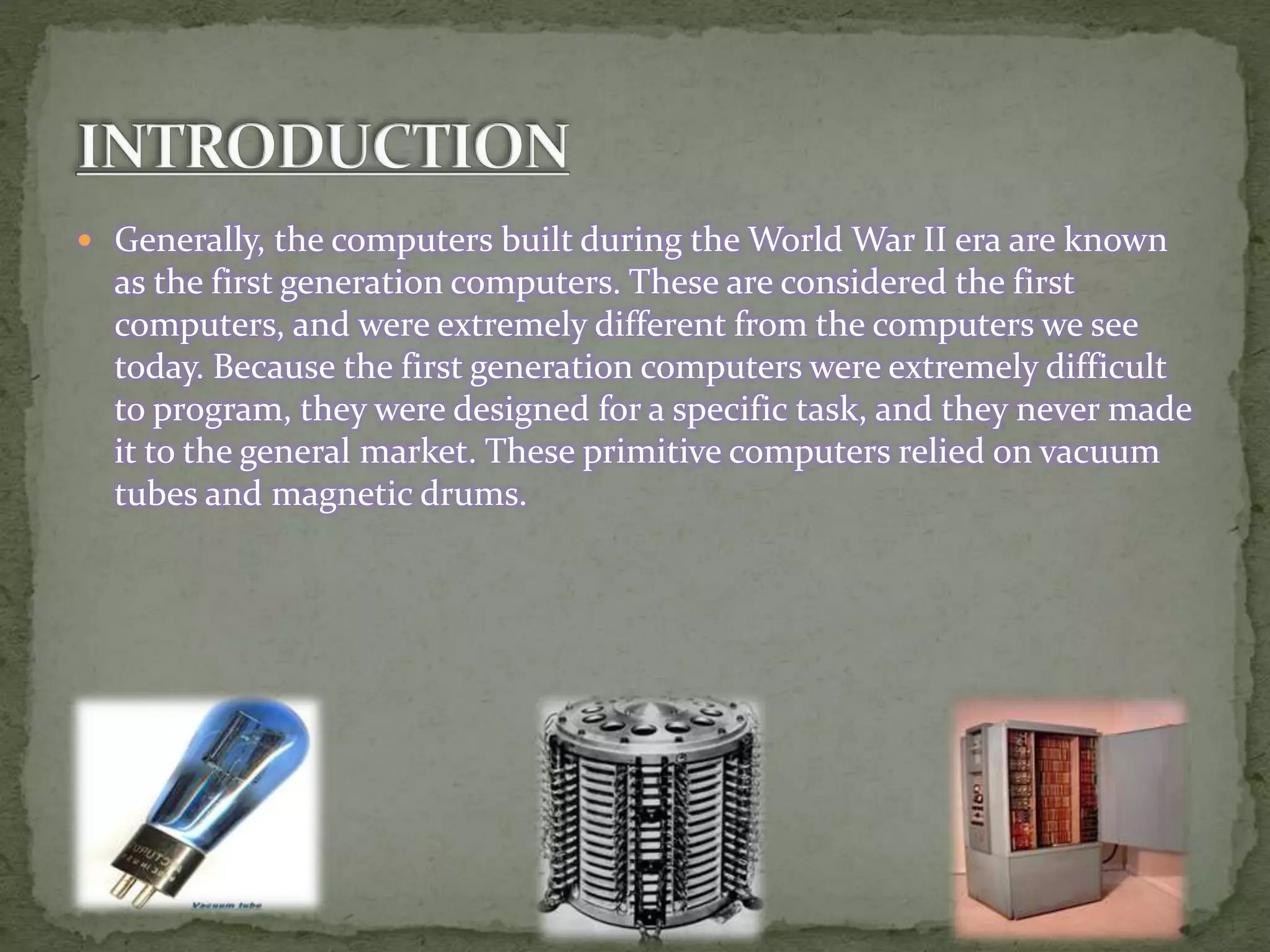
 Generally, the computers built during the World War II era are known 
as the first generation computers. These are considered the first 
computers, and were extremely different from the computers we see 
today. Because the first generation computers were extremely difficult 
to program, they were designed for a specific task, and they never made 
it to the general market. These primitive computers relied on vacuum 
tubes and magnetic drums.
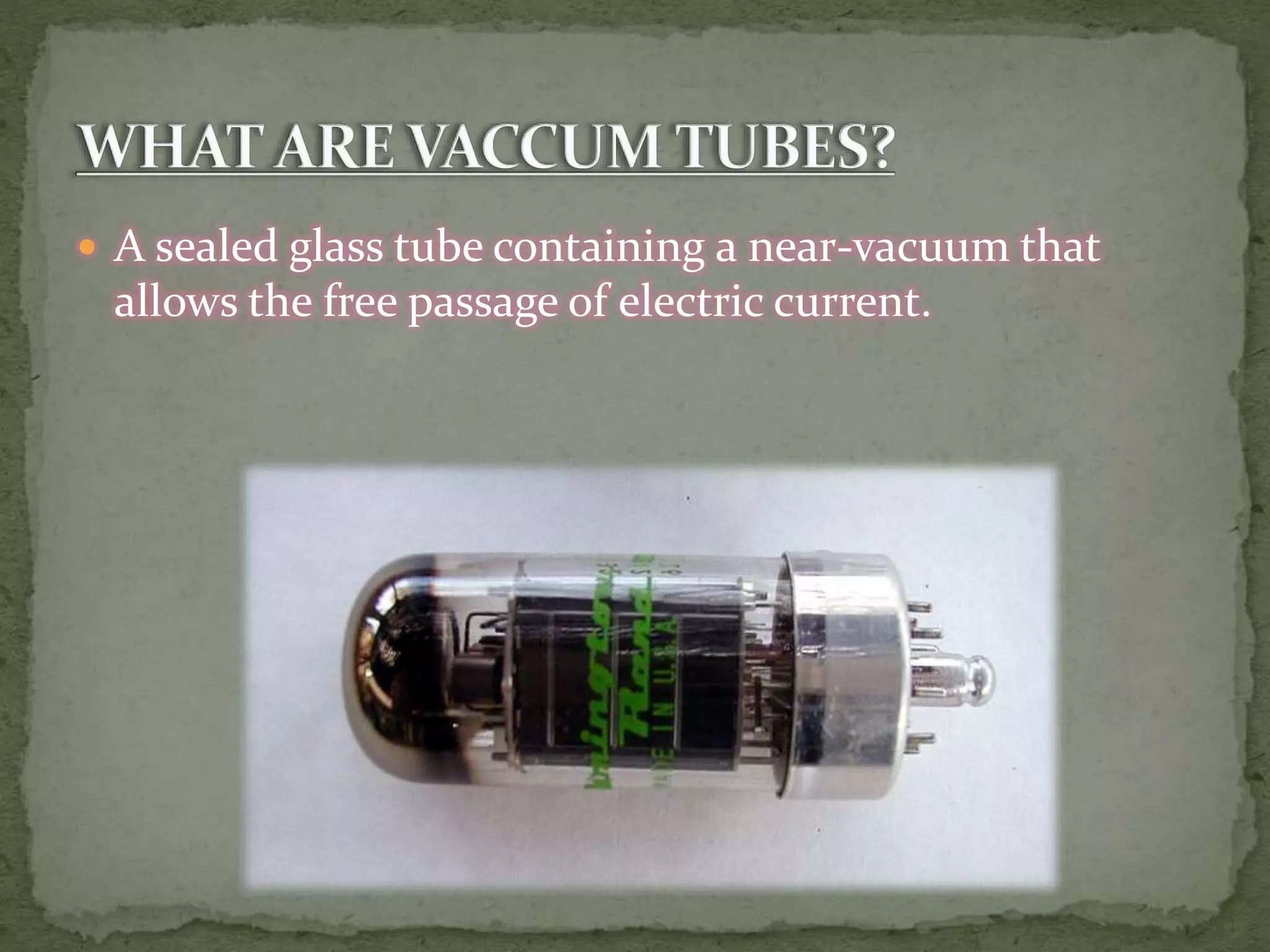
 A sealed glass tube containing a near-vacuum that 
allows the free passage of electric current.
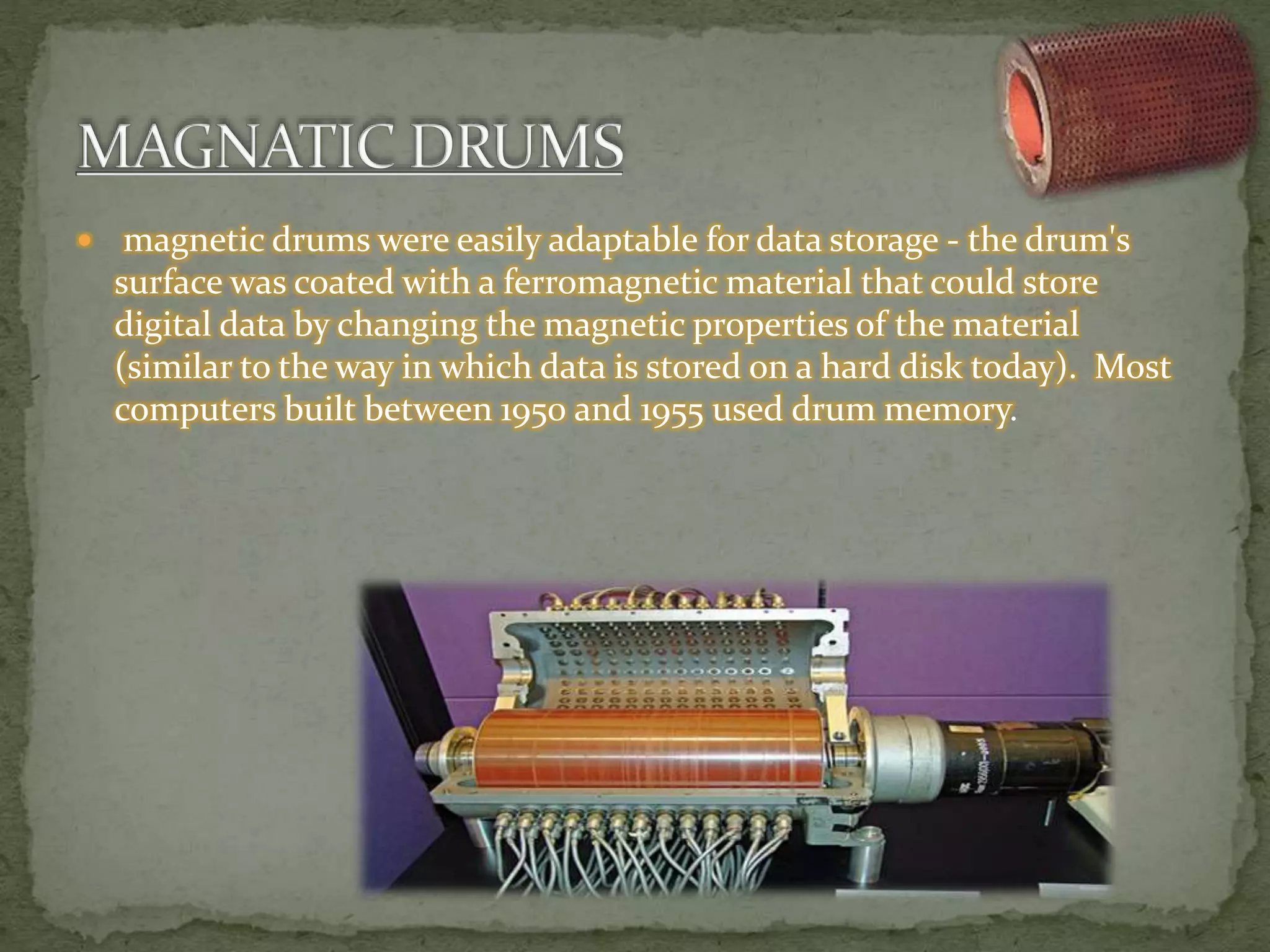
 magnetic drums were easily adaptable for data storage - the drum's 
surface was coated with a ferromagnetic material that could store 
digital data by changing the magnetic properties of the material 
(similar to the way in which data is stored on a hard disk today). Most 
computers built between 1950 and 1955 used drum memory.
 Early computers had no input devices, or any type of software as we 
know it today. They were "hard-wired" to perform specific 
mathematical calculations - a computer's function could only be 
changed by re-wiring its circuits. 
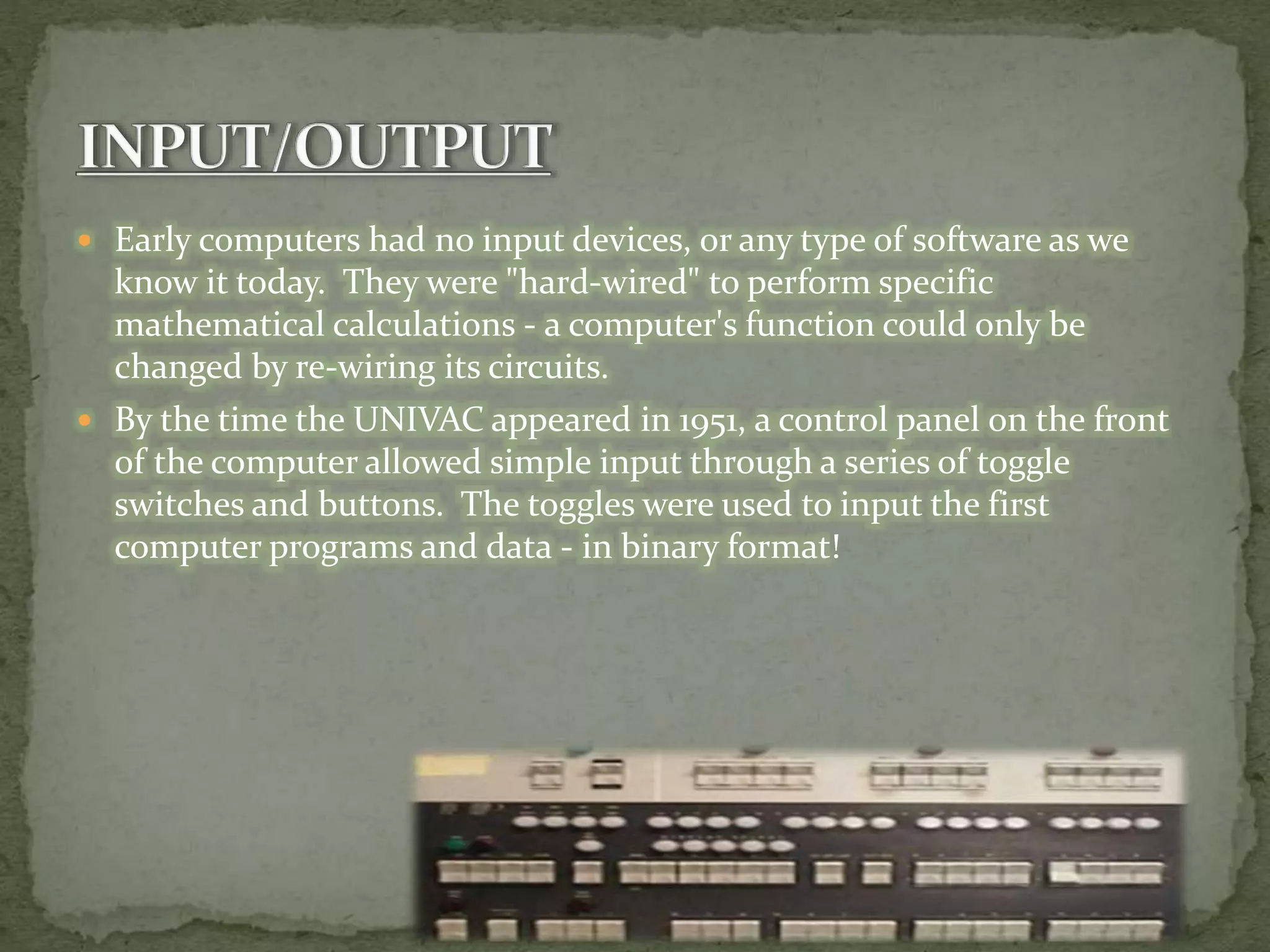
 By the time the UNIVAC appeared in 1951, a control panel on the front 
of the computer allowed simple input through a series of toggle 
switches and buttons. The toggles were used to input the first 
computer programs and data - in binary format!
 The programming was very limited and very complex USN machine 
language. Usually they were hardwired and the applications very 
limited. 
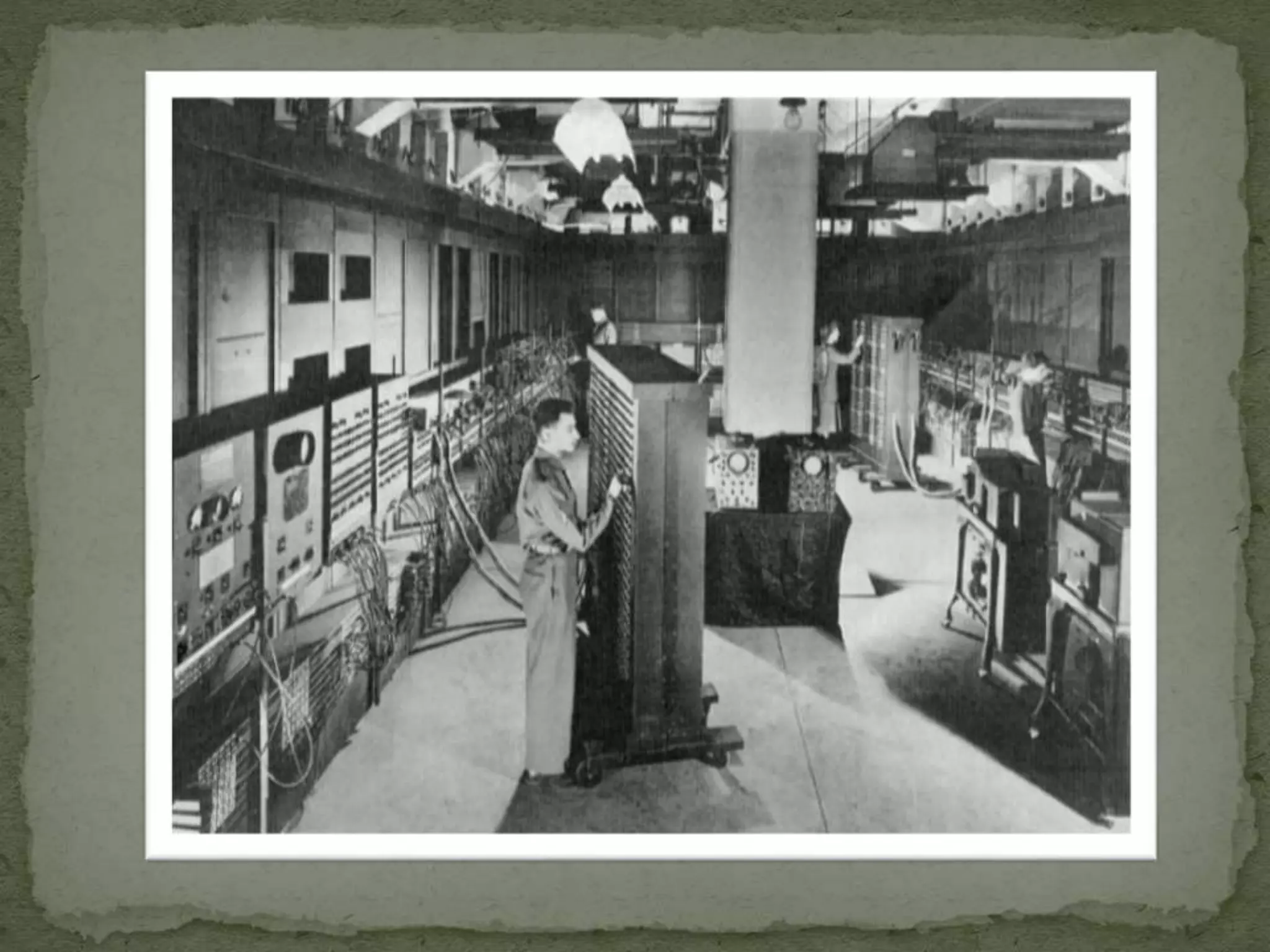
 One of the problems with vacuum tubes was that they took up a large 
amount of space. The ENIAC, developed in 1946, used 18,000 vacuum 
tubes, weighed 30 tons and covered 1,800 square feet! The vacuum 
tubes also produced a lot of heat, so that even with giant air-conditioning 
systems, the vacuum tubes would burn out regularly and 
need to be replaced.
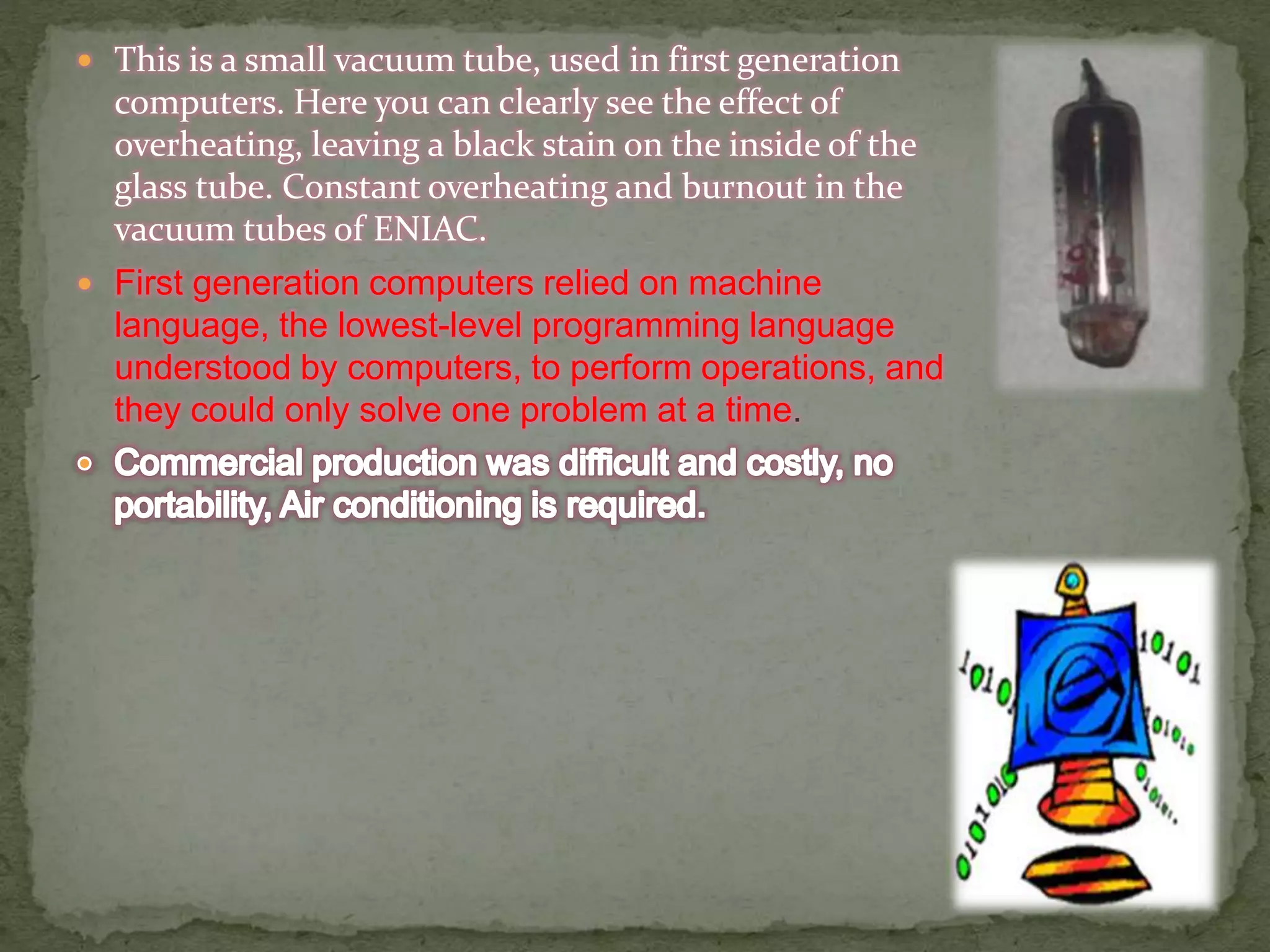
 This is a small vacuum tube, used in first generation 
computers. Here you can clearly see the effect of 
overheating, leaving a black stain on the inside of the 
glass tube. Constant overheating and burnout in the 
vacuum tubes of ENIAC. 
 First generation computers relied on machine 
language, the lowest-level programming language 
understood by computers, to perform operations, and 
they could only solve one problem at a time.
 Vacuum tube technology made possible the development 
of electronic digital computers. 
 Magnetic tapes and drums were used as secondary memory
 1939-1942: Atanasoff-Barry Computer - John Atanasoff and Clifford Berry 
 1941: Z3 – Konrad Zuse 
 1943: Colossus - Tommy Flowers and Max Newman 
 1944: Harvard Mark I - Howard Aiken 
 1943-1946: ENIAC - Dr. John Mauchly and J. Presper Eckert 
 1945: EDVAC - Jogh Mauchly and J. Preper Eckert 
 1944-1945: Plankalkul - Plankalkul 
 1947: Transistors - Bell Telephone laboratories. 
 1948: SSEC - IBM 
 1949: EDSAC - Maurice Wilkes 
 1945-1951: Whirlwind - Jay Forrester and Robert Everrett 
 1951: UNIVAC - John Mauchley and J. Presper Eckert Junior 
 1953: IBM 701 - IBM 
 1954: IBM 650 - IBM
More Reliability 
 Better Portability 
 Less Heat Generation 
 Smaller size 
 Faster Computers
 Very small size compared to a vacuum tube for the same amount of 
amplification. 
 No warm-up time. A tube takes 30 seconds to warm up. 
 A transistor is very easy to mass produce compared to a tube. 
 A transistor can take extreme amounts of shock and vibration 
compared to a tube. 
 A transistor is usually much lower in cost compared to a tube that 
gives the same amplification. 
 Transistors generally live and work forever whereas tubes burn out after 
a while
1st Generation Computers

1st Generation Computers

  • 1.
  • 3.
     Generally, thecomputers built during the World War II era are known as the first generation computers. These are considered the first computers, and were extremely different from the computers we see today. Because the first generation computers were extremely difficult to program, they were designed for a specific task, and they never made it to the general market. These primitive computers relied on vacuum tubes and magnetic drums.
  • 4.
     A sealedglass tube containing a near-vacuum that allows the free passage of electric current.
  • 5.
     magnetic drumswere easily adaptable for data storage - the drum's surface was coated with a ferromagnetic material that could store digital data by changing the magnetic properties of the material (similar to the way in which data is stored on a hard disk today). Most computers built between 1950 and 1955 used drum memory.
  • 6.
     Early computershad no input devices, or any type of software as we know it today. They were "hard-wired" to perform specific mathematical calculations - a computer's function could only be changed by re-wiring its circuits.  By the time the UNIVAC appeared in 1951, a control panel on the front of the computer allowed simple input through a series of toggle switches and buttons. The toggles were used to input the first computer programs and data - in binary format!
  • 7.
     The programmingwas very limited and very complex USN machine language. Usually they were hardwired and the applications very limited.  One of the problems with vacuum tubes was that they took up a large amount of space. The ENIAC, developed in 1946, used 18,000 vacuum tubes, weighed 30 tons and covered 1,800 square feet! The vacuum tubes also produced a lot of heat, so that even with giant air-conditioning systems, the vacuum tubes would burn out regularly and need to be replaced.
  • 8.
     This isa small vacuum tube, used in first generation computers. Here you can clearly see the effect of overheating, leaving a black stain on the inside of the glass tube. Constant overheating and burnout in the vacuum tubes of ENIAC.  First generation computers relied on machine language, the lowest-level programming language understood by computers, to perform operations, and they could only solve one problem at a time.
  • 9.
     Vacuum tubetechnology made possible the development of electronic digital computers.  Magnetic tapes and drums were used as secondary memory
  • 10.
     1939-1942: Atanasoff-BarryComputer - John Atanasoff and Clifford Berry  1941: Z3 – Konrad Zuse  1943: Colossus - Tommy Flowers and Max Newman  1944: Harvard Mark I - Howard Aiken  1943-1946: ENIAC - Dr. John Mauchly and J. Presper Eckert  1945: EDVAC - Jogh Mauchly and J. Preper Eckert  1944-1945: Plankalkul - Plankalkul  1947: Transistors - Bell Telephone laboratories.  1948: SSEC - IBM  1949: EDSAC - Maurice Wilkes  1945-1951: Whirlwind - Jay Forrester and Robert Everrett  1951: UNIVAC - John Mauchley and J. Presper Eckert Junior  1953: IBM 701 - IBM  1954: IBM 650 - IBM
  • 11.
    More Reliability Better Portability  Less Heat Generation  Smaller size  Faster Computers
  • 12.
     Very smallsize compared to a vacuum tube for the same amount of amplification.  No warm-up time. A tube takes 30 seconds to warm up.  A transistor is very easy to mass produce compared to a tube.  A transistor can take extreme amounts of shock and vibration compared to a tube.  A transistor is usually much lower in cost compared to a tube that gives the same amplification.  Transistors generally live and work forever whereas tubes burn out after a while