GENERATIONS OF
COMPUTER
BY- MANISH PANWAR
COMPUTER
• A Computer is a machine that
manipulates data according to a set of
instructions.
• A Computer is a programmable machine
that receives input, stores and provides
output in a useful format.
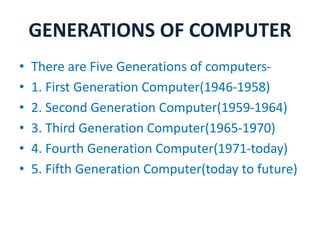
GENERATIONS OF COMPUTER
• There are Five Generations of computers-
• 1. First Generation Computer(1946-1958)
• 2. Second Generation Computer(1959-1964)
• 3. Third Generation Computer(1965-1970)
• 4. Fourth Generation Computer(1971-today)
• 5. Fifth Generation Computer(today to future)
FIRST GENERATION COMPUTER
(1946- 1958)
• First Generation computer uses Vacuum
tubes, Magnetic tape drives and magnetic
core memories were developed.
ENIAC(Electronic Numeric Integrator And
Calculator) was the first electronic digital
computer. Its uses about 18000 vacuum tubes.
Its size was too much large. This was very hard
to read and write programs by every person. It
produces too much heat.
MATERIAL USED
• Vacuum Tubes.
• Magnetic Drum.
• 4000 bits.
• Hard Wire Programs in Computers.
ADVANTAGES
• It is that they could perform thousands of
calculations each second, making it possible
decode messages in a useful time period.
• The “father” of these computers had originally
planned these machines to try and prove
mathematical conjectures, but this type of
applications couldn’t be considered until after
the war.
DISADVANTAGES
• They were very expensive.
• They contained thousands of vacuum tubes
making them unreliable.
• The major limitation for these computers was
that memory was practically non- existent,
only punched tape, delay line memory and
mercury memory were available.
SECOND GENERATION COMPUTER
(1959-1964)
• Second Generation computer uses a new
electronic device called Transistor in the place
of Vacuum Tube. Storage capacity of computer
also increase during this generation. Second
Generation computers also started showing
the characteristics of modern day computers
with utilities such as printers, disk storage and
operating systems.
MATERIAL USED
• Transistor.
• Magnetic cores.
• 32000 bites.
• Punch cards.
ADVANTAGES
• Smaller in size as compared to first generation
computer.
• More reliable.
• Less heat generated.
• Less prone to hardware failures.
• Better portability.
• Wider commercial use.
DISADVANTAGES
• Air- conditioning required.
• Frequent maintenance required.
• Manual assembly of individual components
into a functioning unit was required.
• Commercial production was difficult and
costly.
THIRD GENERATION COMPUTER
(1965-1970)
• In third generation computer transistor were
replaced with Integrated Circuit(IC) which is a
combination of number of transistor and
other electronic components fused together
on single crystal. This generation machine
uses magnetic tape and magnetic disk as
secondary storage device.
MATERIAL USED
• Silicon Chips.
• Cores, IC’s.
• 128000 bits.
• Keyboard Entry.
ADVANTAGES
• Smaller in size.
• Lower heat generated then second generation
computer.
• Maintenance cost is low because hardware
failures are rare.
• Easily portable.
• Less power requirement.
• Commercial production was easier and cheaper.
DISADVANTAGES
• Air- conditioning required in many cases.
• Highly sophisticated technology required
for the manufacture of IC chips.
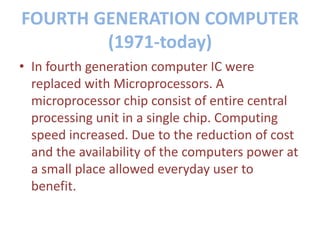
FOURTH GENERATION COMPUTER
(1971-today)
• In fourth generation computer IC were
replaced with Microprocessors. A
microprocessor chip consist of entire central
processing unit in a single chip. Computing
speed increased. Due to the reduction of cost
and the availability of the computers power at
a small place allowed everyday user to
benefit.
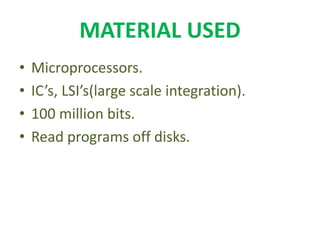
MATERIAL USED
• Microprocessors.
• IC’s, LSI’s(large scale integration).
• 100 million bits.
• Read programs off disks.
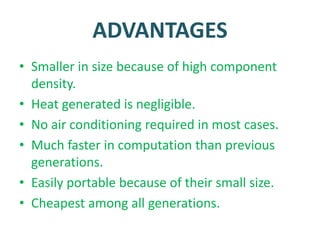
ADVANTAGES
• Smaller in size because of high component
density.
• Heat generated is negligible.
• No air conditioning required in most cases.
• Much faster in computation than previous
generations.
• Easily portable because of their small size.
• Cheapest among all generations.
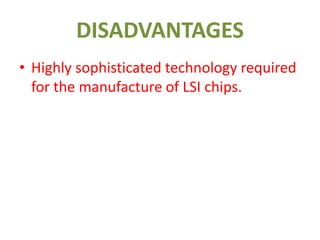
DISADVANTAGES
• Highly sophisticated technology required
for the manufacture of LSI chips.
FIFTH GENERATION COMPUTER
(today to future)
• In fifth generation computing devices, based
on artificial intelligence(AI), are still in
development, though there are some
applications, such as voice recognition that
are used today. The use of parallel processing
and superconductors is helping to make
artificial intelligence a reality.
ADVANTAGES
• These computers are more reliable, work
faster than other computers.
• These are easily portable.
• Having extra high processing speed.
• Having capabilities of parallel processing.
• WIRELESS!!!
DISADVANTAGES
• If computer have their own brain they
can harm the humanity.
THANK YOU

FOC PPT.pptx

  • 1.
  • 2.
    COMPUTER • A Computeris a machine that manipulates data according to a set of instructions. • A Computer is a programmable machine that receives input, stores and provides output in a useful format.
  • 3.
    GENERATIONS OF COMPUTER •There are Five Generations of computers- • 1. First Generation Computer(1946-1958) • 2. Second Generation Computer(1959-1964) • 3. Third Generation Computer(1965-1970) • 4. Fourth Generation Computer(1971-today) • 5. Fifth Generation Computer(today to future)
  • 4.
    FIRST GENERATION COMPUTER (1946-1958) • First Generation computer uses Vacuum tubes, Magnetic tape drives and magnetic core memories were developed. ENIAC(Electronic Numeric Integrator And Calculator) was the first electronic digital computer. Its uses about 18000 vacuum tubes. Its size was too much large. This was very hard to read and write programs by every person. It produces too much heat.
  • 5.
    MATERIAL USED • VacuumTubes. • Magnetic Drum. • 4000 bits. • Hard Wire Programs in Computers.
  • 6.
    ADVANTAGES • It isthat they could perform thousands of calculations each second, making it possible decode messages in a useful time period. • The “father” of these computers had originally planned these machines to try and prove mathematical conjectures, but this type of applications couldn’t be considered until after the war.
  • 7.
    DISADVANTAGES • They werevery expensive. • They contained thousands of vacuum tubes making them unreliable. • The major limitation for these computers was that memory was practically non- existent, only punched tape, delay line memory and mercury memory were available.
  • 8.
    SECOND GENERATION COMPUTER (1959-1964) •Second Generation computer uses a new electronic device called Transistor in the place of Vacuum Tube. Storage capacity of computer also increase during this generation. Second Generation computers also started showing the characteristics of modern day computers with utilities such as printers, disk storage and operating systems.
  • 9.
    MATERIAL USED • Transistor. •Magnetic cores. • 32000 bites. • Punch cards.
  • 10.
    ADVANTAGES • Smaller insize as compared to first generation computer. • More reliable. • Less heat generated. • Less prone to hardware failures. • Better portability. • Wider commercial use.
  • 11.
    DISADVANTAGES • Air- conditioningrequired. • Frequent maintenance required. • Manual assembly of individual components into a functioning unit was required. • Commercial production was difficult and costly.
  • 12.
    THIRD GENERATION COMPUTER (1965-1970) •In third generation computer transistor were replaced with Integrated Circuit(IC) which is a combination of number of transistor and other electronic components fused together on single crystal. This generation machine uses magnetic tape and magnetic disk as secondary storage device.
  • 13.
    MATERIAL USED • SiliconChips. • Cores, IC’s. • 128000 bits. • Keyboard Entry.
  • 14.
    ADVANTAGES • Smaller insize. • Lower heat generated then second generation computer. • Maintenance cost is low because hardware failures are rare. • Easily portable. • Less power requirement. • Commercial production was easier and cheaper.
  • 15.
    DISADVANTAGES • Air- conditioningrequired in many cases. • Highly sophisticated technology required for the manufacture of IC chips.
  • 16.
    FOURTH GENERATION COMPUTER (1971-today) •In fourth generation computer IC were replaced with Microprocessors. A microprocessor chip consist of entire central processing unit in a single chip. Computing speed increased. Due to the reduction of cost and the availability of the computers power at a small place allowed everyday user to benefit.
  • 17.
    MATERIAL USED • Microprocessors. •IC’s, LSI’s(large scale integration). • 100 million bits. • Read programs off disks.
  • 18.
    ADVANTAGES • Smaller insize because of high component density. • Heat generated is negligible. • No air conditioning required in most cases. • Much faster in computation than previous generations. • Easily portable because of their small size. • Cheapest among all generations.
  • 19.
    DISADVANTAGES • Highly sophisticatedtechnology required for the manufacture of LSI chips.
  • 20.
    FIFTH GENERATION COMPUTER (todayto future) • In fifth generation computing devices, based on artificial intelligence(AI), are still in development, though there are some applications, such as voice recognition that are used today. The use of parallel processing and superconductors is helping to make artificial intelligence a reality.
  • 21.
    ADVANTAGES • These computersare more reliable, work faster than other computers. • These are easily portable. • Having extra high processing speed. • Having capabilities of parallel processing. • WIRELESS!!!
  • 22.
    DISADVANTAGES • If computerhave their own brain they can harm the humanity.
  • 23.