GASTRIC ANALYSIS, XYLOSE
ABSORPTION TEST
Amit Kumar Singh
Assistant Professor
Department of Medical Lab Technology
Chandigarh University, Punjab
GASTRIC ANALYSIS
Gastric analysis is the determination of the presence of the acid and the pH of the
stomach.
Purpose
 The purpose of gastric acid determination is to measure the amount of acid
secreted in the stomach.
Procedure
 The test is conducted in the endoscopy laboratory. Then, a small nasogastric tube
is inserted into the nose, which finally enters the stomach. Then, the nurse collects
the contents of stomach in a container. This procedure should start in the morning
and continue for 2 hours. After the test the nasogastric tube is removed.
 The procedure for determining gastric analysis includes the following steps:
 Step 1: Measure acid secretion from the patient, which is taken in fasting state
called Basal gastric secretion test.
 Step 2: Then measure the secretion of gastric acid after the injection of
pentagastrin or other drugs, which easily stimulate the gastric acid.
Precautions
 Nothing should be consumed before the test: neither food nor drink
nor any medicine. The bladder must be empty.
Observations
 The normal result of the gastric analysis is that normal gastric juice
should have a faintly pungent odour, The HCL should secrete 2
mmol/hr for men and 1 mmol/hr for women and the fasting volume
should be 50 ml.
 Mucous should be present as it responsible for the secretion of the
gastric juice. When the mucous is in excess amount, it causes and
swallowing of saliva and nasopharyngeal secretions, gastritis and
gastric retention.
 When the odour of the gastric juice is foul and the acid smell causes
pyloric stenosis, ammoniacal odour suggests achlorohydria, faecal
odour suggests small intestinal obstruction or gastro- colic fistula.
 If the colour is red then it is due to blood, and if it is dark green then it
is due to bile.
Treatment
 The treatment to cure gastric problem, which include drugs,
such as, antacids, H2 antagonists, proton pump inhibitors,
should be taken in time.
 Meals too should be taken on time and a doctor must be
consulted.
 The proton pump inhibitors are drugs which prevent the
enzyme from moving to the stomach. i.e.
hydrogen/potassium adenosine triphosphatase. These drugs
are more effective than the H2-receptor blockers in reducing
the stomach acid.
 Some drugs used in proton pumps inhibitors are omeprazole
(Prilosec), esomeprazole (Nexium), lansoprazole (Prevacid),
pantoprazole (Protonix) and rabeprazole (AcipHex).
XYLOSE ABSORPTION TEST
Xylose (wood sugar) is an aldopentose, reducing
monosaccharide sugar, found in the embryos of most
edible plants. In 1881, Koch was the first scientist who
isolated xylose from wood.
Precaution
 Nothing should he consumed before the test for 8-12
hours, nor should any exercise be done.
 Cetain drugs, such as, aspirin, atropine, indomethacin,
isocarboxazid and phenelzine should be avoided.
 The side effects of this test include giddiness,
haematoma, excessive bleeding and other infections.
Procedure
 There are several ways by which the tests can be
performed which include blood and urine sample test.
 Blood sample is collected by drawing the blood from
the vein on the inside of the elbow or the back of the
hand. An elastic band is placed around the upper arm
to apply pressure and then the needle is inserted into
the vain.
 Blood is then collected in an airtight vial or syringe,
which is taken for the test.
 Urine is collected in the morning in a small, clean
container that holds about 1 gal. Do not touch the
mouth of the container with your finger, do not include
toilet paper, stool or other foreign matter in the
collected urine sample.
Normal range
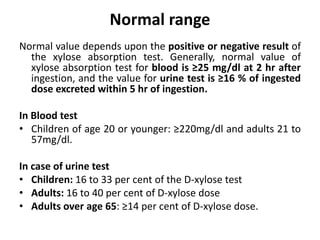
Normal value depends upon the positive or negative result of
the xylose absorption test. Generally, normal value of
xylose absorption test for blood is ≥25 mg/dl at 2 hr after
ingestion, and the value for urine test is ≥16 % of ingested
dose excreted within 5 hr of ingestion.
In Blood test
• Children of age 20 or younger: ≥220mg/dl and adults 21 to
57mg/dl.
In case of urine test
• Children: 16 to 33 per cent of the D-xylose test
• Adults: 16 to 40 per cent of D-xylose dose
• Adults over age 65: ≥14 per cent of D-xylose dose.
Result
• Higher value may be caused by a disease
called Hodgkin's disease or scleroderma.
Lower value is caused by some disorder such
as Celias disease, Crohn disease, Giardia
Lamblia, Whipple disease, viral gastroenteritis
and radiation enteropathy.
Clinical significance
o Xylose absorption test measures the ability of the intestine (mainly
duodenum and proximal jejunum) to absorb the simple sugar called
xylose.
o Generally, xylose is found in the blood or in the urine which does
not undergo metabolism and it is secreted in the gut of the animal.
o This test indicates whether the nutrients are being properly
absorbed in the intestine.
o Abnormal result may be due to different disease such as Crohn’s
disease, Giardia lamblia infestation, hookworm infestation,
lymphatic obstruction, radiation enteropathy, small intestinal
bacteria overgrouth, celiac disease (sprue), viral gastroenteritis and
whipple’s disease.
o These tests are prescribed only when one is suffrering from general
weakness, persistent diarrohea, weight loss and malnutrition.

Gastric analysis & Xylose absorption test.pptx

  • 1.
    GASTRIC ANALYSIS, XYLOSE ABSORPTIONTEST Amit Kumar Singh Assistant Professor Department of Medical Lab Technology Chandigarh University, Punjab
  • 2.
    GASTRIC ANALYSIS Gastric analysisis the determination of the presence of the acid and the pH of the stomach. Purpose  The purpose of gastric acid determination is to measure the amount of acid secreted in the stomach. Procedure  The test is conducted in the endoscopy laboratory. Then, a small nasogastric tube is inserted into the nose, which finally enters the stomach. Then, the nurse collects the contents of stomach in a container. This procedure should start in the morning and continue for 2 hours. After the test the nasogastric tube is removed.  The procedure for determining gastric analysis includes the following steps:  Step 1: Measure acid secretion from the patient, which is taken in fasting state called Basal gastric secretion test.  Step 2: Then measure the secretion of gastric acid after the injection of pentagastrin or other drugs, which easily stimulate the gastric acid.
  • 3.
    Precautions  Nothing shouldbe consumed before the test: neither food nor drink nor any medicine. The bladder must be empty. Observations  The normal result of the gastric analysis is that normal gastric juice should have a faintly pungent odour, The HCL should secrete 2 mmol/hr for men and 1 mmol/hr for women and the fasting volume should be 50 ml.  Mucous should be present as it responsible for the secretion of the gastric juice. When the mucous is in excess amount, it causes and swallowing of saliva and nasopharyngeal secretions, gastritis and gastric retention.  When the odour of the gastric juice is foul and the acid smell causes pyloric stenosis, ammoniacal odour suggests achlorohydria, faecal odour suggests small intestinal obstruction or gastro- colic fistula.  If the colour is red then it is due to blood, and if it is dark green then it is due to bile.
  • 4.
    Treatment  The treatmentto cure gastric problem, which include drugs, such as, antacids, H2 antagonists, proton pump inhibitors, should be taken in time.  Meals too should be taken on time and a doctor must be consulted.  The proton pump inhibitors are drugs which prevent the enzyme from moving to the stomach. i.e. hydrogen/potassium adenosine triphosphatase. These drugs are more effective than the H2-receptor blockers in reducing the stomach acid.  Some drugs used in proton pumps inhibitors are omeprazole (Prilosec), esomeprazole (Nexium), lansoprazole (Prevacid), pantoprazole (Protonix) and rabeprazole (AcipHex).
  • 5.
    XYLOSE ABSORPTION TEST Xylose(wood sugar) is an aldopentose, reducing monosaccharide sugar, found in the embryos of most edible plants. In 1881, Koch was the first scientist who isolated xylose from wood. Precaution  Nothing should he consumed before the test for 8-12 hours, nor should any exercise be done.  Cetain drugs, such as, aspirin, atropine, indomethacin, isocarboxazid and phenelzine should be avoided.  The side effects of this test include giddiness, haematoma, excessive bleeding and other infections.
  • 6.
    Procedure  There areseveral ways by which the tests can be performed which include blood and urine sample test.  Blood sample is collected by drawing the blood from the vein on the inside of the elbow or the back of the hand. An elastic band is placed around the upper arm to apply pressure and then the needle is inserted into the vain.  Blood is then collected in an airtight vial or syringe, which is taken for the test.  Urine is collected in the morning in a small, clean container that holds about 1 gal. Do not touch the mouth of the container with your finger, do not include toilet paper, stool or other foreign matter in the collected urine sample.
  • 7.
    Normal range Normal valuedepends upon the positive or negative result of the xylose absorption test. Generally, normal value of xylose absorption test for blood is ≥25 mg/dl at 2 hr after ingestion, and the value for urine test is ≥16 % of ingested dose excreted within 5 hr of ingestion. In Blood test • Children of age 20 or younger: ≥220mg/dl and adults 21 to 57mg/dl. In case of urine test • Children: 16 to 33 per cent of the D-xylose test • Adults: 16 to 40 per cent of D-xylose dose • Adults over age 65: ≥14 per cent of D-xylose dose.
  • 8.
    Result • Higher valuemay be caused by a disease called Hodgkin's disease or scleroderma. Lower value is caused by some disorder such as Celias disease, Crohn disease, Giardia Lamblia, Whipple disease, viral gastroenteritis and radiation enteropathy.
  • 9.
    Clinical significance o Xyloseabsorption test measures the ability of the intestine (mainly duodenum and proximal jejunum) to absorb the simple sugar called xylose. o Generally, xylose is found in the blood or in the urine which does not undergo metabolism and it is secreted in the gut of the animal. o This test indicates whether the nutrients are being properly absorbed in the intestine. o Abnormal result may be due to different disease such as Crohn’s disease, Giardia lamblia infestation, hookworm infestation, lymphatic obstruction, radiation enteropathy, small intestinal bacteria overgrouth, celiac disease (sprue), viral gastroenteritis and whipple’s disease. o These tests are prescribed only when one is suffrering from general weakness, persistent diarrohea, weight loss and malnutrition.

Editor's Notes

  • #6 Giddiness-feeling of being unbalanced and lightheaded
  • #9 Hodgkin disease, is a type of cancer that develops in the lymph system, Scleroderma is an autoimmune connective tissue and rheumatic disease that causes inflammation in the skin and other areas of the body, Celiac disease is a chronic digestive and immune disorder that damages the small intestine. Crohn's disease is a chronic disease that causes inflammation in your digestive tract, Whipple disease is caused by a type of bacterium called Tropheryma whipplei,