Differential centrifugation
Dr. P. Suganya
Assistant Professor
Department of Biotechnology
Sri Kaliswari College (Autonomous)
Sivakasi
• Differential centrifugation (also known
as differential velocity centrifugation) is a
common procedure in biochemistry and cell
biology, which is used to separate organelles
and other sub-cellular particles based on their
sedimentation rate.
Principle
• In a viscous fluid, the rate of sedimentation of
a given suspended particle (as long as the
particle is more dense than the fluid) is largely
a function of the following factors:
• Gravitational force
• Difference in density
• Fluid viscosity
• Particle size and shape
Procedure
• Differential centrifugation can be used with intact particles
(e.g. biological cells, microparticles, nanoparticles), or used
to separate the component parts of a given particle.
• Using the example of a separation of eukaryotic organelles
from intact cells, the cell must first be lysed
and homogenized (ideally by a gentle technique, such as
dounce homogenization; harsher techniques or over
homogenization will lead to a lower proportion of intact
organelles).
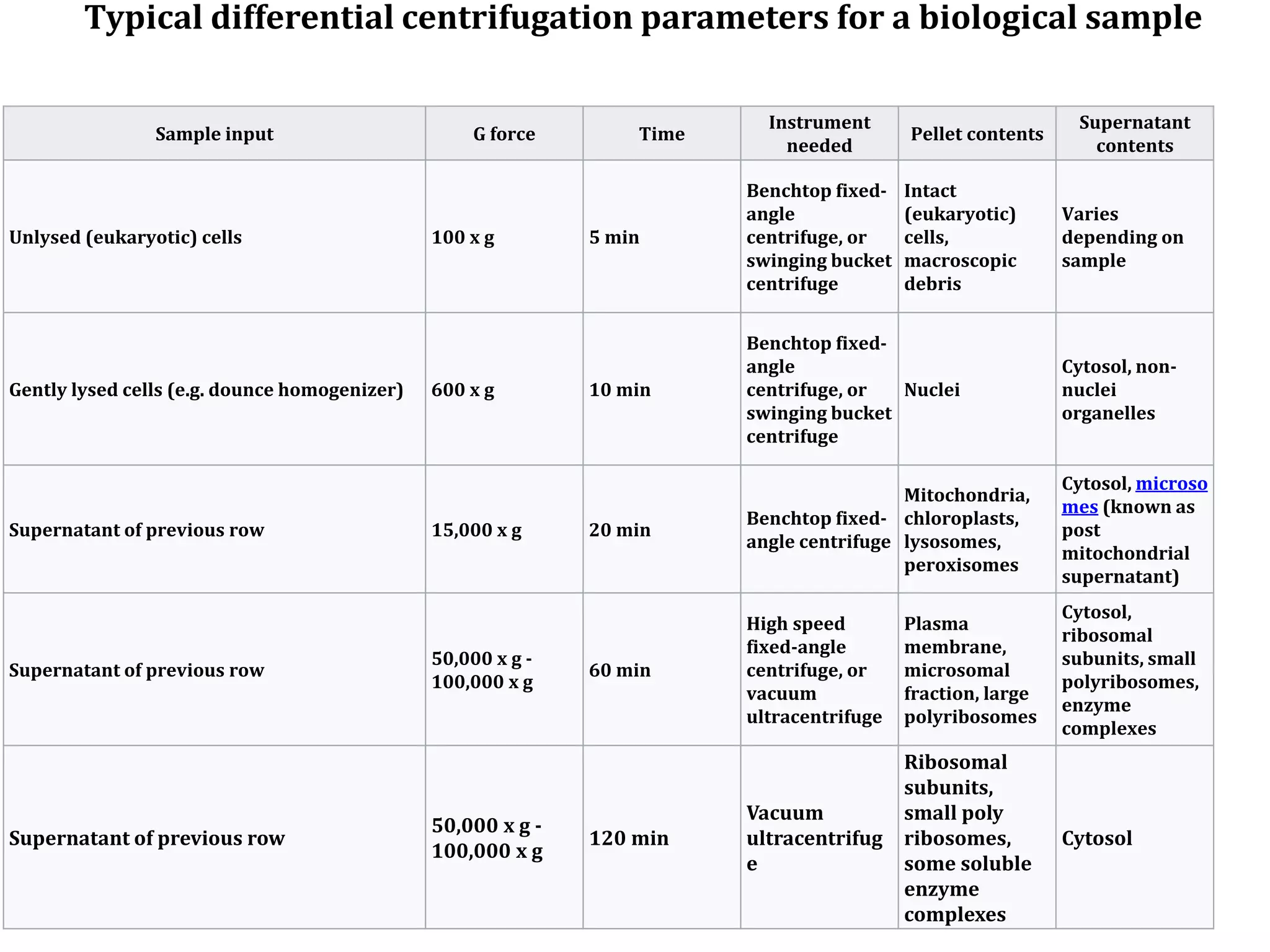
• Once the crude organelle extract is obtained, it may be
subjected to a varying centrifugation speeds to separate
the organelles:
Typical differential centrifugation parameters for a biological sample
Sample input G force Time
Instrument
needed
Pellet contents
Supernatant
contents
Unlysed (eukaryotic) cells 100 x g 5 min
Benchtop fixed-
angle
centrifuge, or
swinging bucket
centrifuge
Intact
(eukaryotic)
cells,
macroscopic
debris
Varies
depending on
sample
Gently lysed cells (e.g. dounce homogenizer) 600 x g 10 min
Benchtop fixed-
angle
centrifuge, or
swinging bucket
centrifuge
Nuclei
Cytosol, non-
nuclei
organelles
Supernatant of previous row 15,000 x g 20 min
Benchtop fixed-
angle centrifuge
Mitochondria,
chloroplasts,
lysosomes,
peroxisomes
Cytosol, microso
mes (known as
post
mitochondrial
supernatant)
Supernatant of previous row
50,000 x g -
100,000 x g
60 min
High speed
fixed-angle
centrifuge, or
vacuum
ultracentrifuge
Plasma
membrane,
microsomal
fraction, large
polyribosomes
Cytosol,
ribosomal
subunits, small
polyribosomes,
enzyme
complexes
Supernatant of previous row
50,000 x g -
100,000 x g
120 min
Vacuum
ultracentrifug
e
Ribosomal
subunits,
small poly
ribosomes,
some soluble
enzyme
complexes
Cytosol
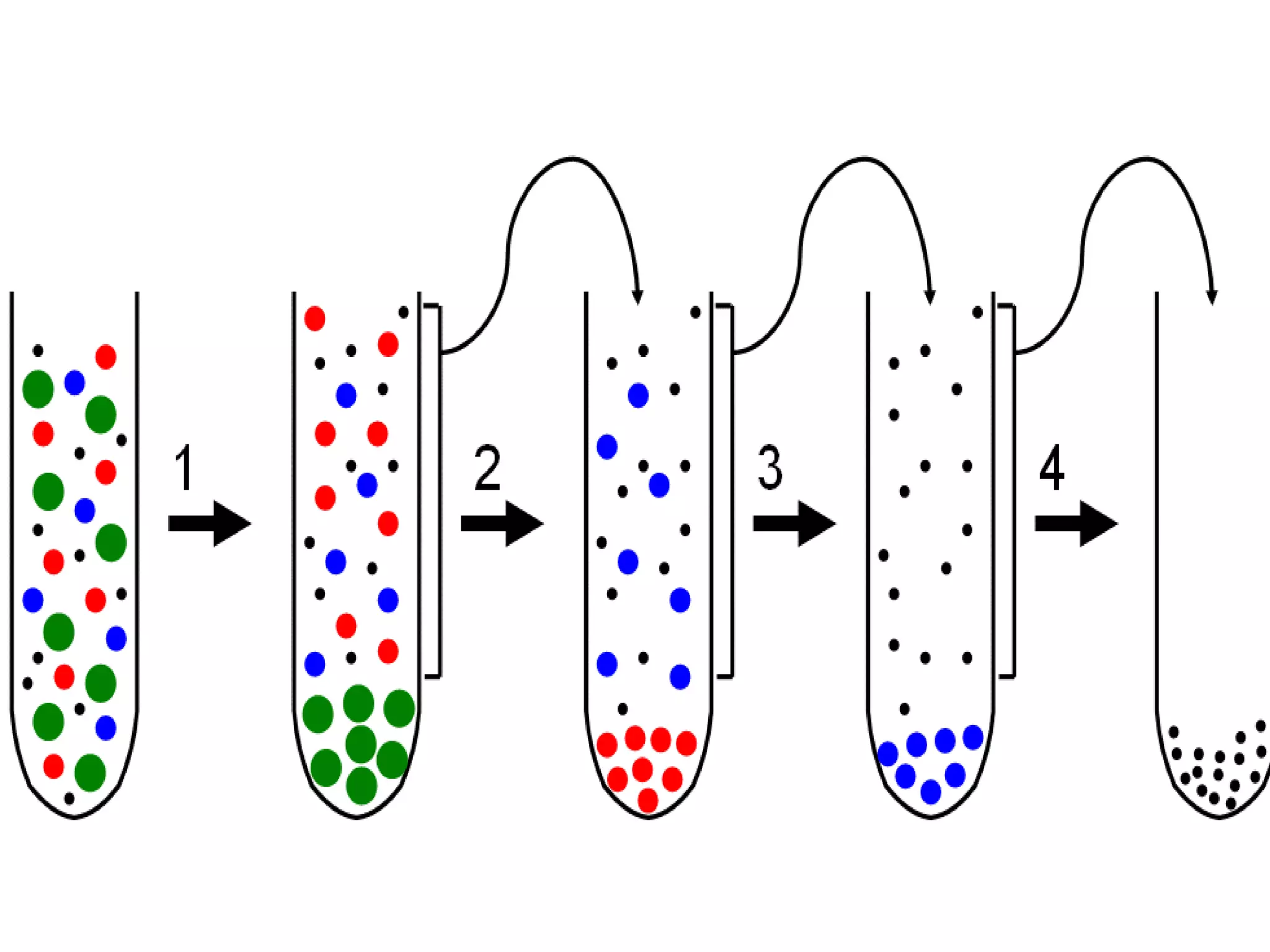
• It is the most common type of centrifugation employed.
• Tissue such as the liver is homogenized at 32 degrees in a
sucrose solution that contains buffer.
• The homogenate is then placed in a centrifuge and spun at
constant centrifugal force at a constant temperature.
• After some time a sediment forms at the bottom of a
centrifuge called pellet and an overlying solution called
supernatant.
• The overlying solution is then placed in another centrifuge
tube which is then rotated at higher speeds in progressing
steps.
Applications
• To separate two miscible substances
• To analyze the hydrodynamic properties of macromolecules
• Purification of mammalian cells
• Fractionation of subcellular organelles (including
membranes/membrane fractions) Fractionation of membrane
vesicles
• Separating chalk powder from water
• Removing fat from milk to produce skimmed milk
• Separating particles from an air-flow using cyclonic separation
• The clarification and stabilization of wine
• Separation of urine components and blood components in forensic
and research laboratories
• Aids in the separation of proteins using purification techniques such
as salting out, e.g. ammonium sulfate precipitation.

Differential centrifugation

  • 1.
    Differential centrifugation Dr. P.Suganya Assistant Professor Department of Biotechnology Sri Kaliswari College (Autonomous) Sivakasi
  • 3.
    • Differential centrifugation(also known as differential velocity centrifugation) is a common procedure in biochemistry and cell biology, which is used to separate organelles and other sub-cellular particles based on their sedimentation rate.
  • 4.
    Principle • In aviscous fluid, the rate of sedimentation of a given suspended particle (as long as the particle is more dense than the fluid) is largely a function of the following factors: • Gravitational force • Difference in density • Fluid viscosity • Particle size and shape
  • 5.
    Procedure • Differential centrifugationcan be used with intact particles (e.g. biological cells, microparticles, nanoparticles), or used to separate the component parts of a given particle. • Using the example of a separation of eukaryotic organelles from intact cells, the cell must first be lysed and homogenized (ideally by a gentle technique, such as dounce homogenization; harsher techniques or over homogenization will lead to a lower proportion of intact organelles). • Once the crude organelle extract is obtained, it may be subjected to a varying centrifugation speeds to separate the organelles:
  • 6.
    Typical differential centrifugationparameters for a biological sample Sample input G force Time Instrument needed Pellet contents Supernatant contents Unlysed (eukaryotic) cells 100 x g 5 min Benchtop fixed- angle centrifuge, or swinging bucket centrifuge Intact (eukaryotic) cells, macroscopic debris Varies depending on sample Gently lysed cells (e.g. dounce homogenizer) 600 x g 10 min Benchtop fixed- angle centrifuge, or swinging bucket centrifuge Nuclei Cytosol, non- nuclei organelles Supernatant of previous row 15,000 x g 20 min Benchtop fixed- angle centrifuge Mitochondria, chloroplasts, lysosomes, peroxisomes Cytosol, microso mes (known as post mitochondrial supernatant) Supernatant of previous row 50,000 x g - 100,000 x g 60 min High speed fixed-angle centrifuge, or vacuum ultracentrifuge Plasma membrane, microsomal fraction, large polyribosomes Cytosol, ribosomal subunits, small polyribosomes, enzyme complexes Supernatant of previous row 50,000 x g - 100,000 x g 120 min Vacuum ultracentrifug e Ribosomal subunits, small poly ribosomes, some soluble enzyme complexes Cytosol
  • 7.
    • It isthe most common type of centrifugation employed. • Tissue such as the liver is homogenized at 32 degrees in a sucrose solution that contains buffer. • The homogenate is then placed in a centrifuge and spun at constant centrifugal force at a constant temperature. • After some time a sediment forms at the bottom of a centrifuge called pellet and an overlying solution called supernatant. • The overlying solution is then placed in another centrifuge tube which is then rotated at higher speeds in progressing steps.
  • 8.
    Applications • To separatetwo miscible substances • To analyze the hydrodynamic properties of macromolecules • Purification of mammalian cells • Fractionation of subcellular organelles (including membranes/membrane fractions) Fractionation of membrane vesicles • Separating chalk powder from water • Removing fat from milk to produce skimmed milk • Separating particles from an air-flow using cyclonic separation • The clarification and stabilization of wine • Separation of urine components and blood components in forensic and research laboratories • Aids in the separation of proteins using purification techniques such as salting out, e.g. ammonium sulfate precipitation.