•COLORIMETER
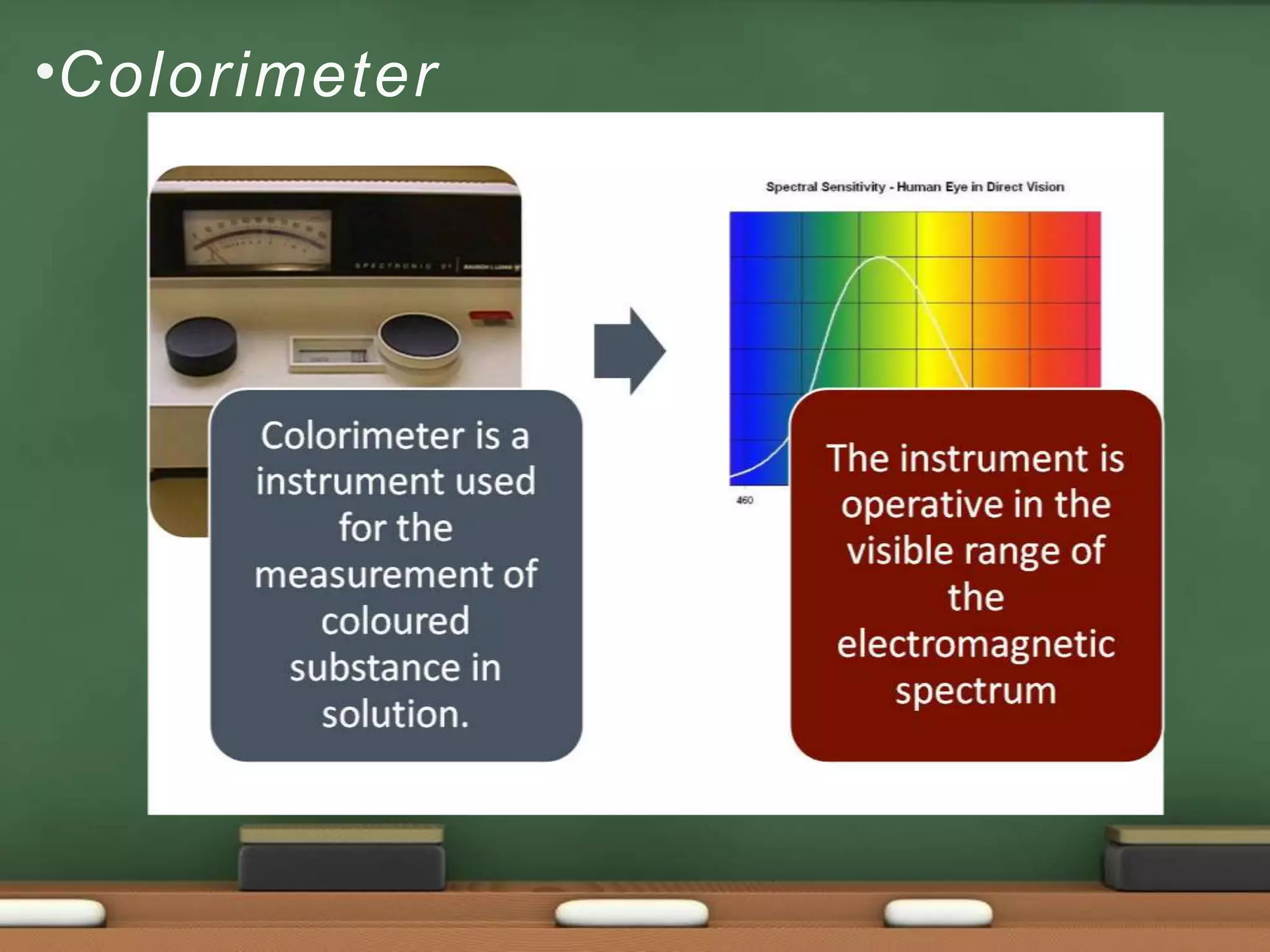
•Visible spectrum
•Colorimeter
•Photometry
Colorimetry
• It is the most common analytical technique
used in biochemical estimation in clinical
laboratory.
• It involves the quantitative estimation of color.
• A substance to be estimated colorimetrically,
must be colored or it should be capable of
forming chromogens (colored complexes)
through the addition of reagents.
• Colored substance absorb light in relation to their
color intensity.
• The color intensity will be proportional to the
conc. of colored substance.
• The instruments used in this method are
colorimeter or photometer or absorptiometers.
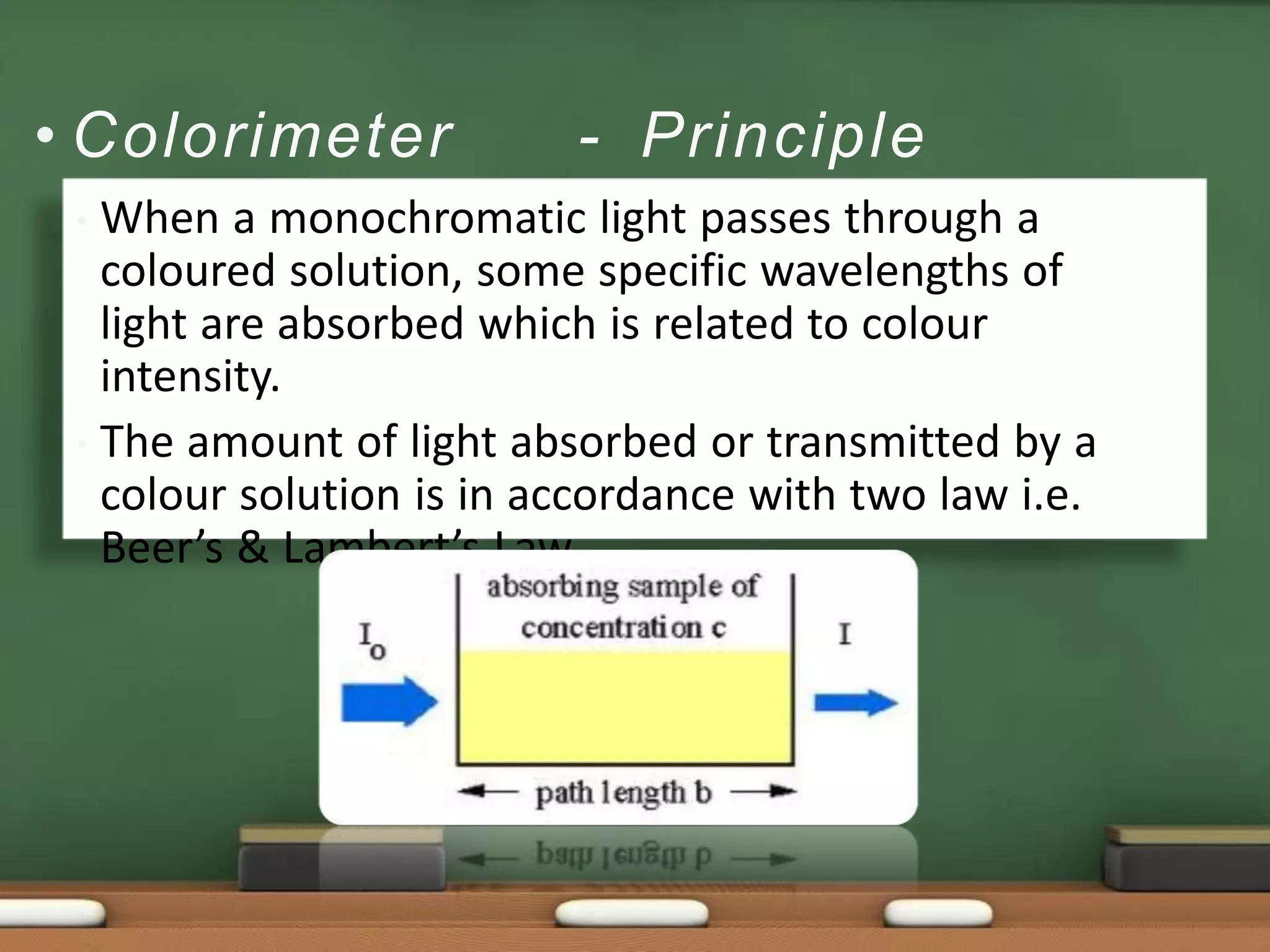
• Colorimeter - Principle
• When a monochromatic light passes through a
coloured solution, some specific wavelengths of
light are absorbed which is related to colour
intensity.
• The amount of light absorbed or transmitted by a
colour solution is in accordance with two law i.e.
Beer’s & Lambert’s Law.
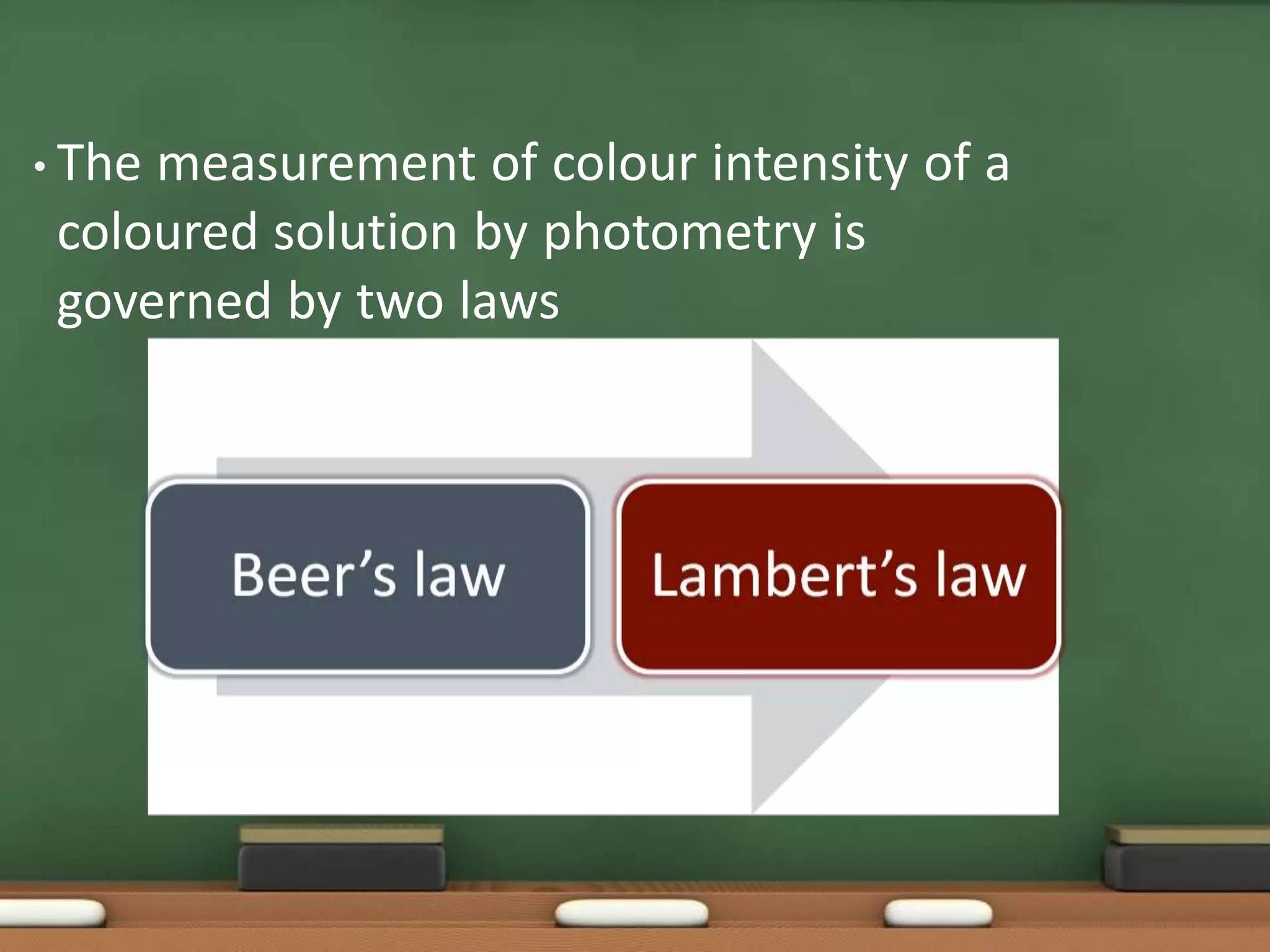
• The measurement of colour intensity of a
coloured solution by photometry is
governed by two laws
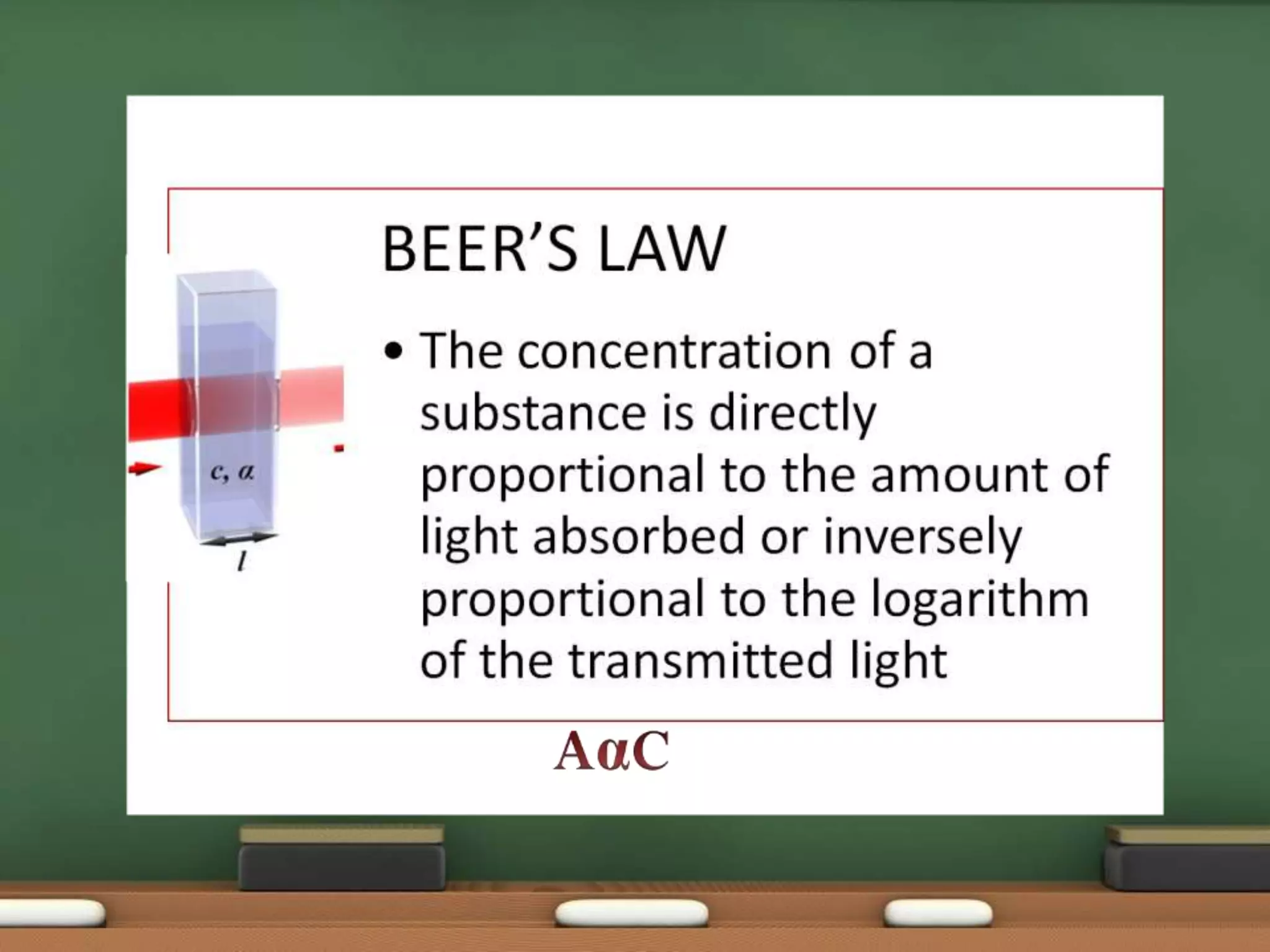
Beer’s law :
•When a monochromatic light passes through a
colored solution, amount of light transmitted decreases
exponentially with increase in concentration of colored
substance.
•i.e. the amount of light absorbed by a colored solution
is directly proportion to the conc. of substance in the
colored solution.
Beer’s law
Beer’s law
09/12/15 08:51
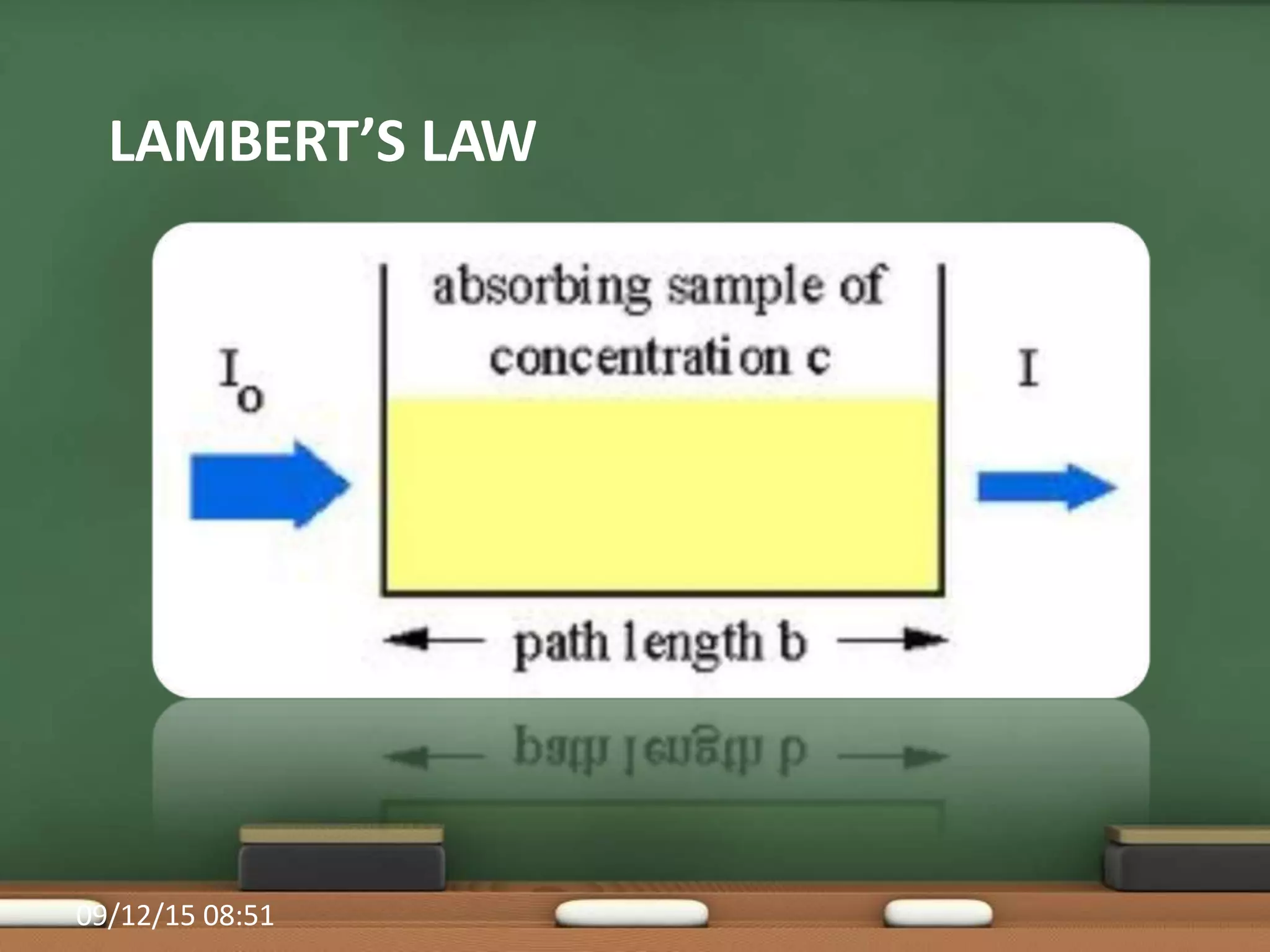
Lambert’s law :
•The amount of light transmitted decreases
exponentially with increase in pathlength (diameter)
of the cuvette or thickness of colored solution
through which light passes.
•i.e. the amount of light absorbed by a colored
solution depends on pathlength of cuvette or
thickness or depth of the colored solution.
LAMBERT’S LAW
09/12/15 08:51
• Combined beer’s- lambert’s law is thus expressed
as amount of light transmitted through a colored
solution decreases exponentially with increases
in conc. of colored solution & increase in conc. of
colored solution & increase in the path length of
cuvette or thickness of the colored solution
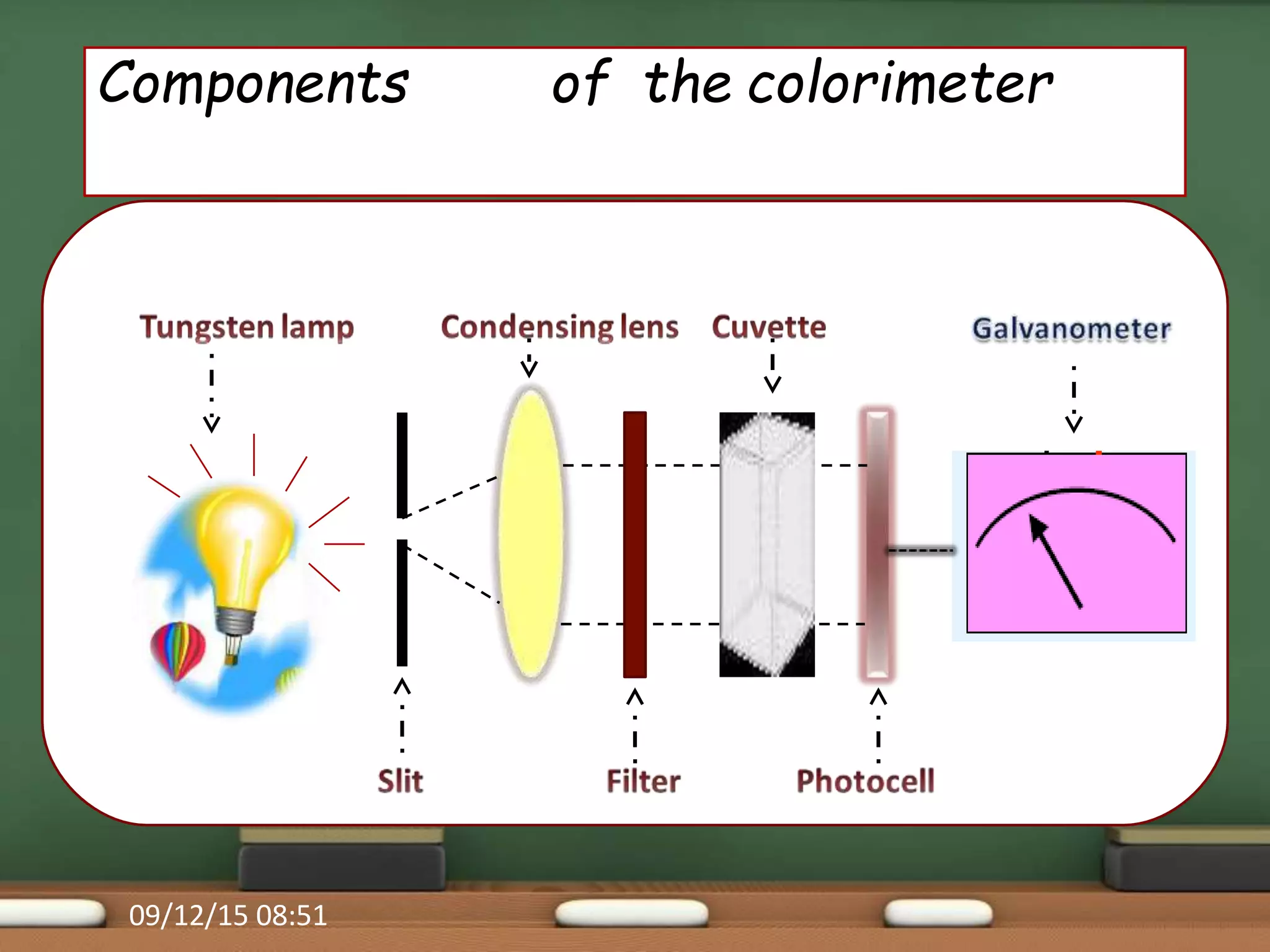
Components of the colorimeter
09/12/15 08:51
Parts of the colorimeter
Light source : tungsten filament lamp
Slit : it is adjustable which allows only a beam of
light to pass through. it prevents unwanted or stray
light
Condensing lenses: light after passing through slit
falls on condenser lense which gives a parllel
beam of light.
Filter :
•made of colored glass. Filters are used for selecting light of
narrow wavelength.
•filters will absorb light of unwanted wavelength and allow only
monochromatic light to pass through.
For ex: a green filter absorbs all color, except green light which
is allowed to pass through. Light transmitted through a green
filter has a wavelength from 500-560 nm.
•Filter used is always complimentary in color to the color of
solution.
Cuvette(sample holder) : the monochromatic light from the
filter passes through the colored solution placed in a cuvette.
• it is made up of special glass/plastic/quartz material.
• it may be square/rectangular/round shape with fixed diameter
(usually 1 cm)& having uniform surface. the colored solution in
the cuvette absorbs part of light & remaining is allowed to fall
on detector.
• For ex : a solution of red color transmits red light & absorbs the
complimentary color green.
Detector (photocell):
•Detector are photosensitive elements which converts light
energy into electrical energy.
•The electrical signal generated is directly proportional to
intensity of light falling on the detector.
Output : the electrical signal generated in photocell is
measured by galvanometer, which displays percent
transmission & optical density.
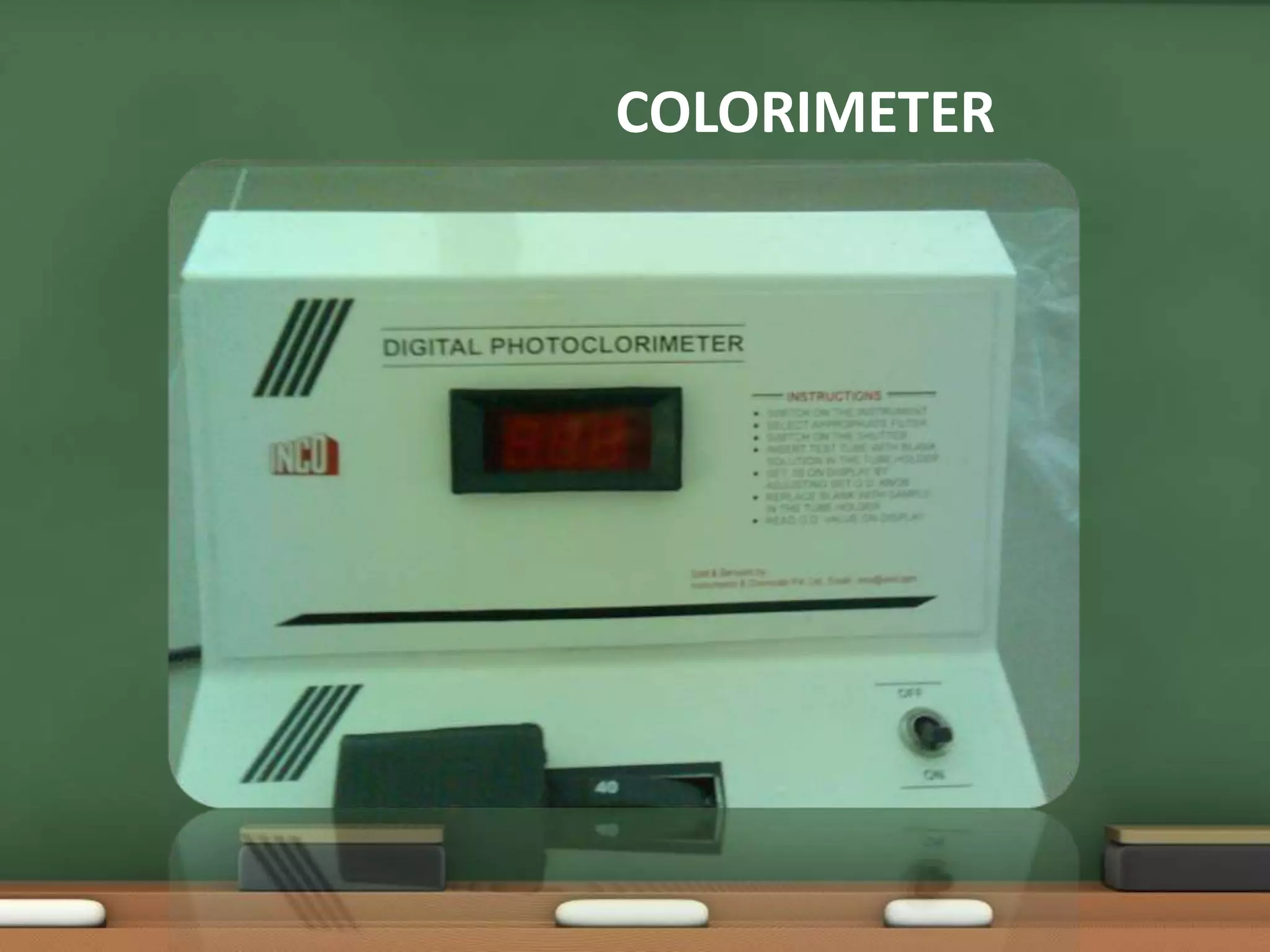
COLORIMETER
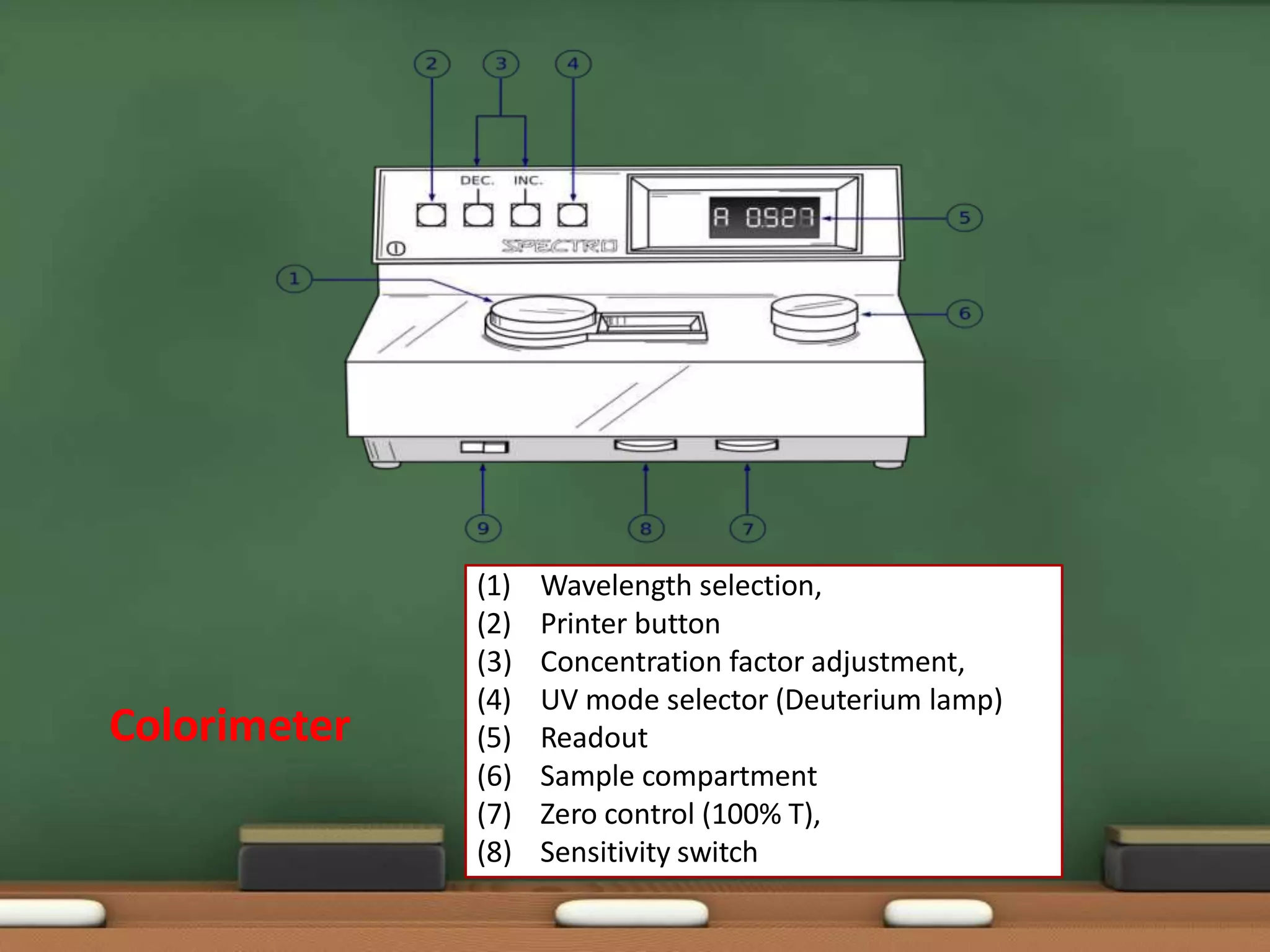
Colorimeter
(1) Wavelength selection,
(2) Printer button
(3) Concentration factor adjustment,
(4) UV mode selector (Deuterium lamp)
(5) Readout
(6) Sample compartment
(7) Zero control (100% T),
(8) Sensitivity switch
Relationship between the wavelength and colour
Approx. wavelength Colour absorbed (Filter) Colour of solution
<4oonm Ultra violet (UV-rays) Not visible
400-420nm Violet Green-Yellow
420-500nm Blue Yellow
500-570nm Green Red
570-600nm Yellow Blue
600-630nm Orange Green-Blue
630-700nm Red Green
>700nm Infrared (IR-rays) Not visible
Advantage
It is inexpensive .
Very well applicable for quantitative analysis of colored
compounds.
Easily transportable.
•COLORIMETER
Disadvantage
Cannot be used for colorless compounds.
It does not work in UV and IR regions.
We cannot set specific wavelength, as we have to set a range as a
parameter.
Similar colors from interfering substances can produce errors in
results .
•COLORIMETER
Use, care and preventive maintenance of
a Colorimeter:
• Read the user manual carefully.
• Use the correct type of cuvette in the colorimeter as
recommended by the manufacturer.
• Make sure that the cuvette is clean and it’s optical surfaces are
dry and free from finger marks and scratches.
• Bring filter in to place before switching on the colorimeter.
• Before reading the absorbance of a solution, check that it is
clear, there are no air bubbles in it.
• Remove the cuvettes from the instrument when not in use.
CONTD…
• Clean the outside of the cuvette with tissue paper to remove any
marks from the optical surfaces.
• To prolong the life of the lamp, switch off the colorimeter after
use.
• At the end of the day, disconnect It from the main switch and
cover the colorimeter with its protective cover.
• At regular intervals check the mains power adapter and cable
for wear and tear and replace if damaged.
• Keep in cool place away from corrosive chemicals or fumes.
12-09-15 08:51 AM
THANK YOU

calorimeter.ppt

  • 2.
  • 3.
  • 4.
  • 5.
  • 6.
    Colorimetry • It isthe most common analytical technique used in biochemical estimation in clinical laboratory. • It involves the quantitative estimation of color. • A substance to be estimated colorimetrically, must be colored or it should be capable of forming chromogens (colored complexes) through the addition of reagents.
  • 7.
    • Colored substanceabsorb light in relation to their color intensity. • The color intensity will be proportional to the conc. of colored substance. • The instruments used in this method are colorimeter or photometer or absorptiometers.
  • 8.
    • Colorimeter -Principle • When a monochromatic light passes through a coloured solution, some specific wavelengths of light are absorbed which is related to colour intensity. • The amount of light absorbed or transmitted by a colour solution is in accordance with two law i.e. Beer’s & Lambert’s Law.
  • 9.
    • The measurementof colour intensity of a coloured solution by photometry is governed by two laws
  • 11.
    Beer’s law : •Whena monochromatic light passes through a colored solution, amount of light transmitted decreases exponentially with increase in concentration of colored substance. •i.e. the amount of light absorbed by a colored solution is directly proportion to the conc. of substance in the colored solution.
  • 12.
  • 13.
  • 14.
    Lambert’s law : •Theamount of light transmitted decreases exponentially with increase in pathlength (diameter) of the cuvette or thickness of colored solution through which light passes. •i.e. the amount of light absorbed by a colored solution depends on pathlength of cuvette or thickness or depth of the colored solution.
  • 15.
  • 16.
    • Combined beer’s-lambert’s law is thus expressed as amount of light transmitted through a colored solution decreases exponentially with increases in conc. of colored solution & increase in conc. of colored solution & increase in the path length of cuvette or thickness of the colored solution
  • 17.
    Components of thecolorimeter 09/12/15 08:51
  • 19.
    Parts of thecolorimeter Light source : tungsten filament lamp Slit : it is adjustable which allows only a beam of light to pass through. it prevents unwanted or stray light Condensing lenses: light after passing through slit falls on condenser lense which gives a parllel beam of light.
  • 20.
    Filter : •made ofcolored glass. Filters are used for selecting light of narrow wavelength. •filters will absorb light of unwanted wavelength and allow only monochromatic light to pass through. For ex: a green filter absorbs all color, except green light which is allowed to pass through. Light transmitted through a green filter has a wavelength from 500-560 nm. •Filter used is always complimentary in color to the color of solution.
  • 21.
    Cuvette(sample holder) :the monochromatic light from the filter passes through the colored solution placed in a cuvette. • it is made up of special glass/plastic/quartz material. • it may be square/rectangular/round shape with fixed diameter (usually 1 cm)& having uniform surface. the colored solution in the cuvette absorbs part of light & remaining is allowed to fall on detector. • For ex : a solution of red color transmits red light & absorbs the complimentary color green.
  • 22.
    Detector (photocell): •Detector arephotosensitive elements which converts light energy into electrical energy. •The electrical signal generated is directly proportional to intensity of light falling on the detector. Output : the electrical signal generated in photocell is measured by galvanometer, which displays percent transmission & optical density.
  • 23.
  • 24.
    Colorimeter (1) Wavelength selection, (2)Printer button (3) Concentration factor adjustment, (4) UV mode selector (Deuterium lamp) (5) Readout (6) Sample compartment (7) Zero control (100% T), (8) Sensitivity switch
  • 25.
    Relationship between thewavelength and colour Approx. wavelength Colour absorbed (Filter) Colour of solution <4oonm Ultra violet (UV-rays) Not visible 400-420nm Violet Green-Yellow 420-500nm Blue Yellow 500-570nm Green Red 570-600nm Yellow Blue 600-630nm Orange Green-Blue 630-700nm Red Green >700nm Infrared (IR-rays) Not visible
  • 26.
    Advantage It is inexpensive. Very well applicable for quantitative analysis of colored compounds. Easily transportable. •COLORIMETER
  • 27.
    Disadvantage Cannot be usedfor colorless compounds. It does not work in UV and IR regions. We cannot set specific wavelength, as we have to set a range as a parameter. Similar colors from interfering substances can produce errors in results . •COLORIMETER
  • 28.
    Use, care andpreventive maintenance of a Colorimeter: • Read the user manual carefully. • Use the correct type of cuvette in the colorimeter as recommended by the manufacturer. • Make sure that the cuvette is clean and it’s optical surfaces are dry and free from finger marks and scratches. • Bring filter in to place before switching on the colorimeter. • Before reading the absorbance of a solution, check that it is clear, there are no air bubbles in it. • Remove the cuvettes from the instrument when not in use.
  • 29.
    CONTD… • Clean theoutside of the cuvette with tissue paper to remove any marks from the optical surfaces. • To prolong the life of the lamp, switch off the colorimeter after use. • At the end of the day, disconnect It from the main switch and cover the colorimeter with its protective cover. • At regular intervals check the mains power adapter and cable for wear and tear and replace if damaged. • Keep in cool place away from corrosive chemicals or fumes.
  • 30.