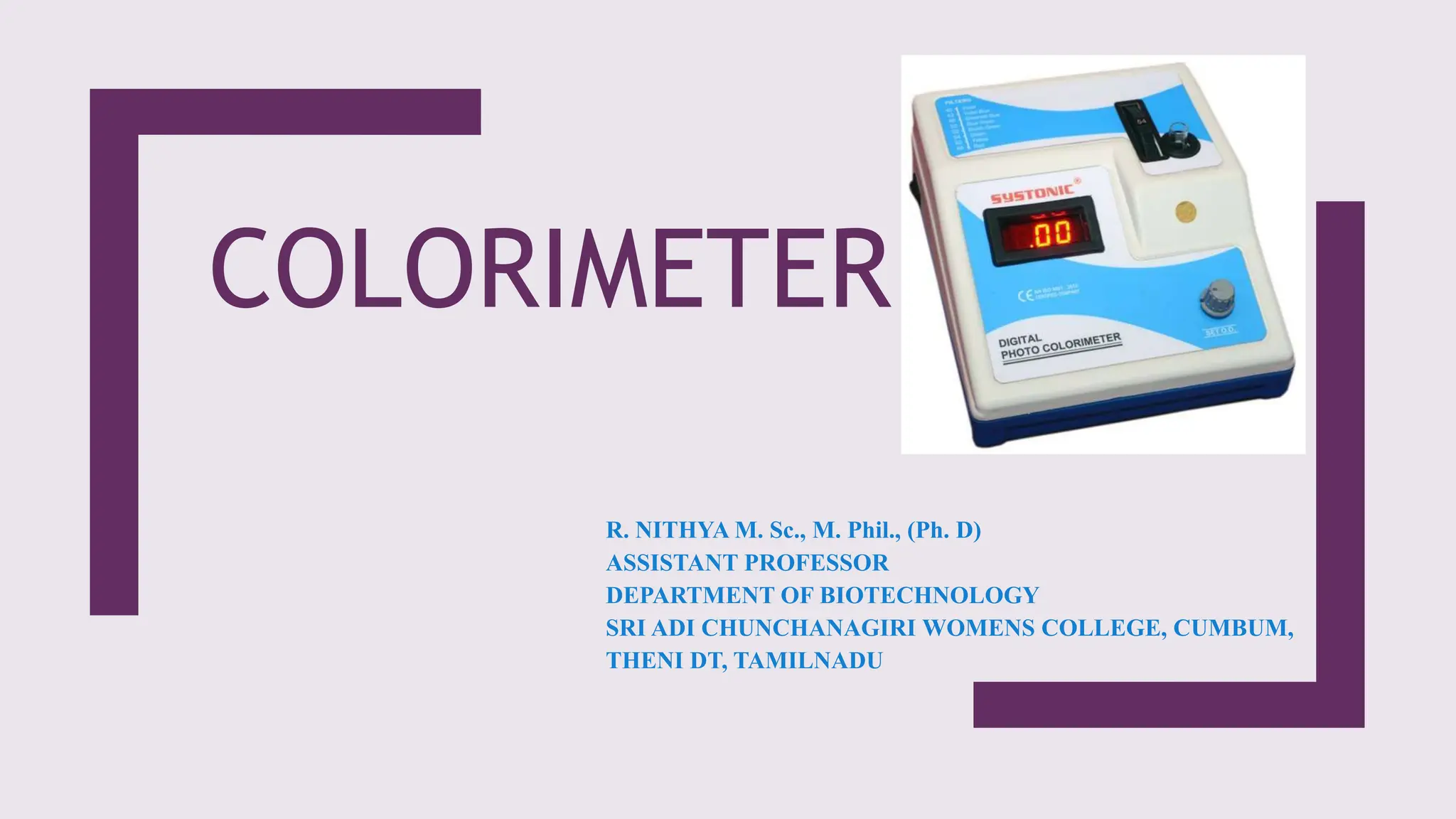
COLORIMETER
R. NITHYA M. Sc., M. Phil., (Ph. D)
ASSISTANT PROFESSOR
DEPARTMENT OF BIOTECHNOLOGY
SRI ADI CHUNCHANAGIRI WOMENS COLLEGE, CUMBUM,
THENI DT, TAMILNADU
Colorimetry
The art of using colorimeters for the quantitative and qualitative estimations of
substances is known as colorimetry.
The instruments used in this method are colorimeter or photometer or
absoptiometers.
Colorimeter
Colorimeter is a instrument used for the measurement of colored substance in
solution.
The instrument is operative in the visible range of the electromagnetic
spectrum.
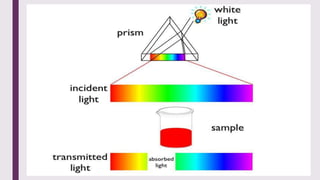
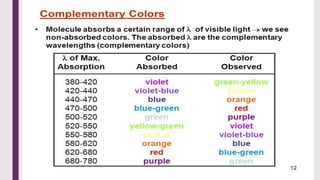
Colored substance absorb light in relation to their color intensity.
The color intensity will be proportional to the concentration of colored
substance.
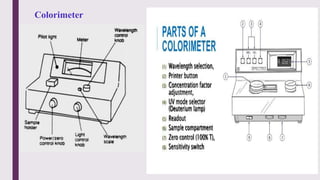
Colorimeter
Law’s
Absorption of monochromatic light by substances can be
quantitized based on two basic laws
Beer’s Law
Lambert’s Law
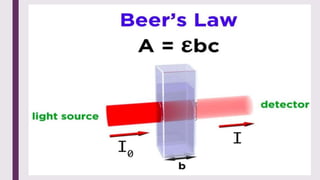
Beer’s Law
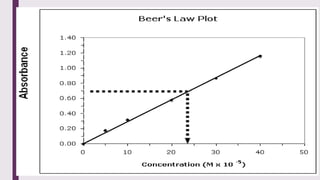
 When a beam of monochromatic light is passed through an absorbing
medium, the intensity of light coming out decreases exponentially with the
increase in the concentration of absorbing substance in the medium.
 Transmittancy decreases with increase in the concentration of absorbing
particle.
 As the transmittancy decreases, the OD increases simultaneously.
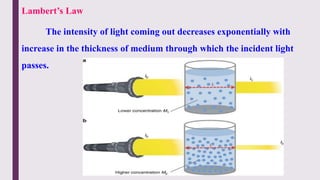
Lambert’s Law
The intensity of light coming out decreases exponentially with
increase in the thickness of medium through which the incident light
passes.
PARTS OF COLORIMETER
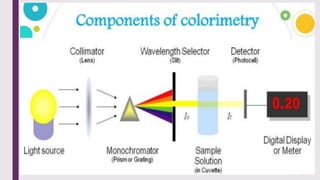
A colorimeter consists of
Light source
Lens system
filter selector
Cuvette holder
photocell
Galvanometer
All these components, except galvanometer are fixed in a straight line inside a
cabinet
Light Source
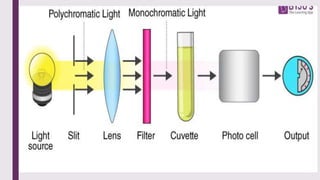
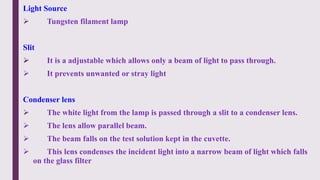
 Tungsten filament lamp
Slit
 It is a adjustable which allows only a beam of light to pass through.
 It prevents unwanted or stray light
Condenser lens
 The white light from the lamp is passed through a slit to a condenser lens.
 The lens allow parallel beam.
 The beam falls on the test solution kept in the cuvette.
 This lens condenses the incident light into a narrow beam of light which falls
on the glass filter
Filter
The glass filter filters off all rays and allow the monochromatic light to
pass through the filter.
Photocell
The monochromatic light coming from the filter passes through the
solution kept in the cuvette and reaches the photocell. It generates an electric
current in direct proportion to the intensity of light falling on it
Amplifier
The small electrical signal is increased in strength by the amplifier.
These amplifier signal passes to a galvanometer or digital read out.
OD adjustor
The OD adjustor between the filter and cuvette holder helps to adjust the
OD to zero.
PROCEDURE
 The solvent to be used is carried in a cuvette and the cuvette is placed on
the path
of the light.
 The solvent should have negligible amount of absorption at the wavelength
used.
 A suitable colour filter is fitted into the filter holder.
 Colorimeter is switched on and the OD is adjusted to zero using the OD
adjustment knob.
 This brings out 100% transparency of the solvent.
PROCEDURE
 The photocell now measures the light intensity and the current produced is read
out by galvanometer.
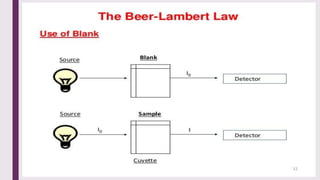
 The initial light intensity Io is noted from the galvanometer.
 Then the solvent containing dissolved colored substance to be estimated is carried
in the cuvette and the cuvette is kept in the cuvette holder.
 Now the photocell measures the intensity of transmitted light I and the
galvanometer shows the OD.
 The absorbency is calculated from A= log 100
T
APPLICATION OF COLORIMETER
 It is widely used in hospital and laboratory for estimation of biochemical
samples like plasma, serum, cerebrospinal fluid (csf), urine.
 A substance to be estimated colorimetrically, must be colored or capable of
forming chromogens (colored complexes) through the addition of reagents.
 It is also used to quantitative estimation of serum components as well as
glucose, proteins and other various biochemical compound.
 They are used by the food industry and by manufacturers of paints and
textiles
Colorimeter - Instrumentation and Applications

Colorimeter - Instrumentation and Applications

  • 1.
    COLORIMETER R. NITHYA M.Sc., M. Phil., (Ph. D) ASSISTANT PROFESSOR DEPARTMENT OF BIOTECHNOLOGY SRI ADI CHUNCHANAGIRI WOMENS COLLEGE, CUMBUM, THENI DT, TAMILNADU
  • 2.
    Colorimetry The art ofusing colorimeters for the quantitative and qualitative estimations of substances is known as colorimetry. The instruments used in this method are colorimeter or photometer or absoptiometers. Colorimeter Colorimeter is a instrument used for the measurement of colored substance in solution. The instrument is operative in the visible range of the electromagnetic spectrum. Colored substance absorb light in relation to their color intensity. The color intensity will be proportional to the concentration of colored substance.
  • 3.
  • 4.
    Law’s Absorption of monochromaticlight by substances can be quantitized based on two basic laws Beer’s Law Lambert’s Law Beer’s Law  When a beam of monochromatic light is passed through an absorbing medium, the intensity of light coming out decreases exponentially with the increase in the concentration of absorbing substance in the medium.  Transmittancy decreases with increase in the concentration of absorbing particle.  As the transmittancy decreases, the OD increases simultaneously.
  • 8.
    Lambert’s Law The intensityof light coming out decreases exponentially with increase in the thickness of medium through which the incident light passes.
  • 10.
    PARTS OF COLORIMETER Acolorimeter consists of Light source Lens system filter selector Cuvette holder photocell Galvanometer All these components, except galvanometer are fixed in a straight line inside a cabinet
  • 12.
    Light Source  Tungstenfilament lamp Slit  It is a adjustable which allows only a beam of light to pass through.  It prevents unwanted or stray light Condenser lens  The white light from the lamp is passed through a slit to a condenser lens.  The lens allow parallel beam.  The beam falls on the test solution kept in the cuvette.  This lens condenses the incident light into a narrow beam of light which falls on the glass filter
  • 14.
    Filter The glass filterfilters off all rays and allow the monochromatic light to pass through the filter. Photocell The monochromatic light coming from the filter passes through the solution kept in the cuvette and reaches the photocell. It generates an electric current in direct proportion to the intensity of light falling on it Amplifier The small electrical signal is increased in strength by the amplifier. These amplifier signal passes to a galvanometer or digital read out. OD adjustor The OD adjustor between the filter and cuvette holder helps to adjust the OD to zero.
  • 15.
    PROCEDURE  The solventto be used is carried in a cuvette and the cuvette is placed on the path of the light.  The solvent should have negligible amount of absorption at the wavelength used.  A suitable colour filter is fitted into the filter holder.  Colorimeter is switched on and the OD is adjusted to zero using the OD adjustment knob.  This brings out 100% transparency of the solvent.
  • 16.
    PROCEDURE  The photocellnow measures the light intensity and the current produced is read out by galvanometer.  The initial light intensity Io is noted from the galvanometer.  Then the solvent containing dissolved colored substance to be estimated is carried in the cuvette and the cuvette is kept in the cuvette holder.  Now the photocell measures the intensity of transmitted light I and the galvanometer shows the OD.  The absorbency is calculated from A= log 100 T
  • 18.
    APPLICATION OF COLORIMETER It is widely used in hospital and laboratory for estimation of biochemical samples like plasma, serum, cerebrospinal fluid (csf), urine.  A substance to be estimated colorimetrically, must be colored or capable of forming chromogens (colored complexes) through the addition of reagents.  It is also used to quantitative estimation of serum components as well as glucose, proteins and other various biochemical compound.  They are used by the food industry and by manufacturers of paints and textiles