Glucose Tolerance Test
Amit Kumar Singh
Assistant Professor
Department of Medical Lab Technology
Chandigarh University, Punjab
Introduction
• OGTT measures the body's ability to use glucose, that is the body's
main source of energy.
• An OGTT can be used to diagnose prediabetes and diabetes.
• Used to test for diabetes, insulin resistance, impaired beta cell
function, and sometimes reactive hypoglycemia and acromegaly, or
rarer disorders of carbohydrate metabolism.
• An OGTT is most commonly done to check for diabetes that occurs
with pregnancy (gestational diabetes).
• Many variations of the GTT have been devised over the years for
various purposes, with different standard doses of glucose, different
routes of administration, different intervals and durations of
sampling, and various substances measured
Who needs a glucose tolerance test?
• All women for gestational diabetes (between the 24th and 28th week
of your pregnancy) to detect complications
• Doctor may also recommend that someone have this test if they are
having the symptoms of prediabetes or diabetes.
• Have had gestational diabetes during a previous pregnancy.
• Have previously given birth to a baby who weighed more than 4.1 kg
• Are younger than age 25 and overweight before getting pregnant.
• Diagnose prediabetes and diabetes
Preparation
• Eat a balanced diet that contains at least 150 grams (g) of
carbohydrate per day for 3 days before the test.
• Fruits, breads, cereals, grains, rice, crackers, and starchy vegetables
such as potatoes, beans, and corn are good sources of carbohydrate.
• Do not eat, drink, smoke, or exercise strenuously for at least 8 hours
before your first blood sample is taken.
• Tell doctor about all prescription and nonprescription medicines you
are taking. Dr may be instruct to stop taking certain medicines before
the test.
• The glucose tolerance diagnostic test may take up to 3-4 hours.
• Since activity can interfere with test results, you will be asked to sit
quietly during the entire test.
• Do not eat during the test. You may drink only water during this time.
Introduction
• Must remain seated quietly for 30 minutes before and during the test.
• You are required to remain in the collection centre until the procedure
is completed.
• Bring some reading material or other activity to pass the time.
• If feel unwell during the test, please inform the collection staff as you
may wish to lie down.
• There should no acute significant illness for 2 weeks prior to test.
• Due to the nature of the test, testing is generally done in the morning.
• Before drinking the glucose, please inform the collection staff if have
any allergies.
Procedure
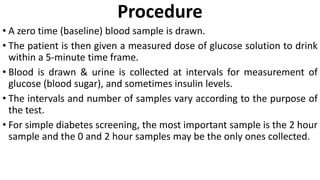
• A zero time (baseline) blood sample is drawn.
• The patient is then given a measured dose of glucose solution to drink
within a 5-minute time frame.
• Blood is drawn & urine is collected at intervals for measurement of
glucose (blood sugar), and sometimes insulin levels.
• The intervals and number of samples vary according to the purpose of
the test.
• For simple diabetes screening, the most important sample is the 2 hour
sample and the 0 and 2 hour samples may be the only ones collected.
• If you are taking the 50-gram, or one-hour test, they will take your blood sample
after one hour.
• If you are taking the 75-gram, or two-hour test, they will take a blood sample
every hour for two hours.
• If you are taking the 100-gram, or three-hour test, they will take a blood sample
every hour for three hours.
Results
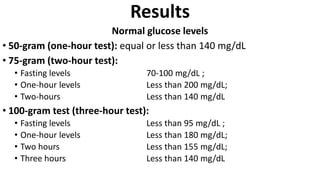
Normal glucose levels
• 50-gram (one-hour test): equal or less than 140 mg/dL
• 75-gram (two-hour test):
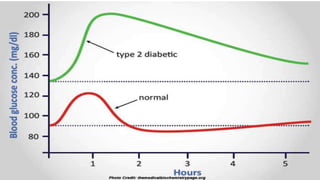
• Fasting levels 70-100 mg/dL ;
• One-hour levels Less than 200 mg/dL;
• Two-hours Less than 140 mg/dL
• 100-gram test (three-hour test):
• Fasting levels Less than 95 mg/dL ;
• One-hour levels Less than 180 mg/dL;
• Two hours Less than 155 mg/dL;
• Three hours Less than 140 mg/dL
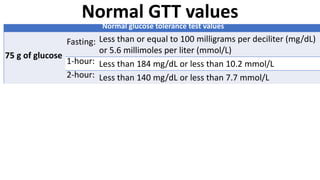
Normal GTT values
Normal glucose tolerance test values
75 g of glucose
Fasting: Less than or equal to 100 milligrams per deciliter (mg/dL)
or 5.6 millimoles per liter (mmol/L)
1-hour: Less than 184 mg/dL or less than 10.2 mmol/L
2-hour: Less than 140 mg/dL or less than 7.7 mmol/L
Glucose tolerance diagnostic test (for gestational diabetes)
Values that indicate gestational diabetes.
75 g of glucose
Fasting: More than or equal to 92 mg/dL or 5.1 mmol/L
1-hour: More than or equal to 180 mg/dL or 10.0 mmol/L
2-hour: More than or equal to 153 mg/dL or 8.5 mmol/L
100 g of
glucose
3-hour: More than or equal to 140 mg/dL or 7.8 mmol/L
High glucose levels may be caused by
• Diabetes.
• Gestational diabetes.
• Hyperthyroidism.
• Some medicines, such as corticosteroids, niacin, phenytoin (Dilantin),
some diuretics, and some medicines used to treat high blood pressure,
HIV, or AIDS.
• Large amounts of the hormone cortisol in the blood (Cushing's
syndrome).
• Inherited diseases, such as hemochromatosis.
Low glucose levels may be caused by
• Certain medicines, such as medicines used to treat diabetes,
someblood pressure medicines (such as propranolol), and some
medicines for depression (such as isocarboxazid).
• Decreased production of the hormones cortisol and aldosterone
(Addison's disease).
• Problems with the thyroid gland or an underactive pituitary gland.
• A tumor or other problems of the pancreas.
• Liver disease.
What Affects the Test
• Smoking.
• Alcohol intake
• Recent surgery, illnesses, and infectious diseases.
• Weight loss through dieting.
• Long periods of bed rest (such as from a hospitalization or illness).
Insulin tolerance test
• An insulin tolerance test (ITT) is a medical diagnostic procedure during
which insulin is injected into a patient's vein, after which blood glucose
is measured at regular intervals.
• This procedure is performed to assess pituitary function, adrenal
function, and sometimes for other purposes.
• An ITT is usually ordered and interpreted by endocrinologists.
• Insulin injections are intended to induce extreme hypoglycemia below
2.2 mmol/l (40 mg/dl).
• In response, ACTH and GH are released as a part of the stress
mechanism.
• ACTH elevation causes the adrenal cortex to release cortisol.
Normally, both cortisol and GH serve as counterregulatory hormones,
opposing the action of insulin, i.e. acting against the hypoglycemia.
High glucose levels may be caused by
• Thus ITT is considered to be the gold standard for assessing the
integrity of the hypothalamic–pituitary–adrenal axis.
• Sometimes ITT is performed to assess the peak adrenal capacity, e.g.
before surgery.
• Differentiation of Cushing's syndrome from pseudo-Cushing's
syndromes eg depression, alcohol excess.
• This test is potentially very dangerous and must be undertaken with
great care, because it can induce the diabetic coma.
• A health professional must attend it at all times.
• Other provocation tests which cause much less release of growth
hormone include the use of glucagon, arginine and clonidine.
Side effects
• Sweating, palpitations, loss of consciousness and rarely convulsions
due to severe hypoglycaemia.
• Once hypoglycaemia has occurred, pituitary stimulation will have
occurred and iv glucose should be given if extreme symptoms are
present.
• An Addisonian crisis may be precipitated in subjects with no adrenal
reserve.
Preparation
• The patient should fast overnight (water permitted) and be recumbent
during the test.
• ECG must be normal and the patient's weight known.
• The side effects of the test should be clearly explained to the patient.
• Insulin dose
• 0.15 U/kg for subjects with normal pituitary function
• 0.10 U/kg for hypopituitary subjects
• 0.2-0.3U/kg for subjects with acromegaly, diabetes or Cushing's
0.2-0.3U/kg for subjects with acromegaly, diabetes or Cushing's
0 minutes take 3 mL blood in plain tubes for GH, cortisol and 1 mL in fluoride tube
for glucose and inject insulin iv.
30,45,60,90,120
min
take 3 mL blood in plain tubes for GH, cortisol and 1 mL in fluoride tube
for glucose.
Interpretation
• The test cannot be interpreted unless hypoglycaemia (< 2.2 mmol/L) is
achieved.
• Hypopituitarism: An adequate cortisol response is defined as a rise to
greater than 550 nmol/L.
• Patients with impaired cortisol responses ie < 550 but > 400 nmol/L
may only need steroid cover for major illnesses or stresses.
• An adequate GH response occurs with an absolute response > 20 mU/L
(7µg/L).
• Cushing's syndrome: There will be a rise of less than 170 nmol/L above
the fluctuations of basal levels of cortisol.

Glucose Tolerance Test.ppt

  • 1.
    Glucose Tolerance Test AmitKumar Singh Assistant Professor Department of Medical Lab Technology Chandigarh University, Punjab
  • 2.
    Introduction • OGTT measuresthe body's ability to use glucose, that is the body's main source of energy. • An OGTT can be used to diagnose prediabetes and diabetes. • Used to test for diabetes, insulin resistance, impaired beta cell function, and sometimes reactive hypoglycemia and acromegaly, or rarer disorders of carbohydrate metabolism. • An OGTT is most commonly done to check for diabetes that occurs with pregnancy (gestational diabetes). • Many variations of the GTT have been devised over the years for various purposes, with different standard doses of glucose, different routes of administration, different intervals and durations of sampling, and various substances measured
  • 3.
    Who needs aglucose tolerance test? • All women for gestational diabetes (between the 24th and 28th week of your pregnancy) to detect complications • Doctor may also recommend that someone have this test if they are having the symptoms of prediabetes or diabetes. • Have had gestational diabetes during a previous pregnancy. • Have previously given birth to a baby who weighed more than 4.1 kg • Are younger than age 25 and overweight before getting pregnant. • Diagnose prediabetes and diabetes
  • 4.
    Preparation • Eat abalanced diet that contains at least 150 grams (g) of carbohydrate per day for 3 days before the test. • Fruits, breads, cereals, grains, rice, crackers, and starchy vegetables such as potatoes, beans, and corn are good sources of carbohydrate. • Do not eat, drink, smoke, or exercise strenuously for at least 8 hours before your first blood sample is taken. • Tell doctor about all prescription and nonprescription medicines you are taking. Dr may be instruct to stop taking certain medicines before the test. • The glucose tolerance diagnostic test may take up to 3-4 hours. • Since activity can interfere with test results, you will be asked to sit quietly during the entire test. • Do not eat during the test. You may drink only water during this time.
  • 5.
    Introduction • Must remainseated quietly for 30 minutes before and during the test. • You are required to remain in the collection centre until the procedure is completed. • Bring some reading material or other activity to pass the time. • If feel unwell during the test, please inform the collection staff as you may wish to lie down. • There should no acute significant illness for 2 weeks prior to test. • Due to the nature of the test, testing is generally done in the morning. • Before drinking the glucose, please inform the collection staff if have any allergies.
  • 6.
    Procedure • A zerotime (baseline) blood sample is drawn. • The patient is then given a measured dose of glucose solution to drink within a 5-minute time frame. • Blood is drawn & urine is collected at intervals for measurement of glucose (blood sugar), and sometimes insulin levels. • The intervals and number of samples vary according to the purpose of the test. • For simple diabetes screening, the most important sample is the 2 hour sample and the 0 and 2 hour samples may be the only ones collected.
  • 7.
    • If youare taking the 50-gram, or one-hour test, they will take your blood sample after one hour. • If you are taking the 75-gram, or two-hour test, they will take a blood sample every hour for two hours. • If you are taking the 100-gram, or three-hour test, they will take a blood sample every hour for three hours.
  • 8.
    Results Normal glucose levels •50-gram (one-hour test): equal or less than 140 mg/dL • 75-gram (two-hour test): • Fasting levels 70-100 mg/dL ; • One-hour levels Less than 200 mg/dL; • Two-hours Less than 140 mg/dL • 100-gram test (three-hour test): • Fasting levels Less than 95 mg/dL ; • One-hour levels Less than 180 mg/dL; • Two hours Less than 155 mg/dL; • Three hours Less than 140 mg/dL
  • 9.
    Normal GTT values Normalglucose tolerance test values 75 g of glucose Fasting: Less than or equal to 100 milligrams per deciliter (mg/dL) or 5.6 millimoles per liter (mmol/L) 1-hour: Less than 184 mg/dL or less than 10.2 mmol/L 2-hour: Less than 140 mg/dL or less than 7.7 mmol/L Glucose tolerance diagnostic test (for gestational diabetes) Values that indicate gestational diabetes. 75 g of glucose Fasting: More than or equal to 92 mg/dL or 5.1 mmol/L 1-hour: More than or equal to 180 mg/dL or 10.0 mmol/L 2-hour: More than or equal to 153 mg/dL or 8.5 mmol/L 100 g of glucose 3-hour: More than or equal to 140 mg/dL or 7.8 mmol/L
  • 10.
    High glucose levelsmay be caused by • Diabetes. • Gestational diabetes. • Hyperthyroidism. • Some medicines, such as corticosteroids, niacin, phenytoin (Dilantin), some diuretics, and some medicines used to treat high blood pressure, HIV, or AIDS. • Large amounts of the hormone cortisol in the blood (Cushing's syndrome). • Inherited diseases, such as hemochromatosis.
  • 11.
    Low glucose levelsmay be caused by • Certain medicines, such as medicines used to treat diabetes, someblood pressure medicines (such as propranolol), and some medicines for depression (such as isocarboxazid). • Decreased production of the hormones cortisol and aldosterone (Addison's disease). • Problems with the thyroid gland or an underactive pituitary gland. • A tumor or other problems of the pancreas. • Liver disease.
  • 12.
    What Affects theTest • Smoking. • Alcohol intake • Recent surgery, illnesses, and infectious diseases. • Weight loss through dieting. • Long periods of bed rest (such as from a hospitalization or illness).
  • 16.
    Insulin tolerance test •An insulin tolerance test (ITT) is a medical diagnostic procedure during which insulin is injected into a patient's vein, after which blood glucose is measured at regular intervals. • This procedure is performed to assess pituitary function, adrenal function, and sometimes for other purposes. • An ITT is usually ordered and interpreted by endocrinologists. • Insulin injections are intended to induce extreme hypoglycemia below 2.2 mmol/l (40 mg/dl). • In response, ACTH and GH are released as a part of the stress mechanism. • ACTH elevation causes the adrenal cortex to release cortisol. Normally, both cortisol and GH serve as counterregulatory hormones, opposing the action of insulin, i.e. acting against the hypoglycemia.
  • 17.
    High glucose levelsmay be caused by • Thus ITT is considered to be the gold standard for assessing the integrity of the hypothalamic–pituitary–adrenal axis. • Sometimes ITT is performed to assess the peak adrenal capacity, e.g. before surgery. • Differentiation of Cushing's syndrome from pseudo-Cushing's syndromes eg depression, alcohol excess. • This test is potentially very dangerous and must be undertaken with great care, because it can induce the diabetic coma. • A health professional must attend it at all times. • Other provocation tests which cause much less release of growth hormone include the use of glucagon, arginine and clonidine.
  • 18.
    Side effects • Sweating,palpitations, loss of consciousness and rarely convulsions due to severe hypoglycaemia. • Once hypoglycaemia has occurred, pituitary stimulation will have occurred and iv glucose should be given if extreme symptoms are present. • An Addisonian crisis may be precipitated in subjects with no adrenal reserve.
  • 19.
    Preparation • The patientshould fast overnight (water permitted) and be recumbent during the test. • ECG must be normal and the patient's weight known. • The side effects of the test should be clearly explained to the patient. • Insulin dose • 0.15 U/kg for subjects with normal pituitary function • 0.10 U/kg for hypopituitary subjects • 0.2-0.3U/kg for subjects with acromegaly, diabetes or Cushing's 0.2-0.3U/kg for subjects with acromegaly, diabetes or Cushing's 0 minutes take 3 mL blood in plain tubes for GH, cortisol and 1 mL in fluoride tube for glucose and inject insulin iv. 30,45,60,90,120 min take 3 mL blood in plain tubes for GH, cortisol and 1 mL in fluoride tube for glucose.
  • 20.
    Interpretation • The testcannot be interpreted unless hypoglycaemia (< 2.2 mmol/L) is achieved. • Hypopituitarism: An adequate cortisol response is defined as a rise to greater than 550 nmol/L. • Patients with impaired cortisol responses ie < 550 but > 400 nmol/L may only need steroid cover for major illnesses or stresses. • An adequate GH response occurs with an absolute response > 20 mU/L (7µg/L). • Cushing's syndrome: There will be a rise of less than 170 nmol/L above the fluctuations of basal levels of cortisol.