PHOTOMETRY
Dr. Farhana Atia
Associate Professor, Dept. of Biochemistry
Nilphamari Medical College, Nilphamari
Email: farhana.atia@gmail.com
PHOTOMETRY
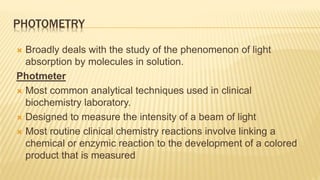
 Broadly deals with the study of the phenomenon of light
absorption by molecules in solution.
Photmeter
 Most common analytical techniques used in clinical
biochemistry laboratory.
 Designed to measure the intensity of a beam of light
 Most routine clinical chemistry reactions involve linking a
chemical or enzymic reaction to the development of a colored
product that is measured
PHOTOMETRIC PRINCIPLES
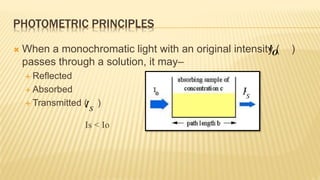
 When a monochromatic light with an original intensity ( )
passes through a solution, it may–
 Reflected
 Absorbed
 Transmitted ( )
Is < Io
O
I
S
I
S
I
PHOTOMETRIC PRINCIPLES
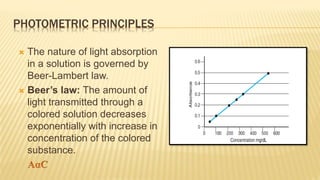
 The nature of light absorption
in a solution is governed by
Beer-Lambert law.
 Beer’s law: The amount of
light transmitted through a
colored solution decreases
exponentially with increase in
concentration of the colored
substance.
PHOTOMETRIC PRINCIPLES
 The nature of light absorption
in a solution is governed by
Beer-Lambert law.
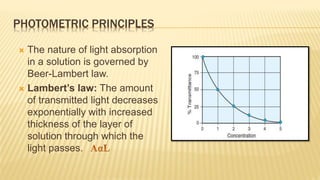
 Lambert’s law: The amount
of transmitted light decreases
exponentially with increased
thickness of the layer of
solution through which the
light passes.
PHOTOMETRIC PRINCIPLES
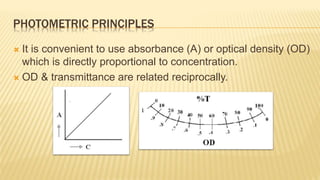
 It is convenient to use absorbance (A) or optical density (OD)
which is directly proportional to concentration.
 OD & transmittance are related reciprocally.
PHOTOMETRIC PRINCIPLES
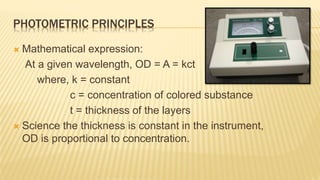
 Mathematical expression:
At a given wavelength, OD = A = kct
where, k = constant
c = concentration of colored substance
t = thickness of the layers
 Science the thickness is constant in the instrument,
OD is proportional to concentration.
TYPES OF INSTRUMENT
 No rigid classification
1. Where absorbed or transmitted light is measured.
 Colorimeter
 Spectrophotometer
2. Where emitted light is measured
 Flame emission photometer.
COLORIMETER
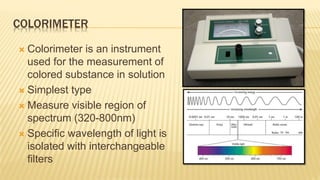
 Colorimeter is an instrument
used for the measurement of
colored substance in solution
 Simplest type
 Measure visible region of
spectrum (320-800nm)
 Specific wavelength of light is
isolated with interchangeable
filters
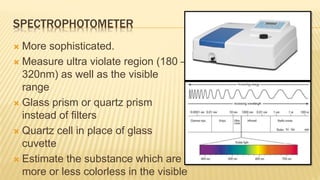
SPECTROPHOTOMETER
 More sophisticated.
 Measure ultra violate region (180 –
320nm) as well as the visible
range
 Glass prism or quartz prism
instead of filters
 Quartz cell in place of glass
cuvette
 Estimate the substance which are
more or less colorless in the visible
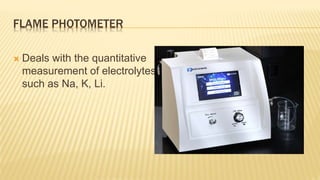
FLAME PHOTOMETER
 Deals with the quantitative
measurement of electrolytes
such as Na, K, Li.
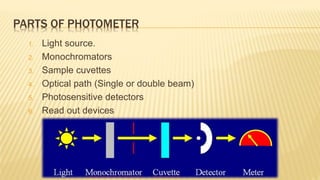
PARTS OF PHOTOMETER
1. Light source.
2. Monochromators
3. Sample cuvettes
4. Optical path (Single or double beam)
5. Photosensitive detectors
6. Read out devices
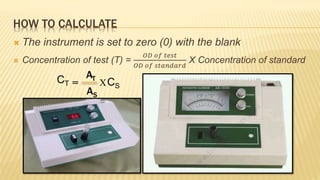
 The instrument is set to zero (0) with the blank
 Concentration of test (T) =
𝑂𝐷 𝑜𝑓 𝑡𝑒𝑠𝑡
𝑂𝐷 𝑜𝑓 𝑠𝑡𝑎𝑛𝑑𝑎𝑟𝑑
X Concentration of standard
CT =
AT
AS
HOW TO CALCULATE
XCS
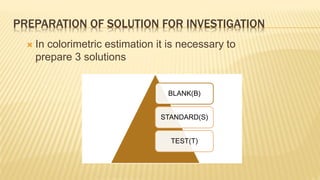
 In colorimetric estimation it is necessary to
prepare 3 solutions
BLANK(B)
STANDARD(S)
TEST(T)
PREPARATION OF SOLUTION FOR INVESTIGATION
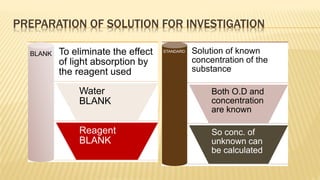
BLANK To eliminate the effect
of light absorption by
the reagent used
Water
BLANK
Reagent
BLANK
STANDARD Solution of known
concentration of the
substance
Both O.D and
concentration
are known
So conc. of
unknown can
be calculated
PREPARATION OF SOLUTION FOR INVESTIGATION
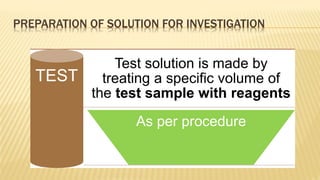
TEST
Test solution is made by
treating a specific volume of
the test sample with reagents
As per procedure
PREPARATION OF SOLUTION FOR INVESTIGATION
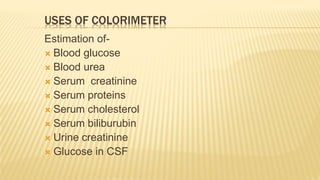
USES OF COLORIMETER
Estimation of-
 Blood glucose
 Blood urea
 Serum creatinine
 Serum proteins
 Serum cholesterol
 Serum biliburubin
 Urine creatinine
 Glucose in CSF
THANK YOU

Photometry

  • 1.
    PHOTOMETRY Dr. Farhana Atia AssociateProfessor, Dept. of Biochemistry Nilphamari Medical College, Nilphamari Email: farhana.atia@gmail.com
  • 2.
    PHOTOMETRY  Broadly dealswith the study of the phenomenon of light absorption by molecules in solution. Photmeter  Most common analytical techniques used in clinical biochemistry laboratory.  Designed to measure the intensity of a beam of light  Most routine clinical chemistry reactions involve linking a chemical or enzymic reaction to the development of a colored product that is measured
  • 3.
    PHOTOMETRIC PRINCIPLES  Whena monochromatic light with an original intensity ( ) passes through a solution, it may–  Reflected  Absorbed  Transmitted ( ) Is < Io O I S I S I
  • 4.
    PHOTOMETRIC PRINCIPLES  Thenature of light absorption in a solution is governed by Beer-Lambert law.  Beer’s law: The amount of light transmitted through a colored solution decreases exponentially with increase in concentration of the colored substance.
  • 5.
    PHOTOMETRIC PRINCIPLES  Thenature of light absorption in a solution is governed by Beer-Lambert law.  Lambert’s law: The amount of transmitted light decreases exponentially with increased thickness of the layer of solution through which the light passes.
  • 6.
    PHOTOMETRIC PRINCIPLES  Itis convenient to use absorbance (A) or optical density (OD) which is directly proportional to concentration.  OD & transmittance are related reciprocally.
  • 7.
    PHOTOMETRIC PRINCIPLES  Mathematicalexpression: At a given wavelength, OD = A = kct where, k = constant c = concentration of colored substance t = thickness of the layers  Science the thickness is constant in the instrument, OD is proportional to concentration.
  • 8.
    TYPES OF INSTRUMENT No rigid classification 1. Where absorbed or transmitted light is measured.  Colorimeter  Spectrophotometer 2. Where emitted light is measured  Flame emission photometer.
  • 9.
    COLORIMETER  Colorimeter isan instrument used for the measurement of colored substance in solution  Simplest type  Measure visible region of spectrum (320-800nm)  Specific wavelength of light is isolated with interchangeable filters
  • 10.
    SPECTROPHOTOMETER  More sophisticated. Measure ultra violate region (180 – 320nm) as well as the visible range  Glass prism or quartz prism instead of filters  Quartz cell in place of glass cuvette  Estimate the substance which are more or less colorless in the visible
  • 11.
    FLAME PHOTOMETER  Dealswith the quantitative measurement of electrolytes such as Na, K, Li.
  • 12.
    PARTS OF PHOTOMETER 1.Light source. 2. Monochromators 3. Sample cuvettes 4. Optical path (Single or double beam) 5. Photosensitive detectors 6. Read out devices
  • 13.
     The instrumentis set to zero (0) with the blank  Concentration of test (T) = 𝑂𝐷 𝑜𝑓 𝑡𝑒𝑠𝑡 𝑂𝐷 𝑜𝑓 𝑠𝑡𝑎𝑛𝑑𝑎𝑟𝑑 X Concentration of standard CT = AT AS HOW TO CALCULATE XCS
  • 14.
     In colorimetricestimation it is necessary to prepare 3 solutions BLANK(B) STANDARD(S) TEST(T) PREPARATION OF SOLUTION FOR INVESTIGATION
  • 15.
    BLANK To eliminatethe effect of light absorption by the reagent used Water BLANK Reagent BLANK STANDARD Solution of known concentration of the substance Both O.D and concentration are known So conc. of unknown can be calculated PREPARATION OF SOLUTION FOR INVESTIGATION
  • 16.
    TEST Test solution ismade by treating a specific volume of the test sample with reagents As per procedure PREPARATION OF SOLUTION FOR INVESTIGATION
  • 17.
    USES OF COLORIMETER Estimationof-  Blood glucose  Blood urea  Serum creatinine  Serum proteins  Serum cholesterol  Serum biliburubin  Urine creatinine  Glucose in CSF
  • 18.