FORMATIVE AND SUMMATIVE
ASSESSMENT
Gathering Information about Student Learning
R. Grant
SUMMATIVE ASSESSMENT
 Definition
 Given periodically to determine at a particular time what
students know and do not know relative to content
standards
 Is associated with but not limited to standardized
testing
 At the district and classroom level is an
accountability measure
SUMMATIVE ASSESSMENT
 Uses and Limitations
 Can only help in evaluating certain aspects of the
learning process because they are spread out
 Occur after instruction every few weeks, months, or
once a year
 Used as tools to help evaluate program effectiveness,
school improvement goals, alignment of curriculum, or
student placement in specific programs
SUMMATIVE ASSESSMENT
 Uses and Limitations
 Happens to far down the learning path to provide
information at the classroom level and to make
instructional adjustments and interventions during the
learning process
SUMMATIVE ASSESSMENT
 Types of
 State assessments
 District benchmark or interim assessments
 End-of-unit or chapter tests
 End-of-term or semester exams
 Scores that are used for accountability of schools (AYP)
and student (report card grades)
FORMATIVE ASSESSMENT
 Definition
 Process of gathering information used by teachers and
students to determine what is needed to adjust teaching
and learning while they are happening
 Informs both students and teachers about student
understanding at a point when timely adjustments
can be made
FORMATIVE ASSESSMENT
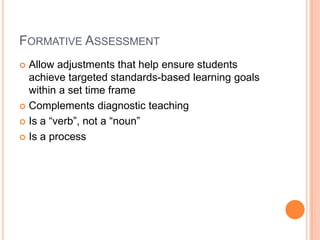
 Allow adjustments that help ensure students
achieve targeted standards-based learning goals
within a set time frame
 Complements diagnostic teaching
 Is a “verb”, not a “noun”
 Is a process
FORMATIVE ASSESSMENT
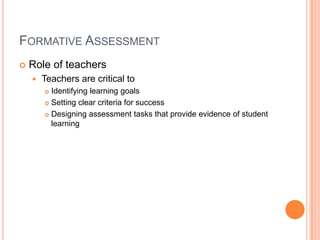
 Role of teachers
 Teachers are critical to
 Identifying learning goals
 Setting clear criteria for success
 Designing assessment tasks that provide evidence of student
learning
FORMATIVE ASSESSMENT
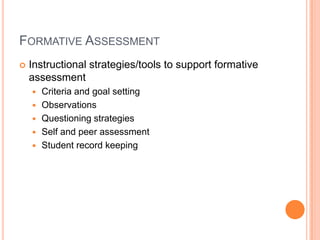
 Instructional strategies/tools to support formative
assessment
 Criteria and goal setting
 Observations
 Questioning strategies
 Self and peer assessment
 Student record keeping
FORMATIVE ASSESSMENT
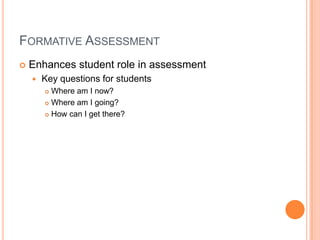
 Enhances student role in assessment
 Key questions for students
 Where am I now?
 Where am I going?
 How can I get there?
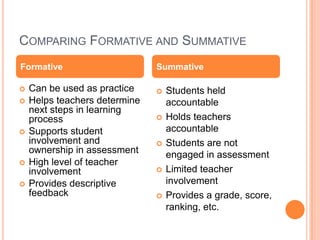
COMPARING FORMATIVE AND SUMMATIVE
 Can be used as practice
 Helps teachers determine
next steps in learning
process
 Supports student
involvement and
ownership in assessment
 High level of teacher
involvement
 Provides descriptive
feedback
 Students held
accountable
 Holds teachers
accountable
 Students are not
engaged in assessment
 Limited teacher
involvement
 Provides a grade, score,
ranking, etc.
Formative Summative
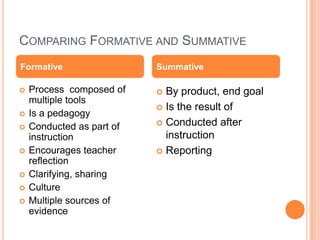
COMPARING FORMATIVE AND SUMMATIVE
 Process composed of
multiple tools
 Is a pedagogy
 Conducted as part of
instruction
 Encourages teacher
reflection
 Clarifying, sharing
 Culture
 Multiple sources of
evidence
 By product, end goal
 Is the result of
 Conducted after
instruction
 Reporting
Formative Summative
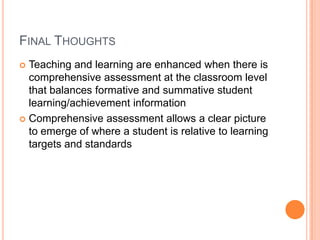
FINAL THOUGHTS
 Teaching and learning are enhanced when there is
comprehensive assessment at the classroom level
that balances formative and summative student
learning/achievement information
 Comprehensive assessment allows a clear picture
to emerge of where a student is relative to learning
targets and standards